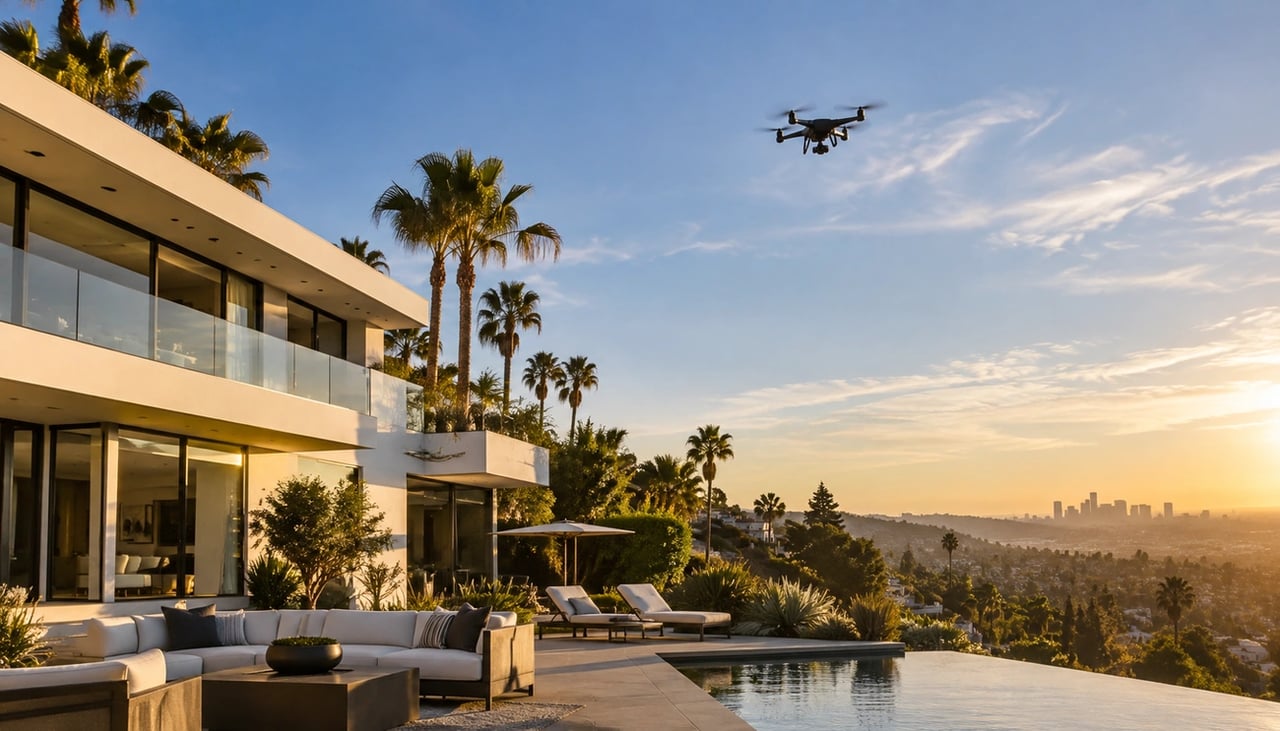
Telephoto lenses have given way to drones as the tool of choice for capturing private moments, yet the legal protections afforded to homeowners when drones cross into their property remain remarkably thin. Federal law permits drone flights over private property, while at the same time making it a federal crime to interfere with or destroy a drone — even one hovering directly over a private residence. For LA homeowners, this creates a frustrating reality with no clean legal footing. Knowing what options exist — detection technology, civil remedies, and proactive security planning — matters more than ever. This guide addresses what homeowners can do when a neighbor flying a drone over their house crosses a line, how to stop drones from flying over your house without violating federal law, and the measures elite properties rely on to counter paparazzi drones targeting high-value homes.
The Reality of Drones Flying Over Your House in Los Angeles
"The U.S. needs laws that more clearly define landowners’ rights to exclude unwanted intrusions of drones into the low airspace immediately above their land." — Troy Rule, Professor at Arizona State University
How Paparazzi Drones Target High-Value Properties
Miley Cyrus filmed a paparazzi drone hovering over her Los Angeles backyard and posted the footage directly to Instagram, bringing widespread attention to a surveillance tactic that had already been circling celebrity homes for years. Photographers flew drones over Tina Turner's Swiss estate during her 2013 wedding ceremony, transmitting images around the world within minutes, regardless of the couple's explicit request for privacy. When Selena Gomez attempted to film an Adidas commercial away from paparazzi cameras, operators sent drones to capture footage from angles no ground-level photographer could reach.
Each of these incidents points to the same problem — gates, walls, and perimeter fencing offer no meaningful barrier against aerial surveillance. Sean Burke, celebrity bodyguard and director of the Paparazzi Reform Initiative, has noted that drone operators can place a camera virtually anywhere, reaching vantage points that were previously inaccessible. Kanye West raised separate concerns altogether, citing the physical danger to his family if an inexperienced pilot lost control near his daughter.
Federal vs. California Law: Where Homeowners Stand
The FAA holds exclusive authority over national airspace, and drone flights below 400 feet over private property are federally permitted. California cannot restrict what happens in federally controlled airspace, yet Civil Code § 1708.8 found a path forward by targeting surveillance conduct rather than the act of flying itself. That distinction allowed the statute to hold up against legal challenges.
Federal rules require drone operators to stay below 400 feet, maintain visual line of sight, and avoid flying over people. Commercial operators — paparazzi included — must carry FAA certification. Privacy, however, falls entirely outside FAA jurisdiction, and California law steps in to address what federal regulation leaves open.
When a Neighbor Flying a Drone Over Your House Becomes Illegal
California Civil Code § 1708.8 targets two specific violations. The first prohibits capturing images or recordings of individuals engaged in private activities where they hold a reasonable expectation of privacy. Backyards, pool areas, patios, and bedroom windows all qualify. A drone operator does not need to land on the property — flying through the airspace above to record private activities is itself considered constructive invasion of privacy.
Those found in violation face damages up to three times the actual harm, alongside civil fines ranging from $5,000 to $50,000 per violation. Flying drones near active fire emergency scenes introduces criminal exposure — up to six months in jail and a $1,000 fine for a misdemeanor charge.
Your Legal Options When Facing Drone Invasion of Privacy
What California Law Says About Paparazzi Drones
Section 1708.8 extends its protections to all residents, not just public figures. Private activities cover most conduct on residential property — anything indoors, within a fenced yard, or set back from property boundaries qualifies as a space where a reasonable expectation of privacy exists. The law does not require proof of intent to harm or harass; capturing images of private activities that an operator would not ordinarily be permitted to see is sufficient to establish a violation. News organizations that direct or compensate pilots to obtain such footage share joint and several liability alongside the operator.
Reporting Violations to Authorities
Dangerous drone operations or criminal activity warrant an immediate call to local law enforcement. FAA rule violations can be reported to the local FAA flight standards district office, where investigators may contact the drone operator directly. Operators without proper authorization face both penalties and criminal charges. A § 1708.8 claim is filed in Superior Court by the plaintiff — no government agency needs to be involved.
Civil Remedies and Damages Available
Plaintiffs who prevail may recover treble damages, punitive damages, disgorgement of profits from any sold images, and the right to pursue anyone who solicited the privacy invasion. The statute also carries a civil fine of not less than $5,000 and not more than $50,000 per violation. Punitive damages require a demonstrated showing of malice.
Criminal Charges Under State Law
Several Penal Code sections apply directly to drone misuse. Eavesdropping under § 632 carries up to one year in jail and a $2,500 fine as a misdemeanor, or up to three years in prison as a felony. Stalking under § 646.9 results in up to one year in jail or up to five years in prison depending on severity[132]. Disorderly conduct under § 647 brings up to six months in jail and a $1,000 fine for first-time offenders[132].
Detection Technology: The First Line of Defense
"A successful drone detection solution must integrate Remote ID signals alongside traditional detection technologies such as radar, radio frequency (RF) detection, and other methods like radar paired with high resolution visual PTZ cameras." — Covered 6, Drone defense experts

Image Source: AirHub
"A successful drone detection solution must integrate Remote ID signals alongside traditional detection technologies such as radar, radio frequency (RF) detection, and other methods like radar paired with high resolution visual PTZ cameras." — Covered 6, Drone defense experts
How Drone Detection Systems Work
For private citizens, detection is the only lawful response available, as active countermeasures remain reserved exclusively for federal agencies. Multi-sensor platforms pull together radio frequency scanners, radar, and optical cameras to identify unauthorized aircraft with precision. RF sensors form the foundation, picking up communication signals between drones and their operators to determine location, flight path, and device model. Remote ID works much like a digital license plate, transmitting identification data from compliant drones within a 2 to 5-mile range.
Radar fills the gaps RF detection leaves behind, identifying autonomous drones that operate without active radio signals. PTZ cameras bring visual confirmation to the process, automatically cueing to GPS coordinates and capturing recorded evidence.
Real-Time Alerts and Monitoring
Speed matters when an unauthorized aircraft enters a protected zone. These systems track drone altitude, direction, make, and model while simultaneously pinpointing the pilot's GPS location. Alerts reach property owners and security teams via dashboard, email, or SMS the moment an aircraft crosses into monitored airspace.
Documentation That Holds Up Legally
Forensic capture runs automatically, recording manufacturer details, flight history, activity duration, and video verification. That documented record is what turns a frustrating intrusion into a legally actionable case. The evidence collected holds weight in FAA investigations, law enforcement actions, and civil proceedings — providing the proof of intrusion patterns and operator behavior that courts require.
How to Stop Drones From Flying Over Your House: LA Homeowner Strategies
Proactive Security Measures Elite Properties Are Using
Shooting down a drone constitutes a federal crime — one that carries FAA civil penalties alongside criminal charges. High-value properties have moved past that temptation entirely, deploying autonomous systems designed for exactly this problem. Sunflower Labs Beehive launches within 5 seconds, sweeps a 4-acre zone in under 30 seconds, and holds performance in temperatures from -20°C to 50°C. RF detection, radar, and cameras work together within a single coordinated framework, with pilot locations identified from several miles out.
Legal Demand Letters and Cease-and-Desist Actions
A cease-and-desist letter puts an operator on formal notice before any lawsuit is filed. The letter needs to state precisely what conduct must stop, set a 10 to 14-day deadline, spell out the consequences of non-compliance, and attach supporting evidence. USPS Certified Mail with Return Receipt provides documented proof that the demand was received.
Coordinating with Private Security and Aviation Attorneys
Aviation attorneys are well-positioned to handle privacy violations tied to aerial surveillance, civil nuisance or trespass claims, and matters involving state statute enforcement. Private security firms can fold drone patrol services into existing ground team operations for a more unified monitoring approach.
Insurance and Liability Considerations
Homeowner policies may extend to liability for bodily injury or property damage connected to drone incidents, including accidental privacy invasions. That said, intentional acts typically fall outside coverage, and commercial drone use may not qualify at all.
Long-Term Airspace Protection Planning
Lasting protection comes from layering prevention, detection, mitigation, and response — not from any single device or measure. At the planning and construction stage, buffer zones, clear sightlines, and thoughtful landscaping can reduce exposure before a drone ever appears overhead.
Conclusion
Drone surveillance over private property is a real and growing concern for homeowners across Los Angeles. California law offers meaningful civil remedies, and detection technology gives homeowners a lawful way to document and act on violations — but the strongest position starts before a drone ever appears overhead. Properties designed with privacy in mind, thoughtful site planning, and the right security infrastructure make all the difference.
For those looking for homes in Los Angeles where privacy and elevated living go hand in hand, Christina Pope is the right person to call. Reach her at 310-404-9931 or [email protected].
Key Takeaways
LA homeowners face a growing challenge as paparazzi drones exploit a legal gray area where federal law permits flights over private property while making it illegal to interfere with aircraft. Understanding your rights and available defenses is crucial for protecting your privacy.
• Federal law allows drone flights over your property, but California Civil Code § 1708.8 protects against privacy violations, offering damages up to three times actual harm plus $5,000-$50,000 fines per violation for unauthorized surveillance of private activities.
• Detection technology is your only legal defense – multi-sensor systems combining RF scanners, radar, and cameras can identify unauthorized drones, track pilot locations, and automatically document evidence that holds up in court.
• Never shoot down a drone as it's a federal crime – instead, deploy cease-and-desist letters, coordinate with aviation attorneys, and invest in autonomous detection systems that elite properties use to monitor 4-acre zones in under 30 seconds.
• Document everything for legal action – forensic capture of manufacturer details, flight patterns, and video verification transforms frustrating intrusions into actionable cases supporting FAA investigations, law enforcement actions, and civil proceedings.
The key to airspace protection lies in combining prevention, detection, and legal remedies rather than reactive measures. With proper documentation systems and understanding of California's privacy statutes, homeowners can effectively defend their property without violating federal aviation laws.
FAQs
Q1. What should I do if a drone is repeatedly flying over my house? Contact local law enforcement if the drone is violating your reasonable expectation of privacy, such as hovering outside windows or flying dangerously close to people. You can also report FAA rule violations to your local FAA flight standards district office. Document the incidents with photos or video, as this evidence can support legal action under California Civil Code § 1708.8 if the drone is capturing images of private activities.
Q2. Is it legal for someone to fly a drone over my property without permission? Yes, federal law permits drone flights over private property since the FAA controls all U.S. airspace from ground level up. However, California law protects against privacy violations. While you cannot prevent overflights, operators who use drones to capture images of private activities where you have a reasonable expectation of privacy (such as backyards, pools, or through windows) can face civil penalties of $5,000 to $50,000 per violation plus treble damages.
Q3. Can I shoot down a drone flying over my house? No, shooting down a drone is a federal crime that can result in up to 20 years in prison under Title 18, US Code 32. You could also face state criminal charges, civil lawsuits from the drone owner, and liability for any injuries caused by the falling drone. Instead, use legal remedies such as detection systems, cease-and-desist letters, or filing a civil claim under California's privacy protection laws.
Q4. How can I detect and document unauthorized drones over my property? Install a multi-sensor drone detection system that combines radio frequency scanners, radar, and optical cameras. These systems can identify drones within 2-5 miles, track their flight paths, pinpoint pilot locations, and automatically record evidence including manufacturer details, altitude, and video verification. This documentation is legally admissible and supports FAA investigations, law enforcement actions, and civil proceedings.
Q5. What legal actions can I take against paparazzi drones invading my privacy? Under California Civil Code § 1708.8, you can file a civil lawsuit for privacy violations and potentially recover treble damages, punitive damages, civil fines of $5,000-$50,000 per violation, and disgorgement of profits if images were sold. You can also send cease-and-desist letters, coordinate with aviation attorneys, and pursue criminal charges under various Penal Code sections including eavesdropping (§ 632), stalking (§ 646.9), or disorderly conduct (§ 647).