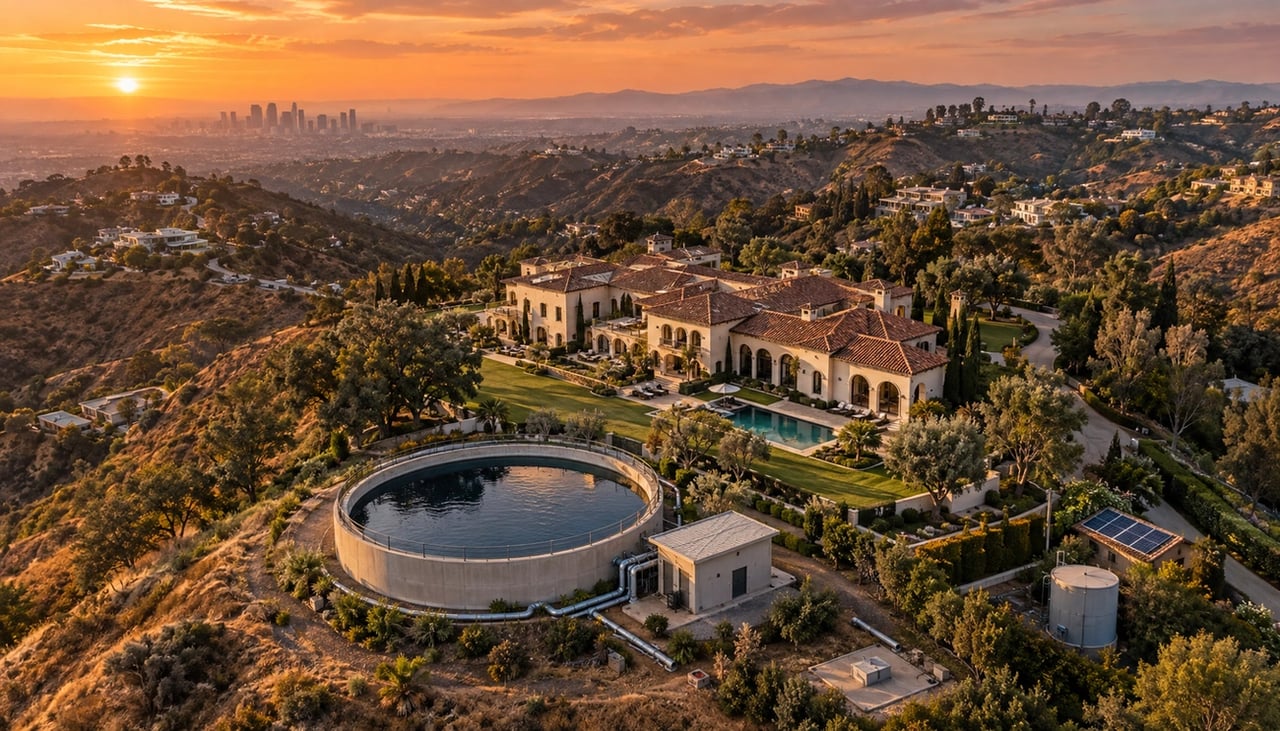
PSPS events across California are growing more frequent, more far-reaching, and expected to last longer than ever — with 2026 projections pointing to heightened fire risk as the driving factor. Luxury homes on LA's Westside, long regarded as insulated from such disruptions, are now squarely in the picture when extended power outages hit during high-risk fire conditions. What was once dismissed as a rural concern has arrived at some of the most coveted addresses in the country. Whole-home generators, once filed under optional upgrades, are earning a very different designation. For high-value properties, they have become essential infrastructure — as expected as a chef's kitchen or a home automation system. This article looks at what PSPS means for Westside homeowners, the real financial exposure these outages create for luxury real estate, and why standby power is now a standard expectation in California's most exclusive neighborhoods.
What Is PSPS and Why LA's Westside Is Now in the Red Zone
"While PSPS events can be disruptive, they are a critical tool to help reduce wildfire risk." — Southern California Edison, Utility company
Public Safety Power Shutoffs are exactly what the name suggests — a deliberate, calculated decision by utilities to de-energize power lines when weather conditions signal a significant wildfire threat. The California Public Utilities Commission granted this authority in 2012, and by 2018, all investor-owned utilities in the state operated under the same framework.
The conditions that trigger a shutoff follow a recognizable pattern: forecasted high winds, low humidity, dry vegetation near powerlines, and red flag warnings issued by the National Weather Service. What catches many homeowners off guard is that the powerlines serving their neighborhood may pass through higher-risk corridors miles away — areas with stronger winds and drier fuel loads — making a property vulnerable even when local skies appear calm.
California's wildfire risk classification system sorts affected areas into tiers. Tier 2 identifies elevated wildfire risk zones; Tier 3 marks extreme risk. Properties and businesses sitting within these tiers face the most frequent shutoffs. The Westside's risk profile has shifted as weather patterns and vegetation conditions continue to evolve — a reality that was not on most homeowners' radar even five years ago.
Outages average close to two days, though some have stretched well beyond six. The length of any given shutoff depends on how long the weather event lasts and on the inspection period utilities require before safely restoring power. Utility improvements have meaningfully reduced the number of customers affected — from over 2 million in 2019 to roughly 18,000 in 2025 — but the timing and frequency remain difficult to predict. The May 17–18, 2026 PSPS event offered a striking illustration of what these measures accomplish: simulations indicated the shutoff prevented wildfire spread across up to 270,000 acres.
The Hidden Cost of PSPS Outages on High-Value Properties
"Owning a home is a keystone of wealth—both financial affluence and emotional security." — Suze Orman, Financial advisor and author

Image Source: Security.org
"Owning a home is a keystone of wealth—both financial affluence and emotional security." — Suze Orman, Financial advisor and author
Luxury real estate in Los Angeles moves through private circles where discretion matters as much as value. For Westside properties above the $5 million mark, PSPS outages carry financial exposure that goes well beyond a few uncomfortable days without power.
California's FAIR Plan caps residential coverage at $3 million combined for dwelling, structures, and contents. A $5 million estate insured only to that limit carries a $2 million uninsured gap should disaster strike during a shutoff event. High-value owners are left layering wrap-around policies — adding both complexity and cost to what should be straightforward protection.
The numbers on the asset side tell an equally compelling story. Whole-home generators increase resale value by 3% to 5%. On a $4 million Westside property, that figure represents $120,000 to $200,000 in added equity — from a system that typically costs $6,000 to $15,000 installed.
The less visible losses deserve attention too. A wine collection stored at 55°F can cook above 70°F during a summer outage, with flavors flattened and corks pushed loose as liquid expands. Smart home systems, digital locks, and surveillance cameras go dark without power — a particular concern for homeowners who travel.
For those beginning a search or considering a move in the near future, Christina Pope understands that the right property protects what matters most, both in terms of value and daily living. Christina Pope 📞 310-404-9931 ✉️ [email protected]
Why Whole-Home Generators Are Now Standard in Westside Luxury Real Estate
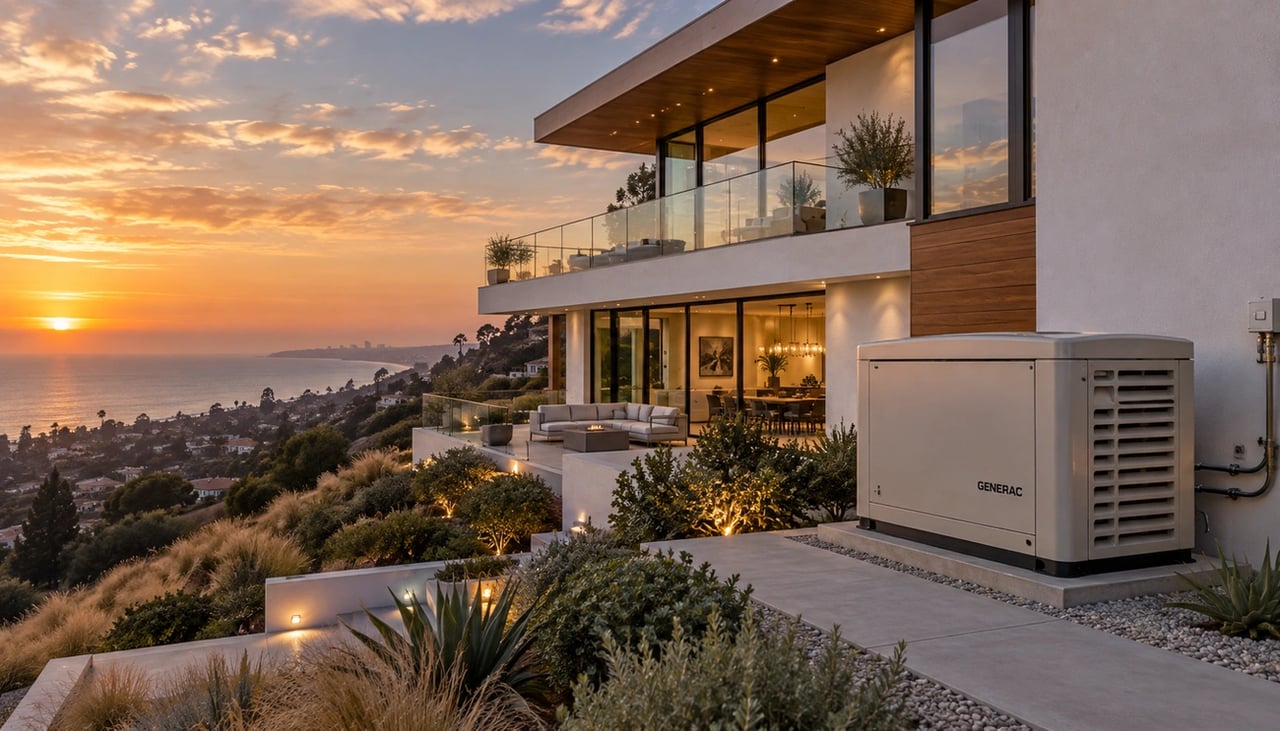
Standby generators in Westside properties speak to preparedness, not alarm. For coastal real estate operating under new PSPS conditions, these systems are straightforward infrastructure decisions — ones that appraisers and prospective buyers now recognize as such.
Professional installations begin with load analysis. A 24 kW unit covers the 80% threshold for a typical 2,000 square foot home with central air conditioning. Estates with multiple HVAC systems, pools, or workshop circuits call for 22 kW to 38 kW capacity. Permanently installed systems, unlike portable units, deliver 50% to 150% return on investment — a figure that reflects both the financial upside and the protection these systems provide.
Installation quality is what determines appraisal treatment. A properly permitted unit set on a concrete pad with a dedicated fuel line communicates professionalism to appraisers and prospective buyers alike. Permits run $150 to $500 on a $15,000 to $20,000 whole-house installation — a modest addition to a system that appraisers classify as a permanent, value-adding improvement.
Fuel access shapes the decision on energy source. Natural gas hookups cost less upfront, though propane remains the practical choice where municipal gas lines are unavailable.
For clients evaluating properties where infrastructure carries as much weight as design, Christina Pope at Sotheby's International Realty brings the expertise to identify what shapes long-term value. EliteResidenceInternational.com
Conclusion
For Westside luxury properties, whole-home generators are no longer a conversation about comfort — they are a conversation about value, protection, and what it means to own a home that truly performs when it matters most. PSPS events have rewritten the expectations buyers bring to the table, and properties equipped with properly installed standby power are meeting those expectations head-on. Christina Pope at Sotheby's International Realty works with clients who understand that the finest homes are built for both beauty and resilience. EliteResidenceInternational.com
Key Takeaways
LA's Westside luxury homeowners now face a new reality: PSPS (Public Safety Power Shutoffs) events that once seemed distant are becoming frequent threats, with outages averaging nearly two days and some extending beyond six days.
• PSPS events are no longer rare occurrences – California utilities now proactively shut off power during high-risk fire conditions, affecting even previously "safe" coastal areas like Beverly Hills and Pacific Palisades.
• Luxury homes face significant financial exposure – California's FAIR Plan caps coverage at $3 million, leaving estates valued above that amount with potentially millions in uninsured losses during power outages.
• Whole-home generators deliver measurable ROI – Professional installations increase property values by 3-5% (up to $200,000 on a $4 million home) while costing only $6,000-$15,000 installed.
• Smart systems become vulnerabilities without backup power – Wine collections, art storage, security systems, and climate control all fail during outages, creating both financial and safety risks.
• Generators are now infrastructure, not luxury – Properly permitted standby generators with 22-38 kW capacity have become standard expectations in Westside luxury real estate, signaling preparedness to buyers and appraisers alike.
The shift is clear: backup power has evolved from optional amenity to essential infrastructure that protects both property value and irreplaceable assets during California's increasingly frequent power shutoffs.
FAQs
Q1. What does PSPS mean and why is it affecting LA's Westside? PSPS stands for Public Safety Power Shutoffs, a strategy where utilities temporarily shut off power during high-risk wildfire conditions. LA's Westside, once considered safe from these disruptions, now faces frequent PSPS events due to evolving weather patterns and wildfire risk classifications. These shutoffs occur when conditions align: high winds, low humidity, dry vegetation near powerlines, and red flag warnings.
Q2. How much does a whole-home generator cost for a typical luxury property? Professional whole-home generator installations typically cost between $6,000 and $15,000 for standard systems, with larger estates requiring $15,000 to $20,000 installations. A 24 kW unit covers most 2,000 square foot homes, while larger estates with multiple HVAC systems, pools, or workshop circuits need 22 kW to 38 kW capacity systems. Permits add an additional $150 to $500 to the total cost.
Q3. Do whole-home generators actually increase property value? Yes, professionally installed whole-home generators increase resale value by 3% to 5%. On a $4 million Westside property, this translates to $120,000 to $200,000 in added equity. These systems deliver 50% to 150% return on investment when properly permitted and installed on a concrete pad with dedicated fuel lines, as appraisers recognize them as permanent, value-adding home improvements.
Q4. What are the risks to luxury homes during PSPS outages? PSPS outages create multiple vulnerabilities for high-value properties: smart home systems and security cameras go offline, wine collections stored at 55°F can cook above 70°F causing damage, climate-controlled art storage fails, and digital locks become inoperable. Additionally, California's FAIR Plan caps residential coverage at $3 million, leaving estates valued higher with potentially millions in uninsured losses.
Q5. How long do PSPS outages typically last? PSPS outages average almost two days in duration, though some extend beyond six days. The length depends on the weather event duration and the inspection period required before utilities can safely re-energize power lines. This unpredictable timeline makes backup power essential for protecting valuable assets and maintaining security systems in luxury properties.