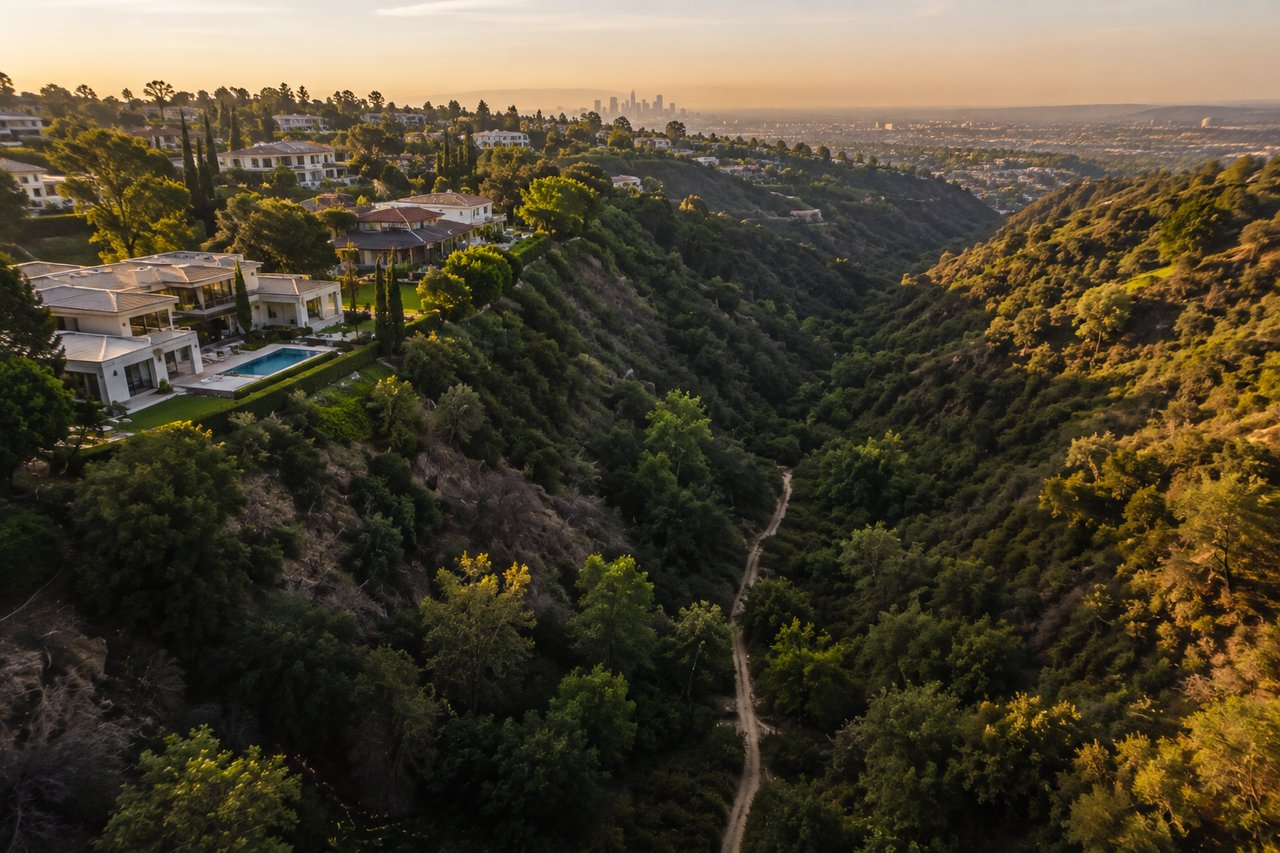
Most Beverly Hills buyers know Franklin Canyon as a hiking loop, a reservoir worth a morning walk, or a favorite dog-walking route tucked between Coldwater and Benedict Canyon. Fewer stop to consider what the 605 acres actually represent in real estate terms: a permanently protected buffer between hillside Beverly Hills neighborhoods and the San Fernando Valley that no future city council, developer, or rezoning vote can ever build on. In a market where views and privacy routinely get erased by the next hillside project up the road, permanence is a genuinely rare form of value protection.
A Park Born From a Fight to Stop Development
Franklin Canyon's protected status wasn't inevitable; it was the outcome of a specific fight. The canyon's history runs through both of the forces that built Los Angeles: oil and water. William Mulholland and the Los Angeles Department of Water and Power began building a reservoir in upper Franklin Canyon in 1914 to distribute water newly arriving from the Owens Valley, while the family of oil baron Edward L. Doheny used the lower canyon as a summer retreat, building a Spanish-style home there in 1935. By the 1970s, the canyon was slated for development, until conservationist Sooky Goldman and then-Congressman Howard Berman pushed the Department of Water and Power and the National Park Service to protect it instead. The National Park Service purchased the Franklin Canyon Ranch parcel in 1981, folding it into the Santa Monica Mountains National Recreation Area — the designation that keeps it permanently off the development table today.
What "Permanently Protected" Actually Means for Property Values
This distinction matters more than it might first appear. A hillside view in Los Angeles is only as durable as the zoning on the land creating it; plenty of Los Angeles neighborhoods have watched a beloved view corridor disappear once an adjacent lot got approved for a taller build. Franklin Canyon operates under a fundamentally different guarantee. As parkland managed under the Santa Monica Mountains Conservancy and the Mountains Recreation and Conservation Authority, it cannot be rezoned or sold off for private development the way an ordinary adjacent hillside parcel could. For homes bordering the canyon, that means the open space, the quiet, and the view are locked in for the long term in a way no private neighboring lot can promise, regardless of how strict current zoning happens to be.
The Wildlife Corridor Context
Franklin Canyon's protection isn't purely aesthetic; it functions as part of a genuine habitat network. The parcel sits within the broader Santa Monica Mountains National Recreation Area, one piece of a decades-long regional effort by public agencies to preserve connected open space across the range, an effort perhaps best known publicly through projects like the Wallis Annenberg Wildlife Crossing over the 101 Freeway. That ecological function adds another layer of institutional backing to the land's protected status: it isn't just a city park that could theoretically be repurposed by a future budget decision, but part of a coordinated regional conservation system with its own dedicated agencies and funding sources working to keep it intact.
How the Buffer Shows Up in Real Comps
The premium isn't theoretical. A six-bedroom home on Franklin Canyon Drive sold for $3.895 million in October 2023, priced well above what a comparable-sized home without direct canyon-adjacent open space would typically command in the surrounding area. The underlying logic is straightforward: supply of "borders permanently protected open space" real estate is fixed. No amount of future development anywhere else in Los Angeles can create more of it, which is exactly the kind of scarcity that tends to hold up value through market cycles rather than erode with them.
What This Means Beyond Beverly Hills Proper
Franklin Canyon's direct real estate impact isn't limited to the City of Beverly Hills itself. The park borders the Beverly Hills Post Office area an unincorporated Los Angeles County community that shares the 90210 zip code without falling inside the actual city limits along with portions of Benedict Canyon and the Coldwater Canyon corridor near Mulholland Drive. Properties directly adjacent to the park boundary, particularly along Franklin Canyon Drive itself and the upper reaches of these neighboring canyons, see the clearest benefit from the buffer, since their proximity to the protected land is what actually anchors the value premium rather than general neighborhood reputation alone.
The Trade-Offs Worth Knowing
Living adjacent to permanently protected wildland comes with real considerations, not just upside:
- Wildfire exposure. Any property bordering chaparral and wildland brush carries wildland-urban interface fire risk, and defensible space planning and insurance considerations should be evaluated with the same seriousness given to any other hillside property near open space.
- Wildlife encounters. Coyotes, deer, and other wildlife moving through the canyon are a normal part of living near protected habitat, and pet owners in particular should plan accordingly.
- Access limitations. Because the land is managed as parkland rather than a private amenity, road access through the canyon is occasionally subject to maintenance closures, which is worth confirming directly rather than assuming permanent unrestricted access.
Key Takeaways
- Franklin Canyon's 605 acres are permanently protected as part of the Santa Monica Mountains National Recreation Area, a status secured in 1981 after a 1970s campaign to stop the land from being developed.
- That permanent protection is a fundamentally different guarantee than ordinary hillside zoning, since the land cannot be rezoned or sold for private development the way a neighboring privately held parcel could be.
- The park functions as part of a genuine regional habitat network, backed by dedicated conservation agencies, rather than as a city amenity subject to future repurposing.
- Real comparable sales reflect a measurable premium for canyon-adjacent properties, with fixed, non-replicable proximity to protected open space supporting durable value.
- The buffer's benefit extends beyond the City of Beverly Hills itself, reaching the Beverly Hills Post Office area, Benedict Canyon, and the Coldwater Canyon corridor — with wildfire exposure and wildlife proximity as genuine trade-offs to plan around.
FAQs
Q1. Is Franklin Canyon actually inside the City of Beverly Hills? The park itself sits in an unincorporated area bordering the City of Beverly Hills, the Beverly Hills Post Office community, and the City of Los Angeles. Its real estate impact extends across all of these adjacent areas rather than being confined to one jurisdiction.
Q2. Can Franklin Canyon ever be developed in the future? It's extremely unlikely. The land is managed as protected parkland under the Santa Monica Mountains Conservancy and the National Park Service's Santa Monica Mountains National Recreation Area designation, which keeps it off the table for private development in a way ordinary zoning does not guarantee for other hillside land.
Q3. Does bordering Franklin Canyon increase wildfire risk for nearby homes? Yes, proximity to wildland brush carries wildland-urban interface fire risk, similar to other hillside properties near open space in Los Angeles. Defensible space planning and appropriate insurance coverage are worth prioritizing for any property directly adjacent to the park.
Q4. Which neighborhoods benefit most from Franklin Canyon's protected status? Properties directly bordering the park, particularly along Franklin Canyon Drive and the upper portions of Benedict Canyon and the Coldwater Canyon corridor, see the clearest value benefit, sciencedirect proximity to the protected land is what drives the premium.
Q5. Is Franklin Canyon open to the public, or is it a private community amenity? It's a public park, open year-round with hiking trails, a nature center, and a reservoir. It functions as a neighborhood amenity for adjacent homeowners without being a private or gated space exclusive to them.
Conclusion
Most of what makes a Los Angeles hillside view valuable comes with an asterisk — it's beautiful until the lot creating it gets sold and redeveloped. Franklin Canyon is one of the few places in Beverly Hills' immediate orbit where that asterisk doesn't apply. Nearly 45 years of permanent federal and regional protection stand between the neighboring hillside streets and any future development pressure, and that guarantee is a real, quantifiable part of what those properties are actually worth.
If you're considering a property near Franklin Canyon or elsewhere in Beverly Hills' hillside neighborhoods, Christina Pope can help you understand exactly what's protecting — or not protecting — the view and privacy you're paying for.  310-404-9931
  [email protected]
Christina Pope — Sotheby's International Realty EliteResidenceInternational.com | 310-404-9931 | [email protected]
Historical and park management details referenced reflect public information from the National Park Service, the Mountains Recreation and Conservation Authority, and the Santa Monica Mountains Conservancy as of 2026. Confirm current fire risk designations and insurance availability for any specific property before making an offer.