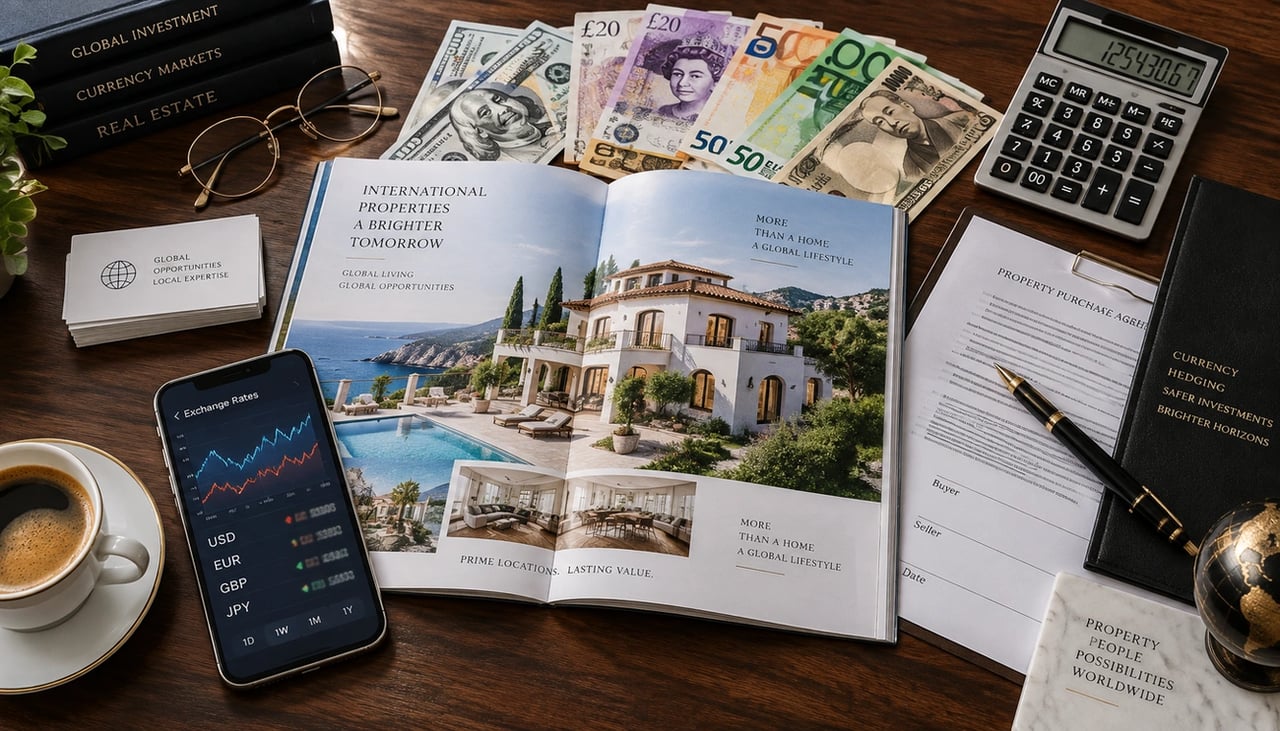
Currency risk is one of the most financially consequential factors in any international property purchase—and one of the least discussed. One international property fund recorded a 137% cumulative return in British pounds between 2008 and 2020, yet the same fund returned just 42% when measured in Japanese yen or Chinese yuan. The property performance was identical. The difference came entirely from currency movement.
For buyers, the numbers are equally striking. A 5% adverse shift in the exchange rate can add £25,000 to a sterling purchase, and a 10% move pushes that figure to £50,000—costs that have nothing to do with the agreed property price and everything to do with when and how the currency conversion happens.
The good news is that proven hedging tools exist to protect against these swings. This guide covers the key strategies and instruments available to international property buyers who want cost certainty and fewer unwelcome surprises at closing.
Why Currency Risk Matters for International Property Buyers
"If you walked into a casino with £25,000, would you risk putting it all on red or black? If you’re not okay with the possibility of losing it all, then currency risk is something to consider when buying a property overseas." — Danny Cook, Account Manager Team Leader at Smart Currency Exchange
Exchange rate shifts are among the most financially significant—and most overlooked—aspects of buying property across borders. Buyers spend considerable energy negotiating the purchase price and arranging financing, yet currency movements can quietly alter the total cost without any change to the agreed figure.
Exchange Rate Movements Can Change Your Purchase Price
Currency markets move fast and respond to events that have nothing to do with the property being purchased. After the Brexit vote, the pound's value fell 10% against the USD in a single day. A property listed at £500,000 suddenly cost American buyers $50,000 less overnight—without the seller reducing the price by a penny.
These shifts cut both ways. The three months following the Brexit vote saw foreign investors account for 78% of commercial property sales in the U.K., drawn in by the weakened pound. President Trump's trade policies against Mexico had a similar effect, with the peso falling sharply in value and drawing international buyers into tourist markets where real estate had become notably more affordable to those holding stronger currencies.
For buyers on the wrong side of these movements, the experience is far less welcome. A rate shift from 1.20 to 1.15 on a €500,000 purchase adds more than £18,000 to the final cost. The property has not changed. The seller has not changed the price. The buyer simply absorbs the difference.
Real Transaction Timelines Create Exposure Windows
Most property transactions take months to complete. That gap between agreeing on a price and making final payment is known as transaction risk—the exposure that rates will move between the handshake and the closing. Markets do not pause while paperwork is processed.
The Canadian dollar has historically moved 5% to 10% against major currencies like the EUR, GBP, and USD over a typical multi-month period. On a EUR 350,000 property, a 5% adverse move in the CAD/EUR rate alone adds roughly CAD 20,000 to the bill—a cost entirely separate from legal fees, taxes, or any negotiated terms.
A straightforward example illustrates this well. A Canadian buyer agreeing to purchase a Spanish property for EUR 300,000 at a rate of 0.680 would budget approximately CAD 441,000. If that rate moves to 0.650 by the time of closing, the same EUR 300,000 now costs approximately CAD 461,500. The buyer pays CAD 20,500 more for the same property at the same agreed price.
The Impact on Large Property Purchases
The larger the transaction, the more consequential these rate movements become. Modest percentage shifts that seem abstract on paper translate into real and substantial sums on six-figure purchases.
One buyer reserving a Spanish villa at €500,000 had budgeted £420,000 for the purchase. Pound depreciation over the following three months pushed the actual cost to £445,000. The £25,000 difference was greater than the combined total of typical legal fees and transfer costs—money lost not to any change in the deal, but purely to currency movement.
The exposure does not end at the initial purchase, either. Mortgage payments, renovation costs, and staged completions all carry the same risk. A favorable rate at the time of the deposit offers no protection for payments made months later. Political events, economic shifts, and market sentiment can all move rates between stages of a transaction, leaving buyers exposed throughout the entire process unless deliberate steps are taken to address it.
Understanding Currency Hedging for Property Transactions
Currency hedging is, at its core, a way to protect a property purchase from exchange rate movements that occur between agreement and final payment. For buyers, that protection takes the form of financial instruments that either lock in an exchange rate or create a buffer against unwanted shifts.
What Currency Hedging Actually Means
The principle is straightforward. A buyer commits to purchasing a property in a foreign currency, and hedging establishes a predetermined rate or range for that future transaction—removing the uncertainty that open currency markets would otherwise introduce.
It is worth distinguishing this from speculation. Currency hedging is not an attempt to profit from exchange rate movements. Speculators take on risk deliberately, hoping the market moves in their favor. Hedging does the opposite—it systematically reduces or eliminates an existing currency exposure. The goal is a predictable outcome, not a better-than-market result.
How Hedging Protects Your Investment
Forward contracts are the most direct tool available. A buyer agreeing to purchase property for €500,000 can lock in today's exchange rate through a forward contract, fixing the final cost regardless of what happens in the market before closing. Whether the currency weakens by 5% or 15%, the predetermined rate holds.
Currency options work differently. They grant the right, but not the obligation, to exchange currency at a set rate. The practical effect is asymmetric protection—buyers are shielded from unfavorable movements but can still take advantage of favorable ones. That flexibility carries a cost: an upfront premium paid whether or not the option is ultimately exercised.
Both instruments accomplish the same essential goal. Renovation budgets, legal fees, and staged payments can all be planned with confidence once the base property cost is fixed.
The Trade-off Between Certainty and Opportunity
Hedging eliminates downside risk—but it eliminates upside potential too. Research covering global real estate portfolios from 2001 to 2017 found that portfolios with no currency hedging achieved the highest returns, while those hedged at around 80% delivered the lowest volatility. Fully hedged portfolios were less efficient on a risk-adjusted basis than partially hedged ones.
The explanation lies in hedging costs and structural imperfections. Annual costs typically run between 0.5% and 1.5% of the hedged volume. Many experienced investors settle on a middle path—hedging 50% to 60% of their exposure, reducing the most significant volatility while leaving enough unhedged to keep costs manageable.
Primary Currency Hedging Strategies for Property Buyers
"I locked in a Forward Contract with OFX and it was very seamless… Because of the Forward Contract, it did better than the market rate when we did get our settlement funds, and the transfer back to Singapore was very easily done." — Stan, OFX client who invested in a Sydney property

Image Source: CurrencyTransfer
> "I locked in a Forward Contract with OFX and it was very seamless… Because of the Forward Contract, it did better than the market rate when we did get our settlement funds, and the transfer back to Singapore was very easily done." > — **Stan**, *OFX client who invested in a Sydney property*
Several established instruments are available to buyers seeking to protect against foreign currency risk. Each works differently, and the right choice comes down to how certain the transaction is, how much timeline flexibility exists, and how much uncertainty a buyer is willing to carry.
Forward Contracts for Locked Exchange Rates
A forward contract is a binding agreement to exchange currencies at a fixed rate on a specified future date. These are customizable over-the-counter arrangements, with flexibility in amount, settlement date, and currency pair, and tenors commonly ranging up to 12–24 months. No upfront payment is typically required, though providers may request a margin deposit as collateral.
The appeal is straightforward: buyers know exactly what their foreign purchase will cost, regardless of what markets do between agreement and closing. A forward contract on a Spanish property priced at €500,000 locks the sterling equivalent at today's rate, with no exposure to subsequent movements. The limitation is equally clear — if spot rates shift favorably after the contract is signed, buyers cannot benefit. They remain obligated to the agreed rate. Any delays in the purchase timeline or changes to the transaction amount can also require contract modifications, which may carry additional costs.
Currency Options for Flexible Protection
Currency options grant the right, but not the obligation, to exchange currency at a predetermined strike price on or before a set expiry date. Call options provide the right to buy currency at the strike price; put options grant the right to sell.
For buyers whose transactions remain contingent — where completion is not yet certain — this structure offers real advantages. When markets move unfavorably, the buyer executes at the protected rate. When they move favorably, the option simply expires, and the buyer converts at the better spot rate instead. That flexibility carries a price: an upfront premium, paid regardless of whether the option is ultimately exercised. Premium costs vary depending on the currency pair's volatility, the contract length, and the chosen strike price.
Limit Orders for Target Rate Execution
Limit orders instruct a currency provider to execute a transfer automatically once the market reaches a target rate set by the buyer. Orders can typically be placed for up to three to six months, and if the target rate is reached during that window, the exchange happens without the buyer needing to act.
Cancellations are allowed at any point before the target rate is hit, and no upfront costs apply[102]. Once triggered, though, the transfer is binding. The main risk is straightforward — if the target rate is never reached, the buyer must eventually transact at whatever rate is available, which could be less favorable than what was accessible at the outset.
Multi-Currency Accounts for Transaction Management
Multi-currency accounts let holders store, send, and receive funds across multiple currencies, giving them the ability to convert when conditions look favorable rather than at a rate automatically applied at the point of transaction. For buyers coordinating payments across several markets or currencies, these accounts can simplify the process considerably.
That said, they offer no formal protection against adverse movements. The timing decisions still rest entirely with the account holder, and getting those decisions right requires market judgment that most buyers are not positioned to exercise consistently. Platform fees and spreads apply, and interest on held balances is generally limited.
Putting Your Currency Hedging Strategy Into Practice
Choosing the Right Currency Provider
High-street banks typically offer worse exchange rates than specialist currency brokers and charge additional fees. On £300,000, the rate difference alone can amount to several thousand pounds. That gap is worth taking seriously.
Reputable FCA-regulated specialist brokers with experience in overseas property transactions include Moneycorp (one of the largest and longest-established), TorFX (well-regarded for property buyers with dedicated account managers), OFX (competitive rates with a strong digital platform), MilltFX (a specialist in larger transactions with bespoke pricing), and Smart Currency Exchange (specifically focused on property buyers).
Before committing to any provider, verify the following:
- FCA registration number on the FCA register at fca.org.uk
- Client funds held in segregated accounts, which offer protection if the broker fails
- Full terms of any forward contract, including what happens if the purchase falls through
- Minimum transaction sizes or fees
Unregulated providers and informal money-exchange services should be avoided, regardless of the rate on offer.
Timing Your Hedge Booking
The right moment to book a hedge is as soon as a price has been agreed and the payment amount and approximate date are known. For most property purchases, that point arrives when contracts are exchanged or a deposit is paid. Booking earlier gives greater certainty over the total sterling cost. Forward contracts can typically be arranged up to two years ahead, though rates booked further out will increasingly reflect the interest rate differential between the two currencies.
Deposit Requirements and Binding Obligations
Forward contracts carry real obligations. Once booked, completing the contract at maturity is not optional. Buyers should understand this fully before signing, particularly when purchase timelines are uncertain.
If the Purchase Falls Through
Should a purchase fall through after a forward contract has been booked, the contract will need to be closed at the prevailing market rate. Depending on how rates have moved, that could mean either a gain or a loss. This is one reason why understanding the full terms upfront—including fallthrough scenarios—matters so much when selecting a provider.
Strategic Considerations Beyond Basic Hedging
When Natural Hedges Already Protect You
Not every buyer needs a formal hedging instrument. Diversified portfolios can create protection organically when different currency exposures offset each other. A weakening euro may coincide with a strengthening dollar, and for investors holding assets in both, the losses in one can be absorbed by gains in the other—without any contract or premium required. Buyers with multi-market holdings are worth assessing their existing currency correlations before adding formal hedging costs on top.
Currency Risk on International Mortgages
Hedging the purchase price is only part of the picture. Currency mismatch—when a mortgage is denominated in one currency while income arrives in another—creates ongoing exposure that compounds over time.
The Swiss franc mortgage crisis between 2008 and 2015 made this painfully clear. Eastern European borrowers took CHF-denominated mortgages at 2–3% interest, attracted by rates far below their domestic options of 6–10%. When the Swiss National Bank removed its EUR/CHF floor in January 2015, the franc appreciated approximately 20% in a single day. Polish zloty mortgage holders woke up to CHF debt that had grown 20% overnight in local currency terms. The monthly payment had not changed in francs. The cost in zloty had.
Markets Where Currency Risk Is Minimal
Some markets reduce this complexity from the outset. Pegged currency regimes limit exchange rate movement by design, and certain jurisdictions allow property transactions to be priced and settled in the buyer's home currency, removing conversion exposure entirely. These are worth identifying early when evaluating where to buy.
Matching Income and Debt in Foreign Currencies
For investment properties, aligning the mortgage currency with rental income is one of the most practical protections available. A London property generating GBP rent paired with a GBP mortgage means debt service and income move in the same currency. There is nothing to convert, and exchange rate shifts become largely irrelevant to the monthly cash flow equation. Where rental income is predictable and denominated in the local currency, borrowing locally is a strategy worth discussing with a financial adviser before exploring more complex instruments.
Conclusion
The financial stakes in international property transactions extend well beyond the agreed purchase price. Exchange rate movements, left unmanaged, can quietly add tens of thousands to a budget—costs that have nothing to do with the property itself and everything to do with timing and preparation. The right hedging strategy, put in place early and executed through a reputable specialist broker, turns that uncertainty into a fixed, predictable number.
For buyers seeking both a rewarding living experience and a sound investment, Christina Pope offers the kind of expertise that comes from years working across international markets. She understands what her clients are looking for and knows how to deliver on those expectations with care and efficiency.
Reach Christina at 310-404-9931 or [email protected] to discuss your property goals and put a sound currency protection plan in place before you need one.
Key Takeaways
Currency fluctuations can dramatically impact international property costs—understanding how to hedge this risk protects your investment from unexpected losses that can reach tens of thousands.
• Exchange rate shifts directly affect purchase costs: A 5% adverse currency movement adds £25,000 to a £500,000 property, while 10% adds £50,000—costs unrelated to the property's actual price.
• Forward contracts lock in certainty: Binding agreements fix exchange rates for future transactions, eliminating uncertainty but removing potential upside if rates move favorably.
• Transaction timelines create exposure windows: Property deals spanning several months leave buyers vulnerable to currency swings, with CAD historically moving 5-10% against major currencies during typical closing periods.
• Specialist brokers save thousands over banks: FCA-regulated currency specialists offer significantly better rates than high-street banks, with differences potentially amounting to several thousand pounds on £300,000 transactions.
• Book hedges immediately after price agreement: Secure your hedge as soon as contracts are exchanged or deposits paid to maximize cost certainty and protect your budget from market volatility.
The stakes are high: one international property fund saw returns vary from 137% in British pounds to just 42% in Japanese yen over the same period—purely due to currency movements. Smart hedging strategies transform this unpredictability into manageable, budgeted costs, protecting your investment from what could otherwise be a financial gamble.
FAQs
Q1. What is the most effective way to protect against currency fluctuations when buying international property? Forward contracts are the most straightforward protection method, allowing you to lock in a specific exchange rate for your property purchase regardless of future market movements. This creates complete budgetary certainty, though you won't benefit if rates move in your favor after booking. Currency options offer more flexibility by protecting against adverse movements while allowing you to benefit from favorable rate changes, but they require an upfront premium payment.
Q2. How much can currency fluctuations actually add to my international property purchase cost? Currency movements can significantly impact your final costs. A 5% adverse exchange rate shift adds approximately £25,000 to a £500,000 property purchase, while a 10% movement adds £50,000. These costs are entirely separate from the negotiated property price, legal fees, or taxes. Historical examples show even larger impacts—after Brexit, the pound fell 10% against the USD in a single day, dramatically changing property costs for international buyers.
Q3. When should I implement currency hedging for my overseas property purchase? Book your hedge as soon as you've agreed on a price and know the payment amount and approximate payment date. For property purchases, this typically occurs when contracts are exchanged or a deposit is paid. Earlier booking provides greater certainty on your total cost. Most forward contracts can be arranged up to two years in advance, giving you ample time to secure protection during the transaction timeline.
Q4. Are specialist currency brokers really better than using my regular bank for international property transactions? Yes, specialist currency brokers typically offer significantly better exchange rates than high-street banks and charge lower fees. On a £300,000 transaction, the rate difference alone can amount to several thousand pounds in savings. Look for FCA-regulated brokers like Moneycorp, TorFX, or OFX that specialize in property transactions, ensure client funds are held in segregated accounts, and verify their registration on the FCA register.
Q5. What happens to my currency hedge if my property purchase falls through? If your purchase doesn't complete after booking a forward contract, you'll need to close the contract at the prevailing market rate, which could result in either a gain or a loss depending on how exchange rates have moved. This binding obligation is an important consideration when choosing hedging instruments. Currency options provide more flexibility in this scenario since you're not obligated to execute them, though you'll lose the upfront premium paid.