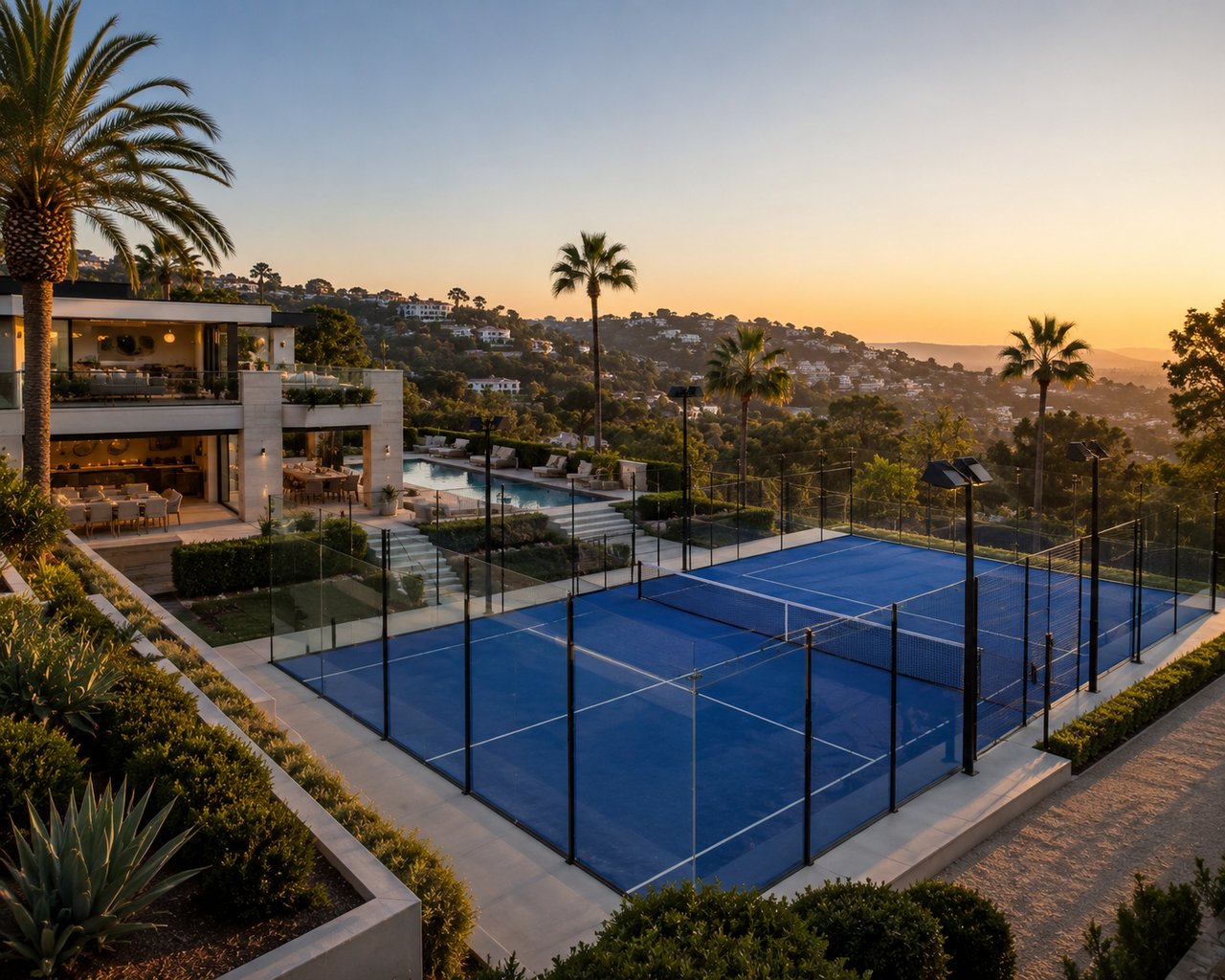
Padel ball courts are replacing tennis installations in Los Angeles luxury estates. These transformations happen through private channels where discretion matters as much as design. The move reflects broader market momentum: fewer than 20 courts existed in the United States in 2019, and now there are nearly 500. 2026 is positioned as the year padel los angeles gains serious traction as a result. What is padel ball, and why are affluent homeowners converting the padel court from tennis layouts? The padel sport combines strategic space efficiency with social exclusivity. This makes padel tennis court installations appealing for privacy-focused buyers. Christina Pope—Sotheby's International Realty and EliteResidenceInternational.com explain how these conversions affect property valuations and market positioning.
Why LA's Luxury Home Market Is Converting Tennis Courts to Padel
"Knight Frank reports that 23% of all super-prime transactions during the pandemic involved homes with a tennis court, confirming that this amenity has evolved into a key driver of desirability and price resilience." — Knight Frank, Global real estate consultancy
Luxury real estate in Los Angeles runs on private conversations, trusted networks, and smart timing rather than public listings. The most important property modifications happen off-market, where discretion matters as much as design. The conversion from tennis to padel ball represents more than athletic preference for those who understand this world. It signals market awareness and space optimization that line up with international luxury standards. Christina Pope—Sotheby's International Realty and EliteResidenceInternational.com position these installations as calculated enhancements for privacy-focused buyers who value current amenities over legacy features.
The Privacy Factor: Off-Market Property Transformations
International clients request padel sport facilities before committing to multi-million dollar purchases. Nikki Field from Sotheby's International Realty reports that three residents selected their properties because of padel court access, with purchase prices ranging from $20 million to $50 million. These buyers view the amenity as a defining factor rather than a supplementary feature. The transactions unfold quietly and often before properties reach broader market visibility. This allows sellers to position conversions as exclusive offerings within private networks.
Space Efficiency Meets Exclusivity
A standard padel tennis court occupies one-third the footprint of a tennis court. This creates immediate advantages for land-constrained estates. Miami developer Todd Glaser plans padel installations for spec houses starting at $60 million and notes the format works especially well in areas like Miami Beach and Palm Beach where parcels run smaller. "It's not as big and intrusive as a tennis court," Glaser states. Carlos Rosso from Rosso Development confirms developers can place two padel courts for every tennis court due to size advantages. This geometric efficiency extends beyond space savings. The padel court functions as social architecture and is built for doubles play. It draws four participants into regular matches. Ignacio Perez, a Houston developer, spent $30,000 converting his tennis court to accommodate both padel and basketball in 2018. He prioritized family and group play over solo tennis sessions.
Smart Timing in High-End Real Estate
Barry Cayton built one of Los Angeles' first private padel courts in 2016 within the gated Bel Air Crest community and invested $700,000 in the court and accompanying entertainment pavilions. His early adoption positioned the property as distinctive when few residential courts existed domestically. Market timing matters. What padel ball meant to most American buyers in 2016 is different from padel los angeles recognition in 2026, as infrastructure and player familiarity expand across California, Florida, Texas and New York markets.
What Is Padel Ball and Why It Appeals to Luxury Homeowners
"Padel is not just a trend; it's a revolution reshaping the sports landscape." — Javier Romero, Padel Specialist, Coach, and Content Creator
Understanding the Padel Sport Fundamentals
The sport emerged in 1969 when Mexican businessman Enrique Corcuera constructed the first padel court at his Acapulco residence. The court measures 20 meters long by 10 meters wide. Glass walls and mesh fencing enclose it and function as active playing surfaces. Players use solid rackets without strings and strike a slightly depressurized ball in doubles format. Glass walls separate padel from other racket sports. The ball remains in play after bouncing off glass surfaces during rallies. This creates strategic angles absent in traditional tennis. The net stands 88 centimeters high at center and divides the court into two equal halves with service boxes marked 6.95 meters from the net.
The sport spread from Mexico to Spain and Argentina before reaching international adoption, with 30 million players now active in 130 countries and 60,000 courts installed worldwide. Padel requires no overhead serving motion, unlike tennis. Players bounce the ball and strike it below waist level. This creates immediate accessibility for beginners. Rallies develop within the first session due to simplified mechanics and compact court dimensions.
The Social Architecture of Padel Tennis Court Design
Doubles-only gameplay promotes interaction between teammates and opponents across the net. The format eliminates solo play and requires four participants for every match. This structural requirement builds community through shared participation rather than individual competition. Teamwork and communication determine success more than raw power. The sport becomes less physically intimidating for new players.
From Country Clubs to Private Estates
Exclusive clubs position padel as premium amenity. Padel Haus charges upwards of $2,000 annually for single-club membership including initiation fees. Residential buildings in Miami install private courts for tenants in million-dollar units. South American and European buyers familiar with the sport from childhood find this especially appealing. So, high-net-worth individuals transition from club memberships to private installations on their estates.
The Padel Court Installation Process for Luxury Properties
Professional installation teams begin with complete site surveys to review existing conditions and design feasibility. The process has engineering and architecture services where applicable.
Site Assessment and Tennis Court Conversion
Converting existing tennis courts offers big cost advantages when the concrete or asphalt base remains structurally sound, level and properly drained. A standard padel court requires 20 meters by 10 meters of playing area. This fits within most tennis court footprints. But the existing surface must support 3.6 tons of steel and glass structural loads. Engineers assess surface levels, cracks, settlement and edge conditions before proceeding. Unsuitable foundations require reconstruction despite the appeal of conversion.
Glass Wall Systems and Premium Materials
Tempered glass panels measuring 10mm to 12mm thick form the main playing surfaces. These systems account for 35% to 55% of total construction costs. Steel frames use galvanized profiles that are laser-cut and powder-coated, then secured with steel anchors on-site. Wind load resistance ranges from 0.5 to 2.0 kN/m² depending on coastal exposure.
Climate Considerations for Los Angeles Installations
Los Angeles outdoor courts require engineered drainage with subtle one-directional slopes that prevent water accumulation. The foundation must eliminate standing water within 15 minutes after rainfall.
Permits and Compliance in High-End Neighborhoods
Local jurisdictions classify padel courts as specialized sports facilities that require pre-construction permitting. Installation teams provide drawings and details that ensure construction passes city requirements and wind load specifications.
How Padel Courts Affect Luxury Home Valuations
High-end real estate decisions in Los Angeles unfold through private channels where market knowledge and positioning determine outcomes. Christina Pope brings global luxury experience from Dubai to Beverly Hills and Hollywood Hills markets. She specializes in off-market opportunities and portfolio strategy for international clients. Her background serving CEOs, fashion industry figures, and high-net-worth families in different countries positions her to identify amenities that line up with lifestyle aspirations and investment objectives.
Market Positioning with Christina Pope—Sotheby's International Realty
Properties featuring padel courts create market differentiation among buyers from Europe and Latin America who view the amenity as expected rather than novel. International clients contact representatives at 111 West 57th Street in Manhattan to confirm padel court availability before committing to purchases exceeding $20 million. Three residents selected units because of court access. Transactions ranged from $20 million to $50 million.
Christina Pope assists buyers navigating these decisions for those who value entertaining and upscale living spaces.  310-404-9931
  [email protected]
Buyer Demographics Driving the Padel Los Angeles Trend
Padel positions itself as a premium lifestyle product in United States markets rather than grassroots recreation. Luxury developments incorporate courts to attract affluent demographics, and real estate developers use installations as foot traffic drivers.
Investment Returns on Court Conversions
Construction costs range from $50,000 to $100,000 per court. Padel club registrations increased 181% over eight years. Buyers pay premiums for access to desirable amenities that improve lifestyle value.
Conclusion
Padel court conversions reflect strategic positioning within Los Angeles luxury markets, where amenities align with international buyer's expectations and space optimization principles. These installations succeed when matched with suitable property profiles and buyer demographics. Christina Pope—Sotheby's International Realty and EliteResidenceInternational.com helps clients identify opportunities where lifestyle improvements translate to market advantages. The right home makes all the difference for those who love to entertain. Christina can help find spaces designed for refined living at 310-404-9931 or [email protected].
Key Takeaways
Padel courts are transforming LA's luxury real estate landscape, offering strategic advantages for high-end homeowners and savvy investors.
• Space efficiency drives conversions: Padel courts occupy one-third the footprint of tennis courts, allowing developers to install two padel courts in the same space while maintaining exclusivity and functionality.
• International buyers prioritize padel amenities: Properties with padel courts command $20-$50 million premiums, with buyers from Europe and Latin America specifically requesting this feature before committing to purchases.
• Installation costs deliver competitive returns: Converting existing tennis courts ranges from $50,000-$100,000, positioning padel as a strategic investment as the sport grows from under 20 U.S. courts in 2019 to nearly 500 today.
• Social architecture enhances property value: Doubles-only gameplay creates natural networking opportunities, making padel courts particularly appealing for entertainment-focused luxury homeowners who value community-building amenities.
• Off-market transactions dominate: Most high-end padel conversions happen through private channels before reaching public listings, requiring specialized market knowledge to identify and capitalize on these opportunities.
The padel trend represents more than athletic preference—it signals market awareness and alignment with international luxury standards that differentiate premium properties in competitive markets.
FAQs
Q1. Can local contractors install a padel court without specialized manufacturers? Yes, experienced construction companies, particularly those with tennis court installation background, can handle padel court installations. The concrete foundations and drainage requirements are similar to tennis courts. However, the glass wall systems and structural components require precise specifications. Many manufacturers now provide detailed instructions and remote guidance, though some complex aspects may benefit from experienced installers.
Q2. Is padel more physically demanding than tennis? No, padel is generally less physically demanding than tennis. The sport eliminates overhead serving motions, requires players to strike the ball below waist level, and features a more compact court size. The simplified mechanics and doubles-only format make the padel immediately accessible for beginners, with rallies developing within the first session. Strategic positioning and teamwork matter more than raw power.
Q3. How much does it cost to convert a tennis court to padel? Converting an existing tennis court to padel typically costs between $50,000 and $100,000. This assumes the existing concrete or asphalt base remains structurally sound, level, and properly drained. The glass wall systems account for 35% to 55% of total construction costs. If the foundation requires reconstruction, costs increase significantly beyond the conversion estimate.
Q4. Why are luxury homeowners choosing padel over tennis courts? Padel courts occupy one-third the footprint of tennis courts, offering significant space efficiency for land-constrained estates. The doubles-only format creates natural social interaction and entertainment opportunities. International buyers, particularly from Europe and Latin America, specifically request padel amenities, with some properties commanding $20-$50 million premiums for this feature.
Q5. What are the key requirements for building a padel court? A padel court requires a 20-meter by 10-meter playing area with proper drainage that eliminates standing water within 15 minutes after rainfall. The foundation must support 3.6 tons of steel and glass structural loads. Tempered glass panels (10mm to 12mm thick) form the playing surfaces, mounted on galvanized steel frames. Local jurisdictions typically require specialized permits for sports facility construction.