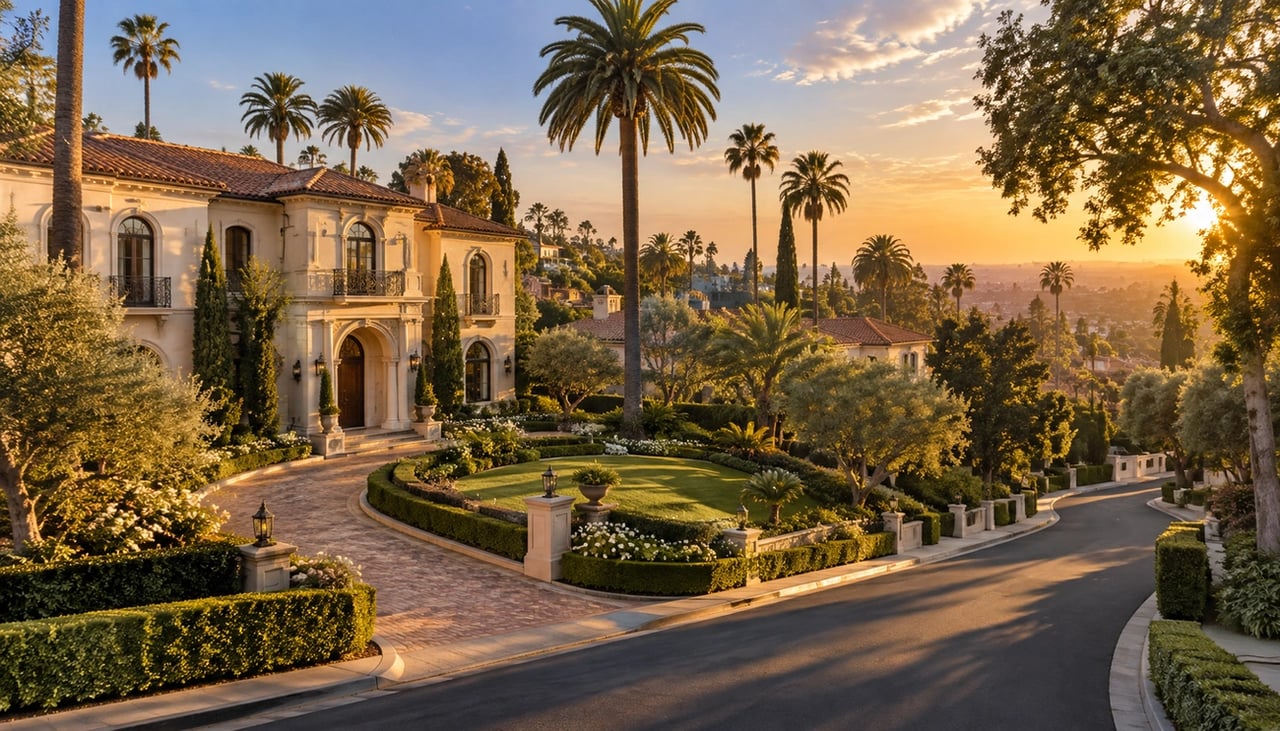
Burton Green didn't just establish Beverly Hills—he chose its most significant address for himself. The oil tycoon who founded Beverly Hills in late October 1906 knew that true luxury is rooted in location and discretion. Green built his personal estate in 1912 on an 11-acre lot along Cove Way, setting a standard for private, strategic property positioning that still defines Los Angeles real estate at its finest. His choice made one thing clear: the most meaningful addresses rarely announce themselves. What followed—from Cove Way's earliest days to the architectural evolution the estate underwent mid-century—tells the story of a street that has always carried more weight than its quiet name suggests.
Burton Green: From Oil Tycoon to Beverly Hills Founder
"Ninety percent of all millionaires become so through owning real estate. More money has been made in real estate than in all industrial investments combined. The wise young man or wage earner of today invests his money in real estate." — Andrew Carnegie, Billionaire industrialist
By 1900, Burton Green had assembled a syndicate of prominent investors to acquire Rancho Rodeo de las Aguas on behalf of the Amalgamated Oil Company. The partnership was an impressive one: Charles A. Canfield, Henry E. Huntington, William G. Kerckhoff, Max Whittier, Frank H. Buck, William F. Herrin, W.S. Porter, and Frank H. Balch. The property came from Henry Hammel and Andrew H. Denker, and the group renamed it Morocco Junction with oil extraction in mind.
The wells never yielded oil. Water came up instead—and in quantities significant enough to sustain a residential community. Green saw what others might have dismissed as a setback for what it truly was: an opening. He reorganized the operation as the Rodeo Land and Water Company in 1906 and took the helm as President. The name "Beverly Hills" came from Beverly Farms, Massachusetts, a place Green knew well.
Wilbur D. Cook, a landscape architect, was brought on in 1907 to plan the streets. Cook's design favored graceful curves, with larger parcels on the steeper northern terrain and smaller lots to the south. The first home went up that same year. Green understood that buyers needed a reason to come, so he moved forward with the Beverly Hills Hotel in 1911, which opened the following year.
His ambitions didn't stop there. Green co-founded Belridge Oil in 1911, a venture Shell Oil Company would later acquire in 1979 for USD 3.65 billion. He lived to see much of what he built endure, passing away in 1965 at age 96.
The Cove Way Estate: Green's Personal Legacy
"We shape our buildings: thereafter they shape us." — Winston Churchill, Former Prime Minister of the United Kingdom

Image Source: Paradise Leased - WordPress.com
With the Beverly Hills Hotel completed in 1912, Green turned his attention to something more personal. He selected an 11-acre parcel between Hartford Way, Cove Way, and North Crescent Drive, and brought in architect Martyn Haenke—a designer known for homes that felt commanding without being cold, livable without sacrificing grandeur.
The residence reflected Green's scale of thinking. On the ground floor: a 25-by-30-foot reception hall, a 24-by-45-foot living room, a 24-by-35-foot dining room, an expansive library, breakfast nook, butler's pantry, and kitchen. Upstairs, five bedrooms each had their own dressing room and full bath, alongside a nursery and a sleeping porch suited to California's warm evenings.
Green named the Tudor Revival mansion "Grennox." Constructed between 1912 and 1914 at what would become 1601 Lexington Road, it sat with views that carried all the way to Santa Monica Bay. The grounds were equally considered—full-grown oaks transplanted from nearby canyons, cocoa palms, flowering trees, garden pavilions, a lake, and a playground for the couple's three children. The Green family held onto the estate until the 1960s.
For those who love to entertain, the right home makes all the difference. If you're considering a purchase in the near future or beginning your search, I'd be delighted to help you discover spaces designed for elevated living and effortless hosting. Christina Pope 📞 310-404-9931 ✉️ [email protected]
Cove Way's Evolution Through the Decades
Green stayed on Cove Way for more than five decades, until his death on May 13, 1965, at age 96. That kind of commitment to a single address speaks for itself. After his passing, the property changed hands three times, and with each transfer came a new chapter for the estate.
The original Tudor Revival structure—known today as 1000 Cove Way—underwent considerable remodeling over the years. Tastes shifted, as they always do, but the house itself endured. It remains one of the few surviving examples from Beverly Hills' founding era, its footprint unchanged on the original 11-acre site.
Haenke's other work from that period held up as well. The Harry Lombard house at 1006 North Crescent Drive, which he designed in 1911, still stands—a physical reminder of how the community began, before the Beverly Hills Hotel had even opened its doors.
Properties with this kind of history rarely surface through conventional channels. For buyers who know what to look for—architectural heritage, provenance, and a location that has proven its worth over generations—the right connections make all the difference.
Christina Pope Sotheby's International Realty EliteResidenceInternational.com 📞 310-404-9931 ✉️ [email protected]
Conclusion
Burton Green's Cove Way estate tells a story that still holds true in Los Angeles luxury real estate: the properties that carry the most weight rarely surface in public listings. Value here is built on trust, timing, and the kind of knowledge that only comes from genuine experience in the market. For buyers who appreciate well-crafted homes, rich history, and spaces suited to gracious entertaining, having the right guide matters. Christina Pope works with discerning clients to uncover exceptional properties—through private channels, informed perspective, and a commitment to getting it right.
Christina Pope Sotheby's International Realty EliteResidenceInternational.com 📞 310-404-9931 ✉️ [email protected]
Key Takeaways
Burton Green's Cove Way estate exemplifies how Beverly Hills' founder established the blueprint for luxury real estate through strategic location selection and architectural vision that continues to influence high-end property development today.
• Burton Green transformed failed oil drilling into Beverly Hills' foundation, reorganizing the Rodeo Land and Water Company in 1906 after wells struck water instead of oil, creating one of America's most prestigious communities.
• Green's 11-acre Cove Way estate set the standard for discretionary luxury, featuring a Tudor Revival mansion with expansive entertaining spaces, demonstrating that significant addresses prioritize privacy over public visibility.
• The original 1912 estate remains standing after 110+ years, surviving multiple ownership changes and renovations while maintaining its footprint, proving the enduring value of strategic property positioning.
• Legacy-driven real estate decisions create lasting value through trusted circles, not public listings—a principle that continues to define Los Angeles luxury markets where discretion and timing matter most.
Green's vision established that true luxury begins with location and architectural integrity. His choice to build on Cove Way wasn't merely personal preference—it was a calculated decision that shaped how elite properties are positioned, valued, and preserved across generations in Beverly Hills.
FAQs
Q1. Who founded Beverly Hills and when was it established? Burton Green founded Beverly Hills in late October 1906. He was an oil tycoon who originally purchased the land for oil drilling but reorganized it as the Rodeo Land and Water Company after the wells struck water instead of oil, transforming the property into a residential community.
Q2. Where did Burton Green build his personal home in Beverly Hills? Burton Green built his personal estate on an 11-acre property along Cove Way between 1912 and 1914. The Tudor Revival mansion, named "Grennox," was positioned between Hartford Way, Cove Way, and North Crescent Drive, featuring expansive entertaining spaces and panoramic views stretching to Santa Monica Bay.
Q3. Why did Beverly Hills develop as a separate city rather than part of Los Angeles? Beverly Hills developed independently because Burton Green and his syndicate established it as a planned community through the Rodeo Land and Water Company in 1906. Green hired landscape architect Wilbur D. Cook to design the street layout and initiated construction of the Beverly Hills Hotel to attract buyers, creating a distinct, self-contained luxury community.
Q4. What happened to Burton Green's original Cove Way estate? Burton Green lived in his Cove Way estate until his death in 1965 at age 96. After his passing, the property changed hands three times and underwent extensive remodeling over subsequent decades. Despite these modifications, the house still stands today at what became known as 1000 Cove Way, making it a rare survival from Beverly Hills' founding era.
Q5. When did Beverly Hills become known as a wealthy community? Beverly Hills began establishing its reputation as a wealthy community shortly after its founding in 1906, particularly after the completion of the Beverly Hills Hotel in 1912. Burton Green strategically built the hotel to attract affluent buyers, and the first house appeared in 1907, setting the foundation for the area's transformation into one of America's most prestigious addresses.