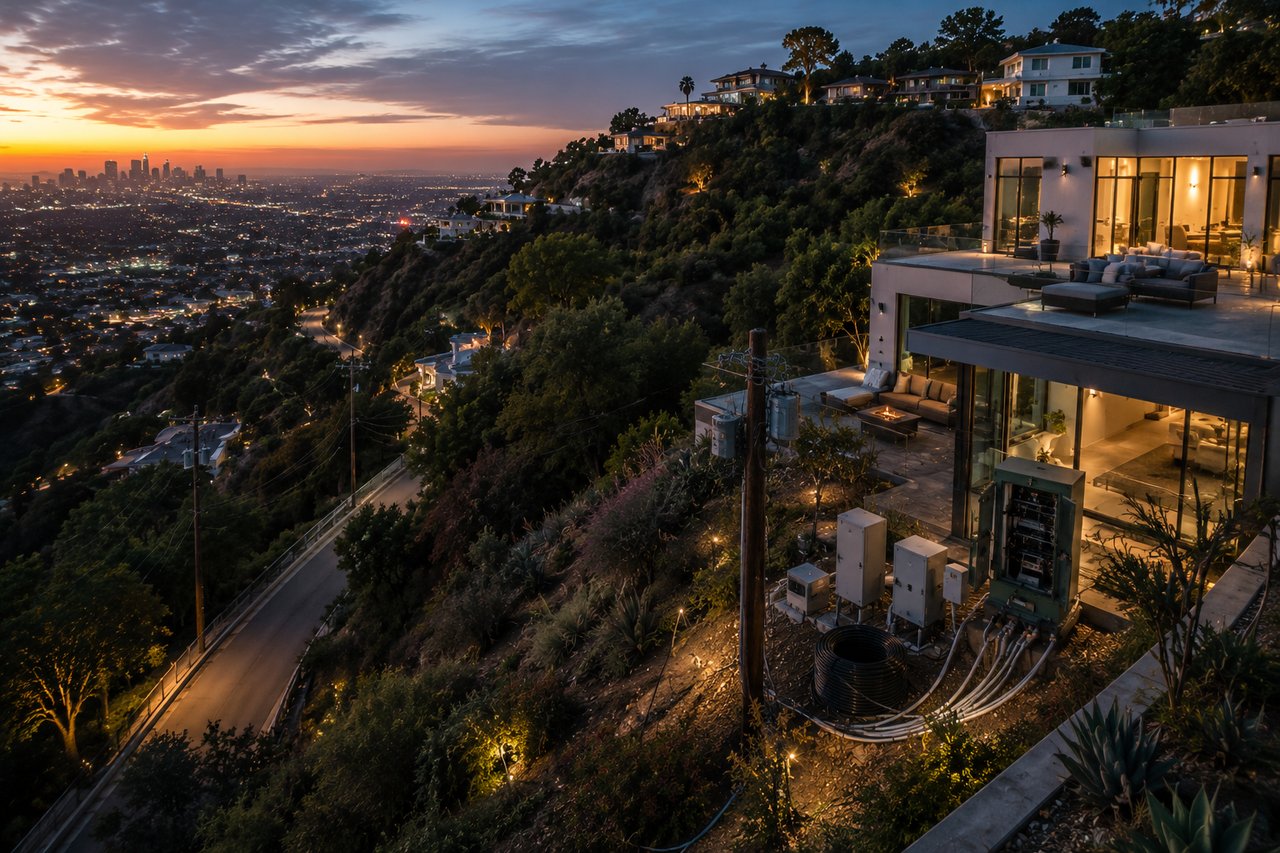
For San Francisco relocators accustomed to reliable, high-speed service, this gap can come as a genuine shock. This guide examines why optic fiber internet providers consistently bypass hillside terrain, which neighborhoods feel the impact most, and what practical options exist for buyers unwilling to sacrifice connectivity for a view.
The Geography Problem: How LA's Hillside Terrain Blocks Fiber Infrastructure
"Including a high-level design engagement in network planning helps evaluate risks and conditions that could affect timeline and budget so customers can prepare for success." — Jay O’Neill, Fiber Program Director, Network Connex
Why Internet Providers in Los Angeles California Avoid Slopes
The physical challenges start before a single cable is laid. Steep slopes destabilize soil conditions, making traditional trenching genuinely risky — heavy rainfall or a minor seismic event can shift ground enough to damage buried infrastructure. Getting heavy equipment to elevated locations is its own obstacle, and rocky hillside ground accelerates drill bit wear fast enough to demand specialized boring machinery that most crews don't carry as standard. Providers face a straightforward choice: absorb the cost of directional boring or walk away from the build entirely.
The problems don't end once installation is complete. Properties with established tree root systems, rocky ground, or sharp gradients carry complex permitting requirements and substantially higher labor costs from the start. When something underground needs repair, re-excavation on a hillside costs far more than equivalent work on flat terrain often enough to make the repair itself economically questionable. Aerial deployment along existing utility poles would sidestep much of this, but pole lines rarely extend to elevated properties in the first place.
Cost-Per-Home Economics in Low-Density Areas
The numbers tell the story plainly. Underground builds run $18 per foot compared to $8 per foot for aerial installation. On mountainous terrain, total deployment costs can reach $500,000 per mile — against $65,000 per mile on flat ground. At that ratio, hillside builds simply cannot produce the return that home internet providers Los Angeles networks require to justify the investment.
Density makes things worse. A provider spending $500,000 to wire a winding hillside street might pass twelve homes, putting the cost per subscriber at roughly $41,667 before factoring in how many actually sign up. That same investment on a flat valley street could pass 200 homes at $2,500 each. The math consistently favors the valley, and providers follow the math.
Permit and Environmental Restrictions in Hillside Zones
Regulatory requirements compound every cost calculation. Major broadband projects in Los Angeles require sign-off from multiple agencies CEQA, the State Historic Preservation Office, California Department of Fish and Wildlife, the State Water Resources Control Board, and US Fish and Wildlife Services among them. The review process typically takes up to 30 months. Construction itself is limited to weekday hours between 8:00 AM and 6:00 PM, Saturday work is restricted to interior jobs only, and violations carry fines of up to $1,000. For a project already strained by terrain and density economics, these restrictions often tip the decision firmly against building at all.
Neighborhood-by-Neighborhood Fiber Internet Los Angeles Availability
Sherman Oaks Hills vs. Valley Floor Coverage
Sherman Oaks tells the elevation story plainly. Spectrum covers roughly 100% of the neighborhood with cable infrastructure, yet AT&T Fiber reaches only 20.9% of residents. That fiber presence concentrates predictably along Ventura Boulevard and near the Sherman Oaks Galleria. Sections south of Magnolia Boulevard toward the Sepulveda Basin revert to cable or legacy copper a meaningful distinction for anyone weighing a hillside purchase against a valley address.
Encino Hills and Mulholland Corridor Access
Encino follows the same pattern. Fiber is available along Ventura Boulevard and within portions of the Encino Hills, while homes closer to the Sepulveda Basin and older postwar subdivisions rely primarily on cable coax or occasional DSL. Spectrum holds 97.5% to 100% cable coverage, yet AT&T Fiber reaches only 20.9% of Encino — nearly identical to Sherman Oaks, and for the same geographic reasons.
Hollywood Hills West: The Connectivity Dead Zone
The numbers here are notably worse. AT&T Fiber reaches just 14.6% of West Hollywood, with service concentrated along the Santa Monica Boulevard and Sunset Strip corridors and within the Norma Triangle. Off La Cienega, older buildings remain on Spectrum cable, which accounts for 88.8% of the area's coverage. For a neighborhood that commands premium prices, the connectivity reality is a sharp contrast.
Mount Washington and Highland Park Elevated Streets
Mount Washington and Highland Park present a quieter version of the same challenge. Elevated streets in both neighborhoods consistently fall outside providers' deployment priorities, with flat terrain installations absorbing the lion's share of infrastructure investment.
Palos Verdes Estates: Peninsula Isolation Issues
Geography on the Palos Verdes Peninsula produces distinct coverage patterns. Malaga Cove and Lunada Bay along Palos Verdes Drive North have reasonable fiber access, while properties on narrower cliffside lanes and older inland blocks depend largely on cable or fixed wireless. Frontier covers 90.46% of the peninsula and EarthLink Fiber reaches 92.36% — respectable figures that nonetheless mask where the actual gaps lie.
Eagle Rock Hills: Where Cable Ends
Eagle Rock offers a useful illustration of how elevation shapes options. AT&T and EarthLink together provide fiber service to 55.1% of homes, while Spectrum cable reaches 97.3%. Fiber ranks as the fastest available option for just 55.13% of Eagle Rock residences; cable is fastest for another 20.53%, and fixed wireless leads for 21.79%. The further uphill a property sits, the more likely it falls into that latter group.
Alternative Solutions for Luxury Hillside Properties
Business Fiber Installation: When to Pay $15K-$50K
When standard residential service cannot reach a hillside property, a dedicated custom fiber build becomes a legitimate option. Costs typically run between $15,000 and $50,000 figures that businesses treat as routine infrastructure expenses. For a homeowner who depends on reliable, high-speed connectivity, the investment can be well worth it.
Satellite Internet: Starlink vs. Viasat Performance Comparison
Starlink and Viasat represent the two most prominent satellite options, though they serve different needs. Starlink delivers up to 400 Mbps download with 39ms latency, with median real-world performance landing at 127 Mbps download and 21 Mbps upload across the US. Plans start at $55 monthly for 100 Mbps, $85 for 200 Mbps, and $130 for 400 Mbps. Viasat caps out at 150 Mbps with 750ms latency — pricing at $70 monthly for 150GB of data at 25 Mbps, or $100 for unlimited data at 150 Mbps. That latency difference matters considerably. Starlink handles video calls without issue, while Viasat's delay makes videoconferencing unreliable.
Cellular Bonding and Load Balancing Systems
Cellular bonding systems offer another path forward for hillside properties caught between poor fiber access and satellite limitations. Peplink routers combine up to 13 internet links through eight load-balancing algorithms, merging multiple carrier connections into a single aggregate link with automatic failover when one signal drops. Hardware from Peplink and Teradek starts at $1,000, while software-based solutions like Speedify are available for under $10 monthly.
Point-to-Point Wireless Bridge Options
Point-to-point wireless bridges offer a practical alternative where nearby fiber infrastructure exists but simply does not extend to an elevated property. These systems create a dedicated link between two locations at distances exceeding 1.25 miles, with pre-configured kits reaching up to 5 km at speeds above 300 Mbps.
Identifying the right property — one that balances location, lifestyle, and practical infrastructure — requires the kind of expertise that comes from genuine market knowledge. Christina Pope brings exactly that to every client search. Those beginning their journey toward a hillside home in the Los Angeles market are welcome to reach out directly.
Christina Pope  310-404-9931
  [email protected]
San Francisco Buyer's Checklist for LA Hillside Properties
"High-speed Internet access is increasingly the equivalent of power and water for many people in the 21st century, and it’s absolutely essential for my work on TidBITS. No Internet, no purchase." — Adam Engst, Publisher of TidBITS
Testing Actual Speeds Before Purchase
Coverage maps tell one story. The router tells another. During walkthroughs, connect directly to the property owner's router via Ethernet cable and run speed tests — Wi-Fi introduces variables that skew results. Test at different points in the day, since evening speeds frequently drop as neighbors log on simultaneously. A conversation with residents on the same street will reveal more than any provider brochure. Look for a fiber-optic box mounted on the exterior of the home as a reliable indicator of quality service; a standard phone box only confirms landline presence, not fast internet.
Verifying Provider Service Commitments in Writing
Provider contracts are careful to note that advertised speeds reflect maximum potential, not what a buyer should expect consistently. Activation can also require physical changes to the property that are not easily undone. Before closing, include inspection clauses that set specific speed thresholds as a condition of purchase.
Understanding Upload Speed Requirements for Video Calls
Download speed gets most of the attention, but upload speed is equally important for anyone working remotely. Stable video conferencing requires 100 Mbps download and 20 Mbps upload minimum. Screen sharing and presentation-heavy calls push that upload requirement to 20 Mbps or higher.
Backup Internet Planning for Remote Work Continuity
Even well-researched connectivity plans encounter outages. A 5G cellular router kept on standby provides up to 100 hours of backup coverage monthly when the primary connection fails. Mobile hotspots serve as a practical secondary option during broader regional disruptions.
Luxury real estate in Los Angeles operates within trusted circles where discretion matters. For clients who want a home that performs as well as it presents — whether for work, entertaining, or simply everyday life — the details matter. Christina Pope brings the same attention to connectivity, lifestyle, and long-term value that her clients have come to expect. 310-404-9931 [email protected]
Conclusion
The allure of a hillside estate — the views, the privacy, the prestige — is real. So is the connectivity gap that comes with it. Geography and economics consistently steer internet providers toward flat terrain, and no coverage map will tell a buyer what actually works at a specific address on a winding hillside street. The only reliable approach is firsthand verification: test speeds on-site, speak with neighbors, and put specific performance requirements in writing before closing.
For those committed to a hillside address, options like Starlink and cellular bonding systems offer genuine solutions, though they require planning and budget. The properties are worth it — provided buyers go in with clear eyes.
Luxury real estate in Los Angeles operates within trusted circles where discretion and expertise matter in equal measure. Christina Pope brings both to every search. Whether the priority is a hillside retreat with a view or a well-connected estate designed for effortless entertaining, she knows how to find what her clients are truly looking for. 310-404-9931 [email protected]
Key Takeaways
Los Angeles hillside properties face severe fiber internet limitations despite the city's impressive overall coverage, creating critical considerations for San Francisco relocators evaluating luxury estates.
• Geography drives the gap: Hillside fiber deployment costs reach $500,000 per mile versus $65,000 on flat terrain, making elevated properties economically unviable for providers despite premium home values.
• Coverage varies dramatically by elevation: Valley floor neighborhoods enjoy 90%+ fiber availability while hillside areas like Hollywood Hills West drop to just 14.6% AT&T Fiber coverage.
• Test speeds before buying: Run multiple Ethernet-connected speed tests during property visits and verify provider commitments in writing, as coverage maps don't reflect actual hillside performance.
• Budget for alternatives: Starlink ($55-$130/month) delivers 127 Mbps median speeds with 39ms latency, while custom fiber builds cost $15K-$50K for properties where standard service won't reach.
• Remote work requires backup plans: Video conferencing needs 100 Mbps download and 20 Mbps upload minimum; cellular bonding systems and 5G routers provide essential failover during outages.
The disconnect between LA's marketed connectivity and hillside reality means affluent buyers must prioritize internet infrastructure verification alongside traditional property considerations, or risk discovering connectivity limitations after closing.
FAQs
Q1. Why do internet providers say fiber isn't available at my address even though my neighbors have it? This often results from address mapping errors in the provider's database rather than actual infrastructure limitations. New construction properties frequently experience delays in getting their addresses properly registered in serviceability systems, even when fiber lines physically reach the area. Contact the provider directly and request a manual serviceability check using your parcel or lot number, or visit a corporate store to open an address validation ticket that triggers engineering review.
Q2. What causes some hillside homes to lack fiber internet while nearby flat areas have full coverage? Hillside terrain creates prohibitive installation costs for fiber providers due to steep slopes, soil instability, and difficult equipment access. Underground fiber deployment in mountainous areas can cost $500,000 per mile compared to $65,000 in flat terrain. Combined with low housing density on hillside streets, the cost per home becomes economically unviable for providers, leading them to prioritize valley floor neighborhoods where infrastructure expenses are significantly lower.
Q3. How can I verify actual internet speeds before purchasing a hillside property? Connect directly to the property owner's router using an Ethernet cable during walkthroughs and run multiple speed tests at different times of day, particularly during evening peak usage hours. Ask neighboring residents about their actual speeds and which providers serve them reliably. Look for a fiber-optic box attached to the house as confirmation of quality connectivity, and include specific speed threshold requirements in your purchase contract inspection clauses.
Q4. What are the best alternative internet solutions for homes without fiber access? Starlink satellite internet delivers median speeds of 127 Mbps download and 21 Mbps upload with 39ms latency, making it suitable for video conferencing at $55-$130 monthly. Cellular bonding systems combine multiple carrier connections for aggregate bandwidth with automatic failover. For properties near existing fiber infrastructure, custom business fiber installation costs $15,000-$50,000 but provides dedicated high-speed connectivity. Point-to-point wireless bridges can also extend networks up to 5 km at speeds exceeding 300 Mbps.
Q5. Why do permit requirements make hillside fiber installation more difficult in Los Angeles? Los Angeles hillside construction faces extensive regulatory approval processes involving multiple agencies including CEQA, State Historic Preservation Office, California Department of Fish and Wildlife, and US Fish and Wildlife Services, typically requiring up to 30 months for review. Hillside zones have restricted working hours limited to 8:00 AM to 6:00 PM on weekdays only, with violations resulting in $1,000 fines. These environmental and permitting restrictions significantly increase project timelines and costs for providers attempting hillside fiber deployment.