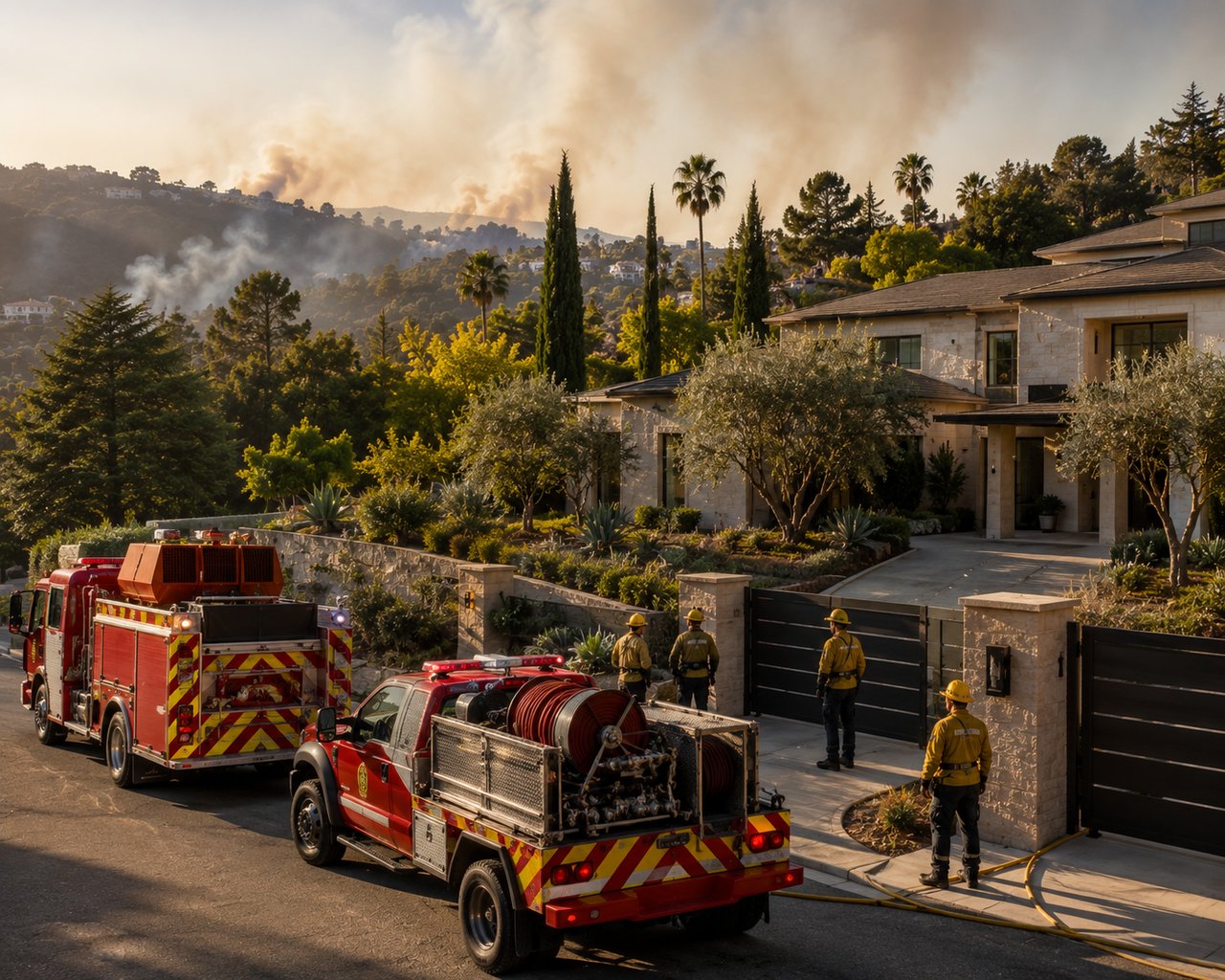
Private firefighters have become a critical line of defense for California property owners as insurance losses from recent Los Angeles wildfires reach an estimated $20bn. Capstone, a private fire service company, deployed over 30 engines across Southern California. Insurance carriers such as AIG, Chubb, and USAA activated specialized wildfire protection programs. This emerging industry has companies like Wildfire Defense Systems, which partners with three dozen insurance carriers. The Rick Caruso private firefighters controversy has ignited national debate about equitable fire protection. Most private fire departments in California serve average homeowners through insurance-funded programs, not just wealthy estates.
Private Firefighters Defend Bel Air During Recent Wildfires
"We clean. We sweep. We clear gutters. We take away the places where the embers can ignite on the property or take away the access that the embers have to get in the buildings." — David Torgerson, Executive Chairman of Wildfire Defense Companies
Private Firefighters Defend Bel Air During Recent Wildfires
Multiple private fire service companies responded to the Los Angeles County wildfires and deployed specialized equipment and personnel among municipal firefighters. These private firefighters California communities witnessed operated under the same regulatory framework as public agencies while serving distinct contractual obligations to insurance carriers, utility companies and property owners.
Capstone Deploys 30+ Engines Throughout Southern California
Capstone Fire and Safety Management positioned over 30 wildfire engines throughout Southern California as the fires spread. The Montana-based company serves the entire Western United States and maintains contracts with the insurance industry, utility companies and individual property owners. Fire Chief Greg McAlpine stated his pride in the women and men of Capstone's fire crews and their efforts to neighbors and friends in the affected areas.
Each Capstone engine carries experienced professional firefighters and command personnel. The equipment has protective firefighting gels and retardants designed to restrict and eliminate wildfire spread on structures. Capstone operates within guidelines set by State and Federal regulations under the direction of and inclusion in the Fire Incident Command System. This regulatory compliance will give coordination with public firefighting efforts rather than independent operations.
USAA's Wildfire Response Program Activates
USAA activated its Wildfire Response Program, which enrolls eligible members in at-risk areas at no additional cost automatically. The program provides wildfire response services that include property damage assessment and the application of fire retardants. USAA enlists Capstone Fire and Chloeta, an association of professional wildland firefighters, to help protect member homes during wildfire events. These teams may visit homes during a wildfire event without requiring appointments.
USAA has this wildfire protection as a standard component of homeowners' policies in 15 states. The company offers accelerated claims handling, streamlined processing and advance payments activated to cover immediate needs such as temporary housing, food and essential supplies. Rebekah Nelson, Catastrophe Communications Director for USAA, acknowledged the service benefits insurance companies while expressing a wish that everybody had this protection on their policies.
List of Private Fire Departments Operating in LA
Nationally, 369 private wildfire suppression companies belong to the National Wildfire Suppression Association and field a combined 11,000 professionally trained wildland firefighters as of 2025. Public reporting on the Los Angeles market has named providers such as Wildfire Defense Systems, which handles pre-fire structure protection contracted through insurers, and All Risk Shield, which offers direct-to-homeowner protective packages.
No authoritative published list exists of every company operating in Los Angeles County at any given time. The NWSA membership roster serves as the closest approximation to a directory to vet providers. Private firefighting companies do not appear in public fire department registries, which track municipal departments only.
Insurance Companies Stimulate Private Fire Protection Growth
Fire insurance carriers developed specialized wildfire defense programs as direct premiums written surged 73.9% between 2019 and 2024, reaching $23bn. The national loss ratio dropped to 40.6% in 2024, the lowest in six years, while commission and brokerage expenses hit $3.15bn, up 13.7% year-on-year. Nine of the ten costliest wildfires in US history have struck since 2017. Carriers had to invest in prevention rather than rely on post-loss payouts alone.
AIG Pioneered Wildfire Defense Units in Wealthy Zip Codes
AIG launched the first carrier-backed wildfire protection program in 2005 through its Wildfire Protection Unit. The program served members of the Private Client Group in 14 of California's wealthiest zip codes, including Brentwood and Malibu. The program offered wildfire mitigation and protection from active wildfires as an optional service to elite policyholders. Policies ran from several thousand dollars to several tens-of-thousands, depending on location and home value.
Members of the Private Client Group included 42 percent of the Forbes 400 Richest Americans. The unit served 2,700 customers in California, Colorado and Texas in 2017. AIG expanded the program to 385 ZIP codes nationwide. AIG and Stone Point Capital formed Private Client Select Insurance Services (PCS) in July 2023, an independent managing general agency that now manages legacy AIG Private Client policies.
Policyholders must sign up for the service through AIG's enrollment page to receive wildfire monitoring as a fire builds, access to contracted response crews, and application of fire-blocking agent Thermo-Gel to houses and landscaping.
Chubb and Travelers Expand Fire Mitigation Services
Chubb introduced Wildfire Defense Services to customers in 13 Western states in 2008. The company expanded coverage to most of Texas in 2011. Coverage started with 73 counties before extending to 141 of 254 counties. The program now operates in 19 states: Arizona, California, Colorado, Florida, Georgia, Idaho, Montana, Nevada, New Mexico, North Dakota, Oklahoma, Oregon, South Carolina, South Dakota, Tennessee, Texas, Utah, Washington, and Wyoming.
Enrollment is mandatory for coverage. Policyholders enroll through the Chubb Mobile app, client portal, or signed authorization form. This grants Wildfire Defense Systems crews permission to enter and work on property during evacuations. Services trigger when a wildfire comes within roughly three miles of an enrolled home or when evacuation orders are issued. The program has helped save dozens of homes since inception.
Travelers contracted with Wildfire Defense Systems, Inc. to provide services at no additional cost to policyholders. The endorsement was added to all new and existing California Dwelling Home and Homesaver policies in June 2019. Coverage expanded to Colorado in June 2021, then to Idaho, Washington, Arizona, Nevada, Utah, Wyoming and Oregon properties in 2022.
Average Homes Now Receive Insurance-Funded Protection
Private firefighting moved from elite-only services to broader coverage through insurance carrier programs. An overwhelming majority of properties served are average value homes with main street carriers. The number of firefighters protecting individual properties of high-net worth individuals represents a fraction of one-tenth of 1%. Less than 1% of contractors are hired by private homeowners or landowners for fire prevention and response services directly.
Mass-market carriers do not field per-home wildfire response crews, and no state FAIR Plan provides loss-prevention services. Carrier wildfire defense remains exclusive to the high-net-worth segment where premiums fund prevention of seven or eight figure claims.
Rick Caruso Private Firefighters Spark National Debate
The January 2025 Los Angeles wildfires exposed stark wealth divides when several high-profile property owners deployed private fire services while neighboring structures burned. Rick Caruso's private firefighters became the focal point of a national conversation about equitable disaster response and resource allocation during emergencies.
Billionaire's Mall Survives While Neighborhood Burns
Rick Caruso dispatched private firefighters from Arizona to protect Palisades Village, his outdoor shopping complex in Pacific Palisades, as the wildfire advanced on January 7, 2025. The billionaire developer brought in water tankers equipped with 3,000 gallons each after local fire hydrants lost pressure. The 25,000-square-foot center housing 42 businesses, including Chanel and Saint Laurent, remained unscathed with mostly smoke damage. "Our property is standing. Everything around us is gone. It is like a war zone," Caruso told The New York Times.
The mall's survival while 6,822 structures burned in the surrounding Palisades fire triggered immediate controversy. Caruso defended his actions and stated his crews operated independently and loaned equipment to the Los Angeles Fire Department. State Assembly members introduced legislation to prohibit private fire crews from accessing public fire hydrants in response. Caruso's team insisted they used no city water.
The developer announced plans to reopen Palisades Village in early 2026, months ahead of the recovery timeline for neighboring businesses and homes reduced to rubble.
Hollywood Manager Hires All Risk Shield for Hills Home
Adam Leber, a Hollywood talent manager, hired All Risk Shield to protect his Hollywood Hills residence when fire threatened the area on January 8. A San Francisco Chronicle reporter's video of workers defending the property went viral and prompted comments such as "Private and firefighter should not be in the same sentence". All Risk Shield responded to more than 120 calls to residences at risk from the wildfires. The company has operated since 2013 and maintains a client base ranging from private homeowners to insurance carriers.
A two-person crew with a small vehicle costs $3,000 per day, while a 20-person crew with four trucks runs $10,000 daily. All Risk Shield stated it never relies on municipal resources like fire hydrants to serve private clients and operates independently from the Los Angeles County Fire Department.
Keith Wasserman's Viral Post Ignites Social Media Backlash
Keith Wasserman, co-founder of Gelt Venture Partners, posted to X on January 7: "Does anyone have access to private firefighters to protect our home in Pacific Palisades? Need to act fast here. All neighbors' houses burning. Will pay any amount". The post generated over 900,000 views before deletion. Critics slammed the real estate executive as "incredibly tone deaf" for attempting to divert firefighting resources to his insured property.
Wasserman responded to backlash by writing "Mama, I'm going viral!" before deleting his account. Public records showed his two-story home was worth approximately $3 million in 2023. The LA Recovery website later confirmed every house on Wasserman's block, including his property, burned down despite his efforts. Less than a fraction of 1% of private firefighting work involves individual homeowner contracts, according to industry representatives.
How Private and Public Fire Services Coordinate
Private fire service companies operate under state-controlled incident command posts and never function independently. So these firms must meet similar certification requirements as public firefighters to gain access behind evacuated lines. Wildfire Defense Systems launched in 2008, and crews have worked behind evacuation lines during more than 400 incidents.
Montana-Based Companies Work Under Public Command
All Wildfire Defense Systems personnel and equipment are subject to National Incident Management System standards used to certify companies contracting with the federal government on fires. The federal government has hired private firefighters to support its own forces since the 1980s. Private contractors provide approximately 40% of wildland fire suppression services nationwide.
Contract firefighters hired by government agencies represent the vast majority of private firefighting work. About 250 private sector fire response companies operate under federal contract and add 10,000 firefighters to United States efforts. Battalion Chief Lucas Spelman of CAL FIRE noted he expects private firefighting numbers to grow, citing accountability and training verification as main concerns.
Less Than 1% of Contractors Serve Individual Homeowners
Individual homeowner contracts make up less than a fraction of 1% of private firefighting. Most member companies of the National Wildfire Suppression Association work through state and federal contracts and supplement public agencies when resources are depleted. A small percentage work for insurance companies and represent a growing industry segment.
Altadena Response Reveals Geographic Disparities
California's Department of Justice launched a civil rights investigation into whether Los Angeles County discriminated against predominantly Black west Altadena during the January 2025 Eaton fire response. Residents in affluent, whiter east Altadena received evacuation alerts within one hour after the fire started. West Altadena residents received alerts eight hours later. A single fire truck reached west Altadena around 3am as flames engulfed the area, while dozens deployed to the eastern side. Eighteen of the 19 people who perished in the fire were from west Altadena. Fire victims had an average age of 77 years old.
Future of Private Fire Departments in California
Future of Private Fire Departments in California
Climate-driven wildfire escalation, insurance market instability, and federal workforce attrition are converging to boost private fire service expansion throughout California and the Western United States.
Climate Crisis Fuels More Frequent Wildfire Seasons
Fire seasons have lengthened by one month compared to 35 years ago. They start earlier and end later. The average peak wildfire growth rate in the United States nearly doubled between 2001 and 2020. Models project that a 1°C temperature increase would boost median burned area per year by as much as 600% in some Western forest types. Climate change enhanced organic matter drying and doubled the number of large fires in the Western United States between 1984 and 2015. California's 20 largest wildfires on record include fifteen that have burned since 2000. Wildfire seasons from 2020 to 2022 far surpassed the average of 1.2 million acres burned since 2016.
Insurance Market Stabilization Through Prevention
Insured losses from the Los Angeles wildfires are on track to reach $30bn or more. Nineteen of California's leading homeowners' insurers have restricted writing coverage in the state, and some have withdrawn entirely. More than 1.2 million California homes face wildfire risk. The CA FAIR plan has grown by more than 200% since 2019. About 4.3 million American households depend on public programs for property insurance as of 2023. Those navigating these market shifts and thinking about a purchase in fire-prone areas need to understand property resilience features. Christina Pope  310-404-9931
  [email protected] can help identify homes designed with fire-resistant construction standards.
Federal Firefighter Retention Challenges Create Private Sector Opportunities
Three out of four federal wildland firefighters thought about quitting within the past 12 months. Low pay starting at $15 per hour remains the biggest barrier to recruitment and retention. Survey respondents worked more than 500 overtime hours in the past year, about 82% of them. Federal firefighters expressed concerns about colleagues leaving for private work that offers better pay. Private contractors now provide approximately 40% of wildland fire suppression services nationwide. The National Wildfire Suppression Association represents 369 private companies fielding 11,000 trained wildland firefighters.
Conclusion
Private firefighting represents a permanent change in wildfire response strategy in California. Fire seasons now extend beyond traditional boundaries because of climate change, and insurance carriers prioritize prevention over post-loss payments. The industry serves average homeowners through carrier-funded programs rather than protecting wealthy estates, as public perception suggests. Coordination between private crews and public incident command systems will determine how well operations work as the need accelerates. Federal workforce retention challenges create opportunities for private sector expansion. Property owners navigate volatile insurance markets and must understand these protective services as standard risk management tools rather than luxury amenities reserved for elite addresses.
Key Takeaways
Private firefighting in California has evolved from an elite service to a mainstream insurance benefit, fundamentally reshaping wildfire protection across the state. Here's what property owners and stakeholders need to understand:
• Insurance carriers, not billionaires, drive most private firefighting — Over 99% of private fire protection serves average homeowners through insurance-funded programs from companies like USAA, Chubb, and Travelers at no additional cost.
• Private crews operate under public command, not independently — All private firefighters must meet identical certification standards as public agencies and work within the National Incident Management System under state-controlled incident command.
• Climate change is making private fire services essential infrastructure — Fire seasons have lengthened by one month since 1985, with median burned area projected to increase 600% per 1°C temperature rise in Western forests.
• Federal firefighter shortages accelerate private sector growth — Three out of four federal wildland firefighters considered quitting in the past year due to $15/hour starting wages, while private contractors now provide 40% of national wildland fire suppression services.
• Geographic and economic disparities persist in fire response — The Altadena case revealed eight-hour delays in evacuation alerts for predominantly Black neighborhoods versus one-hour warnings in affluent areas, highlighting systemic inequities that private services cannot solve.
The convergence of climate crisis, insurance market instability, and workforce challenges means private fire protection will become standard practice rather than controversial exception in high-risk California communities.
FAQs
Q1. How much does it cost to hire private firefighters for your home? Private firefighting costs vary significantly based on crew size and equipment. A two-person crew with a small vehicle typically costs $3,000 per day, while a larger 20-person crew with four trucks runs approximately $10,000 daily. However, most homeowners don't pay these rates directly—insurance companies like USAA, Chubb, and Travelers include wildfire protection services at no additional cost as part of homeowners' policies in high-risk areas.
Q2. Can individual homeowners hire private firefighters in California? Yes, homeowners can hire private firefighting companies directly, though less than 1% of private firefighting work involves individual homeowner contracts. Companies like All Risk Shield offer direct-to-homeowner protective packages during wildfire events. However, the vast majority of private fire protection comes through insurance-funded programs that automatically enroll eligible policyholders at no extra charge, making direct hiring unnecessary for most residents.
Q3. Do private firefighters operate independently from public fire departments? No, private firefighters do not operate independently. All private fire service companies work under state-controlled incident command posts and must meet identical certification requirements as public firefighters. They operate within the National Incident Management System framework and are subject to the same regulatory standards used to certify companies contracting with federal and state governments on fires.
Q4. Are private firefighters only available to wealthy homeowners? Contrary to popular perception, private firefighting primarily serves average homeowners rather than exclusively protecting wealthy estates. Over 99% of properties served are average-value homes through insurance carrier programs. The number of firefighters protecting individual high-net-worth properties represents less than one-tenth of 1% of the industry, with most services provided through mass-market insurance policies.
Q5. How do insurance companies provide wildfire protection services? Insurance carriers like Chubb, USAA, and Travelers partner with specialized companies such as Wildfire Defense Systems and Capstone Fire to provide automatic wildfire protection in high-risk states. When a wildfire comes within approximately three miles of an enrolled home or evacuation orders are issued, contracted crews can apply fire retardants, clear gutters, and perform property assessments. Enrollment is typically mandatory for coverage and handled through mobile apps or client portals at no additional premium cost.