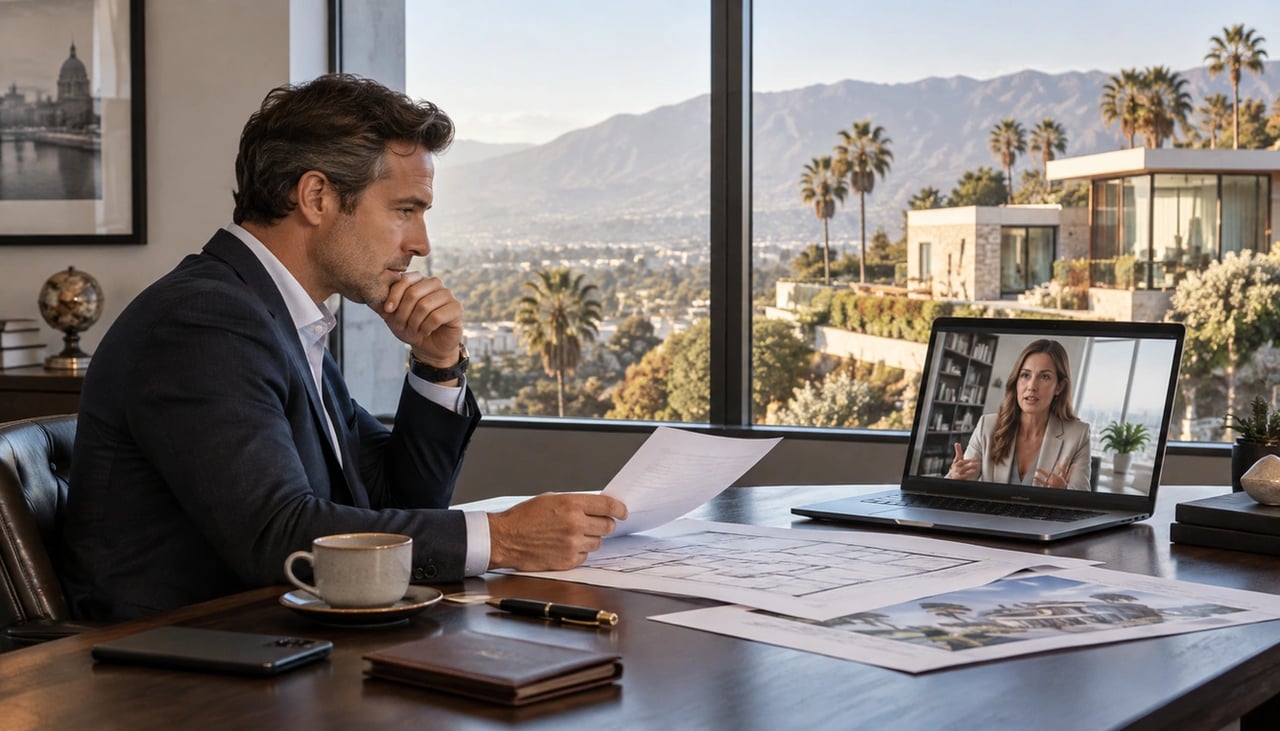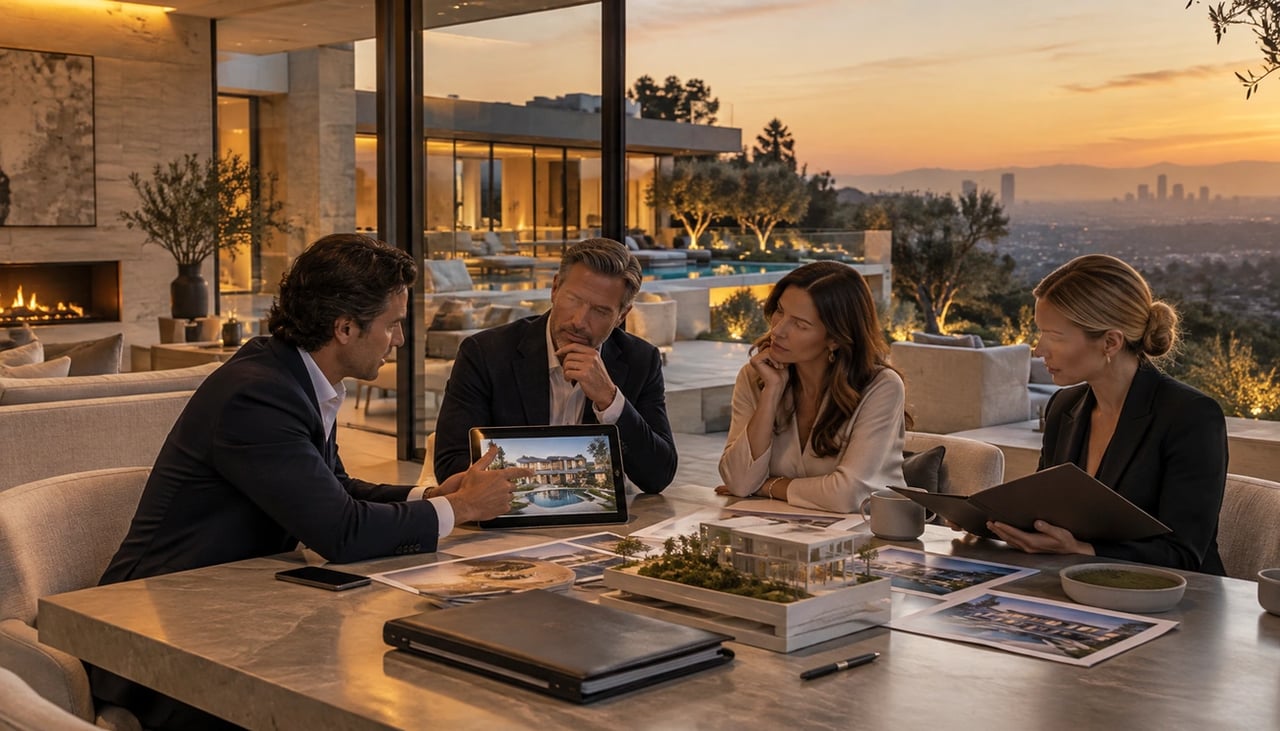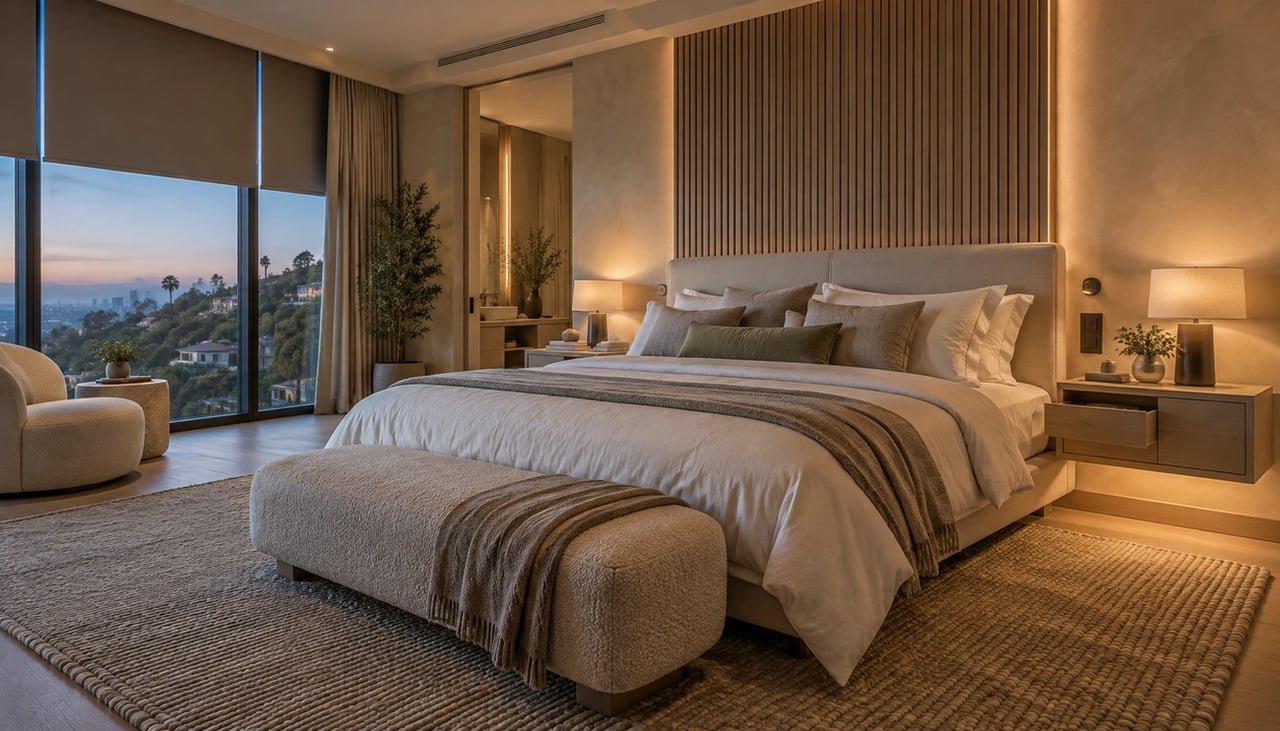
Among luxury homebuyers, the tech bedroom has quietly become one of the most sought-after features a property can offer. The reasoning is straightforward: screen time after bedtime raises insomnia odds by 59% and trims sleep duration by 24 minutes, and a third of American adults are already falling short on rest. Market forecasts project that 40% of new luxury beds will include smart technology by 2027. What has changed, however, is the philosophy behind these installations. A modern high-tech bedroom no longer signals status through visible gadgets — it earns its place through quiet performance. Discreet systems, designed to support rest without announcing themselves, have turned the technology bedroom into a genuine wellness investment rather than a showcase.
Why Los Angeles Luxury Buyers Want Sleep Labs at Home
Los Angeles luxury real estate operates on its own terms. The most significant deals rarely surface on a listing site, and the buyers behind them are not scrolling through online photos. They rely on trusted introductions, private previews, and advisors who know what discretion is worth. A tech bedroom, in this world, is not a bullet point in a brochure — it is something a buyer discovers only after earning access to the property.
Better rest as a luxury buying priority
Sleep has moved to the top of what affluent buyers want from a home. A poll of REMAX luxury agents found 76% of clients want spa-like bathrooms, while 59% prioritize home gyms — numbers that reflect a larger shift: buyers are building personal wellness infrastructure rather than depending on outside clubs or clinics. Saunas, cold plunge pools, and recovery technology have become standard requests in high-end design. The primary suite, once simply a place to sleep, has become a retreat built around rest, recovery, and quiet. A tech bedroom fits that expectation well, offering owners a space genuinely engineered for rest rather than one that merely looks the part.
Why some major transactions stay off-market
Many homes built around these priorities never appear in public search results. Roughly 1 in 5 U.S. luxury homes sold privately, off the MLS, in 2023, and inquiries into off-market opportunities from high-net-worth clients rose 25% over five years, according to Knight Frank. In the UK, a third of homes above £1 million sold off-market that same year — and more than half above £2 million, including 54% of those above £5 million, changed hands without any public advertising. Sellers choose this route for control: fewer showings, less speculation, and protection from the exposure that listing photos inevitably create around layout, security, and personal lifestyle details.
Privacy, timing, and strategic property searches
For buyers, this changes how a search actually works. Properties with sleep labs, wellness suites, or custom tech bedroom installations tend to surface through relationships, not online filters. Off-market access requires demonstrating serious intent and financial readiness to agents who carefully vet every inquiry. Timing carries real weight as well: a seller testing interest privately can adjust price or step away from an offer without any public record, which means buyers who move early and quietly often see opportunities others never will. Precision matters far more here than broad searching.
Christina Pope — Sotheby's International Realty, EliteResidenceInternational.com
Christina Pope, Senior Global Real Estate Advisor with Sotheby's International Realty, works within exactly this framework. Her experience spans the Dubai luxury market and cross-border transactions between the U.S. and Dubai, giving her a clear understanding of how discerning buyers evaluate wellness-driven homes — including those built around advanced sleep and bedroom technology. Through EliteResidenceInternational.com, she connects buyers to properties built on relationships rather than listings, many of which never reach the public market. Sotheby's International Realty brings the reach behind that access, with $143 billion in global sales volume across 84 countries and territories — a network where private opportunities, including those with the most thoughtfully designed tech bedrooms, tend to surface first.
Start With the Bedroom Design, Not the Devices
"One of the most effective shifts people can make is simplifying their bedroom rather than adding to it," — Lisa Sternfeld, Founder of WLLW, a design studio and editorial platform focused on creating healthy, restorative homes
"One of the most effective shifts people can make is simplifying their bedroom rather than adding to it," — Lisa Sternfeld, Founder of WLLW, a design studio and editorial platform focused on creating healthy, restorative homes
A technology bedroom design starts with decisions that have nothing to do with wiring or sensors. The layout, the materials, and the furniture choices set the foundation that any later tech relies on, and skipping this step is why some expensive installations still fall short on delivering better rest.
Plan the layout around sleep and clear storage
The bed anchors the room before any other decision gets made — placed against the longest, most stable wall and kept clear of door swings or walkways. Designers recommend at least 30 to 36 inches of open path from the door to the far side of the room, around the bed, and in front of the dresser. Nightstands and dressers work best when their height roughly matches the top of the mattress, keeping water glasses, alarms, or control panels within easy reach. Under-bed storage adds function without claiming extra floor space, and this pull toward dual-purpose furniture shows up clearly in the data: 52% of millennials now favor space-saving, multifunctional pieces over single-use furniture. Fewer visible objects, more hidden function — that is the logic a modern high-tech bedroom follows.
Choose breathable bedding and a supportive mattress
Material choice affects sleep temperature as much as any cooling device installed later. Covers made from Tencel fabric wick moisture and keep the surface breathable through the night. Independent lab testing on cooling mattresses often uses a thermal gun to measure heat retention after a seven-minute nap, and only mattresses scoring at least 4 out of 5 on cooling earn a place in top reviews. Buyers testing mattresses in person should ask about trial periods — reputable brands typically offer at least 120 nights, sometimes a full year, to confirm comfort before any commitment.
Control outside noise with doors, windows, and soft finishes
Solid-core doors, well-sealed windows, and soft textiles such as rugs or upholstered headboards do a great deal of the sound-control work before any white-noise machine or masking app enters the picture. Getting these basics right means the technology added later has far less to compensate for — and tends to run quieter as a result.
Use calming colors and natural materials
Natural materials — solid wood, reclaimed finishes — bring warmth to a luxury high-tech bedroom without competing for attention the way plastic or heavily branded devices do. Felt, cork, and wood accessories blend into a room far more gracefully than corporate-style materials, keeping the space feeling like a retreat rather than an office annex. Soft, calming palettes paired with these choices give the eye somewhere restful to settle, even in a room that carries a full suite of sensors and controls.
Separate work and evening relaxation from the bed
Zoning matters more than square footage. A bed positioned out of direct view of a desk — paired with a workspace near natural light — creates meaningful separation without adding a single piece of furniture. Line of sight is the detail that holds this balance together: once the bed and the desk are out of each other's view, the mind stops linking the two. Small daily habits reinforce the boundary further — closing a laptop, clearing the desk surface, or tucking a chair in at the end of the day[122]. A felt desk mat or a vertical laptop stand can mark the work zone clearly while the day is active, then disappear visually once it ends, leaving the tech bedroom free for what it was built to do.
The Technology Behind a High-Tech Bedroom
"Most people should target a bedroom temperature between 60 and 68 degrees to enhance sleep." — Dr. Peters, Doctor quoted on sleep temperature regulation
"Most people should target a bedroom temperature between 60 and 68 degrees to enhance sleep." — Dr. Peters, Doctor quoted on sleep temperature regulation
With the room's layout and materials already doing the foundational work, a high-tech bedroom adds systems that perform quietly in the background, reinforcing the sleep environment rather than drawing attention to themselves.
Layered lighting that changes with the time of day
The body's circadian clock is most sensitive to light in the two hours before bed, through the night, and the hour after waking. Dimming fixtures during that pre-sleep window makes falling asleep considerably easier. A well-designed high-tech bedroom typically layers ceiling lights, sconces, and low-level floor strips, with amber tones kept near the floor for late-night movement that doesn't interrupt melatonin production. Lighting designers measure a metric called Melanopic Equivalent Daylight Illuminance, targeting around 250 M-EDI during daytime hours to sustain alertness. Blue-toned LEDs are kept minimal in the evening, as they suppress melatonin more aggressively than warmer wavelengths do.
Blackout shades with simple scheduled controls
Motorized shades programmed to close 60 to 90 minutes before bedtime and open 15 to 30 minutes after a target wake time recreate the light-dark rhythm the body naturally expects. A crossover study found that greater daytime light exposure at home moved melatonin onset earlier and helped people fall asleep roughly 22 minutes sooner. Most systems pair with Matter, Apple Home, Alexa, or Google Home, and cellular shade designs add a degree of sound dampening alongside their insulation properties.
Quiet cooling, ventilation, and air monitoring
Exhaust fans rated at one sone or below keep bedroom humidity within the recommended 30 to 60 percent range without adding audible noise. HVAC filters at MERV 6-8 handle particulate removal effectively for most bedroom environments, while indoor air monitors can flag elevated PM2.5 levels within 30 seconds and display CO2, VOC, and humidity readings from a single screen.
Adjustable beds and separate comfort settings for partners
Split king and split-head frames give each person independent control over head and foot positioning, and certain models raise the head automatically when snoring is detected. Pricing starts below $750 for basic queen frames, rises to $750–$1,500 for midrange options with lumbar support, and reaches $1,500 and above for frames with integrated sleep tracking.
Sleep sensors that track patterns over time
Smart bed bases now monitor vitals and sleep metrics directly, feeding data into companion apps that generate recovery insights and sync with wearables for a broader picture of health.
Simple controls that work without opening an app
Wireless switches on the nightstand can manage lights, fans, shades, and preset scenes without unlocking a phone. Wall panels with built-in voice assistants offer the same hands-free control for those who prefer it.
Why More Technology Does Not Always Mean Better Sleep
A tech bedroom is only as useful as the accuracy of the information it produces — and not every reading from a sleep sensor deserves equal confidence.
What home sleep data can and cannot tell you
Consumer sleep trackers perform reliably at one task: telling the difference between sleep and wakefulness, with sensitivity at 95% or higher across major devices. Identifying specific sleep stages is far less reliable. Oura Ring sensitivity ranges from 76.0% to 79.5%, Fitbit from 61.7% to 78%, and Apple Watch from 50.5% to 86.1%. A multicenter comparison against clinical equipment found macro F1 scores spanning just 0.26 to 0.69 across eleven devices, with wearables regularly misclassifying wakefulness as sleep. Home data offers a useful pattern over time — it does not offer a diagnosis.
When sleep concerns need a clinical sleep study
Polysomnography exists for good reason. Tracking brain waves, eye movement, muscle activity, heart rhythm, and breathing at the same time, it gives a trained technician what is needed to identify sleep apnea, narcolepsy, and insomnia with clinical precision. A valid study requires at least two hours of recorded sleep. Home sleep apnea tests are simpler, capturing airflow, chest movement, and oxygen levels, though providers typically reserve them for cases where apnea is already suspected.
Keep screens out while useful systems run quietly
The most advanced climate controls and lighting schedules cannot fully offset the damage screens do before bed. Device use in the evening raises the odds of insufficient sleep by 44% and poor sleep quality by 51%. About 75% of children and 70% of adults bring electronics into the bedroom — and the blue light exposure that follows disrupts melatonin production regardless of how well the rest of the room performs.
Protect bedroom data and limit device access
Smart beds collect personal information at a scale most owners don't anticipate. One manufacturer reports gathering more than 8 billion biometric data points per night. Privacy settings can pause recording, but they don't erase what has already been stored, and some companies retain that data indefinitely even after an account is closed. Radar-based sleep sensors carry the same concern — federal health privacy law does not extend to most consumer device manufacturers.
What Buyers Should Check Before Paying for a Sleep Lab
A sleep lab is only worth the investment if the systems actually perform. A few practical checks during the buying process separate a well-executed installation from an expensive afterthought.
Test comfort, noise, and controls during a private showing
The showing is the right moment to lie on the mattress, run the adjustable base through its settings, and listen to how quietly the cooling and noise-masking systems actually operate. Spec sheets are written by manufacturers; real conditions tell a different story.
Review installation quality, service costs, and warranties
Recurring costs deserve as much attention as the initial price. Basic equipment packages run near $349.99, with installation around $199.00 and monthly monitoring at $29.99, while larger whole-home systems can require a minimum spend close to $749.99. Some providers offer 0% APR financing for up to 60 months, which changes how a buyer should approach the total cost over time.
Check software support, manual backups, and upgrade options
These systems depend on manufacturer accounts, so sellers should factory-reset all devices and remove personal logins before handoff. Inheriting hardware still tied to a previous owner's account is a frustration no buyer should have to manage after closing.
Treat sleep features as personal value, not guaranteed resale gains
Appraisers work from square footage, condition, and location — not gadgets — so smart tech rarely moves appraised value, even when it helps close a deal with the right buyer. Heavily customized installations can also narrow the field at resale. The honest return on a tech bedroom is daily comfort, and buyers who understand that tend to be happiest with the decision.
Buyers ready to explore homes built around elevated living can reach Christina Pope at 310-404-9931.
Neighborhood Blurbs
Bel Air
Bel Air's large estates leave room for a primary suite designed around rest, with its own climate zone, layered lighting, and a spot for devices that isn't the nightstand. The Sleep Foundation suggests keeping a bedroom between 60 and 71°F and as dark as possible at bedtime, which dedicated zoning and blackout shades can support. Christina Pope advises buyers to look past the finishes and ask how a suite handles light, temperature, and sound, since retrofitting a sleep lab is far easier on a generous footprint. Bel Air guide →
Beverly Hills
Beverly Hills combines residential calm with the energy of a world-class city, which makes a bedroom that controls its own environment especially valuable. Smart shades, quiet climate systems, and acoustic details can turn a suite into a retreat from the outside world. Christina Pope, with deep international experience in the Dubai luxury market, notes that many buyers travel often and appreciate a bedroom that resets easily. She advises touring the primary suite with a sleep lens: where does morning light land, and how does the room handle street sound? Beverly Hills guide →
Hollywood Hills
Hollywood Hills homes are famous for views, and views can mean light. City glow and wide glass call for blackout shades, layered lighting, and smart controls so the room can shift from panorama to pitch dark. Christina Pope advises buyers to check how a bedroom's windows behave after sunset, and whether an upgrade is simple or structural. The best hillside suites let the lights of the city stay where they belong, on the outside. Hollywood Hills guide →
Brentwood
Brentwood's established streets and mature landscaping make it a natural setting for a bedroom designed around quiet and restorative rest. Thoughtful details include dimmable warm lighting, upholstered surfaces that soften sound, and a charging station that keeps devices out of reach. The Sleep Foundation recommends minimizing electronics in the bedroom and avoiding screens for an hour or more before bed. Christina Pope advises buyers to picture the nightly routine in each suite, not just the staging. A sleep lab should feel less like a lab and more like a spa. Brentwood guide →
Pacific Palisades
For many Pacific Palisades buyers, the sleep-lab conversation overlaps with rebuilding. Planning a new or renovated home from the ground up can mean integrating climate zoning, wiring, and window placement for rest from day one, which is far easier than retrofitting. That depends on each property's permits and timeline, so Christina Pope advises buyers to work with their architect and contractor early and ask what's feasible. A bedroom designed for sleep is a good place to start when the blueprint is still open. Pacific Palisades guide →
Hidden Hills
Hidden Hills is a quieter fit for this topic, since its draw is more about space and gated privacy than tech design. The honest pivot is that larger lots can allow a bedroom wing set apart from the busier parts of a home, an ideal start for a sleep-focused layout. The CDC notes adults aged 18 to 60 should get seven or more hours of sleep, and separation from household noise can help. Christina Pope advises buyers to look at floor plans with a sleep lens. Hidden Hills guide →
Malibu
Malibu invites a different take on the sleep lab, one that blends technology with the natural setting. Glass-forward homes call for smart shading and flexible lighting, while the sound of the coast can be a feature or a variable, depending on the room. Christina Pope advises buyers to visit a Malibu suite at different times of day and ask how it manages light, wind, and sound. When the room is dialed in, the ocean becomes a very good white noise machine. Malibu guide →
Conclusion
A tech bedroom earns its place when the room is right first and the technology follows. Layout, materials, and sound control do the foundational work; lighting, climate, and sensors simply reinforce what is already there. Buyers who understand this segment know that rest — not display — is the actual investment, and they treat a sleep lab accordingly: as daily comfort rather than a line item on an appraisal.
That same instinct shapes how Los Angeles luxury real estate works. The most considered properties change hands quietly, through trusted relationships rather than public listings, and the details that matter most — wellness suites, sleep-focused design, private installations — rarely surface any other way. For buyers who place a premium on discretion, timing, and genuine quality of life, Christina Pope brings exactly the kind of access and judgment this market requires. Reach her at 310-404-9931.
Key Takeaways
A high-tech bedroom delivers the most value when it quietly improves rest, privacy, and daily comfort—not when it showcases more gadgets.
- Design for sleep first: prioritize clear layouts, breathable materials, sound control, calming finishes, and separation between the bed and workspace.
- Use discreet technology to support circadian rhythms: schedule warm lighting, blackout shades, quiet cooling, ventilation, and simple bedside controls.
- Treat sleep trackers as trend tools, not medical diagnostics; seek a clinical sleep study for persistent concerns such as apnea or chronic insomnia.
- Protect your bedroom from screens and data risks: keep devices out of bed, review privacy policies, limit access, and retain manual controls.
- Test every system during a showing, including mattress comfort, cooling noise, controls, warranties, software support, and ongoing service costs.
- Buy sleep-lab features for personal wellness, not resale returns; appraisals prioritize location, condition, and square footage over smart-home technology.
FAQs
Q1. What is a sleep lab in a luxury home?
It is a bedroom designed to support better rest through sound control, comfortable bedding, adjustable lighting, blackout shades, and quiet climate systems. Unlike a clinical sleep lab, it does not diagnose sleep disorders.
Q2. How do you start designing a high-tech bedroom?
Start with a clear layout, a supportive mattress, breathable bedding, and reduced outside noise. Add technology only after these basics are in place, and keep work areas separate from the bed.
Q3. Which smart bedroom features can support better sleep?
Warm, dimmable lighting, scheduled blackout shades, quiet cooling, and adjustable beds can improve nighttime comfort. Simple bedside controls let you manage these features without opening a phone.
Q4. Can a smart bed or sleep tracker detect sleep disorders?
Consumer trackers can reveal sleep patterns, but they cannot provide a medical diagnosis. Persistent sleep problems or suspected sleep apnea should be assessed by a healthcare professional, who may recommend a sleep study.
Q5. What should buyers check before paying extra for a home sleep lab?
Test mattress comfort, equipment noise, and controls. Review warranties, maintenance costs, software support, privacy settings, and manual backups, and treat the features as personal comfort upgrades rather than guaranteed resale gains.