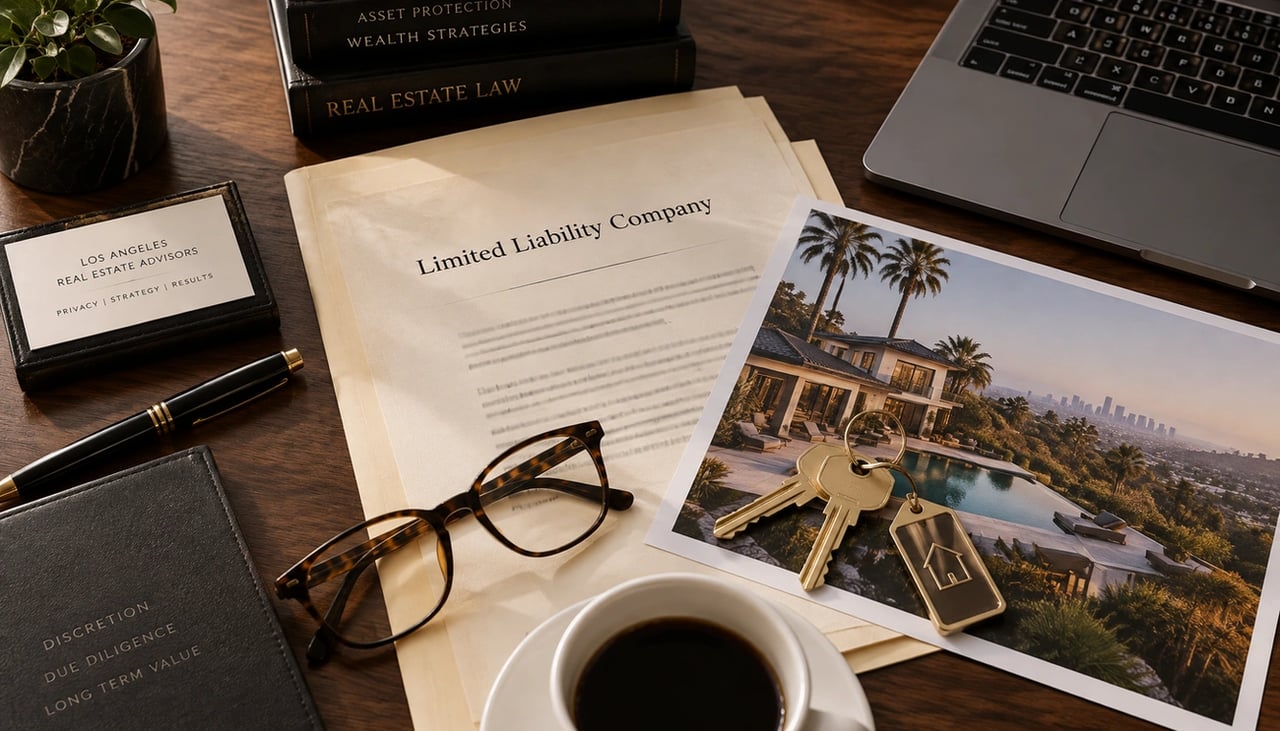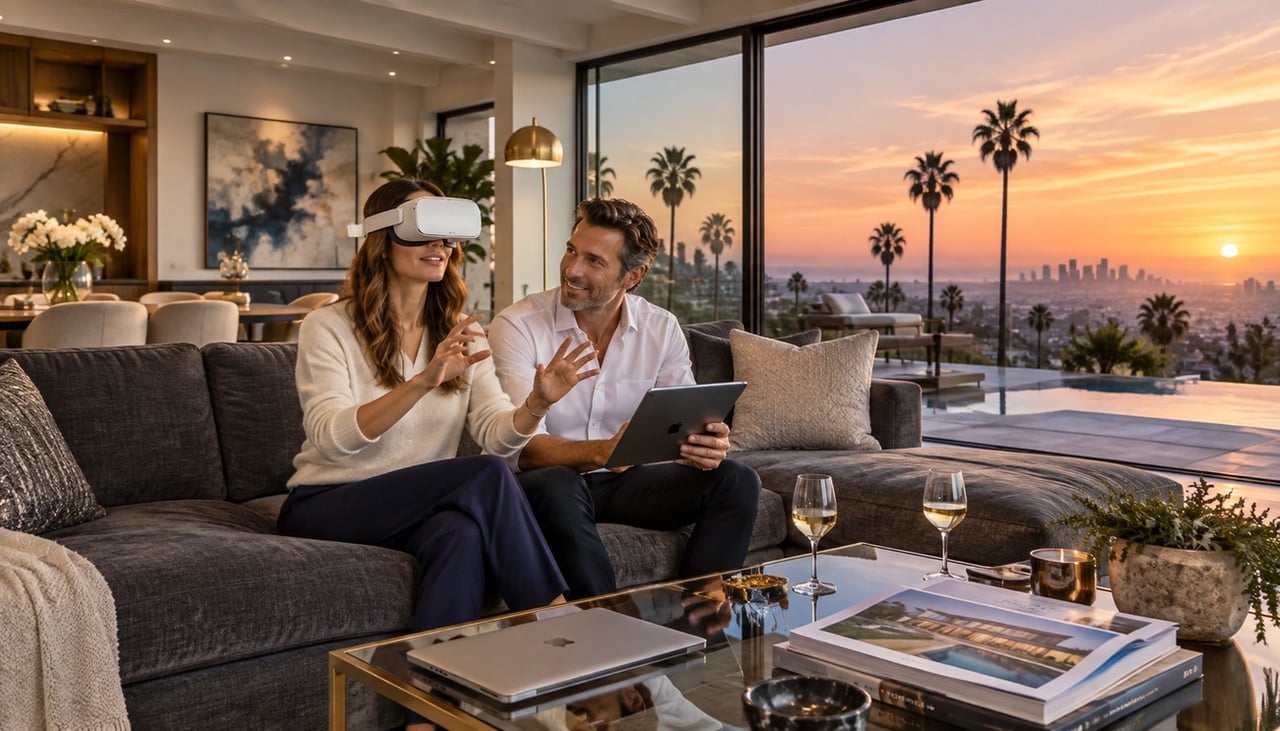
Virtual reality real estate is no longer a novelty — it has become a practical tool for luxury buyers shopping in the $1.5M to $20M-plus range. High-net-worth buyers can now preview properties privately and on their own schedule, without spending days on Los Angeles freeways just to see a home. International buyers and executives pressed for time can experience a property remotely with the same visual clarity they would have standing inside it. Hardware now runs at roughly five hundred dollars, and professional capture systems can resolve fine architectural details with precision. What follows covers how virtual reality is reshaping the luxury buying experience, what sellers should understand about virtual reality real estate marketing, and the practical considerations that apply to both sides of the transaction.
The Current State of Virtual Reality in Real Estate Industry
"Instead of trying to imagine their dream home from a two-dimensional floor plan drawing, virtual reality lets real estate buyers experience the property from every vantage point, inside and out." — Dogu Taskiran, CEO of Stambol Studios
Hardware and Software Accessibility in 2026
The global virtual reality in real estate industry reached approximately $1.21 billion in 2026 and is projected to reach $3.03 billion by 2035, growing at a 10% compound annual growth rate. Much of that momentum comes from hardware and software ecosystems that have finally standardized, removing the friction that once limited adoption. WebXR-based platforms now place buyers inside immersive property environments directly through a browser, with no proprietary application required. The Meta Quest 4 and Apple Vision Pro 2 lead current market share and have established the interoperability standards that professional brokerages rely on to deliver virtual reality tours real estate.
Worth noting: 70 percent of potential buyers access these tours through smartphone browsers rather than dedicated headsets. This has pushed developers to prioritize fast-loading, compressed assets that perform well on 5G networks — load times exceeding 2.5 seconds result in measurable drops in buyer engagement and listing page performance.
Quality Standards for Luxury Properties
Luxury real estate demands more than a basic 360-degree spin. Professional virtual reality real estate marketing calls for LiDAR-assisted spatial capture — using both mobile devices and terrestrial laser scanners — to achieve sub-centimeter accuracy in volumetric mapping. Photorealistic rendering through Unreal Engine 5.4 or higher ensures that light behaves naturally as a buyer moves through a space, and frame rates must hold at a minimum of 90 FPS to keep the experience comfortable for headset users.
For properties with fine finishes and premium architectural details, 4K+ resolution is the standard. Production costs scale accordingly: basic walkthroughs begin at $250, while fully interactive, high-fidelity models for luxury estates run beyond $2,500.
Integration with Traditional Marketing
Virtual reality does not replace the in-person showing — it sharpens the path toward it. Residential and commercial real estate listings that include video walkthroughs generate up to 49% more leads and draw four times the inquiries compared to photo-only listings. Properties with 3D virtual tours sell for up to 9% more and close up to 31% faster. For high-net-worth clients who expect discretion, the ability to privately preview a property before ever stepping through the door fits naturally into how they make decisions.
Virtual Reality Real Estate Marketing for Sellers
Expanding the Buyer Pool
Sellers who offer virtual tours open the door to qualified buyers who would otherwise never schedule an initial visit. A Beverly Hills property becomes fully accessible to buyers in New York, Miami, and international markets — buyers who can evaluate the home thoroughly before committing to cross-country travel. For distinctive properties with a narrow buyer profile, this reach is significant. An architectural estate that might appeal to only 30-40 local buyers could attract 300-400 buyers nationally through remote evaluation. In gateway cities like Los Angeles, virtual reality real estate marketing allows distant buyers to assess a property as thoroughly as a local buyer would, which tends to produce competitive offers rather than discounted bids rooted in limited exposure.
Production and Capture Coordination
Capture work begins only after professional staging is complete. Luxury properties are expected to meet five-star hotel standards of presentation before a single photograph or scan is taken. For typical homes in the 5,000-8,000 square foot range, Matterport Pro3 or comparable LiDAR scanning takes between two and four hours. Technicians move through each room methodically, scanning from multiple positions and capturing 4K photography alongside precise spatial measurements.
Cost Considerations and ROI
A complete virtual reality package priced between $8,500 and $25,000 amounts to just 0.06-0.17% of a $15 million property's value — a modest outlay when weighed against what the numbers show. Properties marketed with VR sell 28-42 days faster than comparable listings without it. On a $12 million property carrying $32,000 in monthly costs, shaving 35 days off the sale timeline saves roughly $37,000 in holding costs alone. VR-marketed luxury properties also average 2.8-4.3% above asking price, while comparable non-VR listings tend to close at 1.2% below.
For buyers who love to entertain, the right home makes all the difference. Whether beginning a search or ready to move forward, Christina Pope (310) 404-9931 would be delighted to help identify spaces built for elevated living and effortless hosting.
Signaling Property Value
A professionally produced virtual tour does more than showcase a home — it signals that the seller takes the property seriously. Listings with virtual tours receive 87% more views than those without, and that visibility alone sets a property apart from competitors still relying on static images.
The Virtual Reality Preview Process
"Buying a home after a virtual tour can work well, but it depends on how much risk you're willing to take and the precautions you put in place." — Investropa, Real Estate Expert

Image Source: Dreamstime
Initial Property Screening
The process starts simply — buyers pull up web-based 3D tours through a standard browser or a dedicated VR application. From there, each property gets evaluated on layout, spatial dimensions, and whether the features align with what the buyer actually wants. International investors and those relocating from other cities find this especially useful, as they can assess a home thoroughly without the expense of travel.
Office-Based Tour Sessions
Buyers who are seriously interested schedule time at brokerage offices equipped with Meta Quest or comparable headsets. A single afternoon session can cover 50 or more properties, narrowing a long list down to genuine contenders. The spatial understanding a headset provides is something flat photography simply cannot replicate.
Remote Preview Logistics
Out-of-state and international buyers work through guided virtual tours over video conferencing platforms. Agents walk through the property live while buyers navigate the shared 3D model independently — questions about specific features get answered in the moment, without scheduling a flight.
Follow-Up and Property Shortlisting
Virtual tours do the heavy lifting of pre-screening. Buyers can shortlist properties on far more than photographs and written descriptions, ruling homes in or out without setting foot on a plane or sitting in traffic.
Scheduling In-Person Confirmations
Physical viewings are reserved for properties that have cleared every virtual screening criteria. When a buyer follows up after a virtual tour, agents already know they are working with genuine purchase intent.
Practical Considerations for Virtual Reality Tours Real Estate
Technology Requirements
The hardware range for VR capture is wide enough to suit different budgets and goals. DIY capture uses cameras ranging from the Insta360 X4 at $500 to the Ricoh Theta Z1 at $1,000, plus a sturdy tripod around $100. Matterport Pro3 systems cost approximately $5,400 for professional-grade results. Hosting fees vary as well: BoxBrownie starts at $16 per tour, while Matterport charges $69 monthly for up to 20 virtual tours.
Connectivity matters just as much as the equipment itself. High-quality virtual reality real estate sessions require sustained bandwidth of 100 Mbps or higher, and latency must stay below 20 milliseconds for a comfortable headset experience — anything beyond 40 milliseconds causes disorientation. Fiber optic connections remain the most reliable option for both capturing content and delivering it to viewers.
Time Investment per Property
Professional scanning typically takes one to two hours depending on property size. For those handling the process themselves, processing and uploading adds another two to three hours. Professional services generally deliver finished tours within 24 to 48 hours after the capture session — a reasonable turnaround given what the finished product accomplishes for a listing.
Legal and Compliance Aspects
Virtual tours do not always capture every property defect, so sellers are well advised to document and disclose known issues clearly to avoid misrepresentation claims. NAR guidelines require disclosure whenever visualizations include virtual staging, and MLS compliance prohibits contact information, branding, or promotional content within the tour itself.
Neighborhood blurbs
Bel Air. In Bel Air, discretion is part of the experience, and virtual tours fit it well. Buyers can use a 3D or 360-degree tour as a first filter, exploring a property privately and at their own pace before asking for in-person access. Christina Pope, Senior Global Real Estate Advisor (CA DRE# 02022142), advises using that preview to shortlist, then saving in-person visits for the homes that truly earn them. Some things, like finish quality and the feel of the grounds, are best confirmed on site. Bel Air guide →
Beverly Hills. Beverly Hills draws buyers from around the world, and a July 2026 market report put international buyer searches at 18.2% of luxury inquiries. For someone viewing from another time zone, a virtual tour turns a long-haul flight into a first look over coffee. Christina Pope, who has deep international experience in the Dubai luxury market, advises remote buyers to tour virtually, then pair a short in-person visit with a licensed advisor on each side of any cross-border move. Beverly Hills guide →
Hollywood Hills. Hollywood Hills homes are bought for views and architecture, which is exactly what immersive tours do well. Buyers use them to check layout, room connections, scale, and whether the view lines up with the living spaces. Christina Pope advises treating the tour as a design tool: measure, compare, and show it to your architect or designer. Light, acoustics, and the drive up the hill still need a real visit before you commit. Hollywood Hills guide →
Brentwood. Brentwood buyers often want to weigh a home's flow before they step inside, and tours make that easy to do together. Buyers commonly share tour links with partners, advisors, and designers, and return to them several times before making contact. One article citing industry sources says agents report fewer unproductive showings when 3D tours are used, though the figure is directional. Christina Pope advises building a short list virtually and spending real showing time on the best candidates. Brentwood guide →
Pacific Palisades. Pacific Palisades is in a rebuilding chapter, and virtual reality has a natural role there. Walkthroughs let buyers experience a planned or newly built home before it is finished and pressure-test layouts before construction details are locked. Christina Pope helps clients think through what to ask for in renderings and tours, and then to confirm the finished home against the plans in person. Pacific Palisades guide →
Hidden Hills. Hidden Hills is a lighter fit for headset-first shopping, because what defines it is land: gated, generous lots whose scale and setting are best judged on site. Virtual tours still help with the house itself, especially room flow and floor plans, so buyers can narrow choices before visiting. Christina Pope advises using a tour to qualify a property, then walking the grounds in person to feel the privacy and space. Hidden Hills guide →
Malibu. Malibu is a place where the experience is as much about light, air, and sound as square footage, so it shows both the promise and the limits of virtual tours. A tour helps out-of-area buyers check layout and view alignment before they make the drive. Christina Pope advises confirming the ocean light, noise, and approach road in person, since industry commentary notes that acoustics and light are what tours cannot fully capture. Malibu guide →
Ready to preview your next home from anywhere? Reach Christina Pope through Contact or at 310.404.9931, request a Home Valuation, explore Relocation and Global Listings, read more on the Blog, or learn About Christina.
Conclusion
Virtual reality works best as a qualification tool — one that helps buyers shortlist properties with confidence and gives sellers access to qualified prospects who might never have scheduled an initial visit otherwise. Properties marketed with professional VR tours sell faster and command stronger prices, making the investment a sound one for luxury listings. The right home is worth finding carefully. Buyers ready to begin that search are welcome to reach out to Christina Pope at (310) 404-9931.
Key Takeaways
Virtual reality has transformed luxury real estate shopping in Los Angeles, evolving from a marketing gimmick into an essential tool for high-net-worth buyers in the $1.5M-$20M+ range. Here's what buyers and sellers need to know:
• VR dramatically accelerates the buying process: Buyers can preview 50+ properties in a single afternoon through immersive headsets, eliminating weeks of physical viewings and LA traffic navigation.
• Properties with VR tours sell faster and for more money: Listings featuring virtual tours sell 28-42 days faster, achieve 2.8-4.3% above asking price, and generate 87% more views than traditional listings.
• International and remote buyers gain equal access: Geographic barriers disappear as buyers from New York, Miami, and international markets can evaluate Beverly Hills properties as thoroughly as local buyers before traveling.
• Professional VR production delivers measurable ROI: Investment of $8,500-$25,000 (just 0.06-0.17% of a $15M property's value) saves approximately $37,000 in holding costs by reducing time-to-sale by 35 days.
• Technology requirements are now accessible: Entry-level VR hardware costs around $500, while professional-grade systems like Matterport Pro3 run approximately $5,400, with hosting fees starting at $16 per tour.
The bottom line: Virtual reality functions as a sophisticated qualification tool that expands buyer pools, reduces time-to-sale, and commands premium prices—making it essential for luxury real estate marketing in 2026 rather than optional.
FAQs
Q1. How much does it cost to create a professional virtual reality tour for a luxury property? Professional VR tour packages for luxury real estate typically range from $8,500 to $25,000 for complete production. Basic 360-degree walkthroughs start around $250, while fully interactive, high-fidelity models for luxury estates exceed $2,500. DIY options using cameras like the Insta360 X4 cost approximately $500, while professional-grade Matterport Pro3 systems run about $5,400. Hosting fees vary from $16 per tour with BoxBrownie to $69 monthly for up to 20 tours with Matterport.
Q2. Do properties with virtual reality tours actually sell faster than traditional listings? Yes, properties marketed with VR tours sell significantly faster than comparable non-VR listings. On average, VR-marketed luxury properties sell 28-42 days faster and achieve 2.8-4.3% above asking price, compared to 1.2% below asking for traditional listings. Additionally, listings with virtual tours receive 87% more views and generate up to 49% more leads than properties relying solely on static images.
Q3. What technology do I need to view virtual reality real estate tours? You have multiple options for viewing VR real estate tours. The most accessible method is through smartphone-based web browsers, which 70% of potential buyers use. For immersive experiences, standalone headsets like Meta Quest 4 or Apple Vision Pro 2 are popular choices, with entry-level VR hardware costing around $500. WebXR-based platforms now allow direct browser access without downloading special applications. For optimal performance, you'll need internet bandwidth of at least 100 Mbps.
Q4. Can international buyers purchase luxury homes using only virtual reality tours? While virtual reality tours enable international buyers to thoroughly evaluate properties remotely, they primarily serve as a sophisticated screening tool rather than a complete replacement for in-person visits. VR allows buyers from anywhere in the world to assess properties as comprehensively as local buyers, narrowing down options efficiently. However, serious buyers typically schedule physical viewings for their shortlisted properties to confirm details and ensure the home meets all expectations before making final purchase decisions.
Q5. How long does it take to create a virtual reality tour of a luxury home? The timeline varies depending on the approach. Professional scanning of a typical 5,000-8,000 square foot luxury home takes 2-4 hours for capture. Processing and uploading add another 2-3 hours for DIY approaches, while professional services typically deliver finished tours within 24-48 hours after capture. The entire process from staging to final delivery usually takes 2-3 days when working with professional providers.