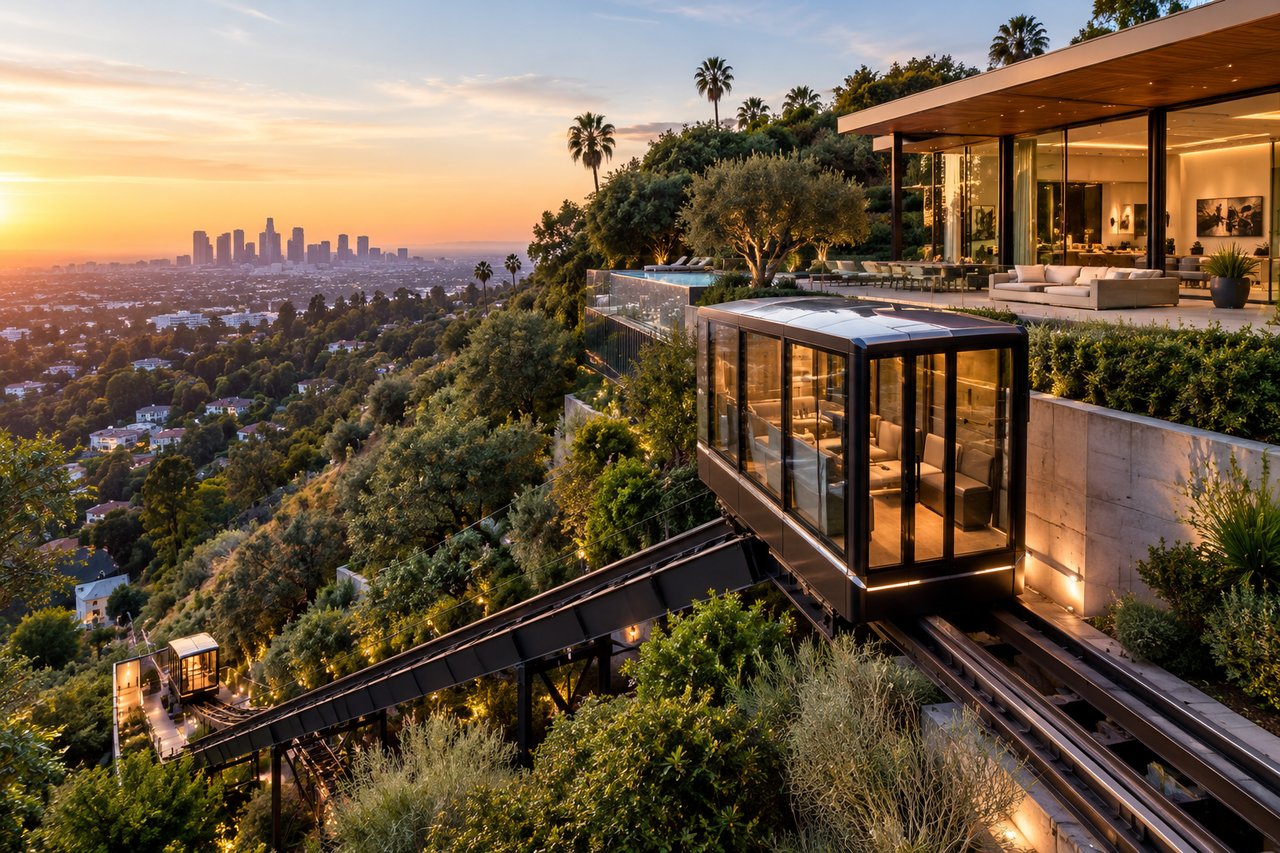
Luxury real estate in Los Angeles moves through private conversations, not public listings—and private funicular systems have quietly become a hallmark of Hollywood Hills properties where steep terrain and exclusivity meet. These cable-driven systems do more than solve an access problem. They signal the kind of discretion that the city's most sought-after homes are known for. A Californian mountain residence listed at $3.295 million comes with cable car access from the hillside base, while expansive estates of 7,200 square feet treat funicular transportation as a standard feature. For buyers who value privacy and careful positioning, these installations carry a significance well beyond convenience—reflecting how elite properties reconcile seclusion with day-to-day functionality, particularly where conventional access simply falls short.
The Rise of Private Transportation Systems in Luxury Real Estate
"For 90% of steep Pacific Northwest waterfront properties, cable lifts are the superior long-term solution." — High Bank Elevators, Manufacturer of residential cable lift systems
What public listings rarely reveal is how much private transportation infrastructure shapes the value of hillside properties. Wellington, New Zealand already demonstrates this at scale—152 private cable cars serving a city of just 215,000 residents. Where accessible sites grow scarce, these systems stop being amenities and start becoming genuine determinants of property value.
Marin County agent Camara Scremin, who has sold hundreds of Sausalito homes over the past decade, confirms funiculars come up regularly in hillside transactions. "Our hillside terrain effectively requires them when people don't want many, many steps up to their front door from the street or garage," Scremin noted. The numbers back this up: an $8 million California Craftsman estate features a four-person hillavator rated at 1,100 pounds, and a San Diego property puts a funicular to work across 62 steps, delivering residents straight to the entrance.
Installation costs range from $150,000 to $200,000 depending on terrain, with annual maintenance sitting around $850 for warrant of fitness checks. Much of the demand comes from buyers planning to age in place—and notably, nearly all of Sausalito's installations were added well after original construction. That tells its own story. When the alternative is an inaccessible hillside lot, a cable system stops looking like an indulgence and starts looking like a sound decision.
Christina Pope—Sotheby's International Realty, EliteResidenceInternational.com
Architectural and Practical Considerations for Funicular Installation
"We are fortunate to have clients who purchase land on hillsides and want to capture the views and maximize the context." — Michael Mills, Principal Architect with The Mills Group
"We are fortunate to have clients who purchase land on hillsides and want to capture the views and maximize the context." — Michael Mills, Principal Architect with The Mills Group
Route selection is where a private funicular either earns its place or creates new complications. Departure and arrival points must simplify the full journey—not merely the cabin ride itself—without introducing awkward thresholds at either end. Route length, gradient changes, station placement, and construction access each shift the engineering requirements in meaningful ways. Exterior installations also contend with rain, salt air, sun, wind, frost, and drainage—conditions that interior systems never face. Before dimensions enter the conversation, practical parameters must already account for residents, regular visitors, luggage, and how frequently the system will be in use.
Architectural integration reaches further than most buyers anticipate. Retaining structures, terraces, and pedestrian circulation all factor into how a funicular sits within a property. Where stations meet facades, waterproofing, thermal continuity, and precise door threshold tolerances become non-negotiable. Coordinated drawings shared between the installation supplier and the building envelope contractor prevent costly conflicts at those boundaries. Treating the station as a small pavilion in its own right—rather than something to conceal after the fact—consistently produces cleaner, more cohesive results.
Soil conditions shape both the method and the final cost. Engineered pin pile systems handle most installations, while rock anchors or cement footings become necessary in specific terrain. All private funicular systems in North America must meet ASME A17.1 elevator safety standards. Building permits are standard, with certain jurisdictions calling for additional testing, engineering certifications, and particular equipment specifications. Every system is custom-engineered to its slope angle, run length, terrain, and local code requirements—there is no off-the-shelf solution for a hillside this particular.
Christina Pope—Sotheby's International Realty, EliteResidenceInternational.com
Accessing Off-Market Opportunities in Elite Los Angeles Real Estate
Elite real estate in Los Angeles runs on relationships, not open platforms. Nearly 25% of luxury deals now bypass the Multiple Listing Service entirely, creating a parallel market where access depends entirely on who you know. California sellers who go off-MLS leave approximately $30,000 per property on the table on average, yet discretion and strategic timing take precedence over maximum exposure for many at this level.
The mansion tax, introduced in April 2023, has added another layer of complexity—a 4% transfer tax on properties above $5 million and 5.5% on those above $10 million. On a $100 million estate, that obligation reaches $5.5 million, which makes pre-market positioning worth pursuing for buyers and sellers alike.
Christina Pope works across luxury and ultra-luxury real estate throughout Los Angeles, with a particular focus on clients managing cross-border investments between the United States and Dubai. Her years in Dubai's demanding luxury market gave her the discretion and market intelligence that clients at this level expect. That background is also what allows her to connect buyers with exceptional properties—many of which never surface publicly.
Ultra-luxury access typically calls for demonstrated net worth above $1 billion or the ability to close in cash. One leading Los Angeles firm alone holds $1.3 billion in unlisted inventory. Elite agent networks are the gatekeepers to this shadow market, and platforms such as Top Agent Network exist to allow the top 10% of agents to move these pre-market opportunities among trusted circles.
Christina Pope—Sotheby's International Realty, EliteResidenceInternational.com
Conclusion
Hillside properties with funicular access offer something that is genuinely rare in Los Angeles—terrain that could have been a limitation, turned into an asset. These systems reflect the same sensibility that defines how the city's finest homes are bought and sold: quietly, purposefully, and with the right people involved. For those who love to entertain and want a home designed for both beauty and ease, Christina Pope would be delighted to help. She brings the market knowledge, the relationships, and the discretion that properties of this caliber deserve. Reach her at 310-404-9931 or [email protected].
Christina Pope—Sotheby's International Realty, EliteResidenceInternational.com
Key Takeaways
Private funiculars are transforming luxury hillside real estate by solving accessibility challenges while maintaining the exclusivity that defines Hollywood Hills properties.
• Installation costs range from $150,000-$200,000 with annual maintenance around $850, making funiculars a practical necessity for steep terrain properties rather than mere luxury additions.
• Nearly 25% of luxury LA real estate transactions bypass public listings entirely, creating a shadow market where relationships and discretion determine access to elite properties.
• Funicular systems must meet ASME A17.1 safety standards and require custom engineering based on slope angle, soil conditions, and local codes—making early architectural integration essential.
• Wellington, New Zealand has 152 private cable cars for 215,000 residents, demonstrating how hillside scarcity drives specialized transportation solutions beyond California markets.
• LA's mansion tax adds 4-5.5% to high-end sales, making pre-market positioning and off-market transactions increasingly valuable for properties exceeding $5-10 million.
These installations reflect a fundamental shift in how elite buyers balance seclusion with functionality, transforming inaccessible hillside terrain into premium real estate opportunities that rarely appear on public platforms.
FAQs
Q1. What is the typical cost to install a private funicular on a hillside property? Installation costs for private funicular systems typically range from $150,000 to $200,000, depending on terrain complexity, route length, and soil conditions. Annual maintenance adds approximately $850 for safety inspections and warrant of fitness checks. These costs vary based on slope angle, run length, and local building code requirements.
Q2. How do funiculars differ from traditional trams or cable cars? Funiculars are cable-driven transportation systems specifically designed for steep inclines, using counterbalanced cars on fixed tracks. Unlike trams that run on level streets or cable cars that hang from overhead cables, funiculars travel on rails along hillsides and are engineered for specific slope angles and terrain conditions at individual properties.
Q3. What safety standards apply to residential funicular installations? Private funicular systems in North America must meet ASME A17.1 elevator safety standards. Each installation requires custom engineering based on slope angle, terrain conditions, and local codes. Building permits are typically required, with some jurisdictions mandating additional testing, engineering certifications, and specific equipment specifications.
Q4. Why are funiculars becoming more common on luxury hillside properties? Funiculars address practical accessibility challenges on steep terrain while allowing homeowners to "age in place" without navigating extensive staircases. As accessible hillside sites become scarce in markets like Hollywood Hills and Marin County, these systems transform previously difficult properties into premium real estate, making them financial necessities rather than luxury additions.
Q5. What architectural considerations are essential when planning a funicular installation? Route selection must account for departure and arrival points, gradient changes, and construction access. Soil conditions determine whether pin pile systems, rock anchors, or cement footings are needed. Architectural integration requires coordination between the funicular supplier and building contractors to address waterproofing, thermal continuity, and door threshold tolerances at station contact points.