Luxury real estate in Los Angeles isn't driven by headlines. Private conversations and access at the right time shape it, and the plunge and sauna method brings that same discretion into the home. A 20-year study found that sauna users who bathed four to seven times a week had a 50% lower risk of fatal cardiovascular events than those who used a sauna once a week. Buyers who value privacy over shared spa access should understand how to use a sauna and cold plunge, then review the plunge and sauna method Miami services, photos, and reviews before investing in a wellness suite.
Why private wellness matters in Los Angeles luxury homes
Beverly Hills buyers rarely explain why they prefer a private sauna over a club membership. The answer lies in two connected areas: how people live at home and how properties change hands in this market without appearing on a public listing site.
Privacy and daily comfort beyond shared spa access
A membership at a wellness club such as Hume or Heimat still requires booking a time, sharing a steam room, and adjusting to someone else's schedule. Builders serving Bel Air, Brentwood, Beverly Hills, and Malibu now build full wellness suites, custom saunas, cold plunge areas, and steam showers into homes, so residents do not need to leave for this routine. Developers at 1010 N Alfred in West Hollywood installed a private cold plunge and infrared sauna on every penthouse terrace as standard equipment rather than an add-on. Each setup has dedicated 240-volt electrical circuits and outdoor-rated equipment for year-round use. A public studio such as the plunge and sauna method in Miami puts its services, photos, and reviews online for anyone considering membership. A private suite eliminates the waitlist and turns "how to sauna and cold plunge" into a daily habit rather than an appointment.
Why many most important transactions never reach the open market
The discretion behind private wellness choices also shapes how these homes are bought and sold. Industry estimates place off-market sales at 15 to 20 percent of Los Angeles properties, with deals moving through trusted relationships instead of public channels. Roughly 25 percent of ultra-luxury deals bypass the MLS entirely. Sellers pay a real price for that privacy. MLS-listed properties sell for about 13 percent more on average, while off-market homes trade for nearly 5,000 dollars less nationally. California sellers who skip the MLS lose closer to 30,000 dollars per property, which adds up to more than 1 billion dollars in lost value across two years. One leading Los Angeles firm still holds 1.3 billion dollars in unlisted inventory. The city's mansion tax, 4 percent above 5 million dollars and 5.5 percent above 10 million, also leads many sellers toward quiet negotiated deals rather than public exposure.
Why timing and strategic positioning matter to private buyers
Privacy at this level works in stages rather than as an all-or-nothing choice. A typical sequence runs:
- Confidential one-to-one outreach to a short list of qualified buyers.
- Expansion to a select group of trusted brokers.
- Limited private marketing to a wider but still curated audience.
- Full public listing, used only if earlier stages don't produce a match.
Each stage has a checkpoint, so sellers can respond to genuine buyer interest instead of guesswork. National Association of Realtors policy also permits office-exclusive listings, which keep a home in MLS records while withholding it from public marketing. Verification matters as much as timing. Proof of funds older than 30 to 60 days tells an agent little about a buyer's current position, so agents confirm funds directly with the issuing institution instead of relying on an emailed letter.
Local guidance: Christina Pope—Sotheby's International Realty, EliteResidenceInternational.com
Christina Pope, Senior Global Real Estate Advisor with Sotheby's International Realty's Brentwood Brokerage, ranks among the firm's Top 100 advisors and in Los Angeles' top 10. Before building her Los Angeles practice throughout Beverly Hills, Bel Air, Malibu, Brentwood, Hidden Hills, Pacific Palisades, and Hollywood Hills, she represented CEOs of major oil companies and fashion industry leaders in Dubai. Her closed sales include a 23,995,000-dollar purchase on Tigertail Road and a 19,995,000-dollar purchase on Tower Grove Drive. These transactions show that discretion and results can coexist in this market. Contact her at 310-404-9931 or through EliteResidenceInternational.com.
The plunge and sauna method: benefits, limits, and safe use
"Contrast therapy creates real physical stress on the body. That stress can lead to positive adaptations but it can also increase risk if someone isn't a good candidate or misuses them." — Mike Elliott, Senior director of Banner Sports Medicine High Performance Center
Homeowners researching a private wellness suite often find The Plunge and Sauna Method's Miami studio while comparing options. They should understand how that business is different from contrast therapy in general before approving a permanent installation.
Contrast therapy versus The Plunge and Sauna Method business
The Plunge and Sauna Method is a South Florida contrast therapy center, not a general term for hot-and-cold bathing. Its signature "METHOD" session combines sauna heat and cold-plunge cycles for twenty minutes. The combined session costs $45, while cold plunge alone and sauna alone each cost $30. The Plunge and Sauna Method's services, photos, and reviews show a commercial studio designed for walk-in clients. That layout serves a different purpose than a residential suite intended for one household's daily use. Contrast therapy is the broader clinical term for alternating heat and cold exposure, which causes blood vessels to dilate and constrict in cycles.
How to sauna and cold plunge: heat, cool, and rest
A standard sauna and cold-plunge protocol begins with ten to fifteen minutes of heat at 185 to 195 degrees Fahrenheit. Follow this with two to three minutes in cold water between 39 and 51 degrees, using slow nasal exhales to manage the initial shock. Rest for two to five minutes before repeating the cycle three to four times. Some practitioners extend the heat phase to fifteen to twenty minutes and the cold phase to ten to fifteen minutes. Ending on cold can increase alertness, while ending on heat may support sleep. Beginners should start with cold exposures of thirty to sixty seconds before building tolerance.
What sauna and cold immersion research supports separately
Frequent sauna bathing, with four to seven sessions each week, relates to sharply lower risks of dementia and Alzheimer's disease in Finnish cohort data. The risk reductions reached up to 66 percent and 65 percent, respectively, compared with sauna use once a week. Sauna combined with regular exercise lowered blood pressure by eight millimeters in a controlled trial. Separately, a meta-analysis of 3,177 participants found that cold-water immersion reduced stress twelve hours after exposure, improved sleep quality, and reduced sickness absence by 29 percent. Inflammation markers rose during the first hour after immersion, however.
Why added benefits from combining heat and cold remain uncertain
The strongest evidence for combining heat and cold comes from sports recovery. It may ease soreness and improve perceived recovery, but it does not establish long-term disease benefits. The "vascular pump" theory behind contrast therapy is plausible, though well-controlled trials have not confirmed it. Researchers examining Finnish sauna traditions note that few high-quality randomized studies assess combined protocols. A separate systematic review also identifies small sample sizes and short follow-up periods as limits on what cold-immersion research alone can show.
Who needs medical advice before trying heat and cold
People with heart disease, a history of arrhythmia, uncontrolled blood pressure, fainting episodes, or pregnancy should consult a doctor before starting. Medical advice is also appropriate for people managing diabetes, poor circulation, Raynaud's phenomenon, venous stasis, or cold agglutinin disease. Documented cases include fatal heart attacks after people moved directly from sauna heat into cold water. Most involved alcohol use or existing medical conditions. One hospitalization for heatstroke led to seizures and organ injury.
What a private wellness suite really costs
Pricing a home wellness suite starts with a simple question: is it better to pay per session at a Miami studio or own the equipment outright? The Plunge and Sauna Method charges $45 for a combined contrast session. That rate works for occasional visits, but costs can add up quickly compared with the one-time price of a private suite.
Equipment budgets: simple, premium, and custom suites
Los Angeles pricing falls into clear tiers:
Suite Tier | Equipment Cost |
|---|---|
Entry-level (cold plunge + portable sauna) | $5,000-$10,000 |
Mid-range (barrel sauna + custom plunge + shower) | $20,000-$35,000 |
Premium (custom sauna + plunge + lounge + shower) | $50,000-$80,000 |
A stock tank with a chiller costs $2,000-4,000, while a custom concrete cold plunge reaches $12,000-20,000. Sauna prices follow a similar range. A portable infrared unit costs $1,500-3,500, while a custom-built room runs $18,000-35,000. Adding a cold zone to an existing pool raises that project’s cost by $8,000-15,000.
Installed costs: electrical work, plumbing, site prep, and delivery
Site prep adds separate costs. A concrete slab runs $240-400, a gravel pad costs $400-1,200, and electrical trenching ranges from $500-2,500. Older homes may also need an electrical panel upgrade that costs $500-2,000 and ventilation work that ranges from $250-1,500. Licensed labor can raise the total quickly. Carpenters charge $45-120 per hour, and electricians charge $50-130 per hour. Together, labor accounts for 30 to 50 percent of total installation costs.
Delivery and assembly also add fees. Sauna delivery alone costs $250-999 based on distance. Third-party installers such as HandyBuddy start at $285.95 before anchoring or hauling fees. A dedicated 240V circuit usually costs $200-600.
Ownership costs: energy, water care, service, and replacement parts
Monthly sauna operating costs run $20-60, while a cold plunge chiller adds $30-80. Chemicals and minor repairs add $200-500 per year. A typical chiller that draws 750 watts for six hours a day, along with a continuous 60-watt pump, costs about $28.51 per month at $0.16 per kWh.
On-demand chillers run briefly before use and cost nowhere near as much over time as continuous systems. Over five years, they cost roughly $300-600 compared with $2,000-4,000 for continuous systems. Sauna upkeep includes a $149 professional tune-up, a $249 deep clean, and repair calls that start at $170 plus $185 per hour. Annual maintenance averages $150-350 nationwide.
What a well-designed wellness suite needs

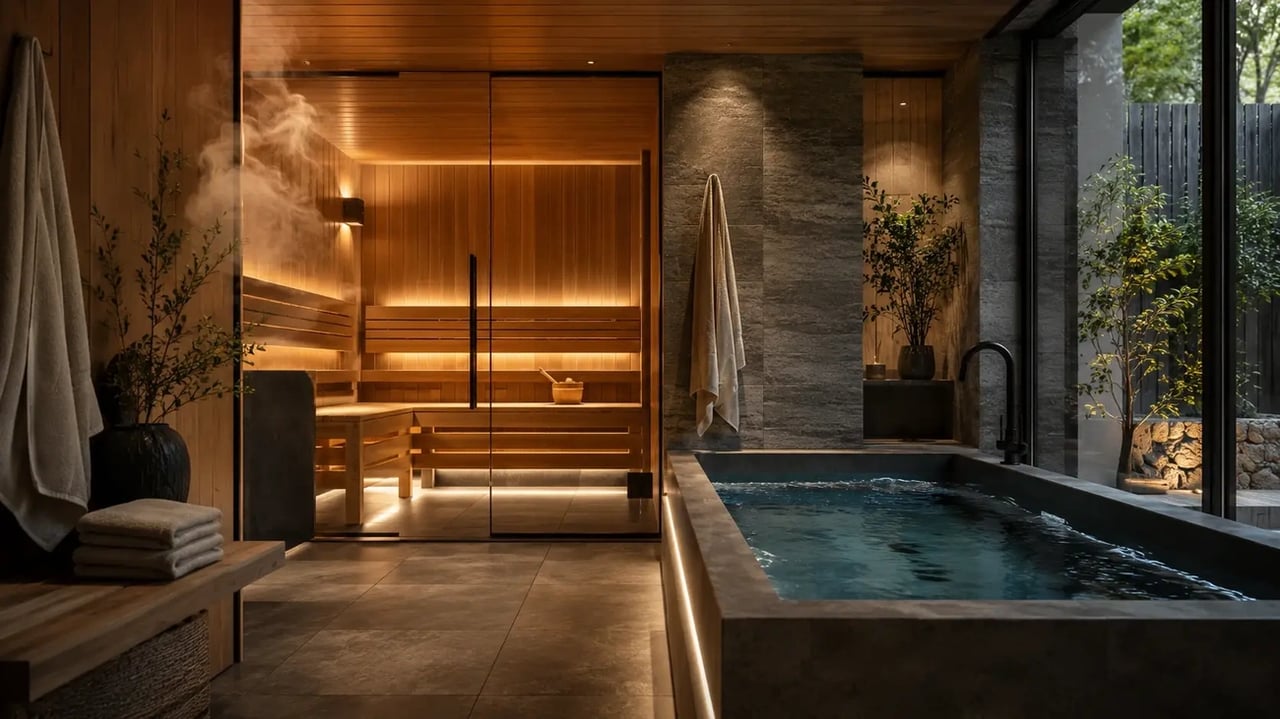
Image Source: Sauna & Steam Center
A wellness suite works only if its design fits the way a household moves through the day, and location is the first consideration.
Indoor versus outdoor layouts for Los Angeles homes
Southern California's climate, with more than 280 sunny days each year, supports outdoor builds that work well with a pool, cold plunge, or outdoor shower. Indoor suites offer year-round access without weather exposure, but the room needs ventilation and moisture barriers from the start rather than as later additions.
Safe routes between the sauna, plunge, shower, and rest area
The route between stations should be short, ideally 10 to 20 steps. More than 30 seconds of walking in open air reduces the contrast between heat and cold. Level, non-slip surfaces, a rinse point along the route, and a dedicated area where residents can rest 5 to 10 minutes between rounds make the routine easier to maintain.
Floor strength, waterproofing, drainage, and ventilation
A filled cold plunge can weigh more than 1,000 pounds over a small footprint, so floor framing is a structural concern rather than a finishing detail. A floor drain, sloped membrane, and continuous exhaust above the code minimum of 50 cubic feet per minute intermittent or 20 continuous prevent moisture from settling into walls and subfloors.
Sauna type, plunge insulation, and climate-matched chiller capacity
Traditional saunas operate at 150 to 195°F on a dedicated circuit, while infrared units run at lower temperatures and often require less power. Chiller capacity depends on tub volume. A well-insulated 80- to 120-gallon indoor tub typically needs about 1/3 to 1/2 HP, while larger or outdoor tubs may require 3/4 to 1 HP. Insulation can reduce the required chiller capacity by 30 to 50 percent.
Permits, electrical safety, noise, and neighbor privacy
Hardwired saunas and plunge chillers typically require electrical permits connected to dedicated circuits, while outdoor structures also need zoning and setback review. Screening or landscaping can block views from neighboring properties without closing off the space.
How to judge the investment before making an offer
"The best way to avoid negative equity is to buy a home not based on the idea that prices will always go up. Buyers should consider affordability of the property, true market value of the property, and long-term financial picture when buying rather than just purchasing at their maximum amount approved by the lender." — Matt Brown, Real estate agent at Matt Brown Real Estate
Treat this decision like any off-market acquisition: verify and compare the details before committing to a permanent suite.
Test the routine before paying for a permanent suite
Buyers who are unsure about daily use should start small. A sauna bought first often sees more use during the first month and retains value better than a bundled setup purchased before the habit takes hold. Buyers with budgets below roughly $5,000 or no clear plunge location gain little by committing to a full package early.
Compare cost per use with private club and spa access
A quality home sauna used over 20 years can cost less per session than a gym membership, with electricity costing about $1.00 per use.
Inspect service records, warranties, and permit history
Plunge's sauna warranty covers components for 2 years from delivery. The warranty becomes void if the installation lacks a dedicated circuit or does not meet installation requirements. Commercial cold plunges require documented water chemistry logs that California standards require operators to retain for one to three years. Federal law has required compliant drain covers since 2008.
Separate personal wellness value from uncertain resale value
Daily comfort and buyer appeal do not always align, so assess each independently.
Choose between an existing suite and a planned update
Paired equipment orders can save roughly $500 to $3,000 through shared freight and a single electrical visit. Those savings fall well below the up to $6,000 that some sellers advertise.
Private Wellness Suites in Luxury Homes: Neighborhood Blurbs
Bel Air
Bel Air estates often have the space and seclusion to build a private wellness suite, and the best ones are planned as part of the architecture. Christina Pope advises buyers to look at how a sauna, cold plunge, shower, and rest area would flow together, and whether the home has the electrical capacity, drainage, and ventilation to support them. Ask for permits and service records on any existing equipment. A suite you use daily is worth more than one that looks good in photographs. Bel Air guide →
Beverly Hills
For some Beverly Hills buyers, a private wellness suite means skipping the booking and the shared room. Christina Pope, with deep international experience in the Dubai luxury market, advises treating one the way you would any significant amenity: check structural support for a filled plunge, waterproofing, dedicated circuits, and neighbor privacy, then budget for installation and upkeep, not just equipment. Anyone with a health condition should talk with a doctor before using a sauna or cold plunge. Beverly Hills guide →
Hollywood Hills
Hollywood Hills homes pair views with outdoor living, so a terrace sauna and plunge can feel like a natural fit. The honest pivot is that hillside sites bring their own limits: weight on decks, drainage, access for delivery, and setbacks. Christina Pope advises buyers to confirm with a qualified professional that a location can carry the load and meet permit requirements. Where the site works, the view comes with the routine. Hollywood Hills guide →
Brentwood
Brentwood homes can offer calm, well-proportioned spaces for an indoor wellness suite, where ventilation and moisture control should be planned from the start. Christina Pope advises buyers to check the route between stations, the surfaces underfoot, and where a rest area would sit. If a suite already exists, request permits, warranty information, and service records. Starting with a simple setup and building up is also a reasonable way to see whether the routine sticks. Brentwood guide →
Pacific Palisades
For Pacific Palisades buyers who are rebuilding or renovating, a wellness suite can be designed into the plan: dedicated circuits, drainage, structural support, and ventilation are easier to include than to add later. That depends on each property’s permits and timeline, so Christina Pope advises bringing an architect and contractor in early. Planning the suite alongside the rest of the build keeps the budget honest. Pacific Palisades guide →
Hidden Hills
Hidden Hills lots can be generous, and some leave room for an outdoor wellness area beside a pool or a guest house. The honest pivot is that community guidelines and city approvals apply, so buyers should confirm what is permitted and what requires approval before planning. Christina Pope advises reviewing association documents early, along with electrical capacity and screening for neighbors’ sightlines. With the approvals in place, a private suite is an easy addition to daily life. Hidden Hills guide →
Malibu
Malibu’s coastal setting makes outdoor wellness spaces appealing, and coastal conditions call for good planning: moisture, salt air, wind, and permit rules all matter. Christina Pope advises buyers to confirm structural support, drainage, and weather-rated equipment, and to check setbacks and approvals for outdoor structures. Buyers should also weigh how much they will use it, since a suite is a daily-life choice more than a resale feature. Malibu guide →
Looking for a home with room for a private wellness suite? Christina Pope, Senior Global Real Estate Advisor (CA DRE# 02022142), can be reached at 310.404.9931 or through Contact. Explore Global Listings, request a Home Valuation, see Relocation support, read the Blog, or learn more About Christina.
Conclusion
These points show that a private wellness suite rewards buyers who plan ahead instead of chasing trends. Equipment tiers and installation costs matter, as do ongoing ownership expenses. The design should also fit daily habits and household routines. Contrast therapy has documented benefits when people use saunas and cold immersion separately. Combined protocols still lack strong clinical evidence, so people with existing health concerns should remain cautious. Discretion also shapes how these homes sell, and many of Los Angeles's most important transactions close quietly before they reach public listings. People who enjoy entertaining know that the right home can make all the difference. Buyers ready to start their search can contact Christina Pope at 310-404-9931 or [email protected] to get precise, trusted guidance.
Key Takeaways
A private wellness suite can elevate daily living—but buyers should weigh health, design, operating costs, and resale value before committing.
Treat sauna and cold immersion as separate evidence-based practices; combined contrast therapy may aid recovery, but long-term health benefits remain unproven.
Prioritize safe, repeatable design: short non-slip routes, drainage, ventilation, structural support, dedicated circuits, and privacy screening make daily use practical.
Budget beyond equipment: complete suites range from $5,000 to $80,000, plus installation, utilities, water care, maintenance, permits, and eventual repairs.
Test your routine before building permanently. Start with a sauna or entry-level plunge, then compare ownership cost per use against private-club access.
Inspect warranties, service records, permits, and electrical capacity when buying an existing suite; value personal enjoyment separately from uncertain resale returns.
FAQs
Q1. What is the plunge and sauna method?
It involves alternating sauna heat with cold-water immersion and rest. Also called contrast therapy, it may help with soreness and recovery, but its long-term benefits beyond either practice alone remain uncertain.
Q2. How much does a home sauna and cold plunge suite cost?
Equipment typically ranges from $5,000–$10,000 for an entry-level setup to $50,000–$80,000 for a premium suite. Installation, electrical work, plumbing, permits, and ongoing maintenance add to the total.
Q3. What should a well-designed private wellness suite include?
Look for short, non-slip paths between stations, a shower or rinse point, and a rest area. Proper drainage, waterproofing, ventilation, structural support, and suitable electrical circuits are also essential.
Q4. Who should seek medical advice before using a sauna and cold plunge?
People with heart disease, irregular heart rhythms, uncontrolled blood pressure, fainting history, diabetes, or circulation problems should consult a doctor first. Pregnant people should also seek medical advice before starting.
Q5. Is a private wellness suite a worthwhile investment for a luxury home?
It can offer privacy and convenience if used regularly, but increased resale value is not guaranteed. Try the routine first, compare ownership costs with spa access, and check permits, warranties, and service records before buying.