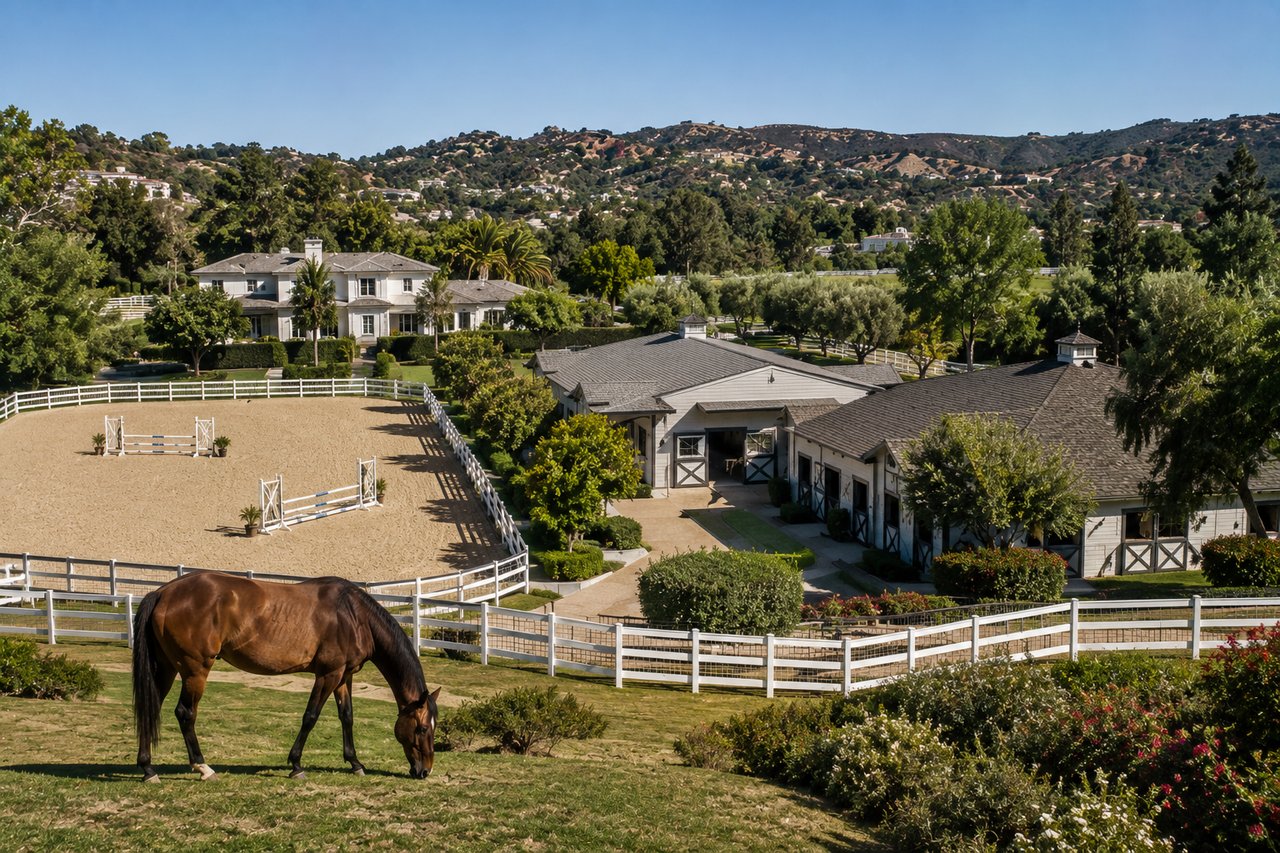
The question of how many acres does a horse need takes on different meaning in luxury equestrian markets, where property decisions are shaped by community rules and privacy rather than baseline animal welfare standards. Hidden Hills exemplifies this dynamic. Horses can thrive on nowhere near as much land. Yet this guard-gated enclave enforces a strict one-acre minimum building-site rule that preserves its estate character and influences what buyers pay. The community maintains exclusivity through density control with approximately 648 home sites and a population of about 1,725. So prospective residents face a significant calculus: understanding how much acreage does a horse need versus what Hidden Hills requires, where can you keep a horse within premium communities, and how these best places to live with horses compare to affordable equestrian communities elsewhere.
How Many Acres Does a Horse Need: The Essential Requirements
Grazing requirements establish baseline land needs. Open pasture dedicated to forage production demands between 1.5 and 2 acres per horse. Two acres per horse reduces hay dependency during growing seasons. This acreage excludes barns, arenas and structures.
Pastures smaller than one acre per horse fail to meet ideal standards. Pennsylvania stocking rates reflect regional variations and recommend one horse per 2 to 3 acres. Geographic location, soil composition, rainfall patterns and management practices alter these calculations substantially.
Exercise areas function separately from grazing land. Minimum exercise space requirements call for one-tenth of an acre, approximately 4,500 square feet per horse. Rectangular configurations encourage natural movement patterns. Irregular shapes limit activity and increase injury risk.
Dry lots serve distinct purposes in horse management. These non-grazing areas require at least 400 square feet per average 1,100-pound horse, excluding space for shelters, feeders and water sources. Larger allocations improve herd dynamics and encourage movement.
The one-acre-per-horse guideline persists as a starting reference point. But this formula oversimplifies land capacity decisions. Soil ratings, vegetative cover maintenance, rotational grazing systems and manure management practices determine actual carrying capacity more accurately than fixed acreage ratios.
Hidden Hills Property Rules and the One-Acre Minimum
"The biggest mistake I see: buyers assume that because the land is zoned A-1 or RR, they can keep however many horses they want. That is rarely true." — Justin Borges, Equestrian Specialist, Real Estate Agent
Luxury real estate operates differently in Hidden Hills, where property rules shape value through discretion rather than visibility. The most strategic acquisitions unfold within trusted circles, where timing and precision matter more than public listings. Christina Pope at Sotheby's International Realty (EliteResidenceInternational.com) understands this dynamic.
Hidden Hills enforces a one-acre minimum building-site rule that preserves estate character and controls density. The smallest allowable lot size in the R-1 zone measures 20,000 square feet, though most parcels reach at least one acre. This regulatory floor answers how many acres for a horse differently than biological minimums suggest.
Governance operates through dual authority. City government handles municipal services and permits. The Hidden Hills Community Association (HHCA) manages private roads, gates, equestrian common areas and enforces CC&Rs and architectural standards. Any exterior change requires Architectural Committee approval—work on dwellings, garages, stables, pools, tennis courts, fences and accessory buildings.
The CC&Rs do not publish a universal numeric cap on horses. Practical limits depend on lot size, site layout, HHCA rules and nuisance considerations. Mandatory equestrian zoning permits horses on every residential lot, establishing Hidden Hills among the best places to live with horses for those seeking gated privacy over affordable equestrian communities.
Hidden Hills Property Costs: What Buyers Actually Pay
Luxury real estate in Los Angeles operates through private conversations and precise timing rather than public visibility. The most important transactions unfold within trusted circles quietly, where discretion carries as much weight as value. Christina Pope at Sotheby's International Realty (EliteResidenceInternational.com) understands this dynamic. Precision matters more than headlines.
Current market data reveals the financial threshold for Hidden Hills entry. Properties near the community average USD 3,845,000 in listing price, with land costs reaching USD 1,787,125 per acre. The average parcel spans 2.2 acres. Baseline acquisitions push well above USD 4 million before improvements.
Closed transactions tell a different story. Hidden Hills recorded a median sale price of approximately USD 8.20M in May 2026 across 6-10 closings. Horse properties command USD 5M to USD 35M depending on acreage and equestrian infrastructure. Days on market average 65, the slowest pace in comparable communities. The narrow buyer pool at premium tiers drives this.
Annual carrying costs add obligations. HCA dues run USD 7,500 to USD 9,500 per year. Insurance totals USD 15,000 to USD 45,000+ on larger estates frequently. Active inventory maintains 18-30 listings typically.
The right home makes all the difference if you love to entertain. I'd be delighted to help you find spaces designed for refined living and effortless hosting if you're thinking over a purchase in the near future or beginning your search. Christina Pope 📞 310-404-9931 ✉️ [email protected]
Conclusion
Hidden Hills revolutionizes the question of how many acres a horse needs into a more complex calculation. Biological requirements suggest two acres per horse, yet regulatory minimums and actual acquisition costs tell different stories. Properties close at USD 8.2M median typically, with carrying costs exceeding USD 20,000 annually. Buyers face decisions shaped by community governance and market timing rather than acreage formulas alone.
Key Takeaways
Understanding how many acres a horse needs versus what luxury equestrian communities require reveals a significant gap between biological minimums and market realities.
• Horses need 1.5-2 acres for grazing per animal, plus separate exercise space of at least 4,500 square feet, though dry lots can function with just 400 square feet minimum.
• Hidden Hills enforces a one-acre minimum building site, but actual properties average 2.2 acres and sell for a median of $8.2M, with horse estates ranging $5M-$35M.
• Annual carrying costs exceed $20,000 including HOA dues ($7,500-$9,500) and insurance ($15,000-$45,000+), making Hidden Hills one of the most expensive equestrian communities.
• All exterior modifications require Architectural Committee approval, including barns, paddocks, and fences, adding regulatory complexity beyond simple acreage calculations.
• Strategic acquisitions happen through private networks rather than public listings, with properties averaging 65 days on market due to the exclusive buyer pool at premium price points.
The true cost of horse ownership in luxury markets extends far beyond minimum acreage requirements, encompassing community rules, infrastructure premiums, and ongoing expenses that can dwarf initial land costs.
FAQs
Q1. Is 2 acres enough land to keep horses at home? Two acres can technically accommodate horses, but it depends heavily on your climate, local zoning laws, and management practices. In dry climates where horses are hay-fed year-round, 2 acres may be sufficient for two horses with proper manure management and rotational turnout systems. However, in wetter regions, horses will quickly turn small pastures into mud, requiring additional space or sacrifice areas with proper drainage. You'll also need to account for structures like barns, storage, and your home, which reduce actual usable space for the animals.
Q2. How much does it cost monthly to keep a horse? Monthly horse expenses vary significantly based on whether you board or keep horses at home. Full-care boarding typically ranges from $600 to $2,500+ per month, covering stall, turnout, hay, grain, and daily care. At-home horse keeping involves different costs including hay and feed ($200-400/month), farrier visits every 6-8 weeks ($50-150), routine veterinary care, and property maintenance. In luxury equestrian communities, additional expenses like HOA dues and premium insurance can add thousands more annually.
Q3. Can you keep just one horse, or do they need companions? Horses are herd animals and generally should not be kept alone. They rely on other horses for mental well-being, proper sleep patterns, and natural social behaviors. A solitary horse may experience stress, difficulty resting, and behavioral issues. While some horses can bond with other animals like goats or donkeys, these companions cannot fully replace equine interaction or teach proper herd behavior. Most equestrian experts and animal welfare guidelines recommend keeping at least two horses together.
Q4. What's the minimum space requirement per horse for healthy living? The minimum space depends on whether you're providing pasture or dry lot accommodation. For grazing pasture, horses need 1.5 to 2 acres per animal to maintain healthy forage, though this varies by climate and soil quality. Dry lots (non-grazing areas) require a minimum of 400 square feet per horse, excluding space for shelters and feeders. Exercise areas should provide at least one-tenth of an acre (approximately 4,500 square feet) per horse. These measurements don't include barns, arenas, or other structures.
Q5. Do local zoning laws restrict how many horses you can keep on your property? Yes, local municipalities typically have specific regulations governing livestock on residential properties. Requirements vary widely by location—some areas mandate 5+ acres for the first horse, while others allow multiple horses per acre in agricultural zones. These laws often specify minimum distances from property lines, manure management requirements, and may distinguish between different property zones. Before acquiring horses, you should verify your county's zoning ordinances, as legal requirements often exceed the biological minimum space horses need and violations can result in fines or removal orders.