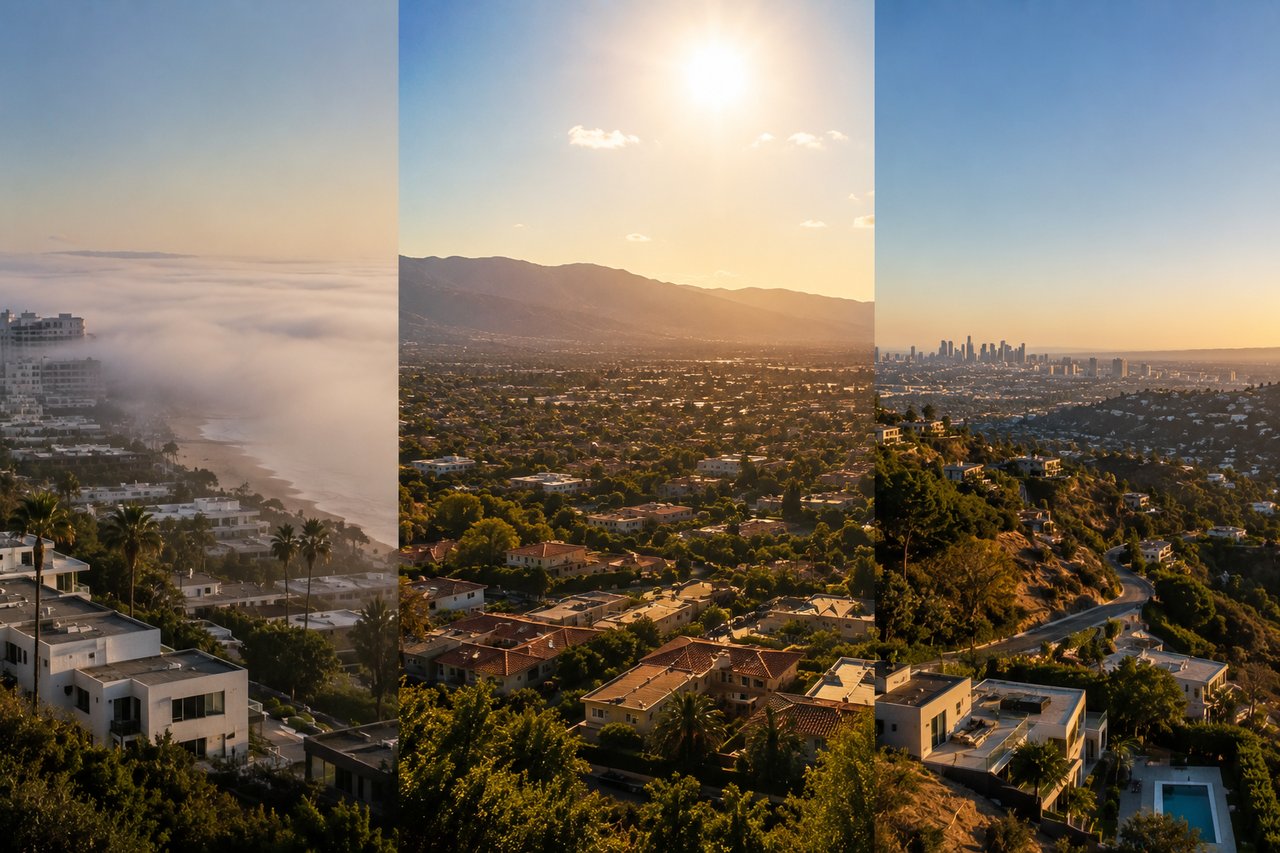
Most Miami buyers assume they already understand California weather: warm, sunny, beach-adjacent, more of the same climate they're leaving, just with better real estate tax treatment. Then they land for a June house-hunting trip, and Santa Monica is a damp 65 degrees under solid grey cloud cover until noon, while a listing twenty minutes away in Sherman Oaks is baking at 98. Same city, same day, a 30-degree swing.
Los Angeles isn't one climate. It's several, layered across a relatively small footprint by mountains, ocean currents, and elevation and which one sits outside your front door will shape your daily life at least as much as the house itself. For Miami buyers used to one climate story played out identically from Brickell to Coral Gables, this is the single biggest adjustment to plan for before choosing a neighborhood.
Forget "LA Weather" — Think in Microclimates
The mechanics are straightforward once you see them. The Santa Monica Mountains run east-west through the middle of Los Angeles, and they act as a wall: cool, moist ocean air piles up against the coastal side, while the inland side bakes under sun that never gets diluted by that marine influence. Drive from the coast to the San Fernando Valley and you can cross a 20-to-30-degree temperature swing in under twenty minutes on a summer day. That's not an exaggeration for a heat wave it's a fairly ordinary Tuesday in July.
For a Miami buyer, the closest useful comparison isn't "hot versus cool." It's humidity versus dryness. Miami's heat is consistent and tropical-humid nearly everywhere in the metro. Los Angeles' heat, wherever you land, is dry even a 95-degree Valley afternoon feels different on the skin than a 90-degree Miami one, because there's essentially no humidity to trap it against you. That single distinction changes how each LA microclimate should actually be evaluated.
The Westside: Marine Layer Living
What It Feels Like
Santa Monica, Venice, Pacific Palisades, and Brentwood sit under the direct influence of the Pacific, and in summer that means "June Gloom" a blanket of marine fog that rolls in overnight and typically burns off by midday, keeping mornings cool and grey well into what would be full sun inland. Summer highs here commonly run in the mid-70s to mid-80s, noticeably milder than the rest of the county, with year-round marine influence moderating both summer heat and winter chill.
Who Thrives Here
Buyers who want the most consistently mild year-round temperature range in Los Angeles and who don't mind grey mornings in exchange for it tend to gravitate to the Westside. It's the closest thing LA offers to "no real extremes," though newcomers from Miami sometimes find the overcast mornings genuinely surprising for a city with California's sunshine reputation. Older Westside homes were often built assuming the marine layer would do the cooling work, meaning some lack the central air conditioning a Miami buyer would consider non-negotiable worth checking directly rather than assuming.
The Valley: Dry Heat, Big Sky
What It Feels Like
Sherman Oaks, Encino, Calabasas, Woodland Hills, and Studio City sit on the inland side of the mountain wall, where the marine layer rarely reaches. The tradeoff for that sunnier, more consistent weather is real heat: summer highs regularly top 100 degrees, with some Valley communities among the hottest readings in the entire county during heat events, even as coastal areas twenty miles away stay in the 70s. Nights cool down more than Miami buyers might expect, thanks to low humidity, but daytime highs are genuinely intense for several months a year.
Who Thrives Here
Buyers who want bigger lots, more space per dollar, and near-guaranteed sunshine closer to the sun-drenched expectation many Miami buyers arrive with often find the Valley a better lifestyle match than the foggier Westside, provided they budget realistically for air conditioning and pool maintenance. It's also where a Miami buyer's existing intuition about heat translates most directly, just without the humidity.
The Hills: Above Both Systems
What It Feels Like
Elevated neighborhoods upper Bel Air, the Hollywood Hills, and hillside pockets of Beverly Hills occupy a middle zone that can sit above the thickest marine layer while staying below the Valley's full heat-island effect. Canyon orientation matters enormously here: some canyons trap cool, moist air and stay noticeably cooler and foggier than nearby ridgelines, while others open toward the Valley and run hotter. The result is genuinely hyperlocal two homes a quarter-mile apart in the hills can have meaningfully different daily conditions depending on which way the canyon faces.
Who Thrives Here
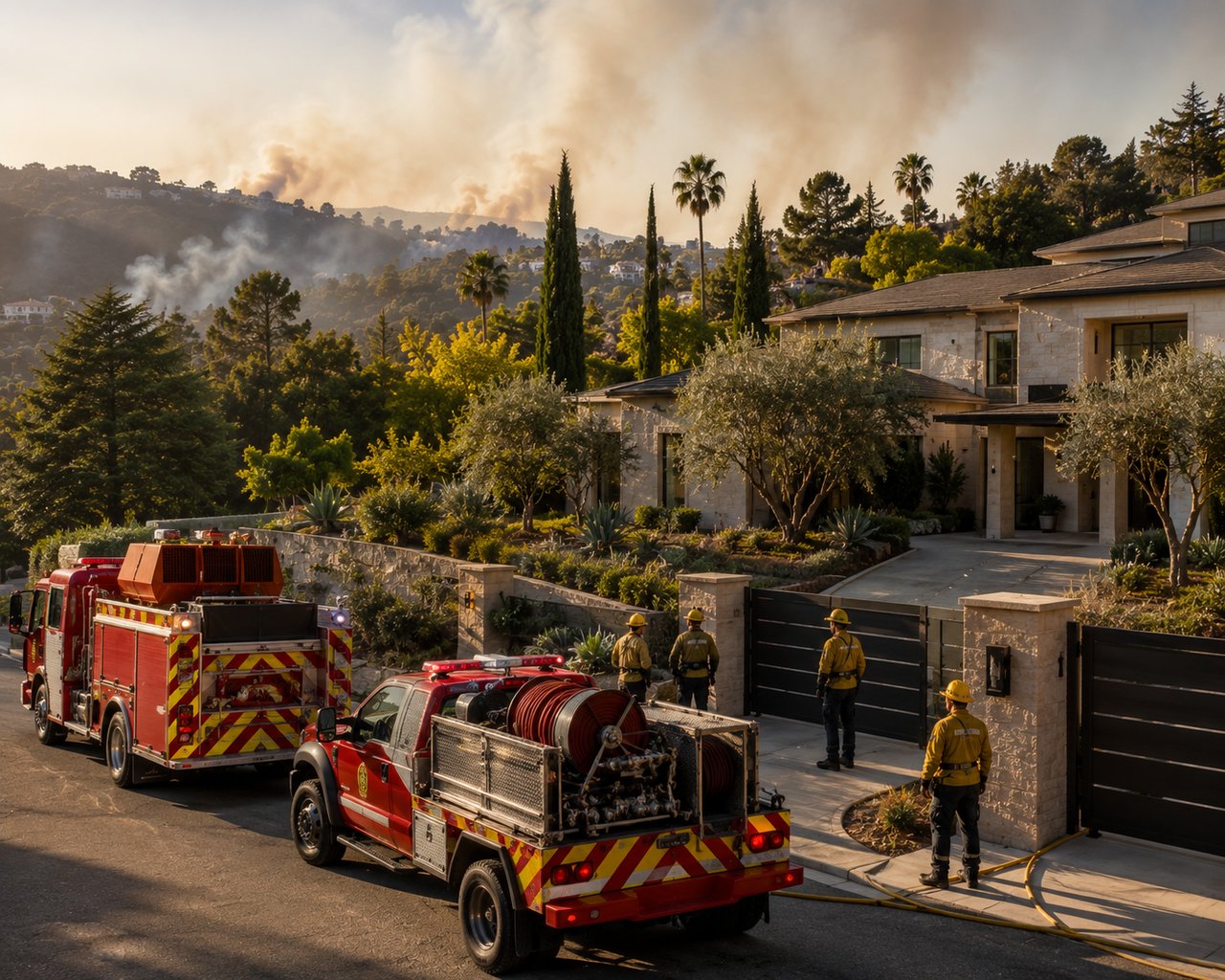
Buyers who want sweeping views and a genuine break from both coastal fog and Valley heat spikes are drawn to the hills, but the tradeoff is worth naming clearly: hillside living in Los Angeles carries wildfire exposure that doesn't have a direct Miami equivalent. Where Miami buyers are used to underwriting hurricane risk named storms, defined seasons, flood zones hillside LA risk shows up as red-flag wind events and fire season, with insurance availability and cost that deserve the same due diligence a Miami buyer would give windstorm coverage.
What Miami Buyers Get Wrong About LA Weather First
The most common misconception isn't about temperature at all it's assuming "sunny California" describes the whole county uniformly, when in practice the marine layer can keep the coast overcast well into summer afternoons while the Valley bakes under cloudless skies the same day. The second most common miscalculation is treating LA's natural-hazard profile like a milder version of Miami's swapping hurricane season for what feels like a vague, lower-stakes concern, when in reality wildfire risk in hillside and canyon communities requires its own serious insurance and defensible-space planning, just on a different calendar than hurricane season.
Microclimates at a Glance
Zone | Representative Areas | Summer Highs | Best Fit For | Key Consideration |
|---|---|---|---|---|
Westside (Marine Layer) | Santa Monica, Venice, Pacific Palisades, Brentwood | Mid-70s to mid-80s | Buyers wanting the mildest, most consistent year-round range | Grey mornings common in summer; check for A/C in older homes |
The Valley (Dry Heat) | Sherman Oaks, Encino, Calabasas, Woodland Hills | Often 95-100+ | Buyers wanting bigger lots, more sun, pool-centric living | Budget realistically for A/C and cooling costs |
The Hills (Elevated) | Upper Bel Air, Hollywood Hills, hillside Beverly Hills | Varies sharply by canyon orientation | Buyers wanting views and a break from both fog and heat | Wildfire exposure and insurance require Miami-style hazard due diligence, on a different calendar |
Practical Advice for the House Hunt
- Visit at different times of day, not just different days. A Westside property at 10am under marine layer looks and feels completely different than the same property at 3pm once the fog burns off.
- Ask about canyon orientation specifically, if you're considering hillside properties two nearby addresses can have very different daily conditions depending on which direction the canyon faces.
- Check cooling infrastructure directly rather than assuming it. Older Westside homes were sometimes built without central air, on the assumption the marine layer would handle it; Valley homes almost universally treat A/C as essential.
- Reframe your hazard mental model. Swap "hurricane season" for "fire season" as the seasonal risk to underwrite, and budget insurance accordingly if you're considering hillside or canyon-adjacent properties.
Key Takeaways
- Los Angeles isn't one climate it's at least three, separated by the Santa Monica Mountains, with temperature swings of 20 to 30 degrees possible across a twenty-minute drive.
- The Westside's marine layer produces the mildest, most consistent year-round temperatures, with summer highs typically in the mid-70s to mid-80s, but frequent overcast mornings that surprise buyers expecting constant sunshine.
- The Valley offers more consistent sun and bigger lots, at the cost of summer highs that regularly exceed 100 degrees hot, but dry, unlike Miami's humid heat.
- Hillside neighborhoods sit in a genuinely hyperlocal middle zone, where canyon orientation can matter as much as elevation, alongside wildfire exposure that requires the same seriousness Miami buyers already give hurricane risk.
- The most important adjustment for Miami buyers isn't temperature it's humidity and hazard type. LA's dry heat feels different at the same number, and fire season replaces hurricane season as the risk to plan around.
FAQs
Q1. Which LA neighborhood has weather most similar to Miami? None does closely, since Miami's defining feature is humidity and LA is dry nearly everywhere. The Valley's sun-heavy, warm days come closest to Miami's overall sunniness, while the Westside's mild temperatures are a poor match for Miami's year-round heat.
Q2. Why is it foggy on the Westside in summer if Los Angeles is known for sunshine? The marine layer, a bank of cool, moist ocean air, regularly blankets the coast overnight and through the morning in summer, typically burning off by early afternoon. It's often called "June Gloom" locally and is a normal seasonal pattern rather than unusual weather.
Q3. Is it actually 20-30 degrees hotter in the Valley than on the coast? Yes, that gap is common during summer heat events, driven by the Santa Monica Mountains blocking marine air from reaching inland areas. It's one of the most pronounced microclimate contrasts in Los Angeles County.
Q4. How should a Miami buyer think about wildfire risk compared to hurricane risk? They're different risk types on different calendars hurricane season is defined and tracked well in advance, while fire season risk is more tied to specific wind and dryness conditions. Hillside and canyon properties warrant the same level of insurance and hazard due diligence a Miami buyer would already apply to windstorm coverage.
Q5. Do older Los Angeles homes on the Westside typically have air conditioning? Not always some were built assuming the marine layer would keep interiors comfortable without mechanical cooling. This is worth confirming directly during a home search rather than assuming, especially for a buyer accustomed to Miami's non-negotiable A/C standard.
Conclusion
Choosing a Los Angeles neighborhood as a Miami buyer means choosing a climate, not just an address — and the three options rarely trade off the way you'd expect. The Westside offers the mildest range at the cost of sunshine certainty. The Valley delivers the sun and space at the cost of serious summer heat. The hills offer a hyperlocal middle ground with a wildfire risk profile that deserves the same planning Miami buyers already give hurricane season. None of the three is objectively best the right one depends entirely on which tradeoff you're actually willing to live with.
If you're relocating from Miami and want to walk a few of these microclimates in person before committing to a neighborhood, Christina Pope can build a house-hunting trip around exactly the tradeoffs that matter most to you. 📞 310-404-9931 ✉️ [email protected]
Christina Pope — Sotheby's International Realty
EliteResidenceInternational.com | 📞 310-404-9931 | ✉️ [email protected]
Climate and temperature figures referenced are directional and reflect typical seasonal patterns; actual conditions vary year to year. Confirm current insurance availability and wildfire risk designations for any specific property before making an offer.