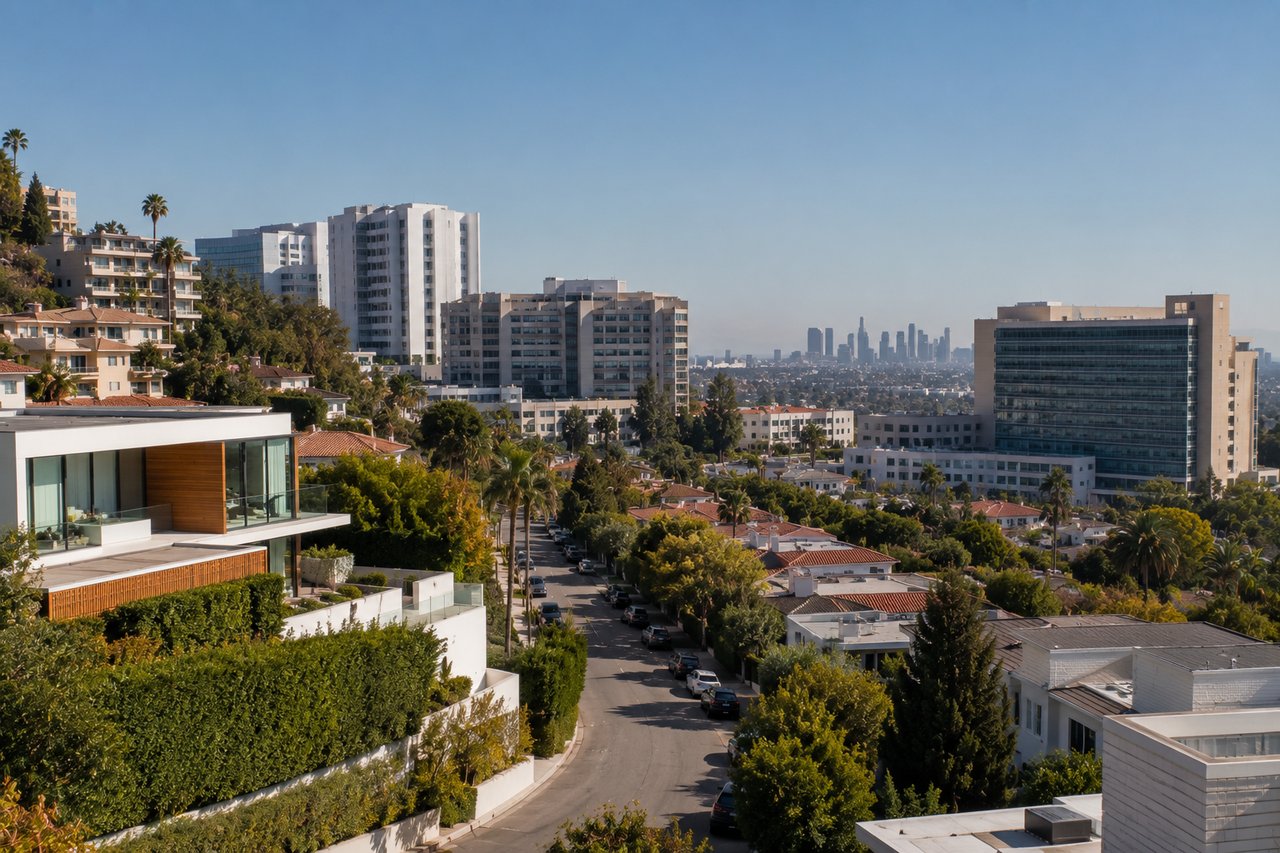
New Yorkers relocating to Los Angeles used to arrive with a familiar list: walkability, school district, proximity to the office, maybe a co-op board's approval process traded for an HOA's. In 2026, a different question is showing up earlier in the conversation sometimes before square footage, sometimes before the pool. How far is this house from Cedars-Sinai? How close is it to UCLA Health? For a growing share of relocating buyers, hospital access has quietly become as important as anything else on the checklist.
It's not a small or eccentric concern. Los Angeles is home to two hospitals that tied for the top ranked position in the entire metro area in the most recent U.S. News & World Report Best Hospitals rankings, and buyers who've spent years managing a chronic condition, aging parents, or a demanding career with zero margin for downtime are building their real estate search around that fact. For New Yorkers used to a world-class hospital on nearly every side of Manhattan, discovering that Los Angeles concentrates its top-tier care into a fairly compact corridor changes how and where they shop.
The New Relocation Checklist: Beyond Schools and Square Footage
Most relocation guides still lead with the obvious comparisons: Los Angeles offers considerably more space per dollar than Manhattan, no city income tax, and a driving culture that trades the subway for a garage. Those factors matter, and they still drive plenty of decisions. But for buyers over 50, families managing an ongoing health condition, or high performers whose schedules don't allow for a wasted afternoon, the calculus increasingly includes a factor moving guides rarely mention: exactly how many minutes separate the front door from a hospital they'd trust with a 2 a.m. emergency.
This shows up differently depending on the buyer. A retiring executive wants confidence that a cardiologist is twenty minutes away, not ninety. A family relocating with a child who has a complex diagnosis wants to know which specialists are realistically reachable without a flight. A couple used to same-day access to a Manhattan specialist doesn't want to trade that convenience for a driving culture that puts serious care an hour outside the city. In each case, the answer tends to point to the same two names.
Why Cedars-Sinai and UCLA Health Anchor the Map
Cedars-Sinai: The Westside's Flagship
Cedars-Sinai Medical Center sits on Beverly Boulevard at the edge of Beverly Hills, and its footprint has only grown the health system recently acquired the nearby Beverly Connection retail site, positioning itself for further expansion beyond its existing 24-acre main campus. In the most recent U.S. News & World Report Best Hospitals rankings, Cedars-Sinai earned a spot on the national Honor Roll for the tenth consecutive year and tied for the No. 1 hospital in both California and the Los Angeles metro area, with national rankings across eleven specialties including a top-ten position in cardiology. It also holds a five-star rating from the Centers for Medicare & Medicaid Services.
UCLA Health: Ronald Reagan and the Westwood Anchor
A few miles west, UCLA Health's Ronald Reagan Medical Center in Westwood carries its own weight nationally ranked across fourteen specialties, including top-five national rankings in ear, nose, and throat care and in pulmonology, and tied with Cedars-Sinai for the top spot among Los Angeles hospitals in the same U.S. News rankings. Newsweek's 2026 World's Best Hospitals list placed Ronald Reagan UCLA Medical Center among the highest-ranked hospitals in the country, ahead of most other California institutions on that list.
Two Hospitals, One Corridor
What makes this especially relevant for house-hunting is geography. Cedars-Sinai and UCLA Health's flagship campus sit roughly six miles apart along the Wilshire and Sunset corridors, with Beverly Hills, Beverly Grove, Century City, Holmby Hills, Westwood, Bel Air, and Brentwood filling the space between them. That stretch of the Westside effectively functions as Los Angeles's highest-caliber medical access zone which is exactly why so many relocating buyers, often without fully realizing it at first, end up narrowing their search to that same corridor.
Which Neighborhoods Actually Deliver the Shortest Commute
Neighborhood | Typical Drive to Cedars-Sinai | Typical Drive to UCLA/Ronald Reagan | Character |
|---|---|---|---|
Beverly Hills | 5–10 minutes | 10–15 minutes | Walkable core, iconic address, strong resale liquidity |
Beverly Grove / Hancock Park-adjacent | 5–10 minutes | 15–20 minutes | Closest proximity to Cedars' main campus |
Holmby Hills | 10–15 minutes | 5–10 minutes | Estate-scale privacy between both hospital campuses |
Westwood | 15–20 minutes | 5 minutes or less | Steps from Ronald Reagan; university-adjacent energy |
Century City | 10–15 minutes | 5–10 minutes | High-rise condo option with strong walkability |
Bel Air | 15–20 minutes | 10–15 minutes | Gated privacy, canyon and hillside estates |
Brentwood | 15–20 minutes | 10–15 minutes | Village walkability, family-oriented streets |
Drive times vary meaningfully with traffic patterns and time of day, and should always be verified in person before an offer — but as a directional guide, this corridor consistently outperforms the rest of the Westside on both metrics at once.
Why This Matters More for New York Buyers Specifically
New Yorkers are used to density solving this problem for them. In Manhattan, a serious hospital is rarely more than a short cab ride away regardless of neighborhood, so healthcare proximity has never had to factor into a real estate decision the way it does in a sprawling, car-dependent market. Los Angeles inverts that assumption. Drive twenty extra minutes in the wrong direction and a routine cardiology follow-up becomes a genuine planning problem, especially during rush hour on the 405 or Wilshire.
That's part of why the corridor between Cedars-Sinai and UCLA Health has become such a natural landing zone for relocating New York buyers. It's one of the few pockets of Los Angeles that replicates the density of access they're used to multiple hospital systems, specialists, and urgent care options within a genuinely short drive, rather than scattered across a metro area that can span sixty miles end to end.
Concierge Medicine, Specialists, and the New Definition of "Nearby"
For many relocating buyers, "nearby" isn't just about the hospital's front door it's about which specific specialty their family actually needs. A buyer managing a cardiac condition is going to weight Cedars-Sinai's cardiology strength differently than a family whose priority is pulmonology or ENT care, where UCLA's rankings lead. Concierge medicine has amplified this pattern: buyers increasingly retain a primary physician affiliated with one system or the other before they finalize a neighborhood, then let that relationship anchor the property search. It's a more specific version of the same logic New Yorkers already used to choose a co-op near their preferred pediatrician or their parents' longtime internist just applied to a much larger city.
Practical Considerations When House-Hunting Near a Hospital Corridor
A few factors are worth building into due diligence rather than assuming:
- Helipad and ambulance activity. Cedars-Sinai operates a helipad for trauma transport, and homes on the closest surrounding blocks can experience occasional related noise worth a site visit at different times of day.
- Traffic patterns, not just distance. A property that's 3 miles from UCLA Health can take longer to reach during weekday rush hour than a home 6 miles away via a less congested route. Test the actual commute, not just the map distance.
- Multiple access points matter. Buyers with ongoing care needs often value having both hospital systems within reach rather than picking a home that's excellent for one and inconvenient for the other.
- Walkability adds a layer of resilience. In neighborhoods like Westwood and parts of Beverly Hills, some medical offices and pharmacies are reachable on foot a meaningful backup when driving isn't ideal.
Key Takeaways
- Healthcare proximity has become a real relocation factor, not just a lifestyle preference, especially for buyers over 50, families managing ongoing conditions, and high performers with no schedule flexibility.
- Cedars-Sinai and UCLA Health both rank at the top of Los Angeles hospitals nationally, per U.S. News & World Report — Cedars-Sinai on the Honor Roll for a tenth consecutive year, UCLA's Ronald Reagan Medical Center nationally ranked in fourteen specialties.
- The corridor between the two hospitals — spanning Beverly Hills, Holmby Hills, Westwood, Century City, Bel Air, and Brentwood — offers the shortest combined access to both systems, making it a natural landing zone for relocating buyers.
- New York buyers feel this shift more acutely than buyers from other Sunbelt-bound cities, since Manhattan's density means healthcare proximity was never previously a factor in their real estate decisions.
- Specialty rankings matter as much as overall rank. Cedars-Sinai's strength in cardiology and UCLA's strength in ENT and pulmonology mean the "best" location can vary by a family's specific medical priorities.
FAQs
Q1. Why are New York buyers prioritizing hospital proximity when relocating to Los Angeles? Manhattan's density means quality hospitals are close to nearly every neighborhood, so healthcare access rarely factors into a real estate decision there. Los Angeles is far more spread out, and its top-ranked hospitals — Cedars-Sinai and UCLA Health — are concentrated in a specific Westside corridor, making location choice much more consequential for ongoing care.
Q2. Which neighborhoods offer the best combined access to both Cedars-Sinai and UCLA Health? Beverly Hills, Holmby Hills, and Century City generally offer the shortest combined drive times to both hospital systems, with Westwood favoring UCLA Health specifically and Beverly Grove favoring Cedars-Sinai. Bel Air and Brentwood remain within a reasonable, if slightly longer, drive to both.
Q3. How do Cedars-Sinai and UCLA Health compare in national rankings? Both tied for the No. 1 spot among Los Angeles hospitals in U.S. News & World Report's 2025-2026 Best Hospitals rankings. Cedars-Sinai is nationally ranked in eleven specialties with particular strength in cardiology, while UCLA's Ronald Reagan Medical Center is ranked in fourteen specialties, including top rankings in ENT and pulmonology.
Q4. Does living near a major hospital affect property value or livability? It can cut both ways. Proximity supports resale appeal for buyers who prioritize healthcare access, but homes on the closest surrounding blocks particularly near Cedars-Sinai's helipad may experience occasional related noise. A site visit at different times of day is worth the effort before writing an offer.
Q5. Should healthcare access outweigh other relocation priorities like schools or commute to work? For most buyers, it's one factor among several rather than the deciding one but for buyers over 50, those managing a chronic condition, or families with complex medical needs, it increasingly ranks alongside school district and commute time rather than behind them.
Conclusion
Los Angeles rewards buyers who look past the postcard version of the city and into its actual infrastructure. For New York buyers used to having a great hospital in every direction, discovering that Los Angeles concentrates its very best care into one Westside corridor is a genuine adjustment and increasingly, a genuine reason to choose Beverly Hills over Malibu, or Century City over the Palisades. The corridor between Cedars-Sinai and UCLA Health isn't just convenient. For a growing number of relocating families, it's become the map they build everything else around.
If you're planning a move from New York and want a search built around the neighborhoods that put you closest to the care your family relies on, Christina Pope can help you navigate the Westside's medical corridor alongside every other priority on your list. 📞 310-404-9931 ✉️ [email protected]
Christina Pope — Sotheby's International Realty EliteResidenceInternational.com | 📞 310-404-9931 | ✉️ [email protected]
Hospital rankings referenced are from U.S. News & World Report's "Best Hospitals 2025-2026" report and Newsweek's 2026 "World's Best Hospitals" list. Drive times are directional estimates and vary by traffic conditions; confirm current commute patterns for any specific property before making a decision.