Luxury real estate in Los Angeles has quietly moved past the expected. A recent home listed at $22M speaks to this shift floor-to-ceiling glass enclosing 84 STACT wine racks, a dedicated tasting room, and fully automated smart home controls. What this property signals goes beyond its price tag.
Affluent homeowners across the city are turning their estates into private micro-wineries, and the appeal is straightforward: complete privacy, investment diversification, and a level of lifestyle prestige that no commercial venue can replicate. Traditional wineries in Los Angeles, California exist to serve the public these residential vineyards exist to serve their owners. For high-end buyers who want the finest wine experience without public exposure, the private micro-winery has become the amenity of choice, pairing sophisticated cellar design with deeply personal wine production.
The Rise of Private Micro-Wineries in Los Angeles Luxury Homes
"This intimate approach to winemaking allows the owners to showcase their personal tastes and preferences in the world of wine, with each vintage telling a unique story." — Zakin Family Estate, Luxury vineyard estate
High-end vineyard estate transactions in Los Angeles rarely surface through conventional channels. The most significant properties move quietly, where discretion and timing matter far more than visibility. Christina Pope at Sotheby's International Realty and EliteResidenceInternational.com understands this well, connecting buyers who prioritize strategic positioning over public exposure.
Los Angeles has a longer relationship with wine than most people realize. Malibu established its first documented vineyard in 1824, and by the mid-1800s, Los Angeles County briefly led California in wine production. The modern revival took hold in 1985, with the Malibu Coast AVA earning formal recognition in 2014. Today, roughly 46,000 acres of steep hillside vineyards catch coastal fog and warm afternoon sun across the region part of a state that accounts for over 80% of all U.S. wine production.
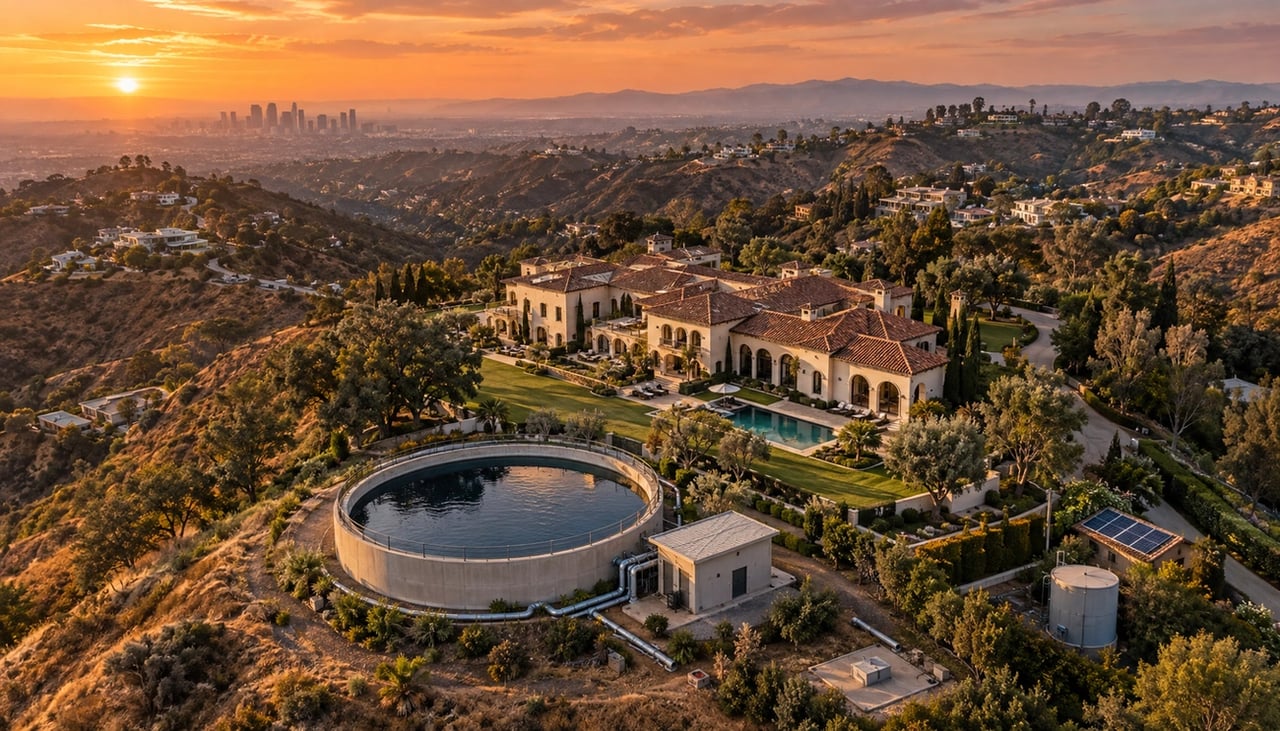
The Rosenthal Estate puts this evolution into clear focus. The 180-acre Malibu property, listed at $38 million, includes a 12,000-square-foot hacienda, three guest houses, and 10,000 vines producing cabernet, shiraz, chardonnay, and merlot under the estate's own wine label. Sitting 1,400 feet above the coastal fog line and just four miles from the beach, it also has room to plant an additional 10,000 vines.
This sensibility has found its way into Beverly Hills as well. Temperature-controlled cellars, dedicated tasting rooms, and curated display walls have become defining features in properties across Trousdale Estates, Beverly Hills Post Office, and Holmby Hills.
What Defines a Luxury Home Micro-Winery
When Christina Pope at Sotheby's International Realty and EliteResidenceInternational.com works with high-end vineyard clients, the conversations rarely start with square footage. What matters most is climate precision, storage architecture, and the automated systems that safeguard six-figure wine collections.
A functional micro-winery holds temperatures between 55-60°F with humidity levels between 50-70% conditions that require serious mechanical support. Cooling systems vary by scale: through-wall units handling 830 to 3,760 BTU/h suit smaller installations, while ducted split systems rated at 3,400 to 14,900 BTU/h serve larger spaces. Smart home integration ties it all together, giving owners remote temperature monitoring, instant fluctuation alerts, and automated humidity adjustments from a smartphone.
Storage architecture carries equal weight. The finest cellars set aside dedicated areas for Original Wooden Containers holding investment-grade bottles, sections reserved for birth year wines, and secured space for First Growths. Inventory platforms like CellarTracker and VinCellar help owners stay on top of provenance, drinking windows, and current market valuations.
The design sensibility in these spaces draws from wine country itself reclaimed wood, stone finishes, and windows that frame vineyard views rather than conceal them. Professional sommeliers step in to organize collections by region and vintage, maintain running inventories, and produce appraisals for insurance or estate planning. The result is a space where bottles age exactly as winemakers intended far removed from the idea of a simple storage room.
Investment Value and Privacy Benefits of Residential Vineyards
"Owning a wine estate in California, especially in Napa Valley, is a ‘lifestyle choice’ rather than, as in Europe, the perpetuation of a family tradition." — Brook, Author and researcher
Christina Pope at Sotheby's International Realty and EliteResidenceInternational.com handles vineyard conversations that go well beyond standard property metrics. Residential vineyards in Los Angeles, California are rarely about quarterly returns they are multi-generational holdings where personal enjoyment and long-term planning coexist comfortably.
The motivations vary. Some buyers operate their own labels, others lease vines to established producers or align with wine brands before eventually passing the estate to the next generation. What ties these decisions together is the understanding that prime vineyard land simply does not replenish itself. AVAs are carefully regulated, and much of California's finest terroir has already been planted or preserved. That scarcity protects value over time and insulates these holdings from oversupply. With California accounting for over 80% of all U.S. wine, the market carries both global demand and the weight of limited premium acreage behind it.
The presence of a vineyard also does measurable work on property value. Homes with established vineyards draw buyers who seek a particular kind of refinement — and while the audience is specific, their interest is serious. Federal and state tax advantages add another layer of appeal, varying based on vineyard size and production intent, making these estates well-suited to thoughtful estate planning.
For those who love to entertain, the right home makes every occasion feel effortless. Christina Pope would be delighted to help find a property that matches both the vision and the life that comes with it. 📞 310-404-9931 ✉️ [email protected]
Conclusion
A private vineyard estate is rarely just a home — it is a considered decision about how one chooses to live, invest, and entertain. The most significant of these properties never reach a public listing. They move quietly, between the right people, at the right time.
Christina Pope at Sotheby's International Realty and EliteResidenceInternational.com understands this world well. For those who appreciate refined living and entertaining and are ready to find a property that reflects that, Christina would be delighted to help. 📞 310-404-9931 ✉️ [email protected]
Key Takeaways
Private micro-wineries are transforming Los Angeles luxury real estate, offering affluent homeowners a unique blend of lifestyle prestige, investment value, and complete privacy that public wineries cannot provide.
• Climate-controlled precision matters: Professional micro-wineries require 55-60°F temperatures with 50-70% humidity, smart home integration, and automated monitoring systems to protect six-figure wine collections.
• Scarcity drives appreciation: Prime vineyard land in California AVAs remains finite and carefully regulated, creating long-term value appreciation as over 80% of U.S. wine production concentrates in limited premium acreage.
• Multi-generational wealth strategy: Residential vineyards function as strategic assets beyond property value, offering tax advantages, agricultural designations, and legacy holdings that blend personal enjoyment with estate planning.
• Discretion defines the market: The most significant vineyard estates move through private channels rather than public listings, where expert guidance and timing matter more than visibility.
These residential vineyards represent a shift from traditional luxury amenities to personalized wine production facilities that serve as both lifestyle statements and sophisticated investment vehicles for high-net-worth individuals seeking privacy and exclusivity.
FAQs
Q1. What makes Los Angeles climate suitable for private vineyard estates? Los Angeles, particularly areas like Malibu, benefits from coastal fog and warm afternoon sun on steep hillsides. The Malibu Coast AVA, formally recognized in 2014, encompasses roughly 46,000 acres where these microclimates create ideal conditions for growing premium wine grapes like cabernet, shiraz, chardonnay, and merlot.
Q2. What are the essential features of a luxury home micro-winery? A functional micro-winery requires climate control maintaining 55-60°F with 50-70% humidity, professional-grade cooling systems, smart home integration for remote monitoring, premium storage infrastructure for investment-grade bottles, and often includes dedicated tasting rooms with reclaimed wood and stone finishes.
Q3. How do residential vineyards increase property value? Residential vineyards attract buyers seeking refinement and exclusivity, though they appeal to a specific market segment. The scarcity of prime vineyard land in California AVAs, combined with careful regulation and limited premium acreage, drives long-term appreciation and protects against oversupply.
Q4. What tax benefits do private vineyard owners receive? Property owners with residential vineyards can access tax advantages at both federal and state levels, including potential agricultural designations. The specific benefits depend on vineyard size and wine production intent, making these estates attractive for multi-generational wealth planning.
Q5. Why do high-net-worth individuals prefer private micro-wineries over public wineries? Private micro-wineries offer complete privacy, investment diversification, and lifestyle prestige that public commercial wineries cannot provide. They allow owners to showcase personal tastes in winemaking, entertain exclusively, and create legacy holdings that blend personal enjoyment with strategic estate planning.