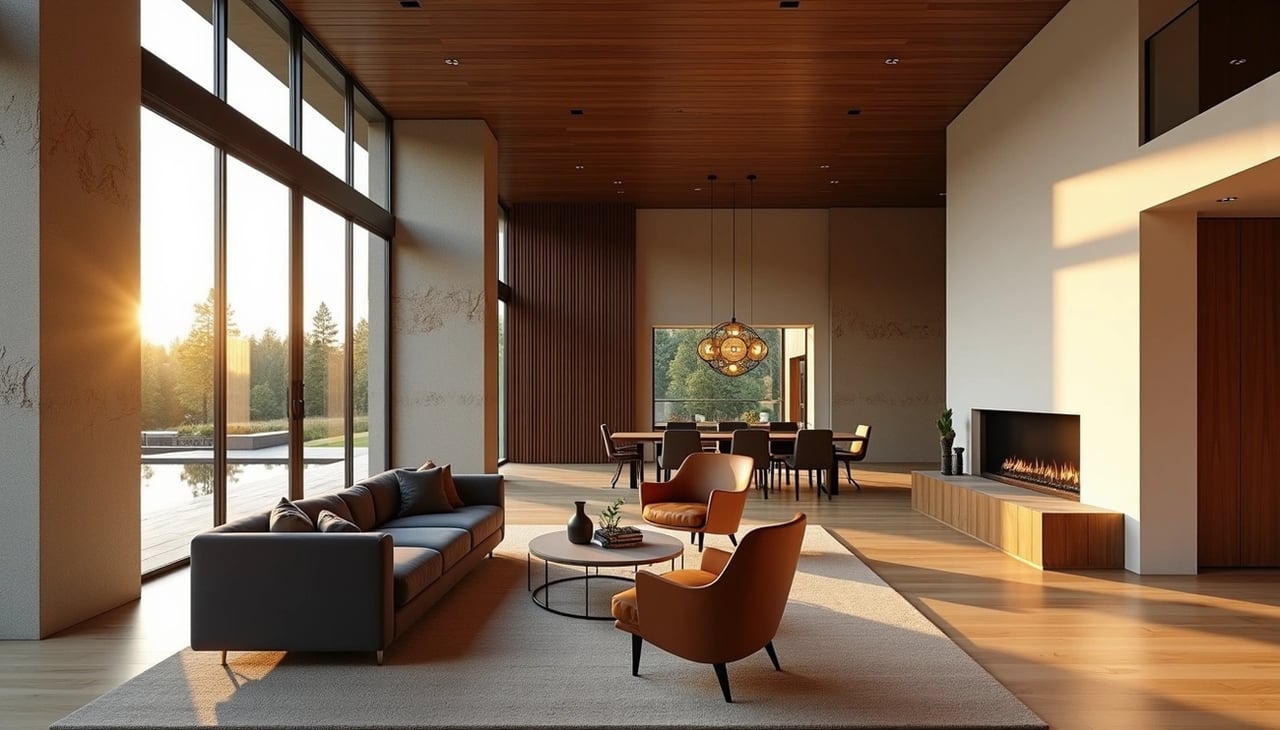
Most standard interior partitions have an STC of only 35, meaning occupants hear almost everything. This reality has positioned acoustic design luxury homes as the ultimate status symbol for the wealthy, surprisingly. Quiet is the new luxury, and you can measure it. Wellness-Certified homes with documented acoustic performance sell at a premium and cater to high-net-worth individuals who prioritize privacy and mental well-being. This piece explores how acoustic designers are redefining luxury standards. It covers the features that distinguish elite properties, the role of acoustic design lab innovation, and how acoustic design llc teams deliver custom solutions that lift both lifestyle and property value.
The Evolution of Luxury Real Estate Standards
Beyond Traditional Status Symbols
Luxury real estate operates within trusted circles where discretion carries as much weight as value. The most important transactions unfold quietly. Private conversations and strategic positioning shape them rather than public listings. Christina Pope from Sotheby's International Realty observes this reality daily: timing and access define success for those who understand how elite properties change hands.
The transformation extends beyond transaction mechanics. Bradley Nelson, chief marketing officer of Sotheby's International Realty, notes that luxury real estate has undergone a fundamental change in the last decade. What once served as a status symbol has progressed into something far more personal: a bespoke definition that functions as true self-expression. The concept of luxury itself has moved from purely esthetic and exclusive dimensions to intimate and personal values.
Buyers vault directly into the trophy market without climbing the traditional ladder of move-up transactions. Millennials and Gen X purchase trophy real estate earlier than prior generations. Early business success and wealth transfer drive this trend. Michael Carucci, executive vice president of Gibson Sotheby's International Realty in Massachusetts, whose sales averaged $8.10 million last year, confirms that ultra-luxury buyers focus on value rather than price.
Visible symbols of wealth no longer define success. The affluent class now prioritizes time, wellness, sustainability, and personalization over ostentation. Homes must deliver more than esthetics and create lifestyle ecosystems. Buyers seek experiences, exclusivity, and connectivity woven into living spaces rather than ornate status symbols.
Why Sound Has Become the New Frontier
Acoustic comfort has emerged as a non-negotiable priority. Luxury homebuyers now demand focus on acoustic details. Custom home design teams get educated on achieving "quiet homes" through methods like mineral wool in interior partitions and solid-core doors in primary suites. Sound comfort represents a change from traditional luxury priorities.
The wellness connection drives this progress. Poor sound environments increase stress, disrupt sleep, and harm long-term health. Research with 356,000 participants in Britain and Norway revealed that long-term exposure to traffic noise alters blood biochemistry and increases cardiovascular risks beyond the effects of exhaust fumes. Controlling noise has become necessary to maintain well-being.
The financial numbers support this focus. The global wellness market sees $3.70 trillion in annual spending and positions acoustic comfort as an important chance rather than a trend. The luxury audio market is poised to reach $4.30 billion by 2028 and powers forward with an 8% CAGR. Homes with superior sound environments often sell at a premium, reflecting growing awareness of sound comfort among buyers.
The Role of Acoustic Design Lab Innovation
Acoustic Design Lab brings 30 years of experience in custom design, engineering, fabrication, and project management to architectural acoustic solutions. The San Diego-based firm delivers technical support from design phase and budgeting through installation. It provides the widest range of custom acoustic products for project requirements.
Their product certifications distinguish their offerings. All products achieve GreenRate Level A certification, with ingredients reviewed against the Living Future Challenge Red List to achieve Third-Party Verified 'Red List Free' status. Health Product Declarations document ingredients and associated health effects for all materials. Products meet CDPH Standard Method limits for low VOC and formaldehyde emissions.
Performance specifications confirm their engineering approach. Products deliver NRC ratings of 0.45-0.9, almost 20 times that of standard drywall. Class A fire ratings per ASTM E84 enable architectural use without limits. The product range spans eight series: ZENWALL with 32 acoustic panel types, ZENBAFFLE offering 14 ceiling-hung solutions, ZENLIGHT combining lighting with sound absorption across 7 fixtures, ZENTILE providing 30 ceiling tile options, ZENCLOUD delivering 15 acoustic clouds, ZENSTAR featuring tessellated 3D designs, ZENRACK offering 4 equipment room solutions, ZENGRID presenting 16 decorative acoustic grids, and ZENSCREEN comprising 32 portable acoustic screens.
What Makes Acoustic Design a Status Symbol
The Invisible Luxury Factor
Wealth expression has moved. Acoustic design luxury homes represent refinement beyond what occupants can touch or photograph. Luxury no longer centers solely on what buyers see. It extends to how spaces feel and sound. Silence, clarity and sonic privacy mark elite living environments.
Acoustic comfort signals quality comparable to craftsmanship and architecture itself. Refinement exists in layers occupants don't see but always experience. Atmosphere has become a status marker as valuable as architectural details. Spaces must feel calmer, clearer and more restorative for homeowners who possess everything material. Emotional elegance defines the new standard.
Privacy and Discretion for High-Profile Residents
Privacy for luxury homeowners addresses three distinct concerns: visual privacy controlling sightlines, acoustic privacy minimizing sound transmission and access privacy managing physical entry. Acoustic privacy prevents interior conversations from carrying beyond walls specifically.
Speech privacy functions as a core requirement in elite residences. Good acoustical design ensures occupants cannot understand conversations in adjacent rooms. Successful design prevents employees from hearing office discussions next door in corporate environments. Proper acoustic treatment protects diagnostic integrity when floor vibrations from footsteps could compromise MRI scans in medical facilities.
Privacy and security serve as essentials for physical safety and emotional well-being. Knowing how to live without intrusion represents a hallmark of true luxury. It magnifies property value for homes designed with privacy priorities. Sound-blocking materials deliver sophisticated solutions that maintain elegance while improving privacy. High-profile residents require boundaries between personal and professional lives. Homes play an integral role in upholding these boundaries.
Creating Environments That Support Wellness
Acoustics prove significant to long-term health and wellness. Poor sound environments deliver constant, insidious stress with harmful effects over time. Research studies show the acoustic environment associates with internal effects on cardiovascular and nervous systems. The WELL Building Standard has Acoustic Comfort Features to prevent unnecessary stress and aid comfort, productivity and overall well-being.
Bad acoustics trigger constant alert mode in the brain. They affect the sense of safety and make relaxation difficult. Blood moves into legs and arms for fight-or-flight response. Cerebral processes shut down. Sound disturbances affect sleep and cause cardiovascular and psychophysiological effects. They reduce performance and provoke behavioral changes.
Improved well-being stems from quiet, serene living environments. Minimizing noise disturbances in bedrooms ensures better sleep quality. This is significant for overall health. Homes with superior acoustic design gain recognition as more desirable and potentially increase market value.
How Acoustic Designers Deliver Exclusivity
Acoustic designers conduct assessments specific to homeowner spaces or new construction plans. Teams get into homes with an acoustic view and identify existing or potential problems. They determine homeowner concerns and their severity. This approach mirrors how architects survey clients to determine design priorities.
Designers assess how sound travels and behaves. They evaluate effects on homeowner health and wellness. They balance acoustic design with noise levels comfortable for specific residents. Questions address room importance and usage frequency. They also ask whether homeowners want optimal acoustic performance for sound quality or simply containment.
Cerami and prominent firms consult with developers and architects on residential buildings. They employ fundamental acoustic engineering principles to optimize spaces for intended purposes. Strategic acoustic design approaches merge within architectural vision. Sound masking and improved wall constructions create appropriate environments ranging from dynamic interactive spaces to private confidential offices. Acoustic designers provide necessary solutions to minimize vibration transfer and maximize experience.
Essential Acoustic Features in Elite Homes
Soundproofing Solutions for Walls and Ceilings
Construction assemblies determine acoustic performance through measurable specifications. Standard interior partitions achieve an STC of approximately 35. Adding insulation raises this to 38. Double drywall with insulation reaches STC 41. Resilient clips provide a better solution and decouple drywall from studs to achieve STC 57. Loud music or shouting becomes very faint or inaudible at this level.
Ceiling assemblies follow three performance tiers. Simple level involves doubled drywall and maintains structural coupling that allows footsteps and impact noise to pass through at STC 52 and IIC 39. Standard level uses decoupled drywall suspended below joists and breaks the vibration path to reach STC 66 and IIC 56. The highest tier employs triple gypsum layers, Green Glue damping compound and full decoupling. It treats both subfloor and ceiling to achieve STC 76 and IIC 64.
Implementation requires attention to detail. Acoustic caulking seals gaps around electrical fixtures and joints to prevent sound from flanking through any air passage. Resilient channels stand wall and ceiling layers off studs or joists. RC8 systems can support up to two layers of 5/8" drywall plus a SheetBlok layer. Steel studs perform better than wood at reducing transmission due to lower rigidity. Double-stud assemblies or staggered stud walls eliminate direct structural pathways between surfaces.
Advanced Floor Assemblies and Impact Reduction
Floor systems address both airborne and impact sound. Cork underlayment demonstrates a Noise Reduction Coefficient of 0.7 and absorbs 70% of sound waves. A 3mm cork layer reduces sound by up to 10 decibels. A 12mm cork underlayment achieves reductions up to 48 decibels. Rubber composite tiles with built-in foam layers cut ambient noise by as much as 20 dB.
Floating assemblies isolate flooring from subfloors to minimize impact transmission. Engineered-wood float systems allow flooring to rest above the subfloor and reduce vibration transfer. Dense underlayments of cork or rubber beneath finished surfaces mute footfall noise between floors.
Strategic Material Selection for Sound Control
Fiberglass ranks as the top sound-absorbing material due to its porous nature and density. Mineral wool matches fiberglass performance and offers better low-frequency absorption due to higher density. Both materials trap sound within fibrous structures and convert wave energy to heat. Mineral wool provides fire resistance, a significant safety feature. Acoustic batts installed in wall and ceiling cavities substantially reduce noise transmission when combined with decoupling techniques.
The Professional Design and Implementation Process
Detailed Acoustic Assessment
Professional acoustic designers start by evaluating spaces with a specialized view. Teams get into homes and identify existing or potential problems. They determine homeowner concerns and their severity. This assessment mirrors how architects survey clients and understand design priorities.
Designers assess how sound travels and behaves within specific environments. They evaluate effects on homeowner health and wellness. They balance acoustic design with noise levels comfortable for residents. Questions address room importance and usage frequency. They also ask whether homeowners want optimal acoustic performance for sound quality or simply containment.
Integration with Architecture and Interior Design
Bringing acousticians into conversations from the earliest stage proves critical. Design decisions affect acoustics profoundly. Early involvement eliminates potential issues before they exist and saves time and money.
Architecture interacts with sound like it interacts with light. Architectural acoustics focuses on how building design, volume and materials influence acoustic environments. Integration partners provide support through every project step, from system design to calibration and training. Teams build detailed scopes before anything is purchased or installed.
Professional firms partner with architects, designers and contractors from planning stage through final installation. This ensures smooth results.
Custom Solutions from Acoustic Design LLC Teams
Acoustic Design LLC teams deliver home automation, commercial AV systems and security monitoring. They also provide acoustic treatments and access control solutions. Services assist clients with integrated audio, video and automation system installations for residential and commercial properties.
White-Glove Installation and Calibration
Installation teams maintain rigorous safety standards. All installers receive OSHA 10 certification. Team leads hold OSHA 30 and CPR certifications. Safety plans and training undergo continuous updates.
Professional installers demonstrate knowledge and respect throughout projects. Teams provide expert calibration and custom acoustic treatments that neutralize ambient noise and control reflections. Installation completion has training on system use.
Market Positioning and Property Value
How Acoustic Design Separates Luxury Properties
Properties with superior acoustic performance stand apart in competitive markets. A substantial 33.6% of acoustic panel demand now originates from high-end lifestyle sectors, reflecting a fundamental change from purely industrial applications. Soundproofing creates a unique quality that becomes a memorable selling point, especially when you have buyers seeking home studios or remote work environments. Properly installed acoustic systems provide competitive advantages that reduce days on market in higher-density areas.
Buyer Expectations in Today's Market
Modern luxury buyers prioritize wellness and comfort above traditional features. 58% of homebuyers think peaceful and quiet surroundings are everything. Homes designed with wellness priorities command markups between 10 to 25% over conventional offerings in the luxury sector. Buyers demonstrate little tolerance for outdated designs, even in relatively new construction. This drives just need for properties with integrated acoustic solutions.
The right home makes all the difference if you love to entertain. I'd be delighted to help you find spaces designed for elevated living and effortless hosting if you're thinking over a purchase in the near future or beginning your search. Christina Pope  310-404-9931
  [email protected]
The ROI of Superior Acoustic Performance
Acoustic investments deliver measurable returns. Properties with soundproofing solutions increase buyer demand and support higher listing prices in competitive neighborhoods while separating properties from others. Appraisers now recognize soundproofing value during evaluations, especially in regions where noise presents common concerns. Soundproofed homes command premium prices as buyers pay more for properties promising peace and privacy.
Conclusion
Acoustic design has in fact transformed from a technical consideration into the defining luxury feature for elite properties. Wealthy buyers recognize now that true refinement exists in what they experience rather than what they display. Sound quality and privacy deliver measurable value that traditional status symbols cannot match. Properties with superior acoustic performance command premium prices and reflect a fundamental move in how discerning buyers review luxury real estate. The right home makes all the difference for those who love to entertain. Christina Pope at Sotheby's International Realty (310-404-9931, [email protected]) helps clients find spaces designed for elevated living and effortless hosting, where silence speaks louder than spectacle.
Key Takeaways
Acoustic design has emerged as the ultimate luxury status symbol, representing a shift from visible wealth displays to invisible comfort that enhances wellness and privacy.
• Acoustic comfort commands premium pricing: Homes with superior sound design sell for 10-25% more than conventional luxury properties, with 58% of buyers prioritizing quiet environments.
• Professional acoustic design requires early integration: Bringing acousticians into architectural planning from the start prevents costly retrofits and ensures seamless sound control throughout the home.
• Advanced soundproofing delivers measurable performance: Elite homes achieve STC ratings of 57-76 through resilient clips, decoupled assemblies, and strategic material selection like mineral wool and cork underlayment.
• Wellness drives acoustic investment decisions: Poor sound environments increase cardiovascular risks and stress, making acoustic comfort essential for high-net-worth individuals prioritizing health and mental well-being.
• Sound privacy equals true luxury: The ability to conduct private conversations without sound transmission represents the new standard of refinement for discerning wealthy buyers.
The transformation reflects a broader evolution in luxury real estate, where experiences and wellness take precedence over traditional status symbols, positioning acoustic design as both a lifestyle enhancement and a strategic property investment.
FAQs
Q1. What defines luxury in modern high-end homes? True luxury in contemporary homes extends beyond visible opulence to encompass depth, craftsmanship, and intentionality. Modern luxury emphasizes invisible comfort factors like acoustic design, wellness features, and personalized experiences rather than flashy displays. It's about how spaces feel and function, creating environments that support well-being and privacy.
Q2. What characteristics distinguish luxury properties from standard homes? Luxury properties feature spacious, light-filled areas with high ceilings and large windows that create a sense of airiness and well-being. They incorporate premium finishes, superior craftsmanship, and advanced systems like acoustic design that enhance comfort. These homes prioritize quality materials, strategic design integration, and features that deliver measurable performance benefits like sound control and privacy.
Q3. Why do wealthy individuals invest in high-end residential properties? Wealthy buyers view luxury homes as solid long-term investments with strong appreciation potential and stable returns. Beyond financial considerations, they seek properties that offer privacy, wellness benefits, and exclusive features that align with their lifestyle priorities. High-end homes provide both a refined living experience and strategic asset diversification.
Q4. What makes luxury real estate a compelling investment opportunity? Luxury real estate offers multiple investment advantages including high appreciation potential, premium rental income, and various tax benefits. Properties in prime locations with unique amenities and superior features like acoustic design command premium prices and attract discerning buyers willing to pay 10-25% more for enhanced comfort and wellness features.
Q5. How does acoustic design increase property value in luxury homes? Superior acoustic performance differentiates luxury properties in competitive markets, with homes featuring professional sound design commanding significant premiums. Appraisers now recognize soundproofing value during evaluations, particularly in high-density areas. Properties with documented acoustic performance sell faster and at higher prices as buyers increasingly prioritize quiet, private environments that support wellness and productivity.