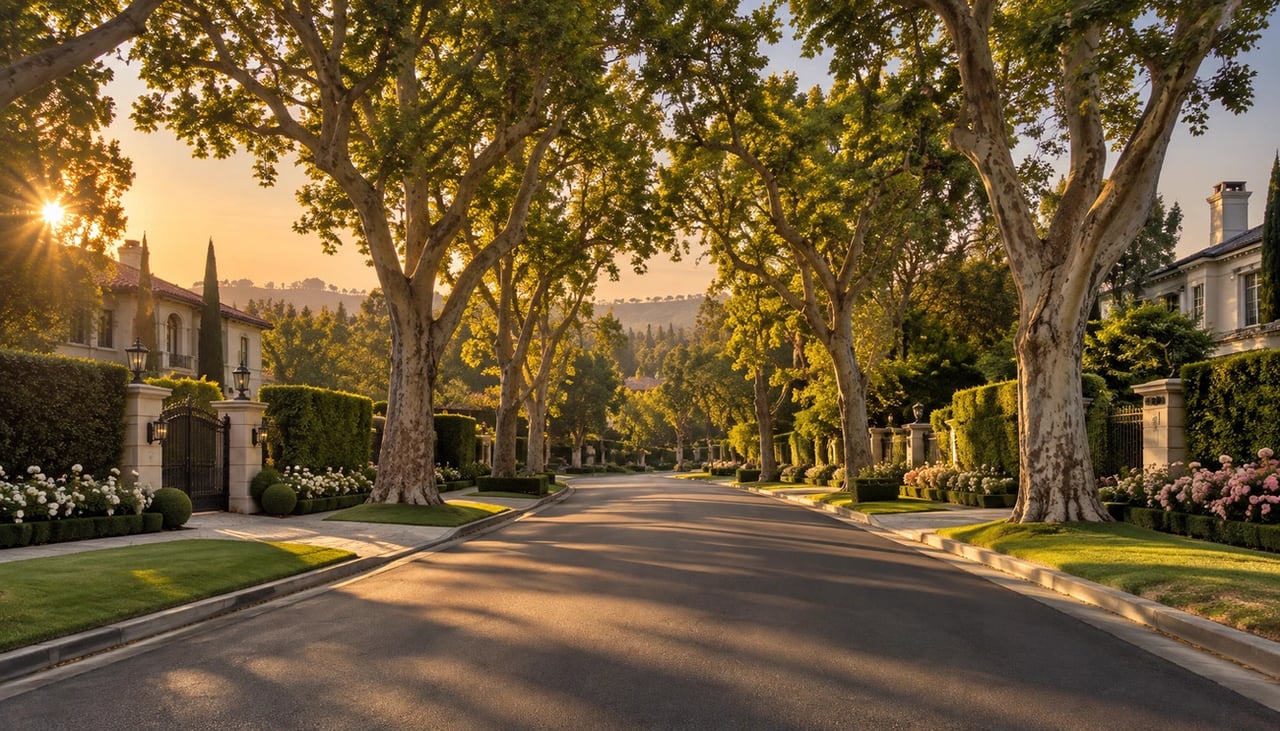
Luxury real estate in Los Angeles moves quietly. The most consequential transactions happen through trusted relationships and well-timed conversations — rarely through public listings. Carolwood Drive Los Angeles is where that reality plays out at its most rarefied. One mile long, the street has drawn an extraordinary roster of residents — Walt Disney, Frank Sinatra, Michael Jackson, Tony Curtis — each choosing it for the same reasons that still draw buyers today. Few streets in the city hold this many layers at once. Carolwood is, in many ways, a compressed history of Los Angeles luxury — where legacy, privacy, and prime positioning have shaped every transaction for nearly a century. What follows covers the origins of the street, the estates that defined it, and the market forces that keep it at the center of the Platinum Triangle.
The Origins of Carolwood Drive's Prestige
From Wolfskill Ranch to Holmby Hills
The land that became Carolwood Drive has roots in one of Southern California's original Mexican land grants, Rancho San Jose de Buenos Ayres, which was eventually carved into the 2,000-acre Wolfskill Ranch. Arthur Letts Sr., founder of the Broadway department stores, purchased 400 acres of that ranch in 1919 at $100 per acre, setting it apart with a specific purpose in mind: an estate enclave that would become Holmby Hills.
Letts named the development after Holdenby, a small hamlet in England where he was born. The name was no accident. He envisioned something deliberately English in character, drawing from the grand estate traditions of his homeland. Streets would carry names like Charing Cross Road and Devon Avenue, each one a reference to places in Great Britain — a detail that speaks to how precisely Letts had the community's identity mapped out.
Arthur Letts' Vision for an Estate Enclave
Letts had ambitions well beyond a standard residential subdivision. His master plan called for a mixed development that included retail, apartments, residences, estates, and a significant university. Holmby Hills was the crown jewel of that vision — the portion designed to attract buyers who valued privacy and room to breathe.
Letts died suddenly in 1923, before the project reached completion. His son-in-law, Harold Janss, stepped in and carried the work forward through the Janss Investment Company, bringing more than two decades of subdivision experience to the task.
How Early Development Shaped Today's Property Values
The decisions the Janss Investment Company made when lots went on sale in 1925 are still felt in Carolwood's market position today. Rather than imposing heavy architectural controls, the developers kept restrictions deliberate but measured — banning commercial structures, requiring minimum setbacks, and prohibiting the subdivision of lots for fifty years.
Their most telling move was building the first two homes themselves before a single lot went to the public. Those residences set the standard — in style, expense, and scale — that every subsequent buyer was expected to honor. The Janss brothers also kept their marketing discreet, rarely identifying who had purchased a lot.
The result was a community that essentially curated itself. Those with the means to buy in Holmby Hills arrived already inclined to uphold the standards the early estates had set. Property values gained from both the land itself and the caliber of the people who shaped its character from the very beginning.
Famous Residents and the Stories Behind Their Estates

Image Source: Michael Jackson Wiki - Fandom
Walt Disney at 355 Carolwood Drive
Walt Disney lived at 355 Carolwood Drive and built the Carolwood Pacific Railroad in his backyard in 1950. The miniature railway was more than a pastime. It reflected the same thinking that would eventually define Disneyland — a love of trains, storytelling, and environments built with intention. The property sold for $8.45 million in 1998 to Gabriel Brener, who chose to demolish the house but kept what mattered most: the original gate, sections of Lillian's rose garden, and the 90-foot tunnel entrance still marked with '1950'.
Tony Curtis, Cher, and 141 South Carolwood Drive
The Italian Renaissance mansion at 141 South Carolwood Drive was built in 1932. Tony Curtis bought the estate in the 1960s. Cher first encountered the property at a party there in 1967 and wanted it immediately. Curtis eventually put it on the market for $1 million in 1972 — Sonny and Cher paid $750,000. Their marriage ended not long after moving in, and Cher walked away from the divorce with the Carolwood estate.
Michael Jackson's Time at 100 North Carolwood Drive Los Angeles
Michael Jackson rented the mansion at 100 North Carolwood Drive Los Angeles for $100,000 monthly, from December 2008 until his death. He suffered cardiac arrest at the property on June 25, 2009. The French château-style home exceeded 17,000 square feet, with seven bedrooms and 13 bathrooms. The estate sold in 2012 for $18.1 million.
Frank Sinatra, Clark Gable, and the Golden Age Connection
Frank Sinatra paid $250,000 for 320 North Carolwood Drive in 1948. The seven-bedroom Mediterranean home sat on 2.3 acres. Clark Gable also called Carolwood home during Hollywood's golden era.
Why Entertainment Industry Leaders Chose This Location
These were not simply house purchases. For public figures, Carolwood offered something harder to find than square footage — a genuine buffer. Long driveways, mature trees, walls, and gates gave residents the seclusion they needed without cutting them off from the city. Beverly Hills, Bel Air, Century City, and Westwood all remained within easy reach, while the street itself stayed quietly residential.
Understanding Carolwood's Unique Market Position
"Today, true luxury is increasingly about time, privacy, service and experience." — Unknown, Luxury Real Estate Advisor
The Privacy Premium: Why Buyers Pay More for Seclusion
Privacy is the real currency in Holmby Hills. The 405 Freeway forms a natural boundary on one side, and the hills do the rest. Buyers here aren't simply purchasing square footage — they are accepted into a community, vetted quietly by the networks that surround it. Price alone doesn't determine access.
Some streets within Holmby Hills are so insular that residents almost never need to leave. Properties with mature landscaping, discreet entries, and meaningful distance from the street consistently command stronger valuations than comparably sized estates with greater exposure.
Lot Sizes and Estate Potential in Carolwood Holmby Hills
Zoning accommodates lot sizes up to 4 acres, with a 20,000-square-foot minimum ensuring meaningful separation between properties. Estates range from nearly 1 acre at 145 North Mapleton Drive to approximately 5 acres at Spelling Manor.
Usable land carries as much weight as interior square footage. Larger parcels allow for guesthouses, pool pavilions, tennis courts, and the kind of setbacks that keep neighbors at a comfortable distance. The estate at 100 North Carolwood Drive Los Angeles sits on 1.26 acres.
How the Street Maintains Value Across Decades
Average home values on Carolwood sit around $40 million, though capital is only part of the equation. Entertainment dynasty wealth still defines much of the ownership profile here. Geographic isolation, decades of deliberate gatekeeping, and strict density controls work together to protect both the character of the street and its pricing. Carolwood Los Angeles also benefits from its position within the Platinum Triangle — the corridor formed by Holmby Hills, Bel Air, and Beverly Hills that remains the most expensive residential zone in Los Angeles.
Buying and Selling on Carolwood Los Angeles
"Simply put: You cannot add more inventory vertically and you cannot create more land, and especially not more prime waterfront lots." — Ana Bozovic, Miami-based real estate agent and founder of Analytics Miami
At this level, deals are made through relationships, not search portals. Buyers and sellers rely on advisors who understand the networks surrounding these properties as well as the properties themselves.
What Defines a Carolwood-Caliber Property
Estates on Carolwood Drive Los Angeles share a consistent standard in both architecture and scale. Private gates, custom millwork, marble thresholds, and designer lighting are expected rather than exceptional. The residence at 250 North Carolwood illustrates this well — 16,305 square feet across nine bedrooms and fifteen bathrooms. Beyond the interiors, resort-style pools, tennis courts, guest houses, and mature landscaping capable of providing genuine screening are all part of what qualifies a property at this address.
The Role of Specialized Representation
Properties of this caliber require brokerages with both global reach and a record of handling transactions with absolute discretion. Sotheby's International Realty operates over 1,100 offices worldwide, with more than 26,000 agents and over $150 billion in annual sales. That reach matters considerably when a property's ideal buyer may be in London, Dubai, or Hong Kong.
Strategic Positioning in the Platinum Triangle Market
Carolwood Holmby Hills sits within the Platinum Triangle alongside Bel Air and Beverly Hills. That concentration of prime submarkets in close proximity shapes both the pricing and the profile of buyers who are drawn here — often those already active across more than one of these neighborhoods.
Working with Christina Pope — Sotheby's International Realty
Christina Pope works with luxury and ultra-luxury real estate clients across Los Angeles, with particular experience serving those with cross-border investments between the United States and Dubai. Relationships come before transactions in her practice, and that access regularly extends to properties that never appear on the open market. For buyers who know exactly what they are looking for — or those still refining their search — Christina brings the knowledge and connections to make it count. Reach her at 310-404-9931 or [email protected].
Conclusion
Carolwood Drive is not simply a prestigious address. It carries decades of Hollywood history, architectural weight, and a standard of privacy that very few streets anywhere can claim. Properties here rarely surface publicly — they move through quiet conversations between trusted parties who already know the landscape. For buyers who want that level of discretion and permanence, the right representation matters as much as the right property. What Arthur Letts set in motion a century ago still holds: Carolwood is an enclave where who you know and how you move through the market determines what becomes available to you.
Key Takeaways
Carolwood Drive represents the pinnacle of Los Angeles luxury real estate, where privacy, legacy, and strategic positioning define every transaction in this exclusive Holmby Hills enclave.
• Historic prestige drives modern value: Originally developed in 1925 by Arthur Letts with minimal restrictions, Carolwood's self-selecting community and strategic lot sizes (20,000 sq ft minimum, up to 4 acres) maintain average home values around $40 million.
• Celebrity legacy creates enduring appeal: Walt Disney built his famous backyard railroad here, while Frank Sinatra, Michael Jackson, Tony Curtis, and Cher chose Carolwood for its unmatched privacy buffer and central location within the Platinum Triangle.
• Privacy commands premium pricing: Geographic isolation from the 405 Freeway, mature landscaping, and network-based vetting create exclusivity beyond price alone, making seclusion the true currency in this market.
• Off-market transactions require specialized expertise: The most significant Carolwood deals unfold through private channels and established relationships rather than public listings, demanding representation with global reach and insider access.
The street's enduring value stems from its unique combination of Hollywood history, architectural significance, and controlled access—qualities that continue attracting legacy wealth and entertainment industry leaders seeking discretion without isolation.
FAQs
Q1. What makes Carolwood Drive historically significant in Los Angeles? Carolwood Drive was developed in 1925 as part of Arthur Letts' vision for Holmby Hills, an exclusive estate enclave. The street has housed numerous Hollywood legends including Walt Disney, Frank Sinatra, Michael Jackson, Tony Curtis, and Cher. Its historical significance stems from both its celebrity residents and its role in shaping Los Angeles luxury real estate through strategic development that prioritized privacy and substantial lot sizes.
Q2. Why do celebrities and entertainment industry leaders choose to live on Carolwood Drive? Celebrities choose Carolwood Drive primarily for its exceptional privacy and strategic location. The street offers long driveways, mature landscaping, gates, and natural barriers that provide seclusion without isolation. It remains centrally positioned within the Platinum Triangle, offering easy access to Beverly Hills, Bel Air, Century City, and Westwood while maintaining residential discretion that protects high-profile residents from public exposure.
Q3. What are typical property values and lot sizes on Carolwood Drive? Average home values on Carolwood Drive hover around $40 million, with properties featuring minimum lot sizes of 20,000 square feet and extending up to 4 acres. Estates typically include substantial square footage (often exceeding 16,000 square feet), multiple bedrooms and bathrooms, resort-style amenities like pools and tennis courts, and extensive landscaping that ensures privacy between neighboring properties.
Q4. How do real estate transactions work on Carolwood Drive? Transactions on Carolwood Drive typically occur through private channels rather than public listings. The most significant deals unfold through established relationships and specialized representation with global reach. Buyers undergo vetting by networks of insiders, and properties often change hands through discreet conversations among trusted advisors who understand both the real estate and the exclusive community surrounding it.
Q5. What happened to Walt Disney's house on Carolwood Drive? Walt Disney lived at 355 Carolwood Drive, where he built the famous Carolwood Pacific Railroad in his backyard in 1950. The property sold for $8.45 million in 1998 to Gabriel Brener, who demolished the original house but preserved significant elements including the original gate, portions of Lillian Disney's rose garden, and the 90-foot tunnel entrance marked with '1950' as a tribute to the property's historical significance.