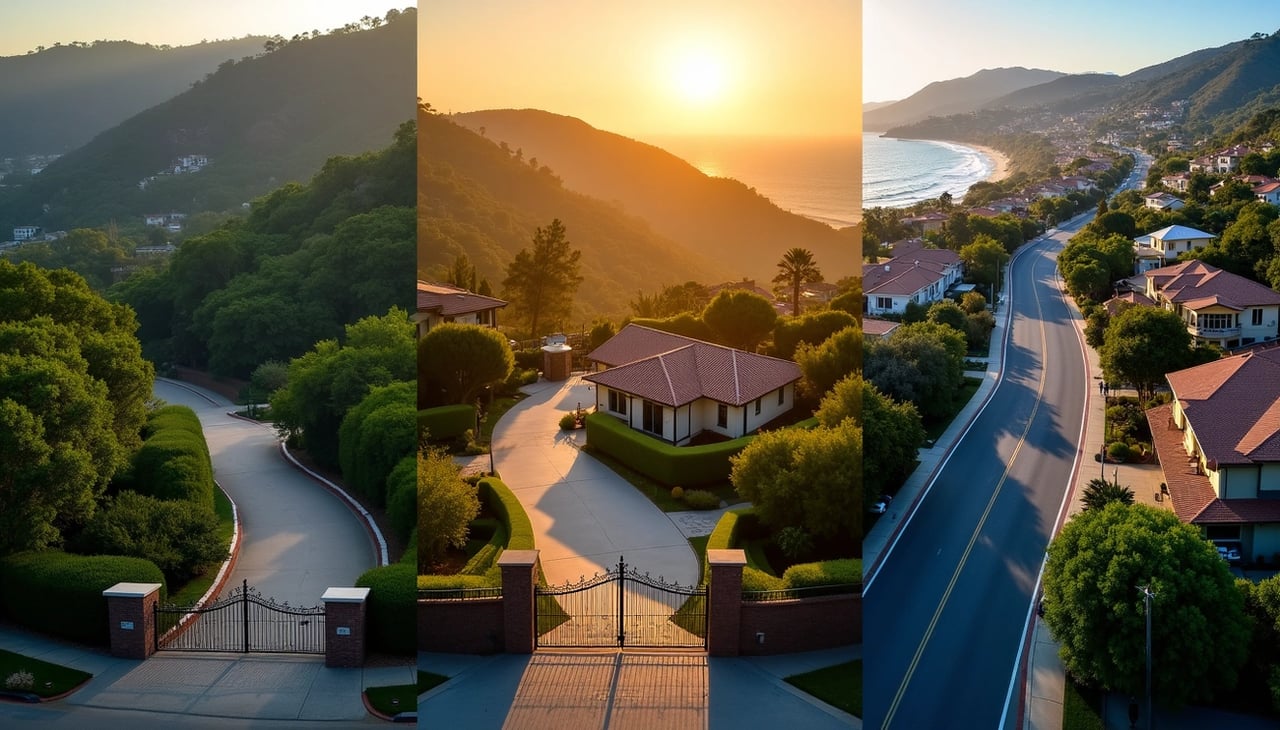
Malibu's beachfront location offers natural privacy through geography, but buyers seeking true seclusion in 2026 face a critical question: does coastal distance provide more protection than controlled gates?
Malibu California relies on sprawling lots and physical barriers. Pacific Palisades operates on an open-access model with community-defined privacy zones. Hidden Hills functions as an entirely gated enclave, where approximately 700 homes serve under 2,000 residents behind 24/7 security checkpoints.
High-net-worth buyers must consider more than views. The choice extends to daily exposure risks, from Nobu Malibu dining visibility to commute anonymity and paparazzi access points in these neighborhoods.
How Each Neighborhood Defines Privacy in 2026
Privacy in high-end residential enclaves operates beyond physical boundaries. The difference between neighborhoods lies not in their claims to exclusivity, but in their operational frameworks for controlling access, managing visibility, and maintaining resident anonymity.
Pacific Palisades open-access model
Pacific Palisades functions without community-wide gate restrictions. Residents rely on individual property security rather than collective checkpoints. Public roads connect homes to Palisades Village and surrounding areas. This creates natural exposure during routine activities. This open-access structure reflects the neighborhood's integration with Los Angeles city planning, where privacy stems from property-level measures instead of perimeter control.
Homeowners install private gates, surveillance systems, and landscaping barriers on their own parcels. The absence of mandatory entry protocols means visitors, delivery services, and the general public navigate streets freely. Buyers who value discretion must make significant investments in property-specific security infrastructure without the buffer of preliminary screening under this model.
Malibu's natural barrier approach
Malibu California uses geographic isolation as its main privacy mechanism. Properties spread across canyon terrain and beachfront parcels, where distance and topography create natural separation. The Pacific Coast Highway serves as the main artery, but homes positioned in secluded canyons or behind private beach clubs benefit from limited road access.
Malibu operates as an incorporated city with public access to beaches and commercial areas, unlike controlled communities. Nobu Malibu and similar establishments sit along available coastal routes. This places diners in view of passing traffic. Privacy depends on property location within the broader Malibu area rather than community-enforced restrictions.
Estate lots with extended driveways and hillside positioning offer seclusion through acreage and elevation. Fire trails and public lands border many properties though. This introduces exposure points that individual homeowners must address through fencing and monitoring systems.
Hidden Hills controlled-entry system
Hidden Hills operates as a fully gated city where access is a privilege, not a right. The community maintains three entrance points, each staffed around the clock by Gate Operations Officers. Gate staff log and monitor every vehicle entering the enclave through a digital pre-authorization system.
Visitors must present valid, government-issued photo identification before gaining entry. The Gate Operations Committee enforces strict protocols: guests receive permission only to visit the specific resident who authorized them. Unauthorized "short-cutting" through the community results in access restrictions. This creates a documented trail of every non-resident entering the approximately 700 homes serving under 2,000 residents.
The infrastructure extends beyond gate checkpoints. Hidden Hills contains over 25 miles of bridle trails with no public sidewalks and limited nighttime lighting. Interior estates enjoy multiple protection layers from surrounding properties, while perimeter homes backing onto trails or public lands face higher exposure risks.
Response protocols differ from public neighborhoods. The Los Angeles County Sheriff's Department contracts for police services through the Malibu/Lost Hills Station, but no deputies station inside Hidden Hills on a permanent basis. Emergency response times can exceed 5 to 7 minutes for high-priority incidents. This positions gate security and private protection teams as the ones who respond first rather than support services.
Gate Operations Officers function under independent contract, not serving as Association employees or complete security providers. The system filters unauthorized access but residents requiring executive protection supplement community gates with estate-specific security measures most of the time.
Physical Privacy Features Across All Three Areas
Physical barriers define privacy differently in these three neighborhoods. Hidden Hills enforces architectural control through gated infrastructure, while Malibu California and Pacific Palisades depend on setback distances and screening regulations to create separation.
Gate systems and security checkpoints
Hidden Hills maintains three entrance points. Gate Operations Officers staff each one and log every vehicle. The digital pre-authorization system requires residents to register guests before arrival and creates documented access records. Interior estates benefit from this perimeter control, though properties backing onto trails face exposure from public lands available without checkpoint screening.
Pacific Palisades and Malibu California operate without community-wide gate systems. Residents install private gates at property entrances, but public roads remain open to unrestricted traffic. This lack of preliminary screening means anyone can drive through neighborhoods, park on public streets, and approach homes.
Property setback requirements
Malibu's zoning ordinances require front yard setbacks of at least 20% of total lot depth, or 65 feet, whichever is less. Side yard setbacks must equal at least 25% of the total lot width when combined, with no single side setback less than 10% of the lot width. Rear yard setbacks reach at least 15% of lot depth.
Hidden Hills mandates 35-foot front yard setbacks measured from the road easement line. Side yard setbacks require 25 feet from the closest side lot line when abutting properties zoned RA-S, or five feet when abutting R-1 zoned properties. Rear yards extend at least 25 feet from rear lot lines adjacent to RA-S zones.
Pacific Palisades follows Los Angeles Municipal Code standards, which vary by specific tract. Some Marquez Knolls CC&Rs limit boundary fences and walls to three feet in height. This restricts privacy screening options compared to neighboring areas.
Hedge height and screening regulations
Malibu restricts front yard fences and walls to 42 inches, though open, non-view-obscuring fencing extends to six feet. Interior side and rear yards allow hedges and fences up to six feet. Coastal Development Permits apply when fencing could affect public access or sits on bluff or beachfront locations. Fire safety regulations prohibit flammable hedges within five feet of structures.
Pacific Palisades limits front yard fences, hedges, and trees to 3.5 feet in height under Los Angeles Municipal Code §12.22.C.20.(f). Side yards and rear yards permit six to eight feet depending on zoning and lot width. Properties in hillside areas face six-foot maximum heights whatever the lot width.
Hidden Hills applies similar height restrictions through its R-1 zoning, though specific community regulations may impose additional limitations on screening materials.
Driveway length and home visibility
Extended driveways provide substantial privacy advantages in all three areas. Malibu properties positioned deep within canyon lots or behind elevation changes achieve natural concealment from Pacific Coast Highway traffic. Properties near Nobu Malibu and Malibu Beach face higher visibility owing to coastal road proximity.
Hidden Hills estates often feature long internal driveways that wind through the property's 25-plus miles of bridle trails. Perimeter homes with shorter setbacks from public trails experience greater exposure despite gate-controlled street access.
Pacific Palisades homes near Palisades Village encounter walkability exposure. Shorter driveways and street-facing facades increase recognizability during daily activities.
Lot size effect on neighbor distance
Larger parcels create measurable separation between residences. Properties on acreage allow strategic house positioning to maximize distance from property lines and reduce visual and acoustic intrusion from neighboring activities.
Hidden Hills features sprawling estates and equestrian properties that ensure ample space between homes. Interior properties surrounded by other estates enjoy multiple protection layers, while boundary homes face different exposure profiles.
Malibu's canyon and beachfront lots vary in size and configuration. Hillside estates with substantial acreage achieve seclusion through topography and distance, whereas beach properties along continuous stretches of sand experience closer neighbor proximity despite substantial lot values.
Security Infrastructure and Privacy Protection
Security infrastructure operates on different models in these neighborhoods. Hidden Hills employs continuous guard staffing at controlled entry points. Malibu California and Pacific Palisades rely on patrol-based coverage without perimeter checkpoints.
24/7 guard presence vs patrol services
Hidden Hills maintains 24/7 manned gates with surveillance systems and private patrols. Gate Operations Officers process every vehicle that enters the community through digital pre-authorization systems. This constant presence creates response capability the moment incidents occur.
Pacific Palisades and Malibu operate without community-wide guard stations. Residents contract private security firms for estate-specific protection or periodic patrol services. Security costs in Hidden Hills range from $20 to $80 per hour for guard services. Most companies charge $35 to $55 per hour and $45 to $80 per patrol visit.
Guards respond to emergencies within seconds when situations develop. Mobile patrols that monitor multiple properties require minutes to respond, as officers rotate between sites. Properties with high vehicle and foot traffic or valuable assets need full-time guards for superior protection. Larger properties or lower-risk locations find mobile patrol services adequate without the expense of continuous staffing.
Surveillance camera policies
Hidden Hills completed installation of Flock Safety cameras at each gated entrance in 2026. These automated license plate recognition (ALPR) systems capture images of license plates and record vehicle characteristics such as color and type. The cameras position to avoid capturing images of private property and do not record drivers or passengers.
Authorized law enforcement agencies throughout California access license plate data through the system. This enables coordinated investigations across jurisdictions. The Lost Hills Sheriff's Station monitors vehicle traffic that enters the community with this technology.
HOAs can install security cameras in common areas under California Civil Code, but placement must respect privacy rights. Cameras cannot point at windows or inside individual homes. Parking lots, hallways and common areas remain permissible locations. Bathrooms, private balconies and similar spaces are prohibited. Homeowners must receive notice about camera locations and intended purposes.
Visitor verification protocols
Visitor management systems in gated communities require pre-registration by residents before guests arrive. Mobile app features allow residents to authorize visitors and ensure only those with proper credentials enter through access control gates. Security guards verify visitor details at checkpoints, often with QR codes for digital passes.
Hidden Hills requires valid, government-issued photo identification for all visitors before entry. Guards log every non-resident vehicle with timestamps and resident authorization. The Gate Operations Committee enforces strict protocols that prevent unauthorized short-cutting through the community.
Monitoring allows security personnel to respond to emergencies and identify unusual activity patterns. Visitor logs maintain detailed records available to property managers and HOA boards through cloud-based systems.
Community association privacy rules
HOAs must establish clear policies that define who can access surveillance footage and under what circumstances. Access should be limited to specific board members and property managers. Usage restricts to formal resident requests or law enforcement investigations. Footage retention policies specify storage duration before permanent deletion.
Data security protocols require password protection for digital documents that contain private information. Hard copies of confidential resident data must remain in locked, secure offices. Access to private information operates on a need-to-know basis among board members.
California privacy laws mandate transparency in surveillance practices. Communities must inform residents about data collection methods and security measures that protect their information. Violations of privacy regulations expose HOAs to legal disputes and loss of resident trust.
Celebrity Privacy: Which Area Handles It Best
Celebrity residents reveal privacy effectiveness through their actual behavior patterns, not marketing claims. The choice between visibility and seclusion becomes clear when we look at where high-profile individuals dine, how paparazzi access is different, and which neighborhoods maintain discretion over decades.
Nobu Malibu and public dining exposure
Nobu Malibu functions as a paparazzi staging ground. Celebrities accept photography as part of the dining experience. Justin Bieber confronted photographers outside the restaurant in June 2025 after dinner and shouted "I'm a real dad. I have a real family. I have a real kid. And I'm not to be fked with, by any of you". Bieber and wife Hailey returned at least twice the following week despite this outburst.
Kendall Jenner visited at least seven times after reopening. Kylie made three separate trips. Demi Lovato and fiancé Max Ehrich appeared six times between June and August. Leonardo DiCaprio, Kaia Gerber, and Jaden Smith each stopped by twice during the same period. The restaurant sits on the beach with panoramic ocean views built into its architecture. Diners become visible from Pacific Coast Highway and surrounding areas.
Celebrities who want genuine privacy know how to avoid photographers. They choose establishments like Soho House with regulated phone use and private rooms. Nobu Malibu represents the opposite choice. Paparazzi photograph arrivals and departures, with images selling between $6,000 and $100,000 each. DailyMail.com relies on Splash News photographers capturing Demi Lovato, Kevin Hart, and Kim Kardashian at the entrance.
Paparazzi access points by neighborhood
Malibu California presents unrestricted paparazzi access along public roads and beaches. Photographers stake out locations like Nobu Malibu, the Malibu Lumber Yard, and Starbucks without legal barriers. Certain businesses have designated "Paparazzi Free Zones," but photographers wait on sidewalks and public property to capture celebrities entering or exiting.
Hidden Hills operates under different parameters. The community maintains three separate guarded gates rather than one. This is a big deal as it means that paparazzi find it harder to predict celebrity exits and stake out positions. Kris Jenner described her Hidden Hills home as "a sanctuary, perfectly calm and peaceful" because her job is "hectic and chaotic". The Kardashian-Jenners, Drake, Travis Scott, Will Smith, Jada Pinkett Smith, Kevin Durant, and Lil Wayne all chose Hidden Hills. Security infrastructure was cited as the determining factor.
Pacific Palisades falls between these extremes. Open streets allow paparazzi movement, but the neighborhood lacks the concentrated celebrity dining destinations that draw photographer crowds. Tom Hanks, Steven Spielberg, and Anthony Hopkins made their homes in Pacific Palisades. The area generates fewer tabloid photos than Malibu beach locations.
Historical celebrity resident patterns
Hidden Hills demonstrates the strongest celebrity retention among buyers who prioritize discretion. The neighborhood attracted early residents before the Kardashians made it famous. Security emphasis clinched deals time and again. Some celebrities like Madonna and Miley Cyrus sold after brief stays, but the core group remains stable. Drake sold his three Hidden Hills properties in 2022 after a decade. Security wasn't cited as a departure factor.
Malibu hosts celebrities who accept higher visibility in exchange for coastal access. The $5.5 million average property price reflects beachfront premium, but paparazzi presence remains constant. Photographers monitor celebrities through residential neighborhoods and run stop signs and speed to capture shots.
Private beach clubs vs public spaces
Private beach clubs create controlled environments where members access serviced beach stretches with strict photography prohibitions. The most exclusive clubs ban members from discussing club activities with outsiders. Beach clubs like Jonathan Club require equity buy-ins approaching $85,000 plus $500 monthly fees. Nobu staff receive training to block unauthorized photos and ask guests to delete images taken without permission. The restaurant's public accessibility undermines these measures compared to membership-only venues that provide true seclusion.
Daily Privacy: School Runs, Shopping, and Commutes
Routine movements through neighborhoods expose residents nowhere near as much as isolated celebrity dining incidents would suggest. School runs, grocery shopping, and daily commutes create predictable patterns. High-profile individuals encounter the public without the buffer of private venues or advance security coordination.
Palisades Village walkability exposure
The pedestrian-friendly layout of Palisades Village makes it Pacific Palisades' social and commercial center. Residents stroll to boutiques, morning coffee, and casual dining without driving. Adam Sandler, Jennifer Garner, John Legend, Kevin Nealon, Billy Crystal, and Kate Beckinsale have been spotted moving through the curated shops and dining options. This walkability makes them unavoidably visible during errands.
Erewhon in Pacific Palisades operates as a hotspot for celebrity sightings. Regular patrons include Eva Longoria, Hailey and Justin Bieber, and the Kardashians. Gelson's Market on Sunset Boulevard sits about a mile inland from the beach between Santa Monica and Malibu California. Hollywood residents like Sally Field, Billy Crystal, and Cindy Crawford browse the aisles there. The concentration of high-profile residents in available retail spaces guarantees recognizability.
Malibu Beach PCH visibility risks
Pacific Coast Highway serves as the main route through Malibu and exposes drivers to constant observation. Over 15 million tourists visit Malibu each summer, with an estimated 40,000 daily commuters consisting of tourists and residents. Tourists driving along PCH look at celebrity houses on one side while viewing the Pacific Ocean on the other.
Calabasas Commons proximity for Hidden Hills
Hidden Hills residents access The Commons at Calabasas for upscale shopping and dining needs. The open-air Mediterranean architecture creates a sociable atmosphere. Nearly two dozen stores, including Kate Spade and Williams Sonoma Home, draw shoppers from all over Greater Los Angeles. Restaurants like Sugarfish by Sushi Nozawa draw crowds.
Recognizability in local businesses
Calabasas maintains a high local concentration of celebrities living in gated communities. This makes grocery store sightings routine rather than exceptional. Gelson's and Bristol Farms serve as typical encounter locations.
Privacy Cost Analysis: What You Pay for Seclusion
Financial seclusion in Los Angeles luxury markets operates through documented costs, not aspirational marketing. Buyers allocate budgets to security infrastructure, ongoing property obligations, and privacy maintenance that compounds each year.
HOA fees for gated security
Hidden Hills homeowners pay around $318 per lot each year for grounds maintenance, pool access, and security services. This contrasts with luxury developments where monthly dues exceed $1,500 to $2,000 for concierge services, golf courses, fitness centers, and round-the-clock security. California luxury properties range from $300 to $400 monthly. Los Angeles communities average $388.
Property tax rates in different neighborhoods
Pacific Palisades homeowners face a 1.64% rate. This results in around $25,000 each year for owners who have held their properties for decades. California's Proposition 13 limits annual increases to 2%, but properties undergo reassessment at sale. New buyers often see tax obligations double compared to previous long-term owners.
Maintenance costs for privacy landscaping
Hedge installation costs $10 to $45 per linear foot. Privacy bushes and shrubs cost $750 to $2,250 when planted together as a hedge 50 feet long and 4 to 6 feet tall. Ongoing trimming costs $5 to $20 per bush. Landscapers charge $50 to $100 per hour.
Insurance considerations for high-profile buyers
Affluent homeowners patch together complicated policies and face six-figure costs.
Comparison Table
Malibu vs Palisades vs Hidden Hills: Privacy Comparison Table
Luxury real estate in Los Angeles isn't driven by headlines—it's shaped by private conversations, timing, and access. The most meaningful transactions often unfold in trusted circles where discretion carries as much weight as value. Those who understand this world know that visibility is secondary to precision. Timing is everything.
Christina Pope—Sotheby's International Realty, EliteResidenceInternational.com
| Feature | Malibu | Pacific Palisades | Hidden Hills |
|---|---|---|---|
| Privacy Model | Natural barrier approach using geography and distance | Open-access model with property-level security | Controlled-entry gated community system |
| Gate System | No community-wide gates; individual property gates only | No community-wide gates; individual property gates only | Three staffed entrance points with 24/7 Gate Operations Officers |
| Access Control | Public roads and beaches; unrestricted access | Public roads; unrestricted access | Digital pre-authorization system; government-issued photo ID required for all visitors |
| Population Density | Not specified | Not specified | Approximately 700 homes serving under 2,000 residents |
| Front Yard Setback | Minimum 20% of lot depth or 65 feet (whichever is less) | Varies by tract per LA Municipal Code | 35 feet from road easement line |
| Side Yard Setback | Cumulatively 25% of lot width; minimum 10% per side | Varies by tract per LA Municipal Code | 25 feet (abutting RA-S zones) or 5 feet (abutting R-1 zones) |
| Rear Yard Setback | Minimum 15% of lot depth | Varies by tract per LA Municipal Code | 25 feet (adjacent to RA-S zones) |
| Front Yard Fence/Hedge Height | 42 inches (solid); 6 feet (open/non-view-obscuring) | 3.5 feet maximum | Similar to R-1 zoning standards |
| Interior Fence/Hedge Height | 6 feet (side and rear yards) | 6-8 feet (depending on zoning and lot width) | Per R-1 zoning standards |
| Security Staffing | No community-wide guards; private patrol services only | No community-wide guards; private patrol services only | 24/7 manned gates with surveillance systems and private patrols |
| Surveillance Technology | Individual property systems only | Individual property systems only | Flock Safety ALPR cameras at all entrances (installed 2026) |
| Emergency Response Time | Standard LASD response | Standard LASD response | 5-7 minutes for high-priority incidents |
| Visitor Verification | None at community level | None at community level | Pre-registration required; all visitors logged with timestamps |
| Paparazzi Access | Unrestricted access along public roads and beaches | Open streets allow movement but fewer celebrity hotspots | Three separate guarded gates make stakeouts much harder |
| Celebrity Dining Exposure | High (Nobu Malibu as paparazzi staging ground) | Moderate (Palisades Village, Erewhon sightings) | Low (dining occurs outside community) |
| Daily Commute Visibility | High (PCH with 40,000 daily commuters and 15M summer tourists) | Moderate (walkable village creates visibility) | Low (controlled exits through three gates) |
| Shopping Exposure | High (Malibu Lumber Yard, public Starbucks) | High (Palisades Village walkability, Erewhon, Gelson's) | Moderate (The Commons at Calabasas nearby) |
| Annual HOA Fees | Not applicable (incorporated city) | Varies by development | Approximately $318 per lot |
| Property Tax Rate | Standard California rate (~1.25% base) | 1.64% (approximately $25,000 per year for long-term owners) | Standard California rate (~1.25% base) |
| Average Property Price | $5.5 million | Not specified | Not specified |
| Private Security Costs | $35-$55/hour guards; $45-$80/patrol visit | $35-$55/hour guards; $45-$80/patrol visit | $20-$80/hour guards (most $35-$55); $45-$80/patrol visit |
| Privacy Landscaping Costs | $10-$45/linear foot installation; $5-$20/bush trimming | $10-$45/linear foot installation; $5-$20/bush trimming | $10-$45/linear foot installation; $5-$20/bush trimming |
| Notable Celebrity Residents | Justin Bieber, Hailey Bieber, Kendall Jenner, Kylie Jenner, Leonardo DiCaprio | Tom Hanks, Steven Spielberg, Anthony Hopkins, Adam Sandler, Jennifer Garner | Kardashian-Jenners, Drake, Travis Scott, Will Smith, Jada Pinkett Smith, Kevin Durant, Lil Wayne |
| Primary Privacy Advantage | Geographic isolation through canyon terrain and beachfront distance | Individual property security with urban integration | Multi-layered controlled access with documented entry logs |
| Primary Privacy Disadvantage | High tourist traffic (15M summer visitors); paparazzi unrestricted on public roads | No perimeter control; walkable village increases daily visibility | Perimeter homes backing onto public trails face exposure; 5-7 minute emergency response |
Conclusion
The privacy equation is different in all three neighborhoods. Hidden Hills delivers documented access control through 24/7 gates and Flock Safety cameras at every entrance. Malibu California trades controlled perimeters for geographic isolation and accepts PCH visibility with unrestricted paparazzi access in exchange for beachfront living. Pacific Palisades operates without community-wide gates and positions walkability above controlled entry points.
Buyers who prioritize seclusion over convenience will find Hidden Hills provides measurable protection through checkpoint screening. Celebrities who seek a coastal lifestyle with managed visibility find Malibu adequate despite tourist traffic. Pacific Palisades suits those comfortable with property-level security in an open environment that's available to the public.
Key Takeaways
For luxury buyers seeking privacy in 2026, each neighborhood offers distinct protection models with measurable trade-offs between seclusion and lifestyle access.
• Hidden Hills provides maximum privacy through 24/7 gated checkpoints with digital pre-authorization systems and documented visitor logs, making it the clear choice for celebrities prioritizing complete seclusion.
• Malibu trades controlled access for geographic isolation, accepting PCH visibility and unrestricted paparazzi access in exchange for beachfront living and natural canyon barriers.
• Pacific Palisades operates on an open-access model where privacy depends entirely on individual property security rather than community-wide perimeter control.
• Daily exposure risks vary dramatically by location: Hidden Hills residents exit through controlled gates, while Malibu's PCH sees 40,000 daily commuters and Pacific Palisades' walkable village creates routine visibility.
• Privacy costs extend beyond purchase price with Hidden Hills charging $318 annually for security, while all areas require $10-45 per linear foot for privacy landscaping and $35-55 hourly for private guards.
The choice ultimately depends on whether buyers prioritize documented access control (Hidden Hills), geographic barriers (Malibu), or urban integration with property-level security (Pacific Palisades). Each model serves different privacy needs and lifestyle preferences in the luxury Los Angeles market.
FAQs
Q1. What makes Hidden Hills more private than Malibu or Pacific Palisades? Hidden Hills operates as a fully gated community with three staffed entrance points monitored 24/7. Every visitor must present a government-issued photo ID and receive pre-authorization from residents before entry. The community uses digital logging systems and Flock Safety cameras to track all vehicles. In contrast, Malibu and Pacific Palisades have no community-wide gates, allowing unrestricted public access to their streets.
Q2. How much do homeowners pay annually for security in these neighborhoods? Hidden Hills residents pay approximately $318 per year per lot for community security services, grounds maintenance, and pool access. Private security guards across all three areas typically cost $35-55 per hour, with patrol services ranging from $45-80 per visit. Privacy landscaping installation costs $10-45 per linear foot, with ongoing hedge trimming at $5-20 per bush.
Q3. Can paparazzi access celebrity homes in these neighborhoods? Paparazzi have unrestricted access to public roads and beaches in Malibu and Pacific Palisades, allowing them to stake out locations like Nobu Malibu and Palisades Village. Hidden Hills presents substantially greater challenges with three separate guarded gates that make it difficult for photographers to predict exits or position themselves for shots. All visitors must show ID and receive authorization before entering Hidden Hills.
Q4. Which neighborhood has the strictest property setback requirements for privacy? Malibu requires front yard setbacks of at least 20% of lot depth or 65 feet (whichever is less), with side yards totaling 25% of lot width. Hidden Hills mandates 35-foot front setbacks and 25-foot side setbacks when adjacent to certain zones. Pacific Palisades follows Los Angeles Municipal Code standards that vary by tract, with some areas limiting boundary fences to just three feet in height.
Q5. How does daily shopping exposure differ between these three areas? Pacific Palisades features walkable Palisades Village where residents frequently encounter others at Erewhon and local boutiques. Malibu shoppers face high visibility along Pacific Coast Highway, which sees 40,000 daily commuters and 15 million summer tourists. Hidden Hills residents must leave the gated community to shop at nearby Calabasas Commons, but they exit through controlled checkpoints rather than open streets.