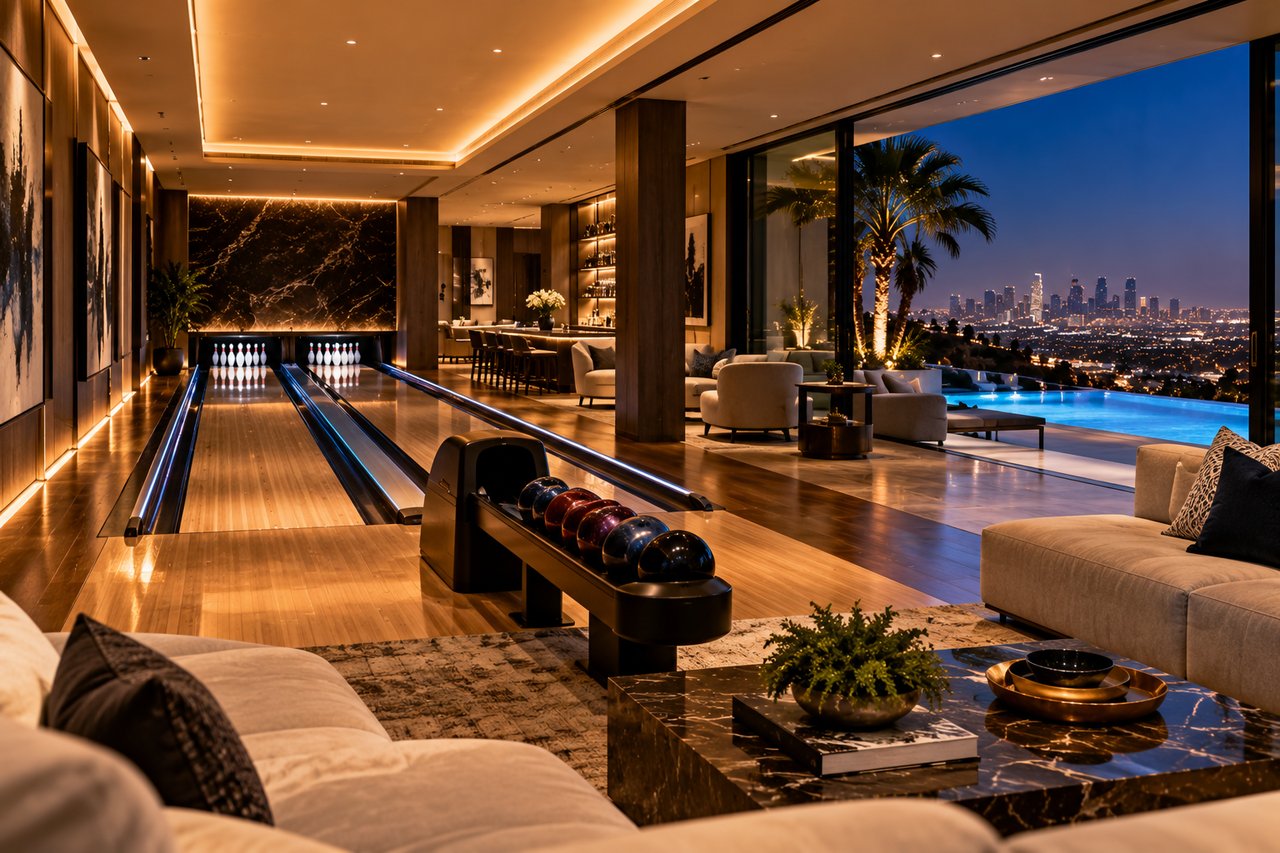
The bowling alley has found its way back into the luxury home — and this time, it carries serious real estate weight. Once considered a novelty, it now ranks among the amenities that define a property's entertainment caliber. The range speaks for itself: a $21 million La Jolla estate with a two-lane alley, the $129 million Palazzo di Amore in Beverly Hills, and properties featuring full arcade spaces and multi-lane setups with custom branding. For ultra-wealthy buyers, the appeal sits at the intersection of nostalgia and modern luxury — a combination that proves surprisingly difficult to replicate with other high-end features. What that means for property values, installation costs, and resale positioning in today's market is worth understanding closely.
The Nostalgic Appeal: Why Bowling Alleys Are Making a Comeback in Luxury Homes
"The backyard is now one of our favorite parts of the house, with a play area for the kids, space for entertaining, a covered porch for outdoor dining, and greenery in every direction. We love the balance of beauty and functionality." — Tripta, TJH Homeowner, Cupertino
From White House to Your House: A Brief History
The cultural legitimacy of the home bowling lane has a clear starting point. President Harry S. Truman officially opened the first White House bowling alley on April 19, 1947 — a two-lane installation in the West Wing, gifted by fellow Missourians. Truman himself had barely bowled since his teenage years, yet his inaugural roll knocked down seven pins, one of which now sits at the Smithsonian Institution.
Those original lanes moved to the Old Executive Office Building in 1955 and eventually gave way to the White House Situation Room during Kennedy's administration. President Nixon, a far more devoted bowler, had a one-lane alley constructed beneath the North Portico in 1973 and spent considerable hours there refining his game. The result of that presidential tradition was simple but lasting: bowling shed its purely commercial association and took on a different kind of status altogether.
The Psychology Behind Childhood Recreation Spaces
Most high-end amenities share a common fate — they photograph well and collect dust. Bowling tends to resist that pattern. Holiday gatherings, birthday celebrations, casual weekends — the lane finds its way into the activity naturally. Kids take to it immediately. Adults rediscover something they had forgotten they enjoyed. Guests who have never bowled in their lives step right up.
Agent Stacy Gottula has observed this firsthand: every time she shows a home for sale with a bowling alley feature, faces light up and everyone wants to try it. That reaction is telling. The lane becomes the detail clients remember long after the showing ends. The psychological pull here is not complicated — nostalgia paired with something that actually works for the whole family tends to stick.
What Today's Ultra-Wealthy Buyers Actually Want
The wish list for luxury buyers has grown more specific. Game rooms, golf simulators, pool tables, and bowling alleys now rank as genuine priorities rather than pleasant surprises. A recent Canadian project assembled an entire entertainment floor — bowling alley, cheese-tasting room, movie theater, game areas, and cigar lounge — all under one roof. The thinking behind it reflects what buyers with families are actually asking for: spaces where multiple generations can find something that suits them.
Gottula puts it plainly — bowling alleys show up most consistently in the homes of active families who want recreation, comfort, and entertainment without leaving the property. That expectation has quietly reshaped how high-end residential design is being approached, and nowhere is that more visible than in Los Angeles.
Inside LA's Most Spectacular Mansions with Indoor Bowling Alleys
"A purchase in Beverly Hills is a strategic move to preserve and grow generational wealth." — Ray Lyon, Real estate expert

Image Source: Instagram
Luxury real estate in Los Angeles operates largely through private channels, where discretion carries as much weight as the asking price. The most consequential transactions happen within trusted circles, well before a property ever reaches a public listing. Christina Pope at Sotheby's International Realty (EliteResidenceInternational.com) understands this market intimately and brings that advantage to every client relationship.
Beverly Hills: Where Vintage Meets Modern Luxury
Paul Williams designed 9555 Heather Rd in 1941, a compound now listed at $22.5 million. Three separate structures define the property, with the entertainment area overlooking tennis courts and housing a wood-paneled bowling alley alongside a game room and bar. Originally built for actor Bert Lahr, the alley is a genuine artifact of Golden Age architecture — the kind that cannot be recreated, only preserved.
Pacific Palisades and Bel Air: Coastal Estates with Strike-Worthy Features
Bel Air's 277 St. Pierre Rd offers 36,000 square feet on a single acre, priced at $49.9 million. Its 20,000-square-foot entertainment complex covers a custom two-lane bowling alley, indoor pool, spa, massage room, theater, and racquetball court. The VANTAGE estate at 2078 Stradella Rd commands $38 million for 18,240 square feet of glass-wrapped living space — a property where the architecture itself does the entertaining.
Hidden Gems: Greystone Mansion and Historic Properties
Gordon B. Kaufmann designed Greystone Mansion's recreation wing with an original Brunswick bowling alley on the lower level. That two-lane installation actually shaped the theater directly above it, dictating its narrow footprint. Production teams for "There Will Be Blood" later discovered the deteriorated alley and restored it to its 1920s specifications — a rare instance where Hollywood brought history back rather than replacing it.
New Developments: Contemporary Homes for Sale with Bowling Alley
Paul McClean's 9126 Cordell Dr lists at $85 million, with 23,894 square feet spread across five levels. Hidden Hills adds 24255 Bridle Trail Rd at $39.995 million and 20,018 square feet, while Calabasas presents 25201 Prado Del Misterio at $15.995 million, complete with a detached two-lane entertainment center. Each property reflects a different interpretation of what private recreation looks like at this level of the market.
The Investment Case: What a Luxury Home Bowling Alley Adds to Property Value
How Much to Put a Bowling Lane in Your House
The cost of a single traditional lane runs between $75,000 and $175,000, covering the lane surface, pinsetter, ball return, and scoring systems. Two-lane configurations typically fall between $110,000 and $175,000, climbing to $200,000 with customization. Premium multi-lane setups — those with designer finishes, acoustic paneling, and LED lighting — can exceed $500,000. Homes with bowling lanes in California generally start at $5 million, with the strongest concentration in Beverly Hills, San Diego, and the Bay Area.
Resale Value and Market Positioning
Real estate agents consistently report a 5-10% value increase for properties with distinctive amenities like bowling alleys. Leisure areas command premium positioning in luxury markets, and homes built around sought-after features tend to hold their desirability well. That said, a private lane is ultimately a lifestyle purchase — the returns are meaningful, but they are not guaranteed. The feature earns its place most convincingly in properties above the $2 million mark.
The Christina Pope Perspective: Strategic Amenities in High-End Real Estate
Christina Pope brings a genuinely global perspective to luxury real estate — one shaped by years in the Dubai market and an intimate understanding of what discerning buyers expect at every price point. Her focus on Beverly Hills and Hollywood Hills is matched by her ability to identify the kinds of properties that align with both lifestyle aspirations and long-term investment thinking. For clients who love to entertain, she understands that the right home makes all the difference. Whether you are ready to purchase or just beginning to explore, Christina would be delighted to help.
Christina Pope 📞 310-404-9931 ✉️ [email protected]
Beyond Bowling: The Complete Entertainment Experience in Modern Luxury Estates
Game Rooms, Theaters, and Multi-Purpose Spaces
A bowling alley rarely stands alone in a well-designed luxury estate — it anchors a larger entertainment vision. Home theaters connect to bowling lanes through smart home systems that manage lighting, audio, and climate from a single tablet. One Arizona estate brought together a bowling alley, indoor shooting range, golf simulator, and billiards room beneath a fiber-optic star ceiling — the kind of space where guests genuinely lose track of time.
Automated scoring, customizable lighting effects, and voice-activated controls make these rooms easy for any guest to enjoy without instruction. Whole-home audio carries music from the lanes through to adjacent bars and outdoor areas, so the atmosphere holds from one space to the next.
Design Trends: Vintage Charm vs. High-Tech LED Lanes
The choice between vintage and modern defines the personality of the entire entertainment floor. Spark technology projects interactive games and visuals directly onto lane surfaces, producing personalized backgrounds and ball throw trails that tend to make an impression on guests. Maintenance on these systems runs $200 to $400 annually for string pinsetters, compared to $1,500 to $3,500 for traditional mechanical setups — a practical consideration that often tips decisions.
Vintage installations take a quieter approach: original wood, softer lighting, and restored 1950s Brunswick equipment. The pace slows naturally, leaving room for conversation between turns rather than automated prompts pushing the game along.
Practical Considerations and Maintenance
The physical requirements are specific and worth accounting for early in any renovation or build. Standard lanes call for roughly 14 feet of width per lane and a 420mm slab set-down below the finished floor level. Synthetic surfaces run $20,000 to $60,000 per lane, while traditional hardwood ranges from $40,000 to $100,000. Annual mechanical service keeps everything running reliably — and for properties at this level, consistency in the details matters as much as the original installation.
Neighborhood blurbs
Bel Air. A newly built 18,240-square-foot Bel Air estate was listed at $38 million with a private two-lane bowling alley and full bar. Its other features include a cinema-grade theater, wine cellar, and full wellness suite. That pairing, lanes plus spa plus screening room, shows how Bel Air buyers think about entertaining: one lower level that serves every mood. Christina Pope advises buyers to ask how the lanes were built for sound isolation and who services them, because privacy is the point here. Bel Air guide →
Beverly Hills. Beverly Hills is where entertainment becomes a full production. One estate returned to the market in 2025 at $195 million, with a bowling alley alongside a 50-seat movie theater. At this level, the lanes are one piece of a showpiece program built for hosting. Christina Pope tells sellers to present them as part of a complete entertainment story, with the theater, bar, and lounge staged together, instead of as a novelty tucked in a basement. Beverly Hills guide →
Hollywood Hills. The Hollywood Hills has one of the more memorable examples: a 24,000-square-foot, five-story compound with a two-lane bowling alley. Hillside lots build up and down, so entertainment levels tend to stack vertically, which gives game rooms a natural home under the main living space. It suits the area's creative energy and its taste for architecture with personality. Christina Pope helps buyers weigh how the lanes fit the home's layout and views. Hollywood Hills guide →
Brentwood. Brentwood shows the trend at a more approachable scale. A Governors Club estate on 1.8 acres, with a two-lane bowling alley, arcade, theater, and billiards, went to auction in 2025 with bidding opening at $3.4 million. Add a putting green, pickleball, and basketball courts, and you have a home designed for gatherings of every age. Christina Pope notes that this "everything at home" idea appeals to Brentwood buyers who love to host. Brentwood guide →
Pacific Palisades. Pacific Palisades is a lighter fit for the bowling-alley story, because I found no recent listings with lanes. What does fit is the neighborhood's rebuilding chapter. Homes built from scratch can include a lower-level game or family lounge from day one, instead of retrofitting one into an older floor plan. Christina Pope helps clients think through what an entertainment space should include before plans are finalized. Pacific Palisades guide →
Hidden Hills. Hidden Hills is also a lighter fit, since I found no published listings with indoor lanes. What defines this market is land: gated, generous lots where entertainment tends to spill outdoors. For buyers who love the nostalgic, play-first idea, the question becomes whether a property has room for a detached game pavilion or guest entertainment building, and what the community's rules allow. Christina Pope helps buyers see what a lot could become. Hidden Hills guide →
Malibu. Malibu leans analog in its own way. One $8 million Malibu property is a restored barn with a billiards table and bar, a charming example of a game room that feels like a getaway. Coastal living favors indoor-outdoor entertaining over basement lanes, so billiards, lounges, and fire-pit terraces tend to win here. Christina Pope helps buyers find the version of nostalgic entertainment that suits the coast. Malibu guide →
Ready to find your own home with a little play built in?
Reach Christina Pope through Contact or at (310) 404-9931, request a Home Valuation, explore Relocation and Global Listings, read more on the Blog, or learn About Christina.
Conclusion
The bowling alley is no longer just a conversation piece — it is a genuine signal of what a property offers its owners and their guests. Costs range from $75,000 for a single traditional lane to well above $500,000 for premium multi-lane configurations, and in the right property, that investment translates to a 5-10% premium at resale. More than the numbers, though, these spaces deliver something few high-end amenities can: consistent, multi-generational use that makes a home worth returning to.
For clients who entertain often and expect their home to reflect that, the right property makes all the difference. Christina Pope, with her background in international luxury markets and a practiced eye for homes that balance lifestyle with long-term value, would be glad to help identify the right fit. Reach her at 310-404-9931 or [email protected].
Key Takeaways
Luxury home bowling alleys have evolved from novelty features into strategic amenities that signal a property's entertainment caliber, with installations ranging from $75,000 to over $500,000 depending on customization and lane configuration.
• Presidential heritage legitimized home bowling: The White House installed its first bowling alley in 1947, transforming bowling from commercial recreation into a prestigious luxury amenity that signals status and sophistication.
• Family entertainment drives buyer demand: Ultra-wealthy buyers prioritize multi-generational spaces, with bowling alleys offering universal appeal that engages children, adults, and guests unlike other high-end features that often go unused.
• Installation costs vary dramatically by scope: Single traditional lanes start at $75,000-$100,000, while premium multi-lane setups with designer finishes and LED technology can exceed $500,000, requiring 14 feet of width per lane.
• Resale value increases 5-10% in luxury markets: Properties with unique entertainment amenities like bowling alleys command premium positioning, though meaningful value addition typically occurs only in homes exceeding $2 million.
• Modern lanes blend nostalgia with technology: Today's installations range from vintage 1950s Brunswick equipment emphasizing conversation to high-tech Spark systems projecting interactive games directly onto lane surfaces for social media-worthy experiences.
The trend reflects a broader shift toward creating comprehensive entertainment ecosystems within luxury estates, where bowling alleys integrate with home theaters, game rooms, and smart home systems to deliver elevated living experiences that preserve and grow generational wealth.
FAQs
Q1. How much does it cost to install a bowling alley in a luxury home? Installing a bowling alley in a luxury home typically costs between $75,000 and $175,000 for a single traditional lane. Two-lane configurations range from $110,000 to $175,000, and can reach $200,000 with customization. Premium multi-lane setups featuring designer finishes, acoustic paneling, and LED lighting systems can exceed $500,000. Synthetic lane surfaces cost $20,000 to $60,000 per lane, while traditional hardwood runs $40,000 to $100,000 per lane.
Q2. Do bowling alleys increase property value in luxury homes? Yes, bowling alleys can increase property values by 5-10% in luxury markets. Properties with unique entertainment amenities like bowling alleys command premium positioning and enhanced desirability. However, meaningful value addition typically occurs only in homes exceeding $2 million. The feature functions more as a lifestyle purchase that enhances market positioning rather than a guaranteed investment return.
Q3. What are the space requirements for a home bowling alley? A home bowling alley requires approximately 14 feet of width per lane and a 420mm slab set-down below the finished surface. The length needs to accommodate the full regulation lane, pin deck, and ball return system. Properties with bowling lanes typically need substantial square footage, which is why homes featuring these amenities usually start at $5 million and are concentrated in areas like Beverly Hills, San Diego, and the Bay Area.
Q4. What maintenance does a residential bowling alley require? Maintenance costs vary significantly based on the pinsetter type. String pinsetters cost $200 to $400 annually for maintenance, while traditional mechanical systems require $1,500 to $3,500 per year. Annual mechanical service completes the maintenance schedule. Modern installations with smart technology may also require periodic software updates and system checks to maintain optimal performance.
Q5. Why are bowling alleys becoming popular in luxury homes again? Bowling alleys offer universal appeal that engages multiple generations, from children to adults and guests. Unlike other high-end amenities that often go unused, bowling lanes naturally become part of family gatherings, birthday celebrations, and weekend entertainment. The feature combines nostalgia with practical functionality, creating memorable experiences that make properties stand out. Ultra-wealthy buyers increasingly prioritize multi-generational entertainment spaces that provide comfort, convenience, and recreation under one roof.