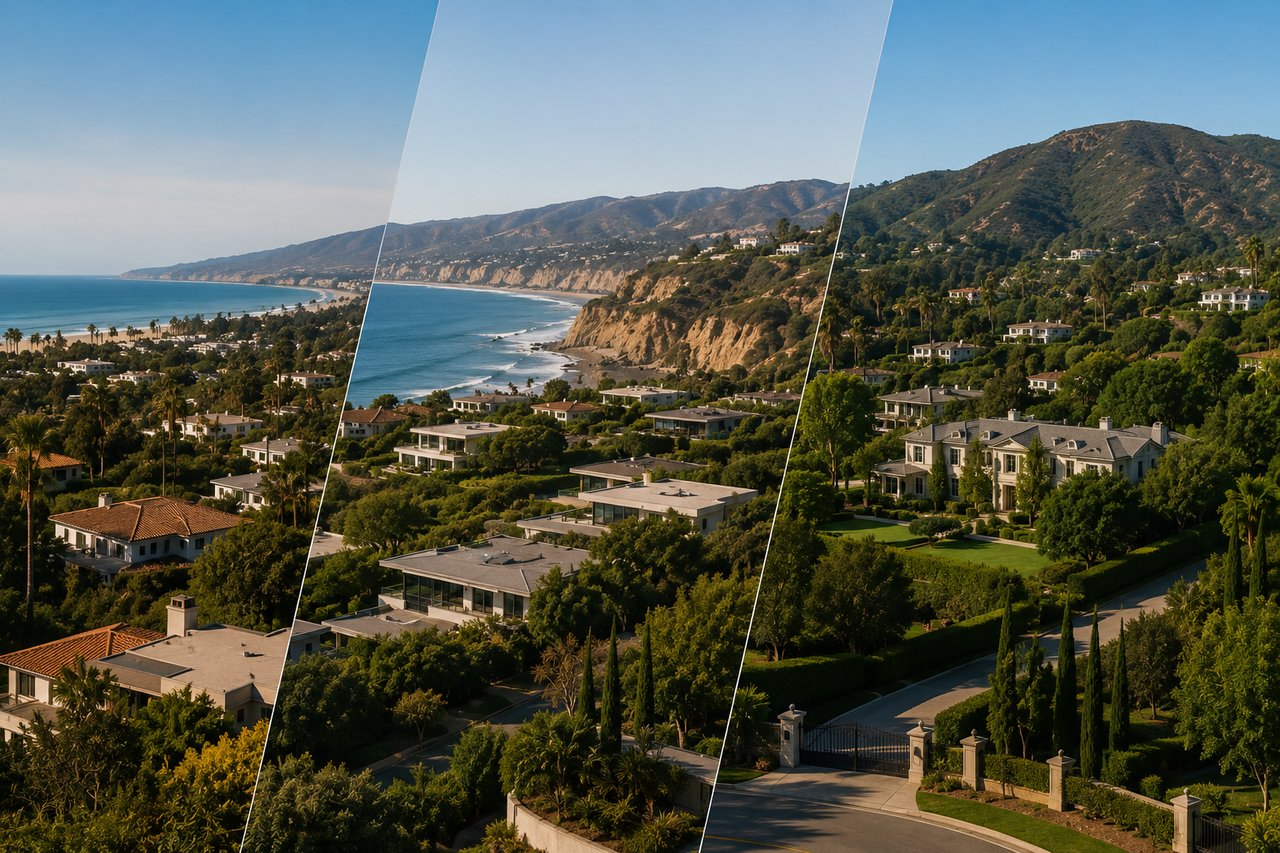
Location and Geographic Context: Where Pacific Palisades, Malibu, and Hidden Hills Are Located
Pacific Palisades CA Location: Between Santa Monica and Malibu in Los Angeles County
Pacific Palisades sits on the Westside of Los Angeles, approximately 20 miles west of downtown, occupying 24.31 square miles, 22.84 of which are land, the remaining 1.47 water. For tax purposes, Los Angeles County jurisdiction applies throughout.
The neighborhood's character is shaped as much by what surrounds it as by what lies within. The Pacific Ocean and Will Rogers State Beach define its southern edge, with Brentwood to the east and the unincorporated community of Topanga to the west. The Santa Monica Mountains form a natural boundary to the north. The Palisades coastline runs roughly three miles, with its western edge placed at the Castellammare area near the J. Paul Getty Museum, a boundary that feels more like a landmark than a line on a map.
Malibu's 27-Mile Coastal Stretch Along Pacific Coast Highway
Malibu's 27-mile coastline along Pacific Coast Highway is one of the most recognized stretches of road in the world. Highway 1 runs with ocean on one side and the Santa Monica Mountains on the other, passing surf breaks and beaches from the Santa Monica Pier northwest toward the Ventura County line a drive that takes roughly 45 minutes without stops.
Traveling south from Ventura, the descent into Malibu past Point Mugu announces itself through dramatic sea cliffs. That continuous coastal access is precisely what separates Malibu's real estate value from anything inland and what makes its pricing reflect something beyond square footage.
Hidden Hills: Gated Community in Western San Fernando Valley
Hidden Hills functions as both a city and a gated community within Los Angeles County. Tucked near the southern Simi Hills Transverse range, it sits adjacent to Calabasas along the western edge of the San Fernando Valley, close to the Ventura County border. The total area measures just 1.688 square miles, all of it land.
Woodland Hills and Calabasas share its borders, while the Upper Las Virgenes Canyon Open Space Preserve stretches along its northern edge offering miles of equestrian, hiking, and mountain biking terrain to residents. To the south, the Leonis Adobe National Historic Landmark adds a rare layer of historical depth to an otherwise contemporary enclave. At roughly 30 miles from downtown Los Angeles, the distance feels intentional privacy by geography as much as by gate.
Distance Comparisons: Pacific Palisades to Beverly Hills and Downtown LA
Pacific Palisades to Beverly Hills covers 9.7 miles by car, typically around 18 minutes in reasonable traffic. The straight-line distance measures closer to 7 miles. Sunset Boulevard offers a scenic route past the Getty Center and UCLA, while the 405 Freeway moves faster when traffic cooperates. Pacific Coast Highway remains a coastal option, though it adds time. Depending on the hour and route, actual commute times range from 20 to 45 minutes a variable that carries real weight for professionals commuting daily between the Palisades and the city's business centers.
Income Demographics: Pacific Palisades Median Income vs Malibu vs Hidden Hills
Pacific Palisades Average Income: $132,000 Individual, $192,476 Household
The income gap between these three communities is meaningful and worth understanding before making any decisions. Pacific Palisades median income for households stands at $174,406, with alternative figures placing it closer to $185,362 either way, well above the national median of $80,734. Individual earnings average $135,206 annually. The neighborhood draws 23,717 residents with a median age of 47, a profile that reflects decades of career building rather than inherited wealth alone.
The professional concentration here is notable. White-collar employment accounts for 99% of the workforce, with just 1% in blue-collar roles. Households where 47% report married status and 32% include children signal a community structured around long-term stability. With 9,311 total households averaging three residents and a median household income that approaches double Los Angeles County's $108,100 figure for 2026, Pacific Palisades occupies a distinct tier comfortable, established, and quietly competitive.
Malibu Household Income and Wealth Indicators
Malibu's median household income reaches $194,421, putting it just ahead of Pacific Palisades but well below Hidden Hills. Per capita income sits at $101,932. Married families here earn a median of $250,001, and family units overall show a median of $249,451 with mean income reaching $421,200. Non-family households drop to $94,250 median and $170,342 mean.
A 12.55% poverty rate does suggest more economic range within the community than the headline figures imply. Homeownership at 75.4% lower than Hidden Hills reflects the reality that coastal property in Malibu is genuinely difficult to access, even for high earners. The community accommodates a wide band of residents, from beachfront estate owners to those employed in the local hospitality and service sectors.
Hidden Hills Income Levels and Resident Profiles
Hidden Hills holds the highest income figures among the three. Median household income stands at $250,001, with some sources reporting $278,705. Average household income reaches $417,850. Per capita income at $137,388 sits at more than double the Los Angeles-Long Beach-Anaheim metro figure of $47,931 and the California state average of $49,513.
The consistency across age groups is striking. Households led by residents aged 25-44 and 45-64 both earn $250,001 at the median. Senior-led households come in at $216,250. With 90.4% of residents above the poverty line just 204 individuals below it compared to 1,931 above the community reflects concentrated, multigenerational wealth. A homeownership rate of 92.4% and an average of three vehicles per household round out a profile that is, in nearly every measurable way, uniform in its affluence.
How Income Levels Shape Community Character
Where people live shapes how they live. Hidden Hills residents average a 25.2-minute commute despite sitting 30 miles from downtown Los Angeles. Pacific Palisades professionals manage 20 to 45 minutes to Beverly Hills, depending on traffic and route. School choices follow income levels, with families across all three communities drawing from the same pool of high-tuition private institutions.
U.S. citizenship rates in Hidden Hills reach 95.3%, and no non-English primary languages are reported among households — a degree of homogeneity that sets it apart from the broader Los Angeles County demographic. Pacific Palisades mirrors this professional concentration at 99% white-collar employment. Malibu, by contrast, carries a wider income band that includes those who serve the community alongside those who own it.
Housing Costs and Entry Requirements: Matching Budget to Neighborhood
"Real estate cannot be lost or stolen, nor can it be carried away. Purchased with common sense, paid for in full, and managed with reasonable care, it is about the safest investment in the world." — Franklin D. Roosevelt, U.S. President
The entry costs across these three communities differ far more than their geography suggests. Each neighborhood carries its own financial infrastructure — one that extends well beyond the listing price and shapes what ownership actually demands month to month.
Median Home Prices: $3.97M vs $5.65M vs $9.35M
Pacific Palisades sits at a $3.97 million median, with current listings trending slightly lower at $3.60 million. Malibu holds at $5.65 million for most properties, with median listings close behind at $5.60 million. Hidden Hills commands $9.35 million at the median, though 2026 listing data shows prices reaching $12 million.
Beachfront parcels in Malibu average $9.83 million, with per-acre costs at $16.20 million. Hidden Hills ultra-luxury estates move well past $15 million, with select properties approaching $30 million. Within Pacific Palisades itself, prices span considerably Alphabet Streets range from $2.50 million to $7 million, while El Medio oceanfront homes start at $4 million and climb past $30 million.
Property Tax Rates: 1.22%–1.64% Effective Rates
Proposition 13 sets the foundation at a 1% base rate, with local assessments added on top. Pacific Palisades carries an effective rate between 1.22% and 1.64%, with the typical homeowner paying roughly $25,000 annually. Malibu homeowners see rates between 1.22% and 1.25%, with median annual taxes at $19,365.
Hidden Hills runs a 1.14% effective rate, producing median tax bills of $33,158 — though the range is wide, from $19,021 at the 25th percentile to $54,207 at the 75th. Worth noting: Proposition 13 caps annual increases at 2%, but a sale triggers full reassessment. New buyers frequently find their tax obligations nearly double what the previous owner was paying.
HOA Fees and Community Assessment Costs
Hidden Hills homeowners pay $200 annually per lot, plus assessments of $0.25 per $1,000 of assessed value. On a $9.35 million property, total annual community costs come to approximately $318 — notably modest for a community at this price point. Pacific Palisades condominiums carry monthly HOA fees ranging from $420 to $615. Malibu West beach club communities structure dues differently depending on whether the property is a single-family home or condominium.
Down Payment Requirements for Luxury Properties
Jumbo loans carry stricter requirements than conventional financing. Most high-end California purchases require at least 20% down, which on a $10 million property means $2 million upfront at minimum. Certain jumbo programs allow for lower percentages when borrowers hold substantial cash reserves as a compensating factor.
Income-to-Price Ratios: What You Need to Qualify
Lenders typically apply a debt-to-income ratio of around 43% for conventional loans, with luxury financing sometimes extending to 50% for well-qualified borrowers. At California's $1.45 million luxury median, buyers need an annual income of approximately $324,160 roughly six times the state average. Monthly mortgage payments reach $9,964 after a $290,407 down payment, with front-end DTI ideally held below 31%. At Hidden Hills pricing, those thresholds scale considerably further.
Daily Living Costs: Shopping, Dining, and Lifestyle Expenses
A mortgage payment is only one part of the equation. Shopping options, school fees, and the cost of maintaining a well-run household all factor into what it truly takes to live comfortably in any of these three communities.
Palisades Village vs Malibu Country Mart vs Calabasas Commons
Palisades Village opened in September 2018 as a walkable retail center with over 40 boutiques and dining establishments. Spread across multiple blocks in the neighborhood's downtown Village area, it houses names like Erewhon, Sephora Studio, Chanel Beauty, Lululemon, and Zimmermann. Dining includes Blue Ribbon Sushi, Ombra, and Sweet Laurel Bakery, with many storefronts run as small, women-owned concepts with limited locations.
Malibu Country Mart covers 6 acres in the Civic Center roughly 90,000 square feet of retail. With 67 merchants that include Chrome Hearts, John Varvatos, and Ron Herman, alongside dining at Lucky's Steakhouse and Taverna Tony, it serves as the natural gathering point for Malibu residents.
Calabasas Commons, at 215,000 square feet and modeled after an Umbrian village with Mediterranean architecture, has anchored the area since 1998. It draws residents from Hidden Hills, Malibu, Thousand Oaks, and neighboring communities, with dining options that include King's Fish House, BLVD Steakhouse, and SugarFish.
Healthcare and Medical Facility Costs
Medical access differs noticeably across the three neighborhoods. Pacific Palisades residents are within reach of UCLA Medical Center and Providence Saint John's Health Center. Malibu has urgent care facilities on hand, though anything beyond routine care requires a drive to Santa Monica or Los Angeles. Hidden Hills residents similarly look outward for specialized services, with Calabasas and Woodland Hills serving as the closest options.
Private School Tuition and Education Expenses
Education is a significant line item for families in all three communities. St. Matthew's School near Pacific Palisades charges $23,300 for half-day preschool and $43,200 for grades 5 through 8 in 2026-2027, with kindergarten through fourth grade running $39,725 annually. California's private school tuition averages $16,884 statewide a figure that understates what families in these neighborhoods typically spend. Elementary programs average at $26,800, middle school at $30,535, and high school at $35,105 per year.
Monthly Maintenance and Household Staff Costs
Running a large estate carries its own set of costs. Housekeepers earn $30 to $35 per hour, chefs between $50 and $100 hourly, and butlers or nannies often reach $100,000 annually. Full-time live-out housekeepers cost $4,000 to $6,500 monthly — $48,000 to $78,000 over the course of a year. Executive housekeepers average $77,913 annually, with senior positions approaching $95,041. House managers command $128,000 to $180,000, while estate managers run $180,000 to $300,000 per year. For those maintaining a full staff of 20, the daily figure reaches $5,000 — or roughly $1.8 million annually.
Long-Term Financial Considerations and Investment Performance
"Ninety percent of all millionaires become so through owning real estate." — Andrew Carnegie, Industrialist and philanthropist
Roughly 25% of luxury transactions in Los Angeles happen off-market, away from public listings entirely. Access to those opportunities depends on established relationships and precise timing — not search algorithms. For buyers weighing Pacific Palisades median income requirements against long-term returns, the more useful question is whether a property functions as a home, a wealth instrument, or both.
Property Appreciation Rates: 6.4%-8.1% YoY Growth
The numbers make a strong case for all three communities. Pacific Palisades single-family homes appreciated 192% between 2010 and 2023, outpacing Brentwood's 174% over the same period. Post-fire discounts of 5 to 15% apply in certain pockets, depending on proximity to affected areas — a condition that experienced buyers will recognize as a timed entry point rather than a deterrent. Hidden Hills posted 52.9% appreciation over five years, placing it third among California's fastest-growing housing markets. Recent median sale prices there dipped 5.2% year-over-year to $12.7 million, while ten new construction listings currently carry a median of $21.97 million. Properties typically remain available for 52 to 75 days — longer than most surrounding Los Angeles neighborhoods, which reflects the deliberate pace of a buyer pool that is never rushed.
Resale Value and Market Liquidity
Hidden Hills properties sell around 6% below asking price on average, which rewards buyers who enter with clear intent. Pacific Palisades sellers hold firmer, with a sale-to-list ratio of 97% roughly 2.6% below asking. Malibu lands at 96%. Equestrian zoning in Hidden Hills adds a layer of value protection that most luxury markets cannot offer land use stays tightly regulated, density creep is structurally contained, and acre-plus parcels remain intact. Future construction is governed by community standards, not speculative pressure.
Rental Income Potential in Each Community
Hidden Hills rental supply is thin by design just six listings on the market at any given time with a median monthly rent of $61,500 and year-over-year rent growth of 6.96%. Pacific Palisades median monthly rent sits at $15,000, with 7.14% annual growth. Malibu reaches $18,000 monthly, though rents there declined 18.18% year-over-year, signaling softer leasing demand relative to the other two communities.
Multi-Generational Wealth Preservation
Hidden Hills holds a particular appeal for families thinking beyond the first generation. The privacy, security, and land stewardship that define the community are not incidental features — they are the foundation of its long-term premium. Those conditions are structurally protected rather than trend-dependent, which is precisely why Hidden Hills has held its value over extended time horizons when other luxury neighborhoods have not.
Budget-to-Lifestyle Match: Which Neighborhood Fits Your Financial Profile
Price alone rarely tells the full story. Pacific Palisades, Malibu, and Hidden Hills each carry a distinct character — and the buyers drawn to each tend to know exactly what they are looking for, often before they have articulated it.
Pacific Palisades: Best Value for Coastal Community Living
Pacific Palisades resonates with buyers who value privacy, landscape, and architecture in equal measure. Homes here carry design pedigree — many feel genuinely connected to their land, their outlook, and the architectural era in which they were conceived. The village structure and primarily residential character keep daily life composed, without the noise of dense commercial surroundings. For those who want Westside access with a quieter footprint, the Palisades delivers. Quality supersedes spectacle here.
Malibu: Premium Pricing for Beachfront Exclusivity
Carbon Beach hosts some of the wealthiest individuals globally, with estates offering direct Pacific access that few addresses anywhere can match. Malibu Colony, rooted in Hollywood's Golden Age, continues drawing those at the top of the entertainment world. Point Dume offers expansive clifftop properties with private beach access and ocean views that feel earned rather than incidental. Buyers who choose Malibu are not simply purchasing a home — they are purchasing a position.
Hidden Hills: Ultra-Luxury for Maximum Privacy
Hidden Hills delivers maximum privacy through 24-hour gated security, giving high-profile residents the rare ability to live without compromise. With only 700 homes and fewer than 2,000 residents, the community feels more like a private sanctuary than a suburb. Equestrian zoning — permitting horse trails and private stables — adds a dimension of outdoor living that is genuinely uncommon in Southern California. Celebrities, business leaders, and multigenerational families are drawn here for exactly that reason.
Making the Financial Decision Beyond Price Points
The right neighborhood is ultimately a reflection of how one wants to live day to day — proximity to the right amenities, the right surroundings, and the right sense of home. For those who love to entertain, and for whom the home itself is central to that life, the details matter enormously. Christina Pope at Sotheby's International Realty has spent her career understanding precisely those details and matching discerning clients with properties that deliver on every level. Reach her at 310-404-9931 or [email protected].
Comparison Table
Pacific Palisades vs Malibu vs Hidden Hills
The numbers tell one part of the story. The rest — the conversations, the timing, the access to the right property before anyone else knows it exists — that is where real decisions are made. For those who have spent time in this market, the table below serves as a starting point, not a finish line.
To explore these neighborhoods with someone who understands both the numbers and the nuance, reach out to Christina Pope at Sotheby's International Realty: 310-404-9931 | [email protected] | EliteResidenceInternational.com
Attribute | Pacific Palisades | Malibu | Hidden Hills |
Median Household Income | $174,406 - $192,476 | $194,421 | $250,001 - $278,705 |
Average Household Income | Not mentioned | $421,200 (family mean) | $417,850 |
Individual/Per Capita Income | $132,000 - $135,206 | $101,932 | $137,388 |
Median Home Price | $3.60M - $3.97M | $5.60M - $5.65M | $9.35M - $12M |
Ultra-Luxury Range | $4M - $30M+ (oceanfront) | $9.83M avg (beachfront) | $15M - $30M+ |
Property Tax Rate | 1.22% - 1.64% | 1.22% - 1.25% | 1.14% |
Median Annual Property Tax | $25,000 | $19,365 | $33,158 |
HOA/Community Fees | $420 - $615/month (condos) | Varies by community | $200/year + $0.25/$1,000 assessed value |
Distance from Downtown LA | ~20 miles | 27-mile coastal stretch | ~30 miles |
Total Area | 24.31 sq miles (22.84 land) | 27 miles of coastline | 1.688 sq miles (all land) |
Homeownership Rate | Not mentioned | 75.4% | 92.4% |
White-Collar Employment | 99% | Not mentioned | Similar to Pacific Palisades |
Poverty Rate | Not mentioned | 12.55% | 9.6% (90.4% above poverty line) |
5-Year Appreciation | 192% (2010-2023) | Not mentioned | 52.9% |
Recent YoY Price Change | Not mentioned | Not mentioned | -5.2% |
Sale-to-List Price Ratio | 97% (2.6% below asking) | 96% (4% below asking) | 94% (6% below asking) |
Median Monthly Rent | $15,000 | $18,000 | $61,500 |
YoY Rent Change | +7.14% | -18.18% | +6.96% |
Days on Market | Not mentioned | Not mentioned | 52-75 days |
Average Commute Time | 20-45 minutes (to Beverly Hills) | Not mentioned | 25.2 minutes |
Population | 23,717 residents | Not mentioned | Under 2,000 residents |
Number of Households | 9,311 | Not mentioned | ~700 homes |
Primary Shopping Center | Palisades Village (40+ boutiques) | Malibu Country Mart (67 merchants) | Calabasas Commons (215,000 sq ft) |
Key Lifestyle Feature | Coastal access + village character | 27 miles of beachfront exclusivity | 24-hour gated security + equestrian zoning |
Ideal Buyer Profile | Established professionals seeking coastal access with design-focused homes | Ultra-wealthy seeking beachfront prestige and celebrity enclaves | High-profile individuals prioritizing maximum privacy and security |
Geographic Character | Between Santa Monica & Malibu, Santa Monica Mountains backdrop | Pacific Coast Highway coastal stretch | Western San Fernando Valley, gated community |
Note: All figures represent 2026 data as presented in the article. Property values and income levels reflect pre- and post-fire market conditions where applicable.
Conclusion
Each of these three communities asks something different of its residents — not just financially, but in terms of how they want to live. Pacific Palisades suits those who appreciate thoughtful architecture and coastal proximity without sacrificing a sense of neighborhood. Malibu is for those who want the ocean as part of their daily life, not just their view. Hidden Hills offers something rarer still: genuine privacy, on a scale that very few communities in Southern California can honestly claim.
The numbers are a starting point, not the full picture. What matters equally is which community's character feels right — and that is a question worth taking time to answer well.
Christina Pope at Sotheby's International Realty brings the kind of experience that makes these decisions clearer. Her clients trust her to listen carefully and deliver results that hold up long after the transaction is complete. Whether the search is just beginning or well underway, she would be glad to help.
Contact Christina Pope at Sotheby's International Realty: 310-404-9931 | [email protected] | EliteResidenceInternational.com
Key Takeaways
Understanding the financial thresholds and lifestyle distinctions between Pacific Palisades, Malibu, and Hidden Hills helps luxury buyers align their budget with the right Southern California community in 2026.
• Pacific Palisades offers the most accessible entry point at a $3.97M median home price with $174K-$192K household income requirements, delivering coastal access and design-focused living without beachfront premiums.
• Income-to-price ratios reveal stark differences: Pacific Palisades requires 20x household income, Malibu demands 29x, and Hidden Hills needs 37x median income to support median home prices comfortably.
• Property appreciation varies significantly by location: Pacific Palisades gained 192% from 2010-2023, while Hidden Hills showed 52.9% growth over five years, though recent market corrections show 5-15% post-fire discounts in affected areas.
• Beyond mortgage payments, lifestyle costs differ dramatically: Hidden Hills household staff averages $1.8M annually for full estates, while private school tuition reaches $43K per child and property taxes range from $19K-$33K depending on the community.
• Off-market transactions dominate luxury sales: Approximately 25% of high-end properties never reach public listings, making established relationships with specialized agents essential for accessing prime inventory before competition emerges.
Each neighborhood serves distinct buyer profiles—Pacific Palisades attracts established professionals valuing architecture and landscape, Malibu appeals to those prioritizing beachfront exclusivity, and Hidden Hills caters to ultra-high-net-worth individuals seeking maximum privacy. The right choice depends less on affordability alone and more on which community's character aligns with your long-term wealth strategy and lifestyle priorities.