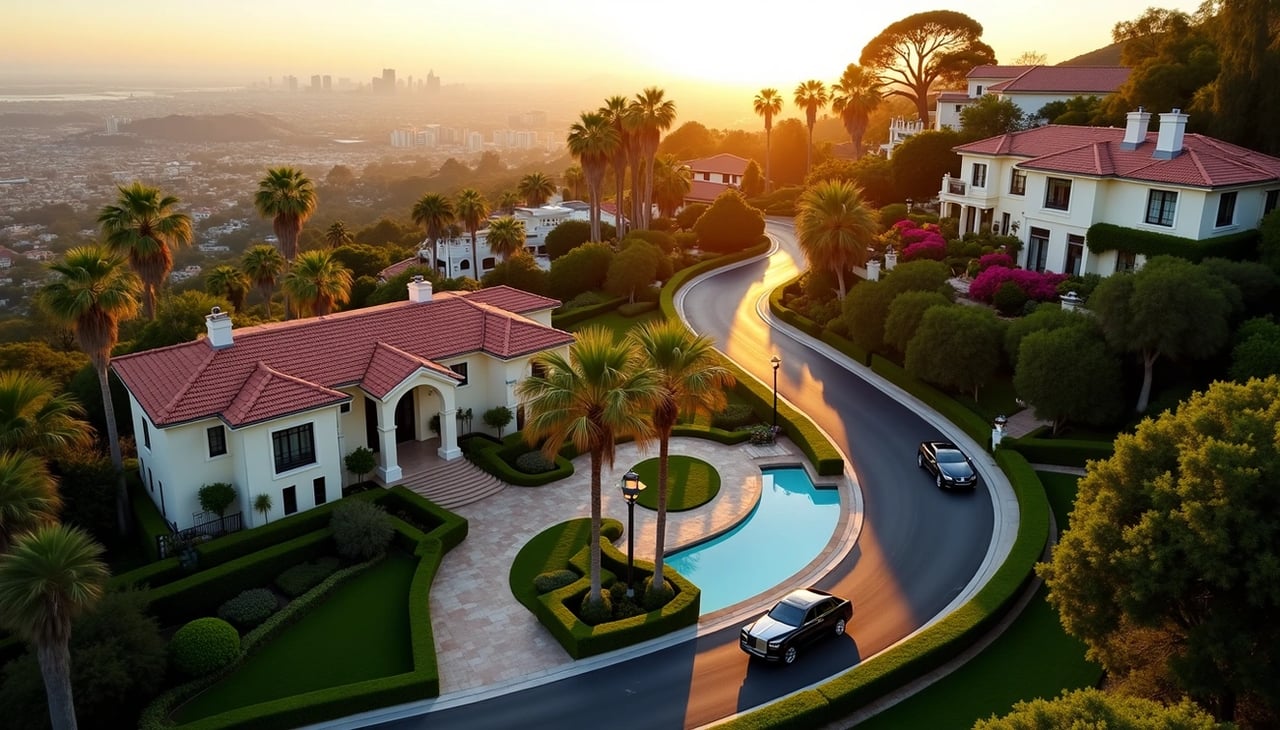
Beverly Hills luxury real estate operates through private networks where discretion matters as much as price. Fewer than 3,000 residential units qualify as luxury homes within city limits, creating scarcity that sophisticated buyers recognize immediately. Properties on the most expensive street command prices between $50 million to $200 million, while premier commercial spaces exceed $1,000 per square foot annually.
The discerning clientele who frequent these addresses understand that genuine prestige stems from supply constraints, economic fundamentals, and strategic positioning rather than marketing headlines. What separates the best streets from merely expensive ones requires insider knowledge of the forces that preserve address exclusivity across generations.
Supply Constraints That Make Beverly Hills Streets Irreplaceable
Physical boundaries create the scarcity that defines Beverly Hills luxury real estate. The city operates within fixed geographic limits that prevent expansion, placing continuous pressure on existing neighborhoods where development opportunities disappear each year.
Finite developable land in established areas
Beverly Hills maintains three distinct residential zones Central Area, Hillside Area, and Trousdale Estates each governed by separate development standards. Prime developable parcels within established neighborhoods have reached near-complete buildout. The most desirable Beverly hills streets emerged from the city's founding commitment to "garden quality" living, and that character remains protected through lot sizes, setback requirements, and floor area ratios that prevent densification.
Height restrictions cap multifamily buildings at five stories, with approval limited to select blocks citywide. Single-family zones face stricter constraints on floor area, parking requirements, landscaping ratios, and accessory structures. These regulations preserve the streetscape cohesion that residents expect while eliminating developer flexibility to increase density on available land.
No-growth policies protecting neighborhood character
Community preservation drives policy decisions that favor character over development. State housing officials mandated Beverly Hills plan for 3,104 new homes, but elected officials and residents declared this would "unalterably change the community's character". Multiple deadline failures and legal battles followed before the city secured housing element certification in March 2024 after three failed attempts.
The Community Character Committee requires Beverly Hills maintain "recognizable design elements" with residential streetscapes serving as "key definers of the overall character" through quality materials, landscaping, and compatible scale. Residents prize their ability to walk tree-lined streets safely and preserve what the committee calls a "unique locale that exists within the midst of a large metropolis".
Homeowner associations actively oppose developments that threaten neighborhood quiet. When a parking lot project at 125-129 S. Linden Drive proposed a building "almost four times taller than the five-story height limit," residents argued it would disrupt their "quiet lifestyle".
Geographic boundaries limiting expansion
Beverly Hills sits landlocked among Los Angeles, West Hollywood, and other municipalities. The city cannot annex territory or expand beyond incorporation boundaries, forcing all development within existing limits.
Regulatory enforcement creates internal boundaries as restrictive as physical ones. Beverly Hills received 19 Builder's Remedy applications from developers seeking to bypass local regulations, but the city fought each application and required discretionary approvals despite contrary state guidance. This resistance proves regulatory boundaries limit new supply as effectively as geographic constraints on famous streets in Beverly hills citywide.
The Most Expensive Street in Beverly Hills: What Creates Peak Value
The highest-value transactions rarely appear in public listings. These deals unfold through private channels where preparation meets opportunity, and where discretion serves both buyer and seller interests. Christina Pope at Sotheby's International Realty and platforms like EliteResidenceInternational.com facilitate these exchanges where the most expensive street in Beverly Hills commands premiums that reflect true scarcity.
Beverly Park's guard-gated exclusivity
Beverly Park Circle and Beverly Park Terrace rank second and third among America's most expensive streets, with median home values of $16,489,565 and $15,813,337 respectively. This guard-gated community contains exactly 80 properties split between North Beverly Park's 64 homes and South Beverly Park's 16 estates, creating a finite universe where mean household income tops $500,000. Recent twelve-month data shows median list prices reached $47.50 million.
Access requires passage through two fortified entrances where guards maintain checkpoints before residents reach individual property gates—what security professionals call "gates within gates". South Beverly Park developed first and retains a single entrance design. North Beverly Park attracts residents who prefer extensive greenery and larger property sizes.
Multi-acre estate requirements
Beverly Park requires 5,000-square-foot minimum home sizes, though properties average 20,000 square feet in practice. Estates commonly exceed these standards, with homes spanning 28,700 to 34,000 square feet on lots from 2.25 to 10-plus acres. Mark Wahlberg's château covers 34,000 square feet across 6 acres, while Steven Udvar-Hazy's Villa Firenze encompasses 28,700 square feet on more than 10 acres.
A 2.25-acre undeveloped lot in North Beverly Park represents one of the final opportunities to build a ground-up estate within the enclave. North Beverly Park clusters larger homes specifically because oversized lots accommodate sprawling compounds.
24/7 security and privacy features
Guarded gatehouses operate round-the-clock while roving patrols provide interior coverage. Security teams coordinate shift changes with overlap periods for thorough briefings between outgoing and incoming personnel. Overnight agents receive specialized training in low-light surveillance and irregular activity pattern recognition.
Individual estates add protection layers beyond community-wide measures. Electronic gates, high walls, dense vegetation, and CCTV systems create comprehensive property monitoring. Security programs combine static post coverage, perimeter monitoring, and emergency response protocols.
Panoramic view premiums
Properties positioned high in the hills offer unobstructed panoramic views spanning city skyline to ocean on clear days. These sightlines from primary rooms and terraces command premiums that distinguish Beverly Park from valley-floor locations. The 2022 record sale reached $70 million for a 31,000-square-foot estate, though the buyer acquired an adjacent lot for $30 million, bringing total investment to $100 million.
No-fly zone designation benefits
Beverly Park's reported no-fly zone status enhances privacy appeal. The FAA governs airspace, and no permanent blanket restriction exists without federal order. Community preferences strongly discourage drone activity and intrusive photography, though enforcement relies on property rights and applicable laws rather than aviation regulations.
Celebrity concentration effects
Denzel Washington, Eddie Murphy, Mark Wahlberg, Sylvester Stallone, Rod Stewart, and members of the Saudi royal family maintain Beverly Park residences. This concentration of A-list entertainers, athletes, media executives, and international buyers reinforces the enclave's position. New buyers increasingly include younger Hollywood talent alongside foreign nationals, sustaining demand that maintains these Beverly hills famous streets at peak valuation.
Economic Fundamentals Behind Address Prestige
Strategic investors recognize that Beverly Hills represents asset classes rather than mere addresses. Christina Pope at Sotheby's International Realty and platforms like EliteResidenceInternational.com connect buyers who understand financial fundamentals behind location premiums, facilitating exchanges where economic intelligence matters more than public perception.
International capital flows into stable assets
Foreign capital reshapes Beverly hills famous streets through concentrated purchasing power. International buyers account for approximately 18% of luxury transactions in Beverly Hills, targeting properties valued three times higher than domestic purchases. Foreign purchasers consistently pursue properties averaging $8.3 million while domestic buyers focus on $2.7 million listings. California commands 64.5% of foreign buyer interest nationally.
Global economic instability drives money toward American real estate assets. During the 2009 financial crisis, foreign investment into U.S. real estate experienced its largest boom despite domestic market collapse. Currency volatility in Argentina, Brazil, and Colombia pushes capital into U.S. properties when radical government changes threaten local economies. International buyers view U.S. real estate as hard assets producing passive income, properties that maintain value regardless of stock market fluctuations.
Hedge against inflation through luxury real estate
High-end properties demonstrate measurable resilience during inflationary periods. During the 2008 financial crisis, ultra-luxury real estate declined only 15% before recovering rapidly, while the S&P 500 plummeted 37% and blue-chip art declined 25%. The 2020 pandemic actually produced 5% appreciation in luxury properties while Bitcoin crashed 50% and stocks fell 20%.
Replacement cost increases protect existing property values. Rising materials and labor costs elevate pricing for newly constructed buildings, which correspondingly lifts valuations for comparable existing structures. Real estate values have followed inflation with a 0.94 correlation over four decades. Additionally, during the high inflation period from 1977 to 1981, real estate generated total annual returns of 17.8% while inflation averaged 10.7%.
Property appreciation outpacing regional markets
Beverly Hills home values reached $3,580,741 average, up 3.0% over the past year. Mid-luxury homes appreciate 7% to 9% annually over five-year periods, outpacing most national markets. This consistent appreciation reflects limited supply meeting persistent demand on the best streets in beverly hills.
Tax advantages for high-net-worth owners
Depreciation creates non-cash deductions that shelter rental income from taxes. Section 1031 exchanges permit deferral of capital gains taxes when reinvesting in like-kind assets, and many high-net-worth individuals execute serial exchanges over decades. Upon death, heirs receive step-up in basis, eliminating deferred gains entirely and creating multi-generational wealth transfer with minimal tax leakage.
Best Streets in Beverly Hills: The Hierarchy of Desirability
Christina Pope at Sotheby's International Realty and EliteResidenceInternational.com understand that successful transactions depend on intimate knowledge of each neighborhood's unique character. Sophisticated buyers recognize that hierarchy among Beverly hills streets reflects genuine market fundamentals rather than popular perception.
The Beverly Hills Flats and central convenience
The Flats extends between Sunset Boulevard and Santa Monica Boulevard, offering rare flat topography within the city's generally hilly terrain. Palm-lined streets showcase properties on substantial lots ranging from 10,000 to 30,000 square feet. Average home values hover just under $9 million, a reflection of unparalleled access to Rodeo Drive, the Golden Triangle, and Beverly Hills Hotel.
Spanish villas and Georgian estates grace oversized parcels complete with expansive backyards, resort-style pools, and mature gardens that create private sanctuaries. For those who love to entertain, the right home makes all the difference. If you're considering a purchase in the near future or beginning your search, I'd be delighted to help you discover spaces designed for elevated living and effortless hosting. Christina Pope  310-404-9931
  [email protected]
Trousdale Estates and architectural cachet
Elevated above Sunset Boulevard, Trousdale Estates encompasses over 500 lots governed by strict architectural guidelines that preserve view corridors. Paul Trousdale's 1954 purchase of 410 acres established single-story height requirements protecting panoramic vistas. Master architects Richard Dorman, Wallace Neff, Paul R. Williams, and A. Quincy Jones created the largest concentration of custom Mid-Century Modern architecture in Los Angeles.
Large glass walls, seamless indoor-outdoor flow, and infinity pools overlooking the Los Angeles Basin, Pacific Ocean, and Santa Monica Mountains define these residences. Design-focused buyers continue gravitating toward this architectural legacy, drawn to horizontal living and elevated positioning.
Benedict Canyon Drive balancing privacy with access
This winding canyon road offers secluded terrain while maintaining connection to Beverly Hills' center. Properties span from traditional residences to contemporary estates, most concealed behind mature vegetation and private gates across multiple acres. Transactions regularly occur between $20 million and $50 million, with larger compounds featuring tennis courts, pools, and substantial guest accommodations.
Angelo Drive's canyon view premiums
Situated within Benedict Canyon, Angelo Drive represents exceptionally high-value real estate on significant acreage. Custom estates feature sophisticated architectural design and panoramic vistas spanning canyons, city lights, and distant ocean. The Angelo Estate exemplifies this tier, occupying a 6-acre promontory with unobstructed views across the entire Los Angeles basin.
Future-Proofing Factors That Ensure Continued Value
Sustained value on Beverly hills streets requires evolution, not preservation alone. The most successful properties adapt to changing expectations while maintaining their exclusive character. Christina Pope at Sotheby's International Realty and EliteResidenceInternational.com work with clients who understand that lasting relevance comes from anticipating tomorrow's luxury standards.
Sustainable luxury and green building integration
One Beverly Hills demonstrates how environmental responsibility enhances ultra-luxury appeal, targeting LEED Platinum and WELL certifications with geothermal systems, greywater recycling achieving 100% irrigation needs, and battery storage maximizing renewable energy use. Today's sophisticated buyers expect green-certified buildings with solar integration and high-efficiency systems as standard features rather than novelties.
Smart home technology adoption
Professional installations featuring Crestron and Josh.ai systems provide seamless control while remaining completely unobtrusive. Advanced AI integration manages wellness, security, and climate without complex interfaces that compromise the living experience.
Adaptive reuse maintaining relevance
Historic properties receive thoughtful updates through sustainable retrofits that honor neighborhood character while reducing construction waste and embodied carbon. This approach satisfies density requirements while preserving the architectural heritage that defines prestigious addresses.
Generational wealth transfer patterns
An estimated $6 trillion transferred intergenerationally in 2025, with $124 trillion expected through 2048. Heirs consistently select Beverly hills famous streets as stable assets, with individuals holding $5 million to $30 million in net worth driving 65.7% of transfers. For those who love to entertain, the right home makes all the difference. If you're considering a purchase in the near future or beginning your search, I'd be delighted to help you discover spaces designed for elevated living and effortless hosting. Christina Pope 310-404-9931 [email protected]
Global luxury market positioning
Younger generations deploy capital internationally, balancing tax efficiency and geopolitical considerations with investment returns. Multi-city, multi-asset approaches protect against volatility while maintaining positions in established luxury markets like the best streets in Beverly hills.
Conclusion
Beverly Hills streets preserve value through structural scarcity that conventional markets simply cannot replicate. Fixed boundaries, regulatory protections, and generational wealth patterns create conditions where supply stays limited while demand grows among the world's most sophisticated buyers.
The most expensive addresses command their premiums because they provide what new developments cannot: established reputation, proven exclusivity, and irreplaceable positioning. Properties on Beverly Park Circle, Trousdale Estates, and Benedict Canyon Drive function as asset classes rather than mere residences.
Savvy buyers understand these streets deliver consistent appreciation, meaningful tax benefits, and wealth preservation that extends well beyond standard real estate returns. The hierarchy endures because the underlying fundamentals resist change, ensuring continued value for those who recognize true market drivers over fleeting trends.
Key Takeaways
Beverly Hills streets maintain their extraordinary value through a unique combination of artificial scarcity, economic fundamentals, and strategic positioning that creates irreplaceable luxury assets.
• Geographic scarcity drives premium pricing: Fixed city boundaries and strict zoning create finite supply, with only 3,000 luxury residential units competing for ultra-high-net-worth buyers.
• Beverly Park leads with $47.5M median prices: Guard-gated exclusivity, multi-acre estates, and celebrity concentration make it America's second-most expensive street.
• International capital seeks stable assets: Foreign buyers pay 3x more than domestic purchasers, viewing Beverly Hills real estate as inflation hedges during global uncertainty.
• Generational wealth transfer sustains demand: $6 trillion in inherited wealth flows into luxury real estate, with heirs prioritizing established prestigious addresses over new developments.
• Future-proofing through smart luxury: Sustainable building practices, AI home systems, and adaptive reuse ensure continued relevance for next-generation buyers.
The most valuable Beverly Hills streets function as asset classes rather than mere addresses, delivering consistent appreciation, tax advantages, and wealth preservation that transcend typical real estate metrics. This structural advantage ensures their continued dominance in the luxury market hierarchy.
FAQs
Q1. What makes Beverly Hills streets maintain such high property values compared to other luxury markets? Beverly Hills streets hold their value through fixed geographic boundaries, strict zoning regulations, and limited supply of only 3,000 luxury residential units. The city cannot expand beyond its borders, and no-growth policies protect neighborhood character by preventing densification. This structural scarcity, combined with international capital flows and consistent demand from ultra-high-net-worth buyers, creates conditions where supply remains permanently constrained while demand continues to grow.
Q2. Which street in Beverly Hills commands the highest property prices? Beverly Park Circle and Beverly Park Terrace are among America's most expensive streets, with median home values exceeding $16 million and median list prices reaching $47.5 million. This guard-gated enclave features only 80 properties total, with homes averaging 20,000 square feet on multi-acre lots. The combination of 24/7 security, panoramic views, celebrity residents, and extreme exclusivity creates pricing that ranges from $50 million to $200 million for individual estates.
Q3. How do international buyers influence Beverly Hills real estate prices? International buyers account for approximately 18% of luxury transactions in Beverly Hills and consistently purchase properties valued three times higher than domestic buyers—averaging $8.3 million versus $2.7 million. Foreign capital flows into Beverly Hills during global economic instability, as buyers view American luxury real estate as stable hard assets that hedge against currency volatility and political uncertainty in their home countries.
Q4. What are the most desirable neighborhoods within Beverly Hills? The hierarchy includes Beverly Park at the top with $47.5 million median prices, followed by Trousdale Estates featuring Mid-Century Modern architecture and panoramic views, the Beverly Hills Flats offering walkable convenience with $9 million average values, and Benedict Canyon Drive providing secluded privacy with properties ranging from $20-50 million. Each neighborhood offers distinct advantages in terms of views, architectural character, lot sizes, and proximity to Beverly Hills amenities.
Q5. How does luxury real estate in Beverly Hills protect against inflation? Luxury properties in Beverly Hills demonstrate measurable inflation resistance, declining only 15% during the 2008 financial crisis while the S&P 500 fell 37%. Real estate values correlate 0.94 with inflation over four decades, and rising construction costs increase replacement values for existing properties. Additionally, high-net-worth owners benefit from depreciation deductions, 1031 exchange tax deferrals, and step-up in basis for heirs, creating multi-generational wealth preservation with minimal tax impact.