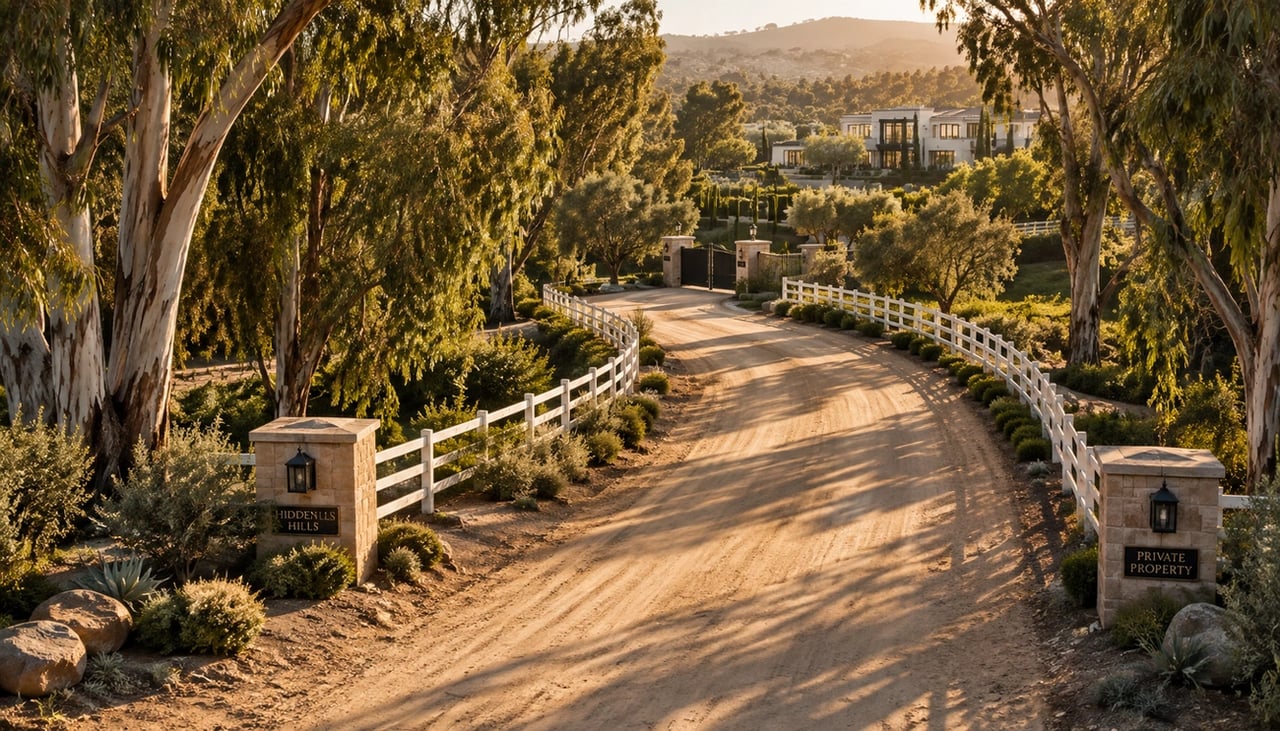
Hidden Hills is a community where the most expensive properties are often reached by unpaved, private routes rather than traditional paved streets. That choice is rarely accidental. Shaded road access — a term that carries specific meaning on property maps and land surveys — signals something discerning buyers in this market actively seek: privacy that is structural, not just implied.
A shaded road is more than a road with tree cover. On surveys and title documents, it appears differently from a public street and carries its own set of rights, responsibilities, and expectations. For buyers who understand what this distinction means, it becomes one of the more telling features a property can offer. This article looks at why that is, and what it means in practice for Hidden Hills' most exclusive estates.
What Shaded Roads Are and Why They Appear on Property Maps
Property maps and land title surveys follow specific labeling conventions. Surveyors mark streets by name and designate them as either "Public" or "Private". That designation is not cosmetic — it clarifies who holds maintenance responsibility and what legal rights accompany the access.
A public roadway falls under the care of city, county, or state authorities. A private roadway receives no public maintenance and carries no dedication to governmental control. The recorded plat for a property indicates whether streets are public or private.
Properties reached by private roads typically hold access rights through beneficial easements, reciprocal easements, or shared ownership percentages among users. Those rights permit legal access but bring maintenance obligations with them. Since public funds cannot be applied to private infrastructure, the owners themselves carry full responsibility for upkeep.
A shaded road, in this context, is a private access route that appears differently on a survey than a public street does. The surveyor's role is to confirm that access exists through private roadways, not to determine the legal rights governing that access. Those rights surface through title commitments or direct field observations.
This distinction matters more than it might first appear. These unmarked roads reflect a different ownership structure altogether — one that affects everything from routine maintenance to legal access rights, and shapes both what a property is worth and what its owner is responsible for.
Why Hidden Hills' Most Exclusive Properties Choose Unpaved Road Access
"luxury buyers in this area are looking for more than beautiful finishes. They want space to recharge, privacy to unwind, and a genuine connection to nature." — Gary Pesso, Real estate advisor with Engel & Völkers Vail
"Luxury buyers in this area are looking for more than beautiful finishes. They want space to recharge, privacy to unwind, and a genuine connection to nature." — Gary Pesso, Real estate advisor with Engel & Völkers Vail
Hidden Hills, spanning 1.688 square miles, has no sidewalks and no street lighting — and that is entirely by design. Residents here have consistently resisted the markers of standard suburban development. The result is a community that feels genuinely removed from the city surrounding it, even as it sits within Los Angeles County.
Private roads reinforce that separation in a way that public thoroughfares simply cannot. Without through traffic, the routes stay quiet. Only neighbors and their guests use them, which matters enormously to families who chose Hidden Hills precisely for that sense of controlled access.
Unpaved roads do more than signal exclusivity. Their texture naturally slows traffic, making them suitable for horseback riding and hiking alongside vehicles — a quality of life feature that resonates deeply with buyers drawn to the area's rural character.
Properties offering genuine seclusion on private roads tend to hold their value well. The settings accessible only through private access — parcels with mountain views, mature tree canopy, or forest surroundings — are the kind that attract buyers seeking an experience rather than simply square footage. For those buyers, shaded road access is not incidental. It is part of what they came for.
The Practical Benefits and Considerations of Shaded Road Access
"The road agreement is not a detail... it's a core part of what you're buying." — Lisa Brouillette, REALTOR®
The appeal of a private road is real — but so are the costs that come with it. Private roads require owners to fund all repairs, from routine maintenance to full resurfacing. A community managing 10,000 square yards of road surface can face repaving bills between $270,000 and $630,000, covered through HOA dues or special assessments when reserves fall short.
A well-maintained road typically holds up for 20 to 30 years before requiring major work. When upkeep is deferred, deterioration accelerates and costs rise faster than they should. Many buyers assume property taxes extend some municipal obligation to their road — they do not. Cities hold no responsibility for private access, regardless of what a homeowner pays. Emergency response remains a non-negotiable consideration, as fire and EMS vehicles require clear, passable routes.
On resale, the effect of private road access cuts both ways. Properties with well-managed HOA roads and stable reserves tend to see little negative impact — and can command a modest premium from buyers who place genuine value on seclusion. Poorly maintained roads, unresolved access rights, or a history of special assessments tell a different story, with discounts of 5% to 15% relative to comparable homes on public streets.
Knowing how to read these details makes a meaningful difference in the outcome. Christina Pope works with clients who expect that level of precision — buyers and sellers alike who want clarity on what they're acquiring or offering. If a private road property is on your radar, Christina would be glad to help you evaluate it fully.
Christina Pope 📞 310-404-9931 ✉️ [email protected]
Conclusion
Luxury real estate in Los Angeles rewards those who know where to look and, just as importantly, who to trust. Shaded road access in Hidden Hills is one of those features that separates buyers with genuine market knowledge from those simply browsing listings. The privacy is real, the rural character is worth preserving, and the maintenance obligations are manageable — provided buyers go in with clear eyes and the right guidance.
For those who value discretion and know what they are looking for, these properties offer something that well-lit suburban streets simply cannot.
Christina Pope | Sotheby's International Realty 📞 310-404-9931 | ✉️ [email protected]EliteResidenceInternational.com
Key Takeaways
Hidden Hills' ultra-luxury properties strategically choose unpaved, private road access to maximize privacy and preserve the area's exclusive rural character. Here's what makes shaded roads a premium feature:
• Shaded roads are private access routes marked differently on property maps than public streets, indicating owner-maintained infrastructure with no municipal responsibility or public funding.
• Privacy drives premium value as private roads eliminate through traffic, reduce public visibility, and create natural barriers that only residents and authorized guests can navigate.
• Maintenance costs are substantial with full repaving ranging from $270,000 to $630,000 for typical communities, funded entirely through HOA dues or special assessments every 20-30 years.
• Resale impact varies significantly based on road quality—well-maintained private roads command premiums for exclusivity, while poor maintenance or unclear access rights can reduce values by 5-15%.
• Rural character preservation matters to discerning buyers who value unpaved roads for horseback riding, reduced light pollution, and the authentic estate experience over conventional suburban infrastructure.
The choice of shaded road access reflects a deliberate trade-off: accepting maintenance responsibilities in exchange for unparalleled privacy, controlled access, and the preservation of Hidden Hills' distinctive rural luxury esthetic that defines its most exclusive properties.
FAQs
Q1. What exactly is a shaded road in the context of luxury real estate? A shaded road refers to a private access route that appears differently on property maps and surveys compared to public streets. These are privately maintained roads that provide access to properties without government oversight or municipal maintenance responsibilities. The term indicates owner-controlled infrastructure rather than publicly dedicated thoroughfares.
Q2. Why do Hidden Hills' most expensive properties prefer unpaved road access? Ultra-luxury properties in Hidden Hills choose unpaved roads primarily for enhanced privacy and exclusivity. These private routes eliminate through traffic, reduce public visibility, and preserve the area's distinctive rural estate character. The absence of sidewalks and street lighting further limits unauthorized access while maintaining the natural esthetic that discerning buyers value.
Q3. Who is responsible for maintaining private roads in gated communities? Property owners bear complete responsibility for maintaining private roads, including all repairs, resurfacing, and upkeep. These costs are typically funded through HOA dues or special assessments, with full repaving projects ranging from $270,000 to $630,000 for typical communities. Municipalities have no obligation to maintain private roads regardless of property tax payments.
Q4. Do homes on private roads sell for less than those on public streets? The impact on resale value depends entirely on road maintenance quality and legal agreements. Well-maintained private roads with stable HOA reserves can command premiums due to the exclusivity factor, while poorly maintained roads or unclear access rights may reduce property values by 5-15% compared to similar homes on public streets.
Q5. How long do private roads typically last before requiring major repairs? Well-maintained private roads generally last 20 to 30 years before requiring full repaving. However, deferred maintenance can significantly accelerate deterioration and increase eventual repair costs. Regular upkeep and adequate reserve funding are essential to maximize the lifespan of private road infrastructure.