City ordinances have made cigar smoking increasingly difficult across Los Angeles, yet private clubs like the Grand Havana Room Beverly Hills have quietly flourished. The secret to their success lies in offering members a legal, exclusive environment where premium cigars can be enjoyed without compromise. This nearly 20-year-old establishment has become the blueprint that luxury homeowners are now looking to — incorporating dedicated cigar lounges directly into their estates. High-end residential properties across Beverly Hills, Downtown, and the South Bay are taking note and adopting similar design principles. The Grand Havana Beverly Hills model proves that exclusivity, proper ventilation, and a carefully curated atmosphere can elevate a simple smoking area into a sophisticated amenity — one that adds measurable value to luxury properties.
What Makes the Grand Havana Room Beverly Hills Model Work
"If done right, your cigar lounge will not just be a place for clients to enjoy a good cigar, but a place where they feel part of a true club, forming bonds with the place, the staff, and other guests." — Olivier Gershony, Entrepreneur and connoisseur in the cigar and luxury hospitality industry
The Grand Havana Room Beverly Hills runs on the same principles that define high-end real estate in Los Angeles — discretion, controlled access, and strategic positioning. Founded in April 1995, this flagship location set standards that members-only cigar clubs still measure themselves against. The model works because it creates genuine scarcity through invitation-only membership that remains strictly limited.
Members enter through On Canon restaurant on North Canon Drive, where a hostess unlocks a private elevator that ascends to the smoking lounge. The centerpiece of the space is a glassed-in humidor containing 350 blond-wood lockers stacked floor to ceiling, each marked with etched brass nameplates. Actors, producers, directors, and agents store their cigars in these cedar keeps — some reachable only by ladder.
The membership structure signals serious commitment. Corporate membership carries a $10,000 initiation fee plus $750 monthly for humidor rental, while individual membership costs $3,000 to join with $200 monthly dues. A business professional dress code is strictly maintained, and members are rewarded with panoramic views of the Hollywood Hills, gourmet dining, a well-stocked bar, and generous lounge space. Exclusivity, proper infrastructure, and a refined atmosphere — together, these qualities form a template that luxury residential properties are now replicating with great intention.
Why California Smoking Laws Changed the Game for Private Cigar Spaces
California made history in 1995 as the first state to ban smoking in nearly every workplace, with AB 13 establishing Labor Code section 6404.5. Restaurants faced restrictions immediately, while bars, taverns, and gaming clubs were given a phase-in period through 1998. The prohibition covered all enclosed places of employment — public and private alike.
Labor Code section 6404.5(e) did carve out limited exceptions. A "private smokers' lounge" — defined as any enclosed area within or attached to a retail or wholesale tobacco shop dedicated solely to tobacco use — qualified for one. The loophole, however, had clear boundaries. The Attorney General issued an opinion in 2011 stating that any establishment serving alcohol to patrons could not claim either the retail tobacco shop or private smokers' lounge exemption. Venues that wanted to pair a fine cigar with a drink found themselves on the wrong side of the law.
The Legislature tightened things further in 2016 through Senate Bill SBX2-5, amending Labor Code section 6404.5(e) and reducing enumerated exceptions from 14 to just 7. The definition of "private smokers lounge" stayed intact — a signal that exemptions were meant to remain narrow and strictly enforced. For cigar enthusiasts, the options outside of a private residence had all but disappeared. Luxury homeowners recognized the opportunity, and dedicated residential cigar lounges became the one viable answer to what the law had taken away.
How LA Luxury Homes Are Building Private Cigar Lounges
"A custom home should reflect how you actually live. If something brings you joy, we design for it." — Eric Brown, Designer at Everett Custom Homes
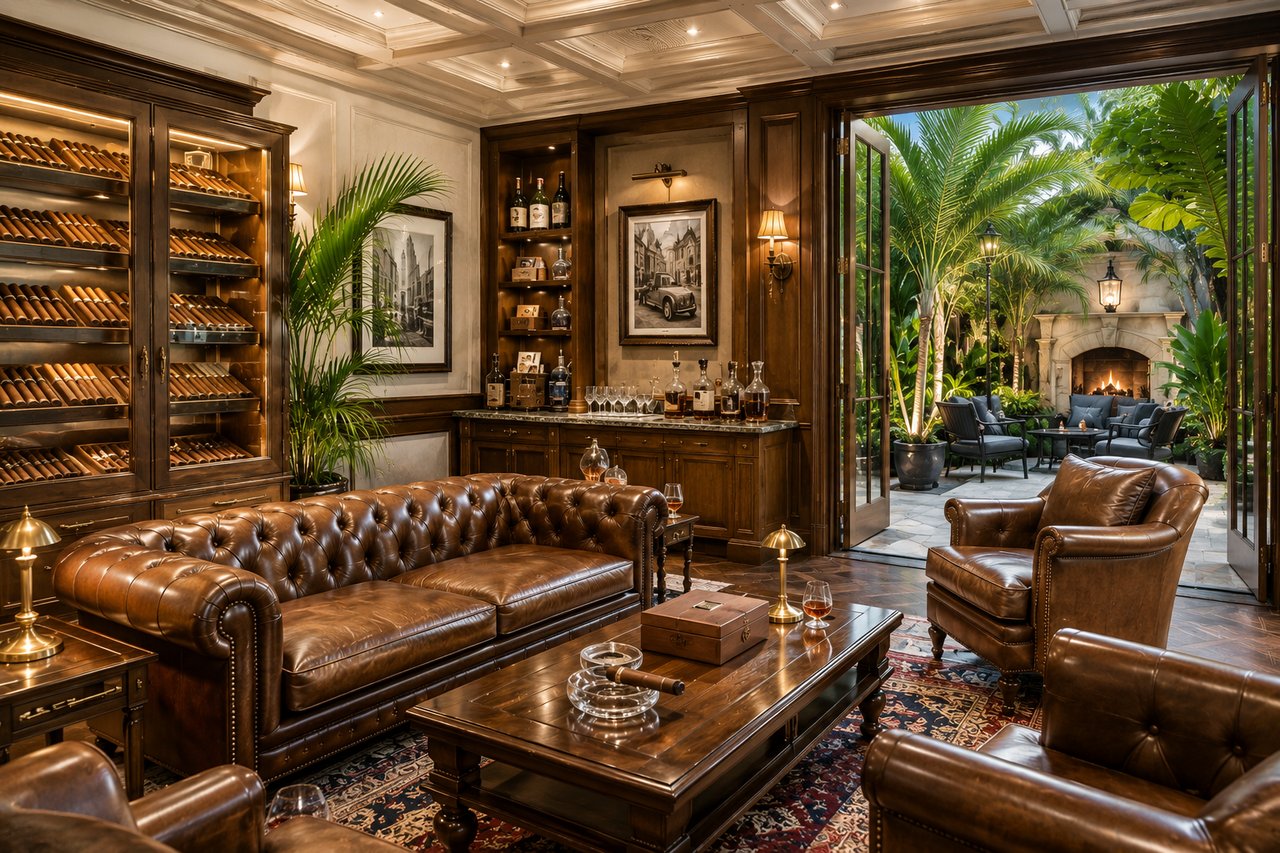
Luxury real estate in Los Angeles is built on private conversations and well-timed decisions — and the homeowners commissioning private cigar lounges approach them the same way. The goal is always the same: commercial-grade performance with the feel of a refined residential space. Proper ventilation is the foundation, requiring 12-15 air changes per hour. A 10' x 12' room with 8' ceilings calls for an exhaust fan rated at 200-300 CFM for a single smoker, while a group of four to five pushes that requirement to 900-1,100 CFM. Commercial-grade exhaust fans tie into insulated ductwork that routes smoke cleanly outside.
Climate-controlled humidor cabinets do the rest of the heavy lifting. Temperatures hold between 41°F and 71°F, with humidity adjustable from 56% to 78%. Spanish cedar interiors manage moisture evenly while lending aromas that actually benefit the tobacco as it ages. Cabinet units accommodate approximately 1,250 cigars, complete with LED lighting and digital monitoring. Costs range from a basic exhaust setup at $1,500 to full air handling systems approaching $10,000.
For clients who love to entertain and want a home built around how they actually live, Christina Pope brings the expertise to find exactly that. Whether the search is just beginning or a purchase is on the near horizon, she would be delighted to help.  310-404-9931
  [email protected]
Conclusion
Private cigar lounges have earned their place among the most sought-after features in Los Angeles luxury homes — not merely as an architectural statement, but as a practical and elegant answer to California's tightening restrictions. The Grand Havana Room Beverly Hills set the standard: exclusivity, thoughtful infrastructure, and an atmosphere worth belonging to. Discerning homeowners have taken that blueprint seriously. With commercial-grade ventilation and climate-controlled humidors, a well-designed residential cigar lounge delivers both property value and the kind of privacy that today's luxury market rewards. For buyers who appreciate the finer details of how a home is lived in, this amenity speaks for itself.
Key Takeaways
California's strict smoking laws have transformed private cigar lounges from luxury amenities into essential features for high-end homeowners seeking legal, sophisticated smoking spaces.
• Grand Havana Room's exclusivity model works: Members-only access, $10,000 corporate initiation fees, and hidden elevator entrances create scarcity that luxury homes now replicate through private lounges.
• Proper ventilation is non-negotiable: Residential cigar rooms require 12-15 air changes per hour with 200-300 CFM exhaust fans for single smokers, scaling to 900-1,100 CFM for groups.
• Climate control protects investments: Spanish cedar humidors maintaining 56-78% humidity and 41-71°F temperatures preserve cigar collections while adding measurable resale value to luxury properties.
• Legal restrictions drove residential demand: California's 1995 workplace smoking ban and 2016 amendments eliminated commercial options, making private home lounges the only viable solution for cigar enthusiasts.
• Design integration matters: Successful cigar lounges connect seamlessly with home bars, wine cellars, and entertainment spaces, creating cohesive luxury environments that appeal to discerning buyers.
The shift from public cigar clubs to private residential lounges reflects broader trends in luxury real estate—exclusivity, privacy, and amenities that can't be replicated elsewhere drive premium valuations in today's market.
FAQs
Q1. What are the membership costs for the Grand Havana Room Beverly Hills? Corporate membership requires a $10,000 initiation fee plus $750 monthly for humidor rental, while individual membership costs $3,000 to join with $200 monthly dues. These fees reflect the club's exclusive, members-only structure that has become a model for luxury residential cigar lounges.
Q2. What dress code standards does the Grand Havana Room Beverly Hills maintain? The Grand Havana Room Beverly Hills mandates a business professional dress code to cultivate an atmosphere of sophistication. This formal requirement contributes to the exclusive environment that luxury homeowners now replicate in their private residential cigar lounges.
Q3. How much does it cost to build a private cigar lounge in a luxury home? Residential cigar lounge installations range from basic exhaust systems at $1,500 to elaborate air handling units approaching $10,000. Additional costs include climate-controlled humidor cabinets that can hold approximately 1,250 cigars with LED lighting and digital monitoring systems.
Q4. What ventilation requirements are needed for a home cigar lounge? A properly ventilated cigar room requires 12-15 air changes per hour. For a single smoker in a 10' x 12' room with 8' ceilings, an exhaust fan rated at 200-300 CFM is necessary, while 4-5 smokers demand 900-1,100 CFM with commercial-grade exhaust fans connected to insulated ductwork.
Q5. How did California smoking laws impact private cigar lounges? California's 1995 workplace smoking ban and 2016 amendments eliminated most commercial cigar smoking options, particularly those serving alcohol. These restrictions pushed cigar enthusiasts toward genuinely private residential spaces, making home cigar lounges the only viable legal solution for luxury homeowners.