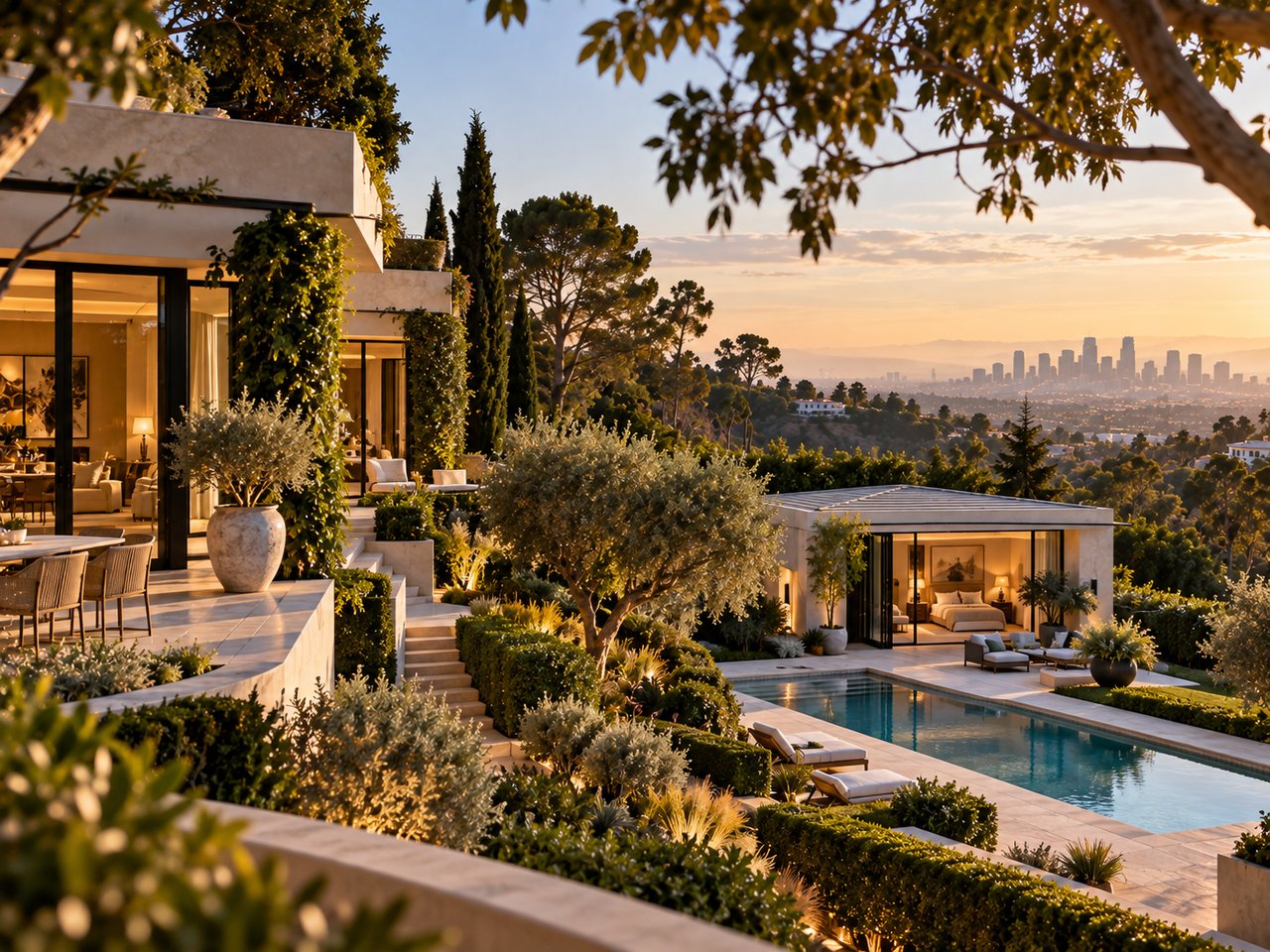
Small lot homes are changing Hollywood Hills real estate in ways that challenge traditional development patterns quietly. The Los Angeles small-lot ordinance enabled construction of fee-simple infill housing on compact parcels and increased single-family density to 24 units per acre. This regulatory change opened possibilities for high density small lot homes that meet modern needs while working within hillside constraints. Inventory remains tight and home values hold steady. Small lot single family homes offer ownership alternatives previously unavailable in multifamily zones. Buyers searching for small lot homes for sale in Los Angeles are finding properties that balance urban density with architectural difference, especially in Hollywood Hills' micro-neighborhoods where median prices range from 1.6 to 2.0 million dollars.
The Hollywood Hills Real Estate Shift: What's Actually Happening
Luxury real estate in Los Angeles operates through channels that rarely surface in public listings. The most strategic transactions unfold within trusted networks where timing and discretion shape outcomes more than market headlines. Christina Pope at Sotheby's International Realty understands this dynamic well, especially when you have small lot homes carving new pathways into Hollywood Hills ownership structures that excluded most buyers from fee-simple hillside property.
Limited inventory is reshaping buyer expectations
Los Angeles has sustained a housing supply crisis that tightened further through 2024 and 2025. The lock-in effect kept resale inventory at historic lows and created a lack that remains a defining characteristic of the market. Active listings in Los Angeles County reached 11,526 in December 2025, down from a summer peak of 15,258 in August 2025. This represents a constrained market by any historical standard, despite modest increases from the extreme conditions of 2021.
Median days on market extended to 67 days for LA County in December 2025. This signals a change in buyers' psychology. Buyers no longer operate with the desperation that characterized previous years. They inspect value, condition and location with patience that sellers must accommodate. The market has split into three distinct segments: turnkey properties priced correctly still move quickly, sometimes with multiple offers; overpriced or problematic listings accumulate 60 to 120+ days on market; luxury properties above $10 million maintain their own momentum independent of middle-market dynamics.
Hollywood Hills exhibits these patterns with local variations. Homes sell after an average of 49 days on the market, compared to the national average of 54 days. The median sale price over the last 12 months sits at $1,740,000, down 3% from the previous period. The area maintains limited inventory and enduring location appeal, and property values demonstrate resilience against broader market fluctuations.
Small lot ordinances opened new development possibilities
The Los Angeles Municipal Code was amended in 2005 to add Section 12.22-C, 27, known as the Small Lot Ordinance. This regulatory framework modified zoning requirements to reduce lot size minimums, amended parking mandates and enabled large parcels to subdivide into multiple smaller parcels. The ordinance addressed underutilized land in multifamily and commercial areas. It created fee-simple homeownership opportunities where only apartment units existed before.
A 2017 amendment refined the original provisions. Small lot subdivisions were removed from R2 zones but remain permitted in RD, R3, R4, R5, RAS, and P and C zones. The minimum lot width increased from 16 feet to 18 feet, and the minimum lot area stands at 600 square feet. Maximum lot coverage by structures dropped from 80% to 75%, unless an open space easement equivalent to 25% of the lot area is provided.
The ordinance established that no front, side or rear yard is required between interior lot lines created within an approved small lot subdivision. This provision allows efficient use of hillside parcels where traditional setbacks would eliminate development potential. Subdivisions with 20 or more new small lot homes must provide open space at a ratio of 30 square feet per unit.
High-density single family homes meet modern demand
Fee-simple ownership distinguishes small lot homes from condominiums. Residents own the land beneath their unit. The ordinance prohibits common foundations or shared walls between units, so no homeowners association fees apply in most cases. Only maintenance associations for shared driveways and utilities are required.
The Department of Housing and Urban Development identified several advantages to this structure: small lot developments increase homeownership at reduced costs, increase housing production, avoid monthly HOA fees and prove easier to finance than condominium projects. Lower construction liability and insurance rates further improve financial viability for both developers and buyers.
Density in small lot subdivisions follows the underlying zone's requirements. An RD1.5 zone permits one dwelling unit per 1,500 square feet, whereas RD2 requires 2,000 square feet per unit, and R3 allows 800 square feet per unit. This framework enables developers to replace single teardown properties with multiple fee-simple homes. This is a big deal as it means that housing stock increases on underutilized parcels.
Who is driving the small lot market in 2026
The median home price in Hollywood Hills reaches $1,894,950. With a 20% down payment and a 30-year fixed mortgage at 6.01%, the estimated monthly payment totals $9,100. Property taxes, insurance and utilities are not included. Buyers need an annual income of at least $390,000 to afford the median home price using standard lending ratios.
The average household income in Hollywood Hills sits at $140,000. This gap reveals that traditional single-family hillside properties remain inaccessible to most local residents. Small lot homes bridge this divide by offering entry points at lower price thresholds while maintaining fee-simple ownership benefits. Professionals aged 25 to 50 represent the primary demographic, drawn to modern design, walkable locations and ownership structures that avoid condo complexities.
Sixty percent of Hollywood Hills residents rent, and only 40% own their homes. Small lot developments create pathways to ownership for renters who lacked options between apartments and multi-million dollar estates. The developments target buyers seeking an alternative to suburban sprawl without sacrificing the autonomy of single-family homeownership.
How Small Lot Homes Work in Hillside Terrain
Hillside development in Los Angeles just needs architectural solutions that most builders avoid. The terrain that defines Hollywood Hills creates engineering challenges that transform small lot homes into exercises in vertical problem-solving. Christina Pope at Sotheby's International Realty works with buyers who understand that hillside properties offer distinct advantages when developers approach site constraints with precision rather than compromise.
Site planning on steep Hollywood Hills lots
Hillside home plans work with sloping terrain through walkout basements, tiered levels and elevated decks. These designs take advantage of natural topography and maximize light, views and privacy. The Hollywood Hills Box House demonstrates this approach. Architect Jeffrey J. Eyster elevated the first floor 40 feet above the driveway. The home separates from a street-level detached garage excavated into a ten-foot vertical rocky cliff. The site slopes at 45%, and the 4,000-square-foot home is nestled into a hilltop on a 12,000-square-foot lot.
Elongated plans follow site contours and minimize excavation. This strategy reduces grading costs and keeps structural integrity on steep slopes intact. Private bedrooms tuck into the hill. Public spaces cantilever toward views. Extreme grades necessitate shared access driveways and pan-handle lot configurations.
Square footage within compact footprints
Multi-level designs create functional space within limited horizontal footprints. A three-level family home embedded in a steep hillside opens to a courtyard that collects sunlight and provides cross ventilation. The plan incorporates a three-story staircase that unites floors and anchors the courtyard as a sculptural element. Expansive decks on the view side extend interior space toward panoramic vistas.
Drive-under garages and inverted layouts unite foundations and add square footage without building upward. This approach maximizes budget efficiency on sloped lots. Sloping lot house plans feature basement foundations that create level bases and provide livable square footage.
Private outdoor space in high-density configurations
Courtyards carved into hillsides become outdoor rooms that flow from interior spaces. One compact mountain home built around a private outdoor space creates intimate connections between interior and exterior zones. The house climbs the hillside and walks out at each level. The east side opens onto natural landscape. The west side uses high linear strips of glass for light and keeps privacy intact.
Rooftop terraces and tiered outdoor spaces provide multiple vantage points. A master suite opens onto a private patio with outdoor shower and water features. Broad overhangs and landscaping control shading. Narrow cross sections optimize ventilation.
Shared access and maintenance structures
Pan-handle lots and shared driveways address access constraints on steep terrain. Multiple lots share driveways where grade prevents individual access points. Both owners share maintenance responsibilities. Maintenance agreements clarify cost allocation and repair obligations. The easement should appear in property deeds and reinforce usage rights and ownership boundaries.
Design Advantages That Appeal to Today's Buyers
Architectural decisions separate small lot homes from conventional hillside properties through design strategies that increase natural assets. Buyers respond to these features because they address lifestyle priorities that traditional developments overlook.
Modern architecture optimized to capture views and light
View optimization relies on cantilevered structures that project living spaces beyond natural slopes and capture panoramas impossible from grade-level placement. Split-level layouts create multiple viewing platforms that ensure primary areas claim unobstructed sightlines. Floor-to-ceiling glass walls frame views as living art and are supported by grade beams that span unstable terrain. Disappearing walls merge interiors with patios and erase the difference between indoor and outdoor spaces.
Three-side exposure versus traditional townhouse walls
Small lot single family homes avoid the shared-wall constraints that define townhouses. Townhouses attach to neighboring units and force residents to share walls. Small lot homes maintain separation between structures and provide natural light and ventilation from three sides rather than limiting exposure to front and back facades.
Flexible floor plans for live-work lifestyles
Open-concept layouts maximize spatial perception in narrow footprints. Kitchens, dining areas and living rooms connect without interior walls. This creates unbroken sightlines that extend visual boundaries. Most units feature around 1,700 square feet of living space. Floor plans accommodate home offices without sacrificing bedroom count.
Rooftop terraces and vertical living solutions
Each unit incorporates a fourth-floor rooftop deck exceeding 450 square feet with panoramic city views. These outdoor rooms function as private retreats. Residents value proximity to restaurants and nightlife while maintaining separation from street-level activity.
The right home makes all the difference if you love to entertain. I'd be delighted to help you find spaces designed to raise your living standards and make hosting effortless if you're thinking about a purchase in the near future or beginning your search. Christina Pope 📞 310-404-9931 ✉️ [email protected]
Regulatory and Economic Factors Driving Growth
Los Angeles small lot subdivision ordinance explained
The Small Lot Ordinance was adopted in 2005. It created a hybrid housing typology that functions like row townhomes but constructs each unit on individual small lots. The ordinance combined benefits of single-family homes with fee-simple ownership and townhouse lifestyle conveniences. It created incentives for infill residential development to increase housing production in areas zoned for multifamily and commercial uses.
The ordinance permits minimum lot areas as small as 600 square feet and minimum lot widths of 16 feet. Parking requirements were amended. Small lot developments now provide two garaged spaces per unit but not on the same lot. One parcel can subdivide into a single home, duplex, or triplex. The subdivision must not exceed dwelling unit requirements set by the zone.
Fee-simple ownership versus condo alternatives
Fee-simple ownership represents the largest bundle of rights one can hold in land. Small lot home owners acquire ownership of both the housing structure and the land beneath it. These units are fee-simple, so homeowners avoid the monthly association fees required for condominium ownership. The ordinance prohibits common foundations or shared walls between units. This eliminates the need for homeowners associations.
Lower construction liability and faster approvals
Construction defect litigation forced condominium HOAs to require additional insurance costing more than $20,000 per unit. Small lot developments avoid mandatory additional insurance costs because they do not require HOAs. This makes bank financing easier. Fee-simple structures carry lower liability and insurance rates than condominiums. Developers face reduced construction liability compared to condo projects.
Price points that attract 25-50 year old professionals
Small lot homes provide affordable options as starter homes or for buyers looking to downsize. The developments reduce land costs per home and pass savings to homebuyers. These units offer comparable living space to average two-bedroom condominiums but with greater advantages. The target demographic consists of professionals seeking modern design and fee-simple ownership without condo complexities.
What Buyers Need to Know Before Purchasing
Buyers who think over small lot homes for sale in Los Angeles enter a specialized segment where standard residential due diligence expands to address unique structural and regulatory factors. Christina Pope at Sotheby's International Realty guides clients through acquisition complexities that distinguish these properties from conventional single-family homes.
Due diligence for small lot homes for sale in Los Angeles
Title searches must confirm fee-simple ownership rights and identify recorded easements that govern shared access. Preliminary title reports reveal encumbrances including utility easements, contractor liens and maintenance obligations that transfer with property ownership. County land records verify shared driveway easements to ensure access rights bind current and future owners.
Shared driveway agreements and HOA structures
Small lot subdivisions mandate recorded maintenance agreements that address shared driveways, utility lines and fire access. Each owner assumes proportional upkeep responsibilities. These agreements run with the land and apply to future owners. Maintenance associations differ from traditional HOAs in that they govern only shared infrastructure rather than architectural standards.
Hillside permits and fire zone compliance
Hollywood Hills properties frequently fall within Very High Fire Hazard Severity Zones, areas that pose the most important fire threats from adjoining natural brush hillside areas. Properties in VHFHSZs and Hillside Management Areas require two distinct means of vehicular access, each containing pavement at least 24 feet in width. Fire safety regulations mandate wide, flat roads with only short dead-end offshoots to ensure evacuation access and firefighting capability.
Resale value and market positioning
Small lot homes often increase property value in high-demand areas owing to higher density on the same land and fee-simple ownership appeal. These properties show strong resale demand.
For those thinking over a purchase, I'd be delighted to help you find properties positioned for long-term value. Christina Pope 📞 310-404-9931 ✉️ [email protected]
Conclusion
Small lot homes represent a radical alteration in Hollywood Hills ownership and create pathways that were previously unavailable to most buyers. The combination of fee-simple rights and modern design addresses the just need that traditional properties cannot meet. These developments succeed because they solve real problems related to inventory lack and pricing barriers.
This specialized market requires expertise in hillside regulations and shared infrastructure agreements. You need to understand fire zone compliance too. Christina Pope at Sotheby's International Realty brings the discretion and insight that defines successful transactions in this segment. Timing and access matter as much as price here. The right guidance makes all the difference for buyers ready to explore small lot opportunities.
Key Takeaways
Small lot homes are revolutionizing Hollywood Hills real estate by offering fee-simple ownership alternatives that bridge the gap between expensive traditional homes and rental apartments, creating new pathways to homeownership for professionals earning $140,000-$390,000 annually.
• Los Angeles Small Lot Ordinance enables 24 units per acre density while maintaining individual land ownership and avoiding HOA fees • Hillside small lot homes maximize views through cantilevered designs and multi-level layouts that work with steep terrain constraints • Fee-simple ownership provides complete property rights without shared walls or monthly association fees unlike condominiums • Target buyers are 25-50 year old professionals seeking modern design and ownership alternatives to $1.9M median hillside homes • Due diligence requires verifying shared driveway agreements, fire zone compliance, and maintenance responsibilities that transfer with ownership
These developments succeed because they solve critical housing problems: limited inventory, pricing barriers, and lifestyle preferences that traditional Hollywood Hills properties cannot address. With proper guidance through specialized regulations and shared infrastructure agreements, small lot homes offer strategic entry points into one of LA's most desirable neighborhoods.
FAQs
Q1. What makes small lot homes different from condominiums in Hollywood Hills? Small lot homes offer fee-simple ownership, meaning you own both the structure and the land beneath it. Unlike condominiums, these homes don't have shared walls or common foundations, which eliminates monthly HOA fees in most cases. You only pay for maintenance associations that cover shared driveways and utilities, resulting in lower ongoing costs and greater ownership autonomy.
Q2. What is the minimum lot size allowed under the Los Angeles Small Lot Ordinance? The Los Angeles Small Lot Ordinance permits minimum lot areas as small as 600 square feet with a minimum lot width of 18 feet. The ordinance allows developers to subdivide larger parcels into multiple fee-simple homes in multifamily and commercial zones, increasing density to up to 24 units per acre while maintaining individual property ownership.
Q3. How do small lot homes handle steep hillside terrain in Hollywood Hills? Small lot homes on hillsides use multi-level designs with walkout basements, tiered levels, and cantilevered structures that project living spaces beyond natural slopes. These designs maximize views and natural light while minimizing excavation costs. Many feature drive-under garages and inverted layouts that create functional space within compact footprints on slopes as steep as 45%.
Q4. What income level is needed to afford a small lot home in Hollywood Hills? With median home prices around $1.9 million in Hollywood Hills, buyers typically need an annual income of at least $390,000 using standard lending ratios. However, small lot homes offer more accessible entry points at lower price thresholds while maintaining fee-simple ownership, making them attractive to professionals earning between $140,000 and $390,000 annually.
Q5. What special considerations apply when buying a small lot home in a fire hazard zone? Properties in Very High Fire Hazard Severity Zones require two distinct means of vehicular access, each with pavement at least 24 feet wide. Buyers should verify fire zone compliance during due diligence and confirm that shared driveway agreements meet these safety requirements. These regulations ensure proper evacuation access and firefighting capability in hillside areas.