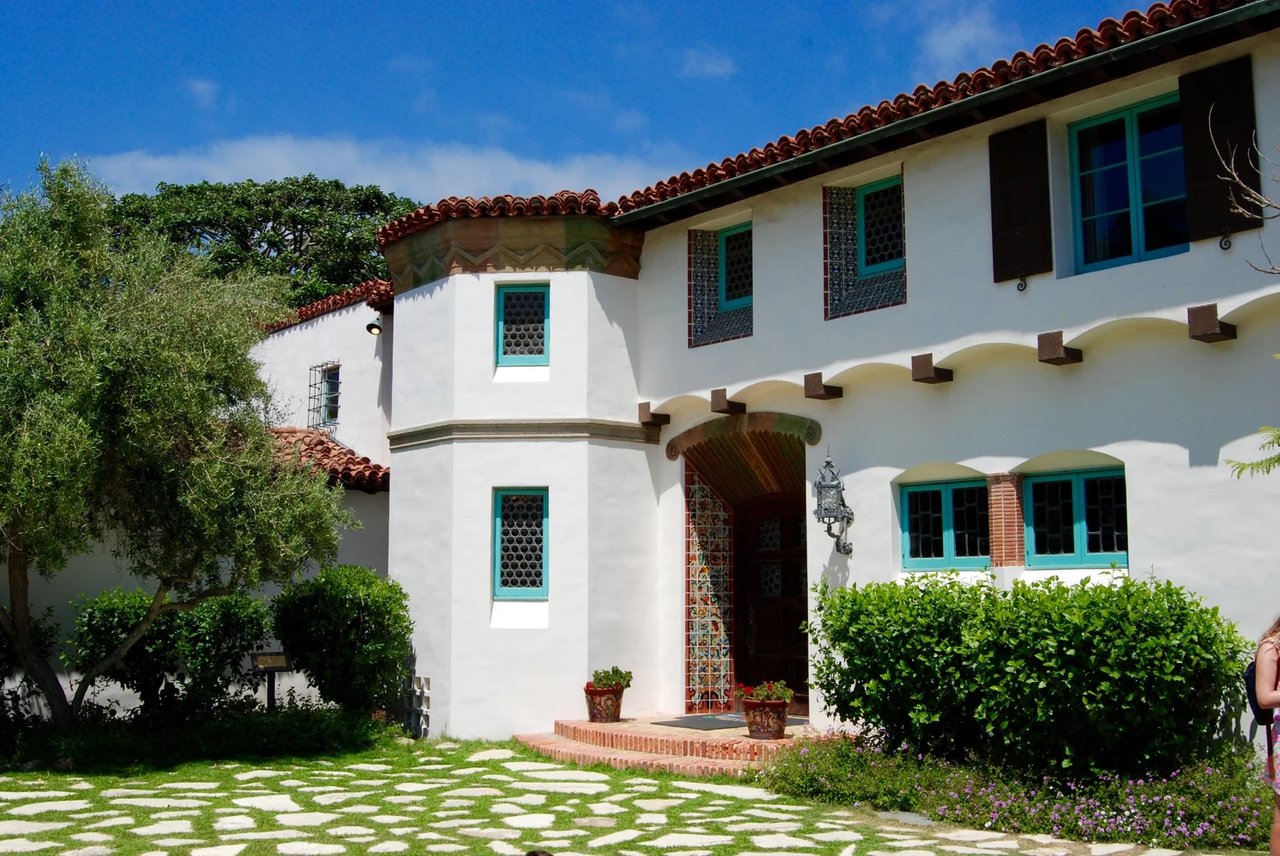
Few historical heritage sites in Malibu have survived intact — the Adamson House is one of them, and its nickname, the "Taj Mahal of Tile," tells you exactly why. Completed in 1930 by Merritt and Rhoda Rindge Adamson, this Spanish Colonial Revival estate captures the architectural spirit that swept Southern California after World War I and has never really left. A California Historical Landmark and a property listed on the National Register of Historic Places, the Adamson House holds the finest surviving examples of decorative ceramic tile from Malibu Potteries, the celebrated studio that operated between 1926 and 1932. Those who take the time to tour it find a place where architectural beauty and coastal cultural heritage are inseparable.
The Spanish Colonial Revival Style That Defined Adamson House
Architect Stiles O. Clements took on the commission in 1929, spending 1½ years completing the 5,000 square-foot house. The design called for five bedrooms, each with an attached bath and most with fireplaces, along with two servants' bedrooms. For all its square footage, the exterior reads as something far more understated — a story-and-a-half façade that draws immediate comparisons to an Andalusian farmhouse.
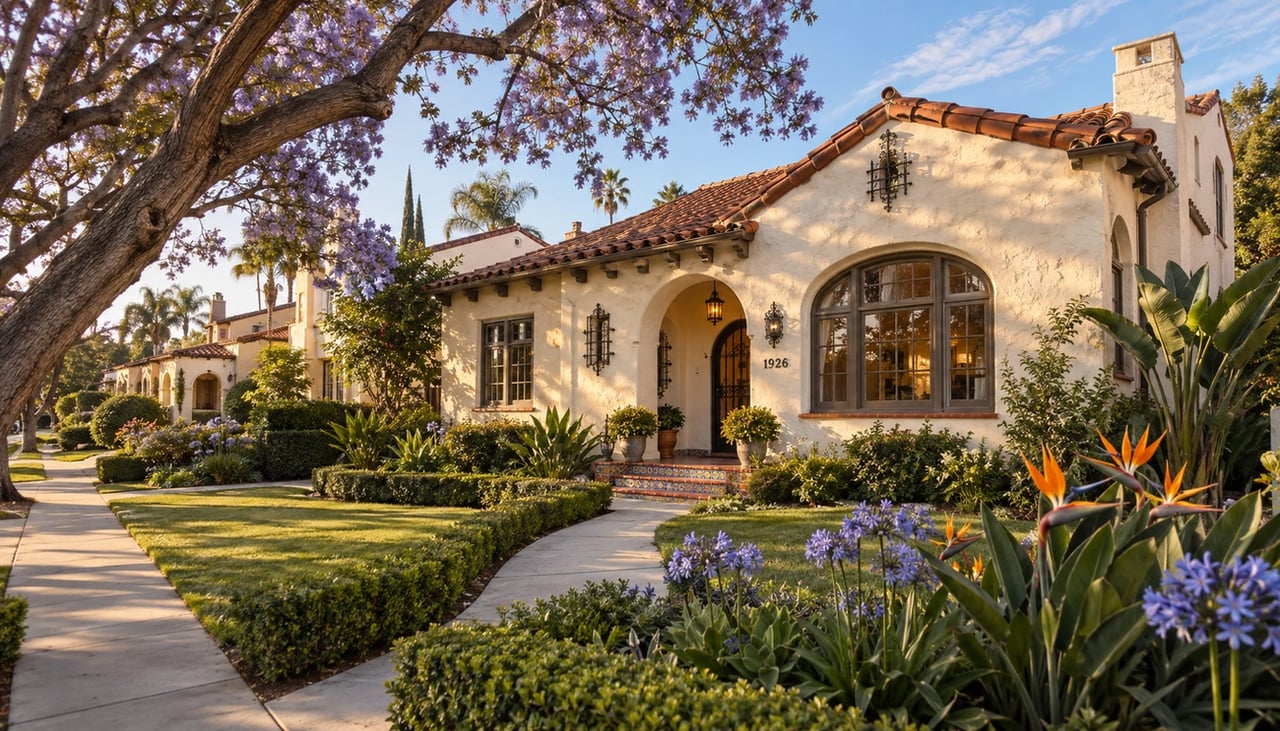
Medieval touches punctuate the clean white-stucco, tile-roofed exterior. A projecting stair tower fitted with lead-framed Rondel glass windows gives the composition a quiet architectural distinction. Clements built a prolific career between 1911 and 1960, responsible for The Mayan Theater and nearly 60 office buildings across Los Angeles's Wilshire corridor, which makes the Adamson House a rare entry in his residential work.
The interior is where the collaboration truly shows. Decorator John Holtzclaw sourced reproduction pieces rooted in 16th and 17th century Spanish tradition, produced either at his own studio or through Barker Brothers — the same firm that outfitted Hearst Castle. Danish artists Ejnar Hansen and Peter Nielsen devoted a full year to hand-painted designs across ceilings, doors, beams, and walls. Rufus Keeler, chief designer at Malibu Potteries, brought his ceramic expertise to round out the effort. The result is a property where Spanish Colonial Revival and Moorish sensibilities meet with genuine cohesion, standing as one of the finest examples of Mediterranean Revival design in the region.
The Malibu Potteries Legacy: Inside the Tile House
"The uniqueness of a work of art is inseparable from its being imbedded in the fabric of tradition. This tradition itself is thoroughly alive and extremely changeable." — Walter Benjamin, Cultural critic
When May Rindge found clay deposits on her Malibu property rather than oil, she turned the discovery into an opportunity — establishing Malibu Potteries in 1926. The factory ran 1,500 feet along the beach just east of the Malibu Pier, where 125 employees produced up to 30,000 square feet of tile monthly. Los Angeles City Hall and The Mayan Theater both bear their work.
The centerpiece of the Adamson House is a 60-foot Persian carpet assembled from 674 individual tiles. Measuring 6' 8" x 20' 4", every detail is accounted for — including fringed ends — a collaboration between William Handley, ceramicist Rufus Keeler, and Donald Prouty. First-time visitors routinely mistake it for an actual woven carpet. Its design drew from Islamic tile traditions spanning the 8th through 16th centuries.
Each tile was made using the cuerda seca technique, with colored glaze applied drop by drop through a bulb syringe. Cultural references ran deep — Moorish, Egyptian, Mayan, and Saracen influences all found their way into the patterns. Tile surfaces appear throughout the house without restraint: walls, floors, ceilings, fountains, bathrooms, and even an outdoor dog-washing tub. The attention given to every corner of the property reflects a standard of craft that treated no space as an afterthought.
A fire tore through large sections of the factory in 1931, and the weight of the Depression brought closure in 1932. What survived remains remarkable for its rarity alone.
Visiting the Historic Adamson House Today
"It has been said that, at its best, preservation engages the past in a conversation with the present over a mutual concern for the future." — William Murtagh, Noted preservationist
The Adamson House sits at 23200 Pacific Coast Highway, with grounds open daily from 8 a.m. to sunset for self-guided walks through the gardens and exterior viewing. Access to the interior requires joining a docent-led tour, available Wednesday through Saturday from 11 a.m. to 2 p.m., with the last tour departing at 2 p.m. Tours go out roughly every 45 minutes on a first-come, first-served basis, and groups of eight or more should plan ahead — reservations are required at least 30 days in advance.
Admission is $7 for adults, $2 for ages 6 to 17, and free for children 5 and under. Cash only. Guided garden walks run every Friday at 10 a.m. and include access to the house. Volunteer docents lead each 45-minute to hour-long tour through rooms with original furnishings, offering family history and architectural context along the way. Photography is not permitted inside, though the tile work and ocean views make for compelling exterior shots.
The Malibu Lagoon Museum, housed in the original five-car garage, is open free of charge Wednesday through Saturday from 11 a.m. to 3 p.m. There is no on-site parking, but the Surfrider Beach lot and the Malibu Lagoon Beach lot across the bridge both serve visitors well. Tour availability depends on weather and volunteer staffing.
A home with this kind of character — one designed with genuine intention — is rare. For clients who appreciate spaces built for both beauty and living, Christina Pope brings the expertise and market knowledge to help find exactly that. 📞 310-404-9931 ✉️ [email protected]
Conclusion
The Adamson House is, at its core, a place where decorative artistry and residential architecture were treated as one and the same — and that intention has held for nearly a century. The Malibu Potteries tilework and the Spanish Colonial Revival design together tell the story of an era when craftsmanship was considered as essential as structure. A visit offers something that photographs simply cannot — the experience of standing inside spaces where every surface was considered, every detail deliberate. It is well worth the trip.
Key Takeaways
Discover why the Adamson House remains one of Malibu's most treasured architectural landmarks and what makes its Spanish Colonial Revival design timeless.
• The Adamson House earned its "Taj Mahal of Tile" nickname through extraordinary craftsmanship—featuring a 60-foot Persian carpet made from 674 hand-glazed tiles and decorative ceramics throughout every room.
• Malibu Potteries operated briefly but brilliantly (1926-1932), producing up to 30,000 square feet of tile monthly before fire and Depression-era economics forced closure, making surviving examples exceptionally rare.
• Spanish Colonial Revival architecture thrives in coastal climates by combining white stucco exteriors, terracotta roofs, and Moorish influences—a design approach that remains popular in Southern California nearly a century later.
• Public tours run Wednesday through Saturday from 11 a.m. to 2 p.m. for just $7, offering docent-led access to original furnishings, hand-painted ceilings, and beachfront grounds at this National Register landmark.
The Adamson House demonstrates how intentional design and cultural craftsmanship create enduring value—transforming a residential estate into a living museum that continues captivating visitors and inspiring modern architecture today.
FAQs
Q1. Who currently owns and operates the Adamson House? The Adamson House is now a California Historical Landmark and National Register property that operates as a museum. It's managed by the California Department of Parks and Recreation in partnership with the Malibu Lagoon Museum, offering public tours and preserving this architectural treasure for future generations.
Q2. What makes the tile work at Adamson House so special? The house features extraordinary hand-crafted tiles from Malibu Potteries, including a famous 60-foot Persian carpet made from 674 individual tiles. Artists used the cuerda seca technique, applying each drop of colored glaze by hand, creating intricate designs influenced by Moorish, Egyptian, Mayan, and Saracen cultures throughout the entire property.
Q3. How much does it cost to tour the Adamson House? Admission costs $7 for adults and $2 for children ages 6 to 17, while children 5 and under enter free. Tours are offered Wednesday through Saturday from 11 a.m. to 2 p.m. on a first-come, first-served basis, and payment is accepted in cash only.
Q4. Why did Malibu Potteries close after only six years? Malibu Potteries operated from 1926 to 1932, producing up to 30,000 square feet of tile monthly. A devastating fire destroyed large factory areas in 1931, and combined with economic pressures from the Great Depression, the company was forced to close in 1932, making surviving examples of their work exceptionally rare.
Q5. What architectural style is the Adamson House and why does it work well in Malibu? The Adamson House showcases Spanish Colonial Revival architecture with Moorish and Mediterranean influences, featuring white stucco exteriors, terracotta tile roofs, and arched elements. This design style is perfectly suited to Malibu's coastal climate and continues to inspire Southern California architecture nearly a century after its construction.