The Beverly Hills Flats map is as much about lifestyle as it is about geography — it shows precisely where privacy, value, and accessibility part ways across the area's most exclusive addresses. Terrain shapes everything here. The Flats carry a median of $8.5 million, while hillside properties in the richer pockets of Beverly Hills reach $14 million. That gap reflects far more than elevation. What separates ridge-top exposure from canyon seclusion is a question of how a buyer wants to live and understanding that distinction is what this article is about. The focus here is Benedict Canyon and Trousdale Estates: their terrain, their pricing, and what each one actually delivers for buyers seeking the finest streets Beverly Hills has to offer.
Beverly Hills Flats Map and How Neighborhoods Actually Break Down
"Beverly Hills is not one neighborhood — it’s at least two fundamentally different ways of living, separated by elevation and by a lifestyle gap that no amount of money can fully bridge." — Jacob Lavian,
The Flats as the central reference point
Beverly Hills neighborhoods operate within three distinct planning frameworks, and each one shapes everything from permitting timelines to long-term resale value. The city divides single-family properties into three zones: the Central Area (the Flats), the Hillside Area, and Trousdale Estates, each governed by its own development standards and review processes.
The Flats cover approximately 200 acres, bounded by Sunset Boulevard to the north, Santa Monica Boulevard to the south, Doheny Drive to the east, and Whittier Drive to the west. This is the residential core where most Beverly Hills residents actually live. The mid-Flats, running between Burton Way and Sunset, hold the highest concentration of preserved Spanish, Tudor, and Mediterranean architecture in the neighborhood. Design review here focuses on street-visible elements and compatibility with neighboring homes.
Where Benedict Canyon and Trousdale sit on the map
Benedict Canyon is a ravine running north to south from the crest line of the Santa Monica Mountains. The canyon sits north of Beverly Hills proper, with Sherman Oaks to the north, Beverly Glen to the west, and Beverly Park and Franklin Canyon to the east. Historically, Benedict Canyon was part of Rancho de las Aguas the same land grant that encompassed present-day Beverly Hills.
Trousdale Estates occupies Beverly Hills' eastern ridge, developed into 535 lots during the 1950s from former Doheny ranch land. Homes rest on level pads cut into the hillside, with panoramic city and ocean views on clear days. The neighborhood carries the largest concentration of custom mid-century modern architecture in Los Angeles, with properties designed by A. Quincy Jones, Paul R. Williams, Wallace Neff, and Cliff May. Topography drives every decision here design, construction budget, and the realities of long-term ownership.
Why municipal boundaries matter more than zip codes
A 90210 postal address does not guarantee Beverly Hills city services. Some properties within that zip code sit outside city limits entirely and fall under LAUSD rather than BHUSD. School enrollment follows municipal designation, not zip code. Benedict Canyon carries a Beverly Hills Post Office designation dating to the 1920s, when the area was still rural land. The 90210 ZIP Code, established in 1963, covers both the northern part of Beverly Hills and this surrounding area.
BHPO residents have no access to Beverly Hills Police, Beverly Hills Fire, or any other Beverly Hills city services. They receive Los Angeles city services and vote in Los Angeles elections. The practical implications extend to property taxes, emergency response times, and school district quality. For buyers evaluating long-term ownership, verifying the municipal boundary matters considerably more than the recognition that comes with a well-known zip code.
Benedict Canyon: Terrain, Privacy, and What Buyers Actually Get
Winding canyon roads and lot sizes
The terrain here does most of the work. Benedict Canyon drops north-to-south from the Santa Monica Mountains crest line, and roads follow the natural contour of the ravine rather than any grid. That produces the winding, narrow streets characteristic of canyon living — streets that can create real bottlenecks during peak hours and become a primary concern in emergency situations.
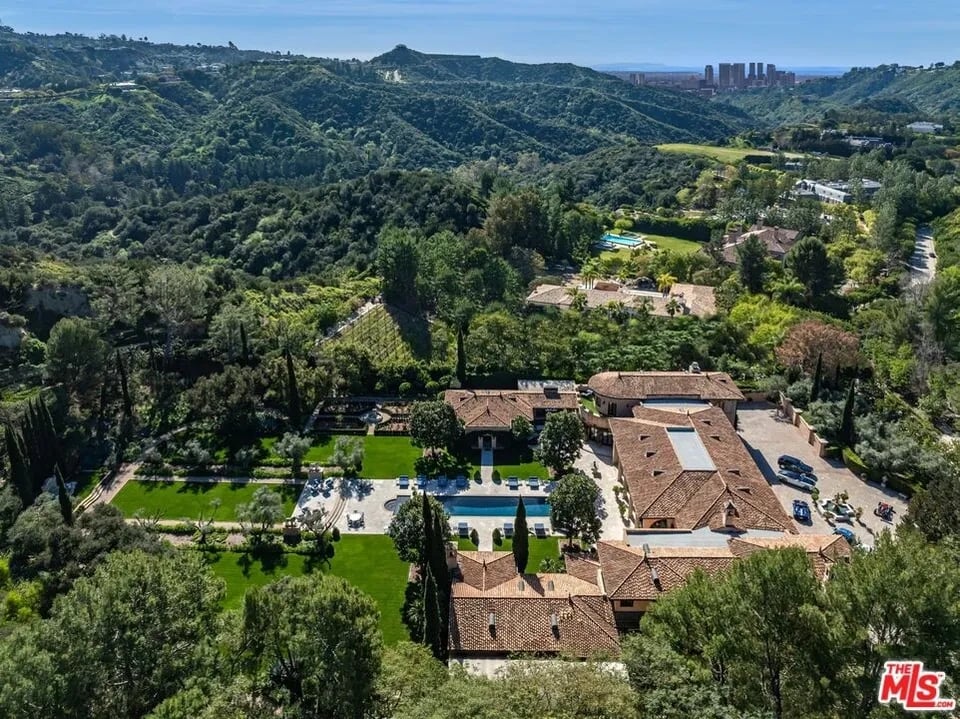
Lot sizes vary considerably. Some properties command promontory positions on multiple acres; others occupy smaller parcels that were developed much earlier. Most of the housing stock dates to around 1960, a reflection of the canyon's post-war build-out. Upper Benedict Canyon includes two distinct subdivisions Benedict Hills, with 107 homes, and Benedict Hills Estates, with 229 homes positioned between Deep Canyon and Mulholland Drive.
Forest cover and natural screening
The vegetation is genuinely varied and layered. Lower slopes carry oaks and native grasses, while higher hillsides give way to chaparral and lupine. Coast live oak groves settle into the valleys where rainfall collects, forming an evergreen canopy that shelters wildlife year-round. Along Franklin's Creek, sycamores, ferns, and vines form the kind of riparian corridor that no landscape architect can manufacture on demand.
Pines, cypresses, deodars, and eucalyptus were planted as development expanded across the canyon. Chaparral drought-tolerant evergreen shrubs reaching four to ten feet — remains the dominant plant subtype. That combination of established trees and dense shrub cover delivers natural privacy between properties that walls and fencing simply cannot replicate.
Single-family estates versus smaller canyon properties
There are no condos, townhomes, or commercial uses here. The canyon is entirely residential, and the range of properties reflects its long development history — from smaller one-story family homes to large multi-acre estates. A handful of the more modest structures originated as hunting cabins in the early 1900s. Contemporary estates sit back from winding driveways on hilly lots, with meaningful separation from the street.
The setback varies by lot depth and topography, but the net effect is consistent: a sense of remove that is difficult to achieve closer to the Flats. Most properties are 10 to 15 minutes from the heart of Beverly Hills, which keeps canyon seclusion practical rather than isolating.
Distance from commercial Beverly Hills
Rodeo Drive and the business district are a 10 to 15-minute drive from Benedict Canyon, depending on where in the canyon the property sits. The canyon itself has no retail, no restaurants, and no service businesses. Daily errands mean a trip to the Flats or adjacent neighborhoods — a trade-off buyers here accept knowingly, in exchange for the quiet.
Fire zone designation and what it means
Benedict Canyon falls within the Very High Fire Hazard Severity Zone established in Los Angeles in 1999. The designation is based on an evaluation of physical conditions — fuel loading, slope, fire weather, and wind patterns — assessed over a 30 to 50-year horizon.
Ownership in this zone carries specific obligations. Sellers must provide Natural Hazard Disclosure Reports, and vegetation management inspections are mandatory. New construction must meet ignition-resistant building standards under Chapter 7A of the California Building Code, covering roofing, siding, windows, and vents.
Red flag days add another layer of protocol. When winds exceed 25 mph and humidity falls below 15%, vehicles parked illegally on narrow canyon streets are ticketed and towed. Fire officials point to both the density of foliage and the absence of recent fires as factors that keep the canyon under close watch.
Trousdale Estates: Views, Architecture, and the Premium You Pay
"In Trousdale the architect is part of the asset." — Debbie Pisaro, Beverly Hills architectural
Ridge position and panoramic sightlines
Trousdale sits at the highest point of Beverly Hills an elevated shelf above Sunset Boulevard where elevations reach roughly 1,100 feet. Developer Paul Trousdale began carving out this plateau in 1954, working with approximately 410 acres of former Doheny ranch land and eventually subdividing it into 532 lots. The ridge delivers what the market simply calls jetliner views: unobstructed sweeps across the downtown skyline, Century City, and the Pacific Ocean. Most properties here capture true 180-degree exposure no borrowed views across neighboring rooftops. At the most elevated positions, Pacific Ocean visibility is not an amenity. It is a price variable.
Single-story design standard and view corridors
Every house in Trousdale was required to be at least 3,000 square feet and limited to a single story a standard set by the original design review board, led by architect Allen Siple, specifically to protect the view corridors that give the neighborhood its value. Homes stayed low and horizontal rather than stacked. When renovations and additions in the 1980s began to erode neighbors' sightlines, the Trousdale Estates Homeowners Association and the City of Beverly Hills stepped in with the Trousdale Ordinance of 1987. That ordinance set a 14-foot maximum structure height, with only narrow exceptions available by specific permit[182]. Structures must stay on the level pad no building beyond it, aside from limited elements like fences or hedges. Beverly Hills' formal view corridor protections mean a neighbor's tree or addition is far less likely to compromise your sightlines over time.
Mid-century modern legacy and contemporary rebuilds
Trousdale holds the largest and most complete concentration of custom mid-century modern architecture in Los Angeles. A. Quincy Jones, Paul R. Williams, Wallace Neff, Cliff May, Lloyd Wright, and Richard Dorman all worked here. Construction ran through the 1960s and into the early 1970s. Architectural provenance matters in a measurable way a home by A. Quincy Jones or Paul R. Williams is not interchangeable with a 1970s spec build on a comparable lot. More recent decades have brought contemporary rebuilds that carry forward the single-story philosophy, with architects like Landry, McClean, and Ehrlich commanding their own premiums.
Flat pad construction advantages
Most lots sit on broad, graded pads a condition that encouraged single-story footprints and generous indoor-outdoor transitions. Flat pads simplify new builds and major remodels considerably compared with steeper hillside sites. The code prohibits grading-permit work on slopes steeper than one vertical foot per every five horizontal feet and bars raising a level pad above its existing elevation.
Pricing against Benedict Canyon
As of May 2026, Trousdale ran 25 to 30 percent above the Beverly Hills 90210 median of $5.62 million. The average sale price exceeded $11 million as far back as September 2019. Asking prices today span from single digits for original homes needing work all the way to trophy listings well above $30 million.
Benedict Canyon versus Trousdale: the Trade-offs That Matter
Privacy through terrain versus privacy through elevation
The Flats, Benedict Canyon, and Trousdale are all Beverly Hills, but they behave like three separate markets serving three different kinds of buyers. Grid streets, flat half-acre lots, and pre-war estates define the Flats. Benedict Canyon is a winding ravine of older, larger compounds set well back from the road. Trousdale is something else entirely — a hillside plateau of single-story, view-oriented homes held to an unusually consistent design standard.
The path to privacy differs entirely between the two hillside options. Benedict Canyon relies on winding roads and dense natural screening. Trousdale uses elevation, lot scale, and gates to achieve the same end result. Neither approach is superior — they simply suit different sensibilities.
Accessibility and daily logistics
Residents in Trousdale tend to be those for whom views and privacy outweigh proximity to retail. Daily errands require a car; that is simply part of the trade-off. Benedict Canyon, sitting 10 to 15 minutes from the heart of Beverly Hills, offers a similar sense of remove with a slightly shorter return to the city.
Architectural flexibility and permitting differences
Trousdale's 14-foot height cap and level-pad requirement define what is and is not possible for any addition or new build on the ridge. Benedict Canyon carries no such single-story mandate. Buyers who want vertical flexibility or a more varied architectural statement will find greater latitude in the canyon — though hillside sites do bring their own demands, including grading, retaining walls, and geotechnical review. Trousdale's flatter pads can sidestep much of that complexity.
Pricing dynamics and buyer profiles
Trousdale ran 25 to 30 percent above the overall single-family median through early 2026, with prices spanning $7.50 million to $11.50 million. The finest architectural masterworks command $25 million to $55 million. Benedict Canyon median prices fall between $3.50 million and $5.50 million — a meaningful distinction for buyers who place equal weight on seclusion and parcel size. For those who love to entertain, the right home makes all the difference. If you are considering a purchase or beginning your search, Christina Pope would be delighted to help you find spaces suited to elevated living. 📞 310-404-9931 ✉️ [email protected]
Resale liquidity and market depth
Properties in the Flats move efficiently — the buyer pool is simply broader. High-end Trousdale listings and homes within the Beverly Hills Post Office area tend to take longer, waiting for a buyer whose priorities align specifically with views, privacy, or lot scale. That is not a weakness of those markets; it is a reflection of how defined and particular their ideal buyer truly is.
Who Chooses Benedict Canyon and Why Trousdale Doesn't Fit
Buyers seeking canyon seclusion over city views
Luxury real estate in Los Angeles moves through private conversations and careful timing. Buyers drawn to Benedict Canyon are typically those who place forested seclusion above panoramic exposure — and who want parcels that can exceed one acre rather than level pads engineered for views. Hidden Valley Estates, near Franklin Canyon Park, holds 33 homes with prices ranging from USD 3.00 million to USD 19.00 million. Along the Mulholland corridor, the draw is acreage — properties measured on a different scale than the standard residential lot.
Families prioritizing larger parcels and natural surroundings
Properties zoned LARE40 suit families whose priorities center on land and quiet. Estates set on nearly two acres give room to breathe, and the surrounding nature is very much part of the appeal. Canyon living offers a residential character that ridge-positioned view homes simply cannot replicate — it is unhurried, grounded, and genuinely private.
Those avoiding ridge exposure and design restrictions
Trousdale's 14-foot height cap and single-story mandate are the right fit for the right buyer — but not every buyer. Those who want greater architectural freedom, varied massing, or a more expansive vertical footprint find Benedict Canyon far more accommodating. The design latitude here is a meaningful distinction.
Budget considerations at the $10M to $25M range
The canyon has seen its share of notable transactions. Gene Simmons' two-acre estate was listed at USD 25.00 million, and Steve Wynn's Villa Lulu closed at USD 47.75 million following a multi-year price correction. Christina Pope specializes in private market opportunities at this level — the kind of transactions where timing, discretion, and market knowledge matter most. 📞 310-404-9931 ✉️ [email protected]
Conclusion
Benedict Canyon and Trousdale are both Beverly Hills — and that is where the similarities end. One offers forested seclusion through topography and natural cover; the other commands price premiums that can reach 30 percent for jetliner views and mid-century pedigree. Fire zone designations shape ownership responsibilities in the canyon. Single-story height restrictions define every project in Trousdale. Both attract buyers who place a premium on privacy, yet what privacy looks and feels like differs entirely between them.
The right choice comes down to how a buyer wants to live — and knowing which neighborhood genuinely fits those priorities requires more than a zip code search. Christina Pope works with clients who value that kind of precision, whether the search involves off-market inventory, boundary distinctions, or architectural premiums that don't always appear in the listing price. She is happy when her clients are fully satisfied — and that process begins with truly understanding what they are looking for.
📞 310-404-9931 ✉️ [email protected]
Key Takeaways
Beverly Hills luxury real estate isn't one market—it's distinct neighborhoods with different terrain, pricing, and lifestyle trade-offs that shape long-term value and daily living.
• Benedict Canyon offers natural privacy through topography and forest cover, with median prices of $3.5M-$5.5M, while Trousdale commands 25-30% premiums for ridge views at $7.5M-$11.5M.
• Trousdale's 14-foot height restriction and single-story mandate protect view corridors but limit architectural flexibility, while Benedict Canyon permits greater design freedom on larger, often multi-acre parcels.
• Fire zone designation in Benedict Canyon requires specific building standards and vegetation management, while Trousdale's flat-pad construction simplifies development but restricts grading beyond existing elevations.
• Municipal boundaries matter more than zip codes—some 90210 properties fall outside Beverly Hills city limits, affecting school districts, emergency services, and property taxes regardless of postal address.
• Architectural provenance directly impacts value in Trousdale, where homes by A. Quincy Jones or Paul R. Williams command measurable premiums over comparable lots with generic construction.
Understanding these distinctions between canyon seclusion and ridge exposure helps buyers align property characteristics with actual lifestyle priorities rather than relying on zip code prestige alone.
FAQs
Q1. Which Beverly Hills neighborhood offers better value: Benedict Canyon or Trousdale Estates? Benedict Canyon typically offers better value with median prices ranging from $3.5M to $5.5M, while Trousdale Estates commands 25-30% higher premiums with prices spanning $7.5M to $11.5M. The price difference reflects Trousdale's ridge-top views and mid-century architectural pedigree versus Benedict Canyon's natural seclusion and larger parcels.
Q2. What are the main architectural restrictions in Trousdale Estates? Trousdale Estates enforces a strict 14-foot maximum structure height and requires homes to remain single-story to protect view corridors for all properties. The Trousdale Ordinance, enacted in 1987, also prohibits building beyond the level pad except for limited elements like fences or hedges, ensuring that neighbors' panoramic views remain unobstructed.
Q3. Does Benedict Canyon require special fire safety measures? Yes, Benedict Canyon falls within the Very High Fire Hazard Severity Zone, which requires ignition-resistant building standards for new construction, including special roofing, siding, windows, and vents. Property owners must conduct mandatory vegetation management inspections, and sellers must provide Natural Hazard Disclosure Reports during real estate transactions.
Q4. How does lot size differ between Benedict Canyon and Trousdale Estates? Benedict Canyon offers more varied lot sizes, with many properties exceeding one acre and some estates sitting on nearly two acres of naturally forested land. Trousdale Estates features more uniform lots on graded pads, originally subdivided into 532 lots from approximately 410 acres, with properties designed to maximize views rather than parcel size.
Q5. Why do some 90210 addresses not receive Beverly Hills city services? Municipal boundaries matter more than zip codes in this area. Some properties with Beverly Hills postal addresses fall outside actual city limits and are part of the Beverly Hills Post Office (BHPO) area. These residents receive Los Angeles city services, fall under LAUSD rather than BHUSD for schools, and do not have access to Beverly Hills Police or Fire Departments.