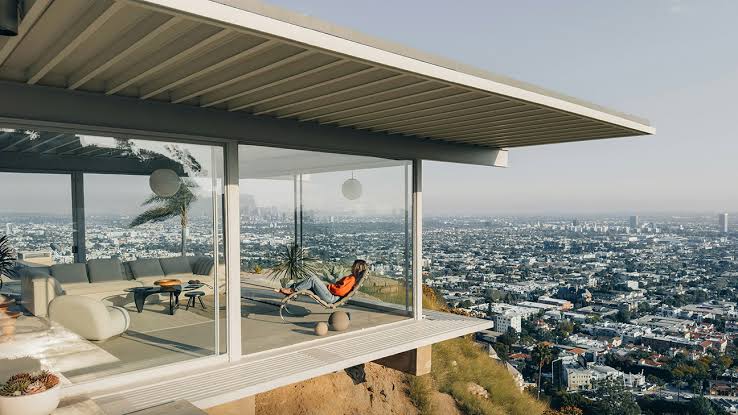
The highest tier of Los Angeles real estate moves quietly. Discretion and timing carry as much weight as price, and the properties that truly matter rarely surface until the moment they change hands. The Stahl House Case Study House #22 is precisely that kind of property. For the first time, it has entered the Los Angeles luxury real estate market with an asking price of $25 million. At 2,200 square feet, built in 1959[-3], it is not the largest home on the market. What it represents, however, is far more significant than its footprint.
The Stahl House stands as a defining example of how mid-century modern architecture reshaped the Los Angeles real estate market particularly in the Hollywood Hills, where lots once written off as unbuildable became some of the most coveted addresses in the city. This piece looks at how one home redefined architectural value, set new pricing standards for Los Angeles California real estate, and continues to shape the way buyers and sellers think about luxury property across the Los Angeles area.
Christina Pope, Sotheby's International Realty | EliteResidenceInternational.com
Understanding the Stahl House's Role in Defining Los Angeles Real Estate
The Evolution from Experimental Design to Cultural Landmark
Buck Stahl purchased a lot deemed unbuildable for $13,500 in 1954. Several architects had already walked away from the steep Hollywood Hills site before Pierre Koenig recognized what others could not see. Construction began in May 1959 on a budget of $37,500 roughly $408,100 in today's dollars. The two-bedroom, two-bathroom residence was finished by May 1960 as Case Study House #22.
Julius Shulman photographed it that same year. His image two women in the glass-walled living room, the city glittering far below later earned recognition from Time Magazine as one of the most influential photographs in the publication's 200-year history. A home originally conceived as an affordable housing prototype had become a global symbol of California modernism. Los Angeles designated it a Historic-Cultural Monument in 1999, and the National Register of Historic Places followed in 2013.
What Makes a $25 Million Two-Bedroom Home
The current asking price exceeds $11,000 per square foot. Standard Los Angeles real estate valuations simply do not apply. The Stahl family once declined a $15 million offer not out of indifference, but out of a desire to find a steward rather than a buyer.
That distinction matters. The home has remained in the original family for 65 years, a claim no other Case Study House can make. Since 2008, the family has welcomed visitors through organized tours, with proceeds supporting the structure's maintenance and restoration. Film productions, commercials, and editorial shoots have added further revenue, and location rentals reportedly allowed the Stahls to retire their original mortgage well ahead of schedule.
The Intersection of Architecture and Real Estate Value
Architect-designed homes tend to appreciate faster than standard residential properties, and the Stahl House makes that case with particular clarity. Having appeared in over 1,200 publications, it occupies a place in public consciousness that extends well beyond architectural discourse.
Historic designation does shape what an owner can do with the property exterior modifications require review, which limits flexibility. At the same time, that same protection guarantees preservation, and with preservation comes scarcity. Standard luxury homes offer no equivalent assurance. Here, architectural significance, photographic legacy, and original authenticity together produce a valuation framework unlike anything conventional Los Angeles real estate metrics are built to measure.
Christina Pope, Sotheby's International Realty | EliteResidenceInternational.com
How Mid-Century Modern Design Transformed the Los Angeles Real Estate Market
The Case Study House Program's Commercial Legacy
Arts & Architecture magazine launched the Case Study House program in January 1945, commissioning the country's most respected architects to respond to the post-World War II housing shortage. The result was 36 prototype designs, 25 of which were built — the majority concentrated in Los Angeles County. Editor John Entenza set a clear mandate: each house had to be "capable of duplication and in no sense be an individual performance".
The public responded. Before the first residents moved in, 350,000 visitors had already walked through the open homes. That kind of attention turned experimental design into something people genuinely wanted for themselves. When the program closed in 1966, its ideas had already taken root across the broader Los Angeles real estate market open-plan layouts, indoor-outdoor living, and an unapologetic relationship with natural light had all made their way into tract housing and custom builds alike.
Steel-and-Glass Construction: Changing Building Standards in Los Angeles
Wartime industry left behind materials that architects found equally useful in peacetime. Steel, aluminum, tempered glass, stucco, and plywood met the moment practical solutions for returning soldiers and a growing population. Charles Eames was among the first to bring steel into domestic architecture with his 1949 house and studio, and what followed was a shift in what residential design could actually achieve. Floor-to-ceiling glass, open volumes, and light-filled rooms that once seemed out of reach became standard expectations.
Open Floor Plans and Their Impact on Modern Home Valuations
The numbers reflect what the market confirmed over time. Homes with open floor plans appreciated at 7.4% annually between 2011 and 2016 in the United States. Across the Atlantic, open-plan living areas add up to 15% to property values in the United Kingdom. Today, 70% of American homebuyers prefer fully or partially open kitchen and family room configurations. Well-designed mid-century modern homes consistently command a premium of 15–20% over comparable traditional properties.
Why Authenticity Matters in Architectural Real Estate
Authenticated mid-century modern properties have moved well beyond their original purchase prices. A Pennsylvania home acquired for $995,000 now carries an asking price of $2.49 million. A California property that sold for $950,000 in 2010 lists today at $1.90 million. Upkeep runs higher than a conventional home specialized materials and exacting restoration standards see to that — but for buyers who understand what they are acquiring, the trade-off is well worth considering.
Christina Pope, Sotheby's International Realty | EliteResidenceInternational.com
Hollywood Hills as a Blueprint for Premium Los Angeles Luxury Real Estate
"As a luxury Realtor and an occasional custom home project developer in Paradise Valley I'm very in tune with luxury custom home construction." — Gary Todd, Luxury Realtor and custom home project developer
Site Selection and the Value of Impossible Lots
Steep hillside parcels that other buyers and architects passed over now anchor some of the most sought-after addresses in Los Angeles luxury real estate. The Stahl House made this case definitively. What looked like a liability — an unstable cliff site with no obvious path to construction — became, in the right hands, a singular asset. Architectural vision has a way of doing that.
View-Oriented Architecture and Price Per Square Foot
Glass walls and cantilevered structures shifted the way the Los Angeles real estate market assigns value. Square footage, once the primary measure, gave way to something harder to quantify: the view. Properties that prioritized vistas above all else established pricing models where the panorama itself commanded a premium, regardless of what sat behind it. For buyers of los angeles california real estate in hillside locations, that calculus has held ever since.
For clients who love to entertain or simply want a home that earns its setting, finding the right property takes more than a search it takes someone who understands what elevated living actually looks like. If you are beginning that process, Christina Pope would be glad to help. Christina Pope 📞 310-404-9931 ✉️ [email protected]
The Rise of Architectural Tourism and Property Prestige
A well-placed photograph can do what no listing description ever could. When an iconic image of a residence reaches a wide enough audience, the home stops being simply a private address and becomes a destination. Properties featured in major publications or on film earned recognition far beyond real estate in los angeles area circles, and owners who understood this found ways to put that recognition to work through tours, location rentals, and editorial access without sacrificing the residential character of the home. The Stahl House wrote that playbook.
Christina Pope, Sotheby's International Realty | EliteResidenceInternational.com
Market Dynamics and Investment Considerations for Iconic Properties
"Architecture should speak of its time and place, but yearn for timelessness." — Frank Gehry, Famous Architect
Landmark properties in the Los Angeles real estate market call for a different kind of due diligence. Protected designation under federal and local programs introduces a distinct set of considerations ones that informed buyers evaluate with care rather than caution.
Protected Status and Ownership Responsibilities
Federal listing in the National Register of Historic Places carries no automatic restrictions on private ownership under federal law. That said, exterior alterations require certificates of appropriateness from preservation commissions before any work can proceed. For buyers who value integrity over modification, this process is less a burden than a safeguard and it comes with a meaningful financial benefit: federal tax credits of up to 20% of qualified rehabilitation costs.
The Private Sale Market for Landmark Homes
Architectural properties of this caliber rarely move through conventional channels. Dedicated platforms connect sellers of architect-designed residences with buyers who share an understanding of preservation values. Brokers who specialize in protected properties are well-versed in deed restrictions that preclude demolition, and their expertise proves essential in facilitating these transactions.
Maintenance Costs and Revenue from Cultural Significance
Standard single-family home maintenance averaged $10,433 annually as of Q3 2024. Historic structures routinely exceed that figure, given the specialized materials and restoration expertise they require. The Stahl House, as noted earlier, offset these costs meaningfully through tours and location rentals a model worth understanding before any acquisition of this nature.
Strategic Positioning in the Los Angeles Real Estate Area
Heritage properties have shown a consistent ability to hold their ground when the broader market softens. Research points to 59% of heritage homes outperforming average properties in their respective markets. These are not purchases suited to every buyer — landmark buildings appeal most to those comfortable with a higher risk-return profile. For the right buyer, however, scarcity does the heavy lifting. Authenticated architectural provenance in the Los Angeles luxury real estate segment commands premiums that no amount of new construction can replicate.
Christina Pope, Sotheby's International Realty | EliteResidenceInternational.com
Conclusion
The Stahl House is not simply a home for sale it is a record of what architectural conviction can produce over time. Cultural significance, photographic legacy, and protected status combine here in a way that standard luxury properties rarely, if ever, achieve. Buyers who understand this recognize that architectural provenance carries its own kind of currency, one that holds across market shifts and outlasts temporary trends.
Within the Los Angeles luxury real estate market, scarcity and heritage do the work that square footage alone cannot. The properties that endure — and appreciate — are the ones with a story worth telling and the credentials to support it. The Stahl House has both.
Christina Pope, Sotheby's International Realty | EliteResidenceInternational.com
Key Takeaways
The Stahl House exemplifies how architectural significance transcends traditional real estate metrics, commanding $25 million for just 2,200 square feet—over $11,000 per square foot—based on cultural impact rather than size alone.
Mid-century modern architecture fundamentally reshaped Los Angeles luxury real estate by proving that:
• Impossible sites become premium assets: Buck Stahl's $13,500 "unbuildable" lot transformed into a $25 million landmark, establishing hillside parcels as prime real estate opportunities in the Hollywood Hills.
• Authenticity drives exponential value: Original ownership, protected status, and documented cultural impact create pricing models where heritage properties appreciate 15-20% faster than comparable traditional homes.
• View-oriented design commands premiums: The Case Study House program's steel-and-glass construction pioneered open floor plans that now boost property values by 7-15% and attract 70% of modern homebuyers.
• Architectural tourism generates dual revenue streams: Landmark properties monetize cultural significance through tours, film locations, and editorial shoots while maintaining residential function—the Stahls paid off their mortgage through location rentals alone.
• Protected designation ensures long-term investment resilience: Heritage properties outperform average market properties 59% of the time, offering scarcity value and federal tax credits up to 20% of rehabilitation costs for sophisticated investors.
The intersection of architectural provenance, photographic legacy, and structural authenticity creates a luxury real estate category where cultural significance matters more than square footage—a principle that continues defining Los Angeles's most prestigious properties.
FAQs
Q1. What architectural style is the Stahl House and why is it significant? The Stahl House is one of the most iconic examples of mid-century modern architecture in the world. Designed by architect Pierre Koenig and completed in 1960, it features the hallmark characteristics of the style including steel-and-glass construction, open floor plans, and seamless indoor-outdoor integration. Its significance extends beyond architecture—Julius Shulman's famous photograph of the house transformed it into a global symbol of California modernism.
Q2. Why does the Stahl House command such a high price despite its small size? The $25 million asking price (over $11,000 per square foot) reflects cultural significance rather than square footage. The property maintains original family ownership after 65 years, holds protected status as a Historic-Cultural Monument, and appears in over 1,200 publications. Its authenticated architectural provenance, photographic legacy, and role in defining Los Angeles luxury real estate create value that standard properties cannot replicate.
Q3. How did mid-century modern design influence Los Angeles real estate values? Mid-century modern architecture established new pricing models in the Los Angeles market. Open floor plans boost property values by 7-15%, and well-designed mid-century homes command premiums of 15-20% over traditional properties. The style proved that view-oriented design, steel-and-glass construction, and challenging hillside sites could become premium assets, fundamentally transforming how buyers evaluate luxury real estate.
Q4. What are the investment considerations for owning a landmark property like the Stahl House? Landmark properties require different evaluation criteria than standard acquisitions. Protected status brings both constraints (modifications require review) and advantages (federal tax credits up to 20% of rehabilitation costs). Maintenance costs exceed typical homes due to specialized restoration needs, but heritage properties demonstrate resilience, outperforming average market properties 59% of the time and generating additional revenue through tours and location rentals.
Q5. Who were the key figures behind the Stahl House's creation and fame? Buck Stahl purchased the "unbuildable" lot for $13,500 in 1954, architect Pierre Koenig designed the innovative structure with a $37,500 budget, and photographer Julius Shulman captured the iconic 1960 image that made the house world-famous. Time Magazine later recognized Shulman's photograph as one of the most influential in the publication's history, cementing the Stahl House's status as a cultural landmark.