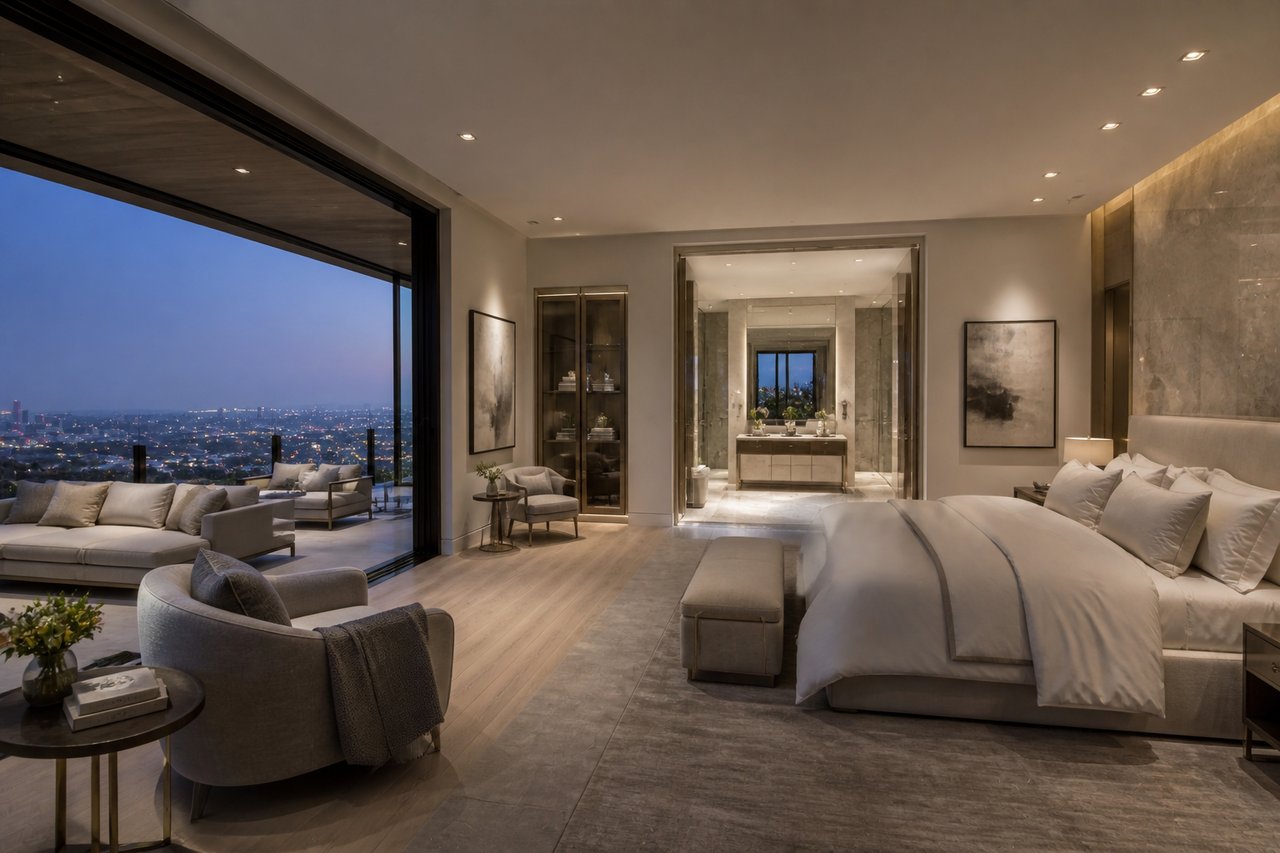
The Beverly Hills primary suite has become the defining measure of what constitutes true luxury in today's market. Then the most important design decisions unfold privately, where buyers prioritize clarity of purpose over excess square footage. Great design is not a matter of fashion but a reflection of lifestyle. Discerning buyers understand this difference. The primary suite reveals what ultra-luxury buyers value: integrated wellness features and refined finishes, with spaces engineered for both retreat and function. This piece gets into the design standards, spatial planning approaches and technical details that distinguish trophy bedrooms in Beverly Hills.
The Market Expectations for Beverly Hills Primary Suites
Luxury real estate transactions in Beverly Hills operate through private networks where discretion matters as much as price. The most substantial deals unfold quietly, made easier by professionals like Christina Pope at Sotheby's International Realty and platforms such as EliteResidenceInternational.com, where timing and strategic positioning drive outcomes more than public visibility. Buyers seeking properties in the upper echelons of this market must understand what commands premiums by looking beyond surface-level amenities.
What Buyers Pay Premiums For
The Beverly Hills primary suite functions as a daily-use asset that buyers underwrite with the same scrutiny they apply to the entire property. High-net-worth purchasers pay for repeatable quality-of-life benefits rather than difficult-to-maintain complexity. The financial logic centers on privacy, wellness, and operational ease delivered through layouts that read as coherent wings with intentional transitions.
Strong buyer response emerges when the suite provides clear separation from secondary bedrooms, a defined entry moment, and circulation that avoids forcing passage through the sleeping area to reach closets or bathrooms. This layout discipline protects resale liquidity across different buyer demographics and design styles. Properties with well-zoned suites maintain pricing power even when competing homes offer similar square footage. Spectacular bathrooms attached to awkward bedrooms can trade at a discount because the daily experience feels compromised.
Nearly one out of three people seeking homes priced at $2 million or more express interest in dual master bedrooms. This demand has risen substantially among buyers dealing with different work schedules or sleep requirements. The trend allows each partner to personalize their space while maintaining sleep quality that supports healthier lifestyles.
Direct access to terraces, balconies, or private patios is expected more when pricing implies resort-level living. The difference lies in usability: comfortable depth, privacy from neighboring properties, and connections that feel natural rather than added as afterthoughts. These outdoor extensions work when they improve lifestyle without stealing from core proportions.
Turnkey Presentation Standards
Buyers in this market segment will pay premiums to avoid multi-year construction and permitting timelines. Move-in-ready homes with modern systems, high-end finishes, and professional staging shorten time-on-market and raise perceived value. The pressures of modern life mean clients lack time to manage multiple consultants, coordinate contractors, or oversee countless decisions that shape major builds.
Turnkey design has become an expectation rather than a luxury, especially when you have clients who value their time. Single partners guide projects from concept to completion by bringing architecture, interiors, and project management under one roof. This integration delivers better outcomes because every discipline arranges toward one shared vision. Both local and international buyers get peace of mind and clarity at every stage without the complexity of managing processes themselves.
Quality of materials and craftsmanship remains central. Buyers look for custom millwork and theater-grade acoustics, along with art-forward lighting that respects collections. Recent upgrades to major systems and documented renovation costs help justify asking prices in this segment.
Privacy and Discretion Features
High-net-worth buyers expect privacy and controlled public presence. Gated entries, set-back homes, mature landscaping, and discreet perimeter walls reduce visibility and improve comfort during daily living. Many Beverly Hills properties feature large lots, gated entrances, and lush landscaping that create natural barriers between homes and the outside world. Some neighborhoods are designed to prioritize privacy, with limited access points and private roads.
Professional security systems rank as highly desirable. Buyers look for integrated controls, monitored systems, and secure guest access. Showing protocols and privacy-centric marketing often matter as much as the hardware itself for celebrity and executive buyers. Properties positioned high in the hills offer unobstructed panoramic views that command premiums distinguishing them from valley-floor locations.
The value-resilient investment dollars go to plan corrections, bath performance, acoustic comfort, and closet workflow before allocating resources to exotic materials or niche amenities. Buyers understand that privacy as a luxury asset drives property values, as they remain willing to pay premiums for the peace and security these properties deliver.
Spatial Planning and Layout Approaches
Layout decisions in the Beverly Hills primary suite determine whether substantial square footage translates into functional luxury or wasted space. The difference between a well-planned suite and an awkward one often comes down to circulation patterns, zoning clarity and how spatial volumes relate to one another.
Entry Sequence and Transition Zones
The entry sequence establishes expectations before anyone reaches the bed. High-end suites benefit from defined transitions that separate the primary bedroom from secondary bedrooms and common areas. This can take the form of a short hallway, a vestibule or even a subtle shift in ceiling height that signals arrival into private territory.
Circulation paths must maintain minimum widths of 36 inches to feel comfortable during daily use. Movement from the door to the bed, then to storage and bathroom, should follow direct lines without forcing detours around furniture. Clear spacing near bathroom doors improves both convenience and comfort. Architects plan distinct zones within the bedroom: a sleeping area with king-size bed and nightstands, a seating area for relaxation and thoughtful transitions to the ensuite bathroom and closet areas.
Premium designs allocate 300 square feet minimum for the bedroom alone. Upper-tier projects extend to 400-450 square feet to accommodate additional features like morning bars or reading nooks. High ceilings, preferably 10 feet or higher, create a sense of grandeur often improved by tray or coffered ceiling details.
Bedroom Orientation for View Capture
Strategic window placement frames views while maintaining privacy and creates balance between openness and seclusion. The bed should be positioned diagonally to the entrance door rather than directly in front of it. This allows an unobstructed view of the entrance from the bed for a sense of security. Properties positioned higher in hillside locations command premiums for unobstructed panoramic views.
Separate Sitting or Lounge Areas
Sitting areas transform bedrooms into multi-functional retreats. Window-adjacent seating maximizes natural light in primary bedroom designs. Seating should be placed away from main circulation paths and positioned with backs to beds to create distinct zones. Even in smaller footprints, a planned chair or bench adds functionality without overwhelming the space.
Balcony or Terrace Integration
Smooth transitions between interior and exterior spaces add dimension to luxury bedroom floor plans through private balconies, floor-to-ceiling windows and sliding glass doors. The difference lies in usability: comfortable depth, privacy from neighboring properties and connections that feel integrated rather than added as afterthoughts.
Dedicated Workspace Zones
Whether for a private home office, meditation space or exercise area within the primary suite, architects can incorporate these elements while maintaining overall flow and luxury esthetic. Small desk areas support daily tasks or hobbies without requiring full home office buildouts. Proper integration ensures these zones improve rather than disrupt the suite's primary function as a retreat.
Bathroom Design as a Luxury Statement
Bathrooms in Beverly Hills primary suites function as wellness environments where material choices and fixture selection communicate status through restraint rather than excess. The most successful designs prioritize daily experience over visual effect alone, a difference that separates properties commanding premiums from those trading at comparative discounts.
Sculptural Tubs and Glass-Enclosed Showers
Freestanding tubs serve dual purposes as functional bathing fixtures and sculptural focal points. Materials such as stone resin, acrylic, or hammered copper affect both the esthetic and the physical experience of soaking. Windows placed near the tub capture views while floor-mounted tub fillers create striking visual statements.
Walk-in showers with curbless designs improve accessibility and create smooth transitions across the bathroom floor. Frameless glass enclosures maintain open sightlines and reduce visual clutter. Rain showerheads paired with handheld options provide flexibility. Built-in benches and niche storage address practical needs without compromising design integrity.
Wet rooms that combine shower and tub functions within a single tiled space have transitioned from small-bathroom solutions into sought-after features in luxury primary bathrooms. These configurations position the tub near one wall with shower fixtures on the opposite side, supported by discreet floor drains at both ends.
Imported Stone and Custom Tile Work
Natural stone with subtle veining establishes tone and durability. Large-format slabs create continuity and visual flow. They eliminate grout lines that require maintenance. Textured tiles add depth, and handcrafted finishes such as Moroccan-inspired Zellige bring character to surfaces.
Tile layouts contribute as much as material selection. Herringbone patterns, vertical stacks, and geometric mosaics transform functional surfaces into design statements. The change away from stark whites toward natural materials like stone and wood introduces warmth.
Smart Mirrors and Integrated Technology
Mirrors now include integrated lighting, dimmers, defoggers, and built-in storage. Anti-fog technology maintains clarity after hot showers. Magnifying panels assist with grooming tasks. Adjustable LED lighting eliminates harsh shadows.
Smart toilets offer heated seats, touchless flushing, motion-activated lids, automatic deodorizers, and UV sterilization. Wall-mounted installations save floor space and maintain full functionality.
Separate Water Closet and Bidet
Separate water closets add privacy and flexibility. They allow shared bathroom use without compromising comfort. This dedicated enclosure includes the toilet behind a pocket door. Bidets are specified as standard equipment rather than optional upgrades.
Closet Systems That Function Like Boutiques
Walk-in closets in high-end Beverly Hills properties function as curated environments where organization meets presentation. The difference between standard storage and boutique-inspired design determines whether substantial square footage delivers daily efficiency or simply houses clothing behind doors.
Scale and Proportion Guidelines
Center islands serve as both visual anchors and functional hubs in luxury closet design. Drawers accommodate jewelry, and pull-out trays hold watches. Hidden charging ports integrate technology without visible clutter. Marble or quartz tops define these islands as statement pieces rather than utilitarian surfaces. A plush bench or ottoman nearby creates a boutique-style dressing experience that lifts daily routines.
The spatial approach borrows from retail design principles. Items breathe rather than crowd shelves, even when additional storage capacity exists. Adjustable components allow shelving and rods to change as wardrobes evolve. Valet features such as pull-out rods and hooks assist with outfit planning. This flexibility supports long-term usability across different lifestyle phases.
Material Palette and Finish Selections
Material combinations establish the closet's architectural character. Walnut wood paired with brushed gold accents delivers warmth with refined detailing. Glass doors framed in matte black aluminum protect garments and maintain visibility. Marble countertops atop vanity islands bridge function with visual weight.
The most effective palettes balance texture and quality. Matte oak panels contrast with high-gloss lacquer to create depth. Handcrafted solid wood cabinetry paired with soft-close drawers eliminates operational friction. Built-in jewelry organizers and velvet-lined trays protect valuables and display them with intention. These elements create cohesive environments rather than utility rooms.
Accessory Display and Jewelry Storage
Specialized storage transforms accessories into curated displays. Tie and belt racks with lighting organize items and highlight patterns and textures. Scarf and handbag displays use built-in shelving with soft edges to prevent wear. Watch winders and jewelry trays incorporate climate controls to maintain proper conditions for fine pieces.
Shoe storage receives equal attention through angled shelves or glass-front cabinets with focused lighting. Custom shelving dedicated to handbags and footwear creates visual arrangements organized by color, designer, or style. LED strip lighting installed beneath shelves improves visibility and adds boutique ambiance. These solutions prevent damage to valuable items and convert necessary storage into display opportunities.
Lighting Design and Atmospheric Control
Atmospheric control in the Beverly Hills primary suite depends on lighting systems that adapt to activity, time and mood. The most sophisticated installations combine technical precision with operational simplicity, a difference that separates properties commanding premiums from those offering standard solutions.
Layered Lighting for Different Moods
The three-layer approach combines ambient, task and accent lighting to create depth and versatility. Ceiling-mounted or recessed fixtures provide overall illumination as ambient lighting. Task lighting adds focused brightness for reading, grooming or detailed work. Accent lighting highlights artwork and architectural features, fine-tuned to roughly three times the brightness of surrounding ambient light. High-end bedrooms incorporate at least four separate light sources to achieve warmth and flexibility.
Circadian Rhythm Considerations
Circadian lighting systems mimic natural daylight progression and move from cooler, brighter tones in the morning to warmer tones in the evening. Wakefulness gets support during active hours from this progression, and relaxation before sleep gets promoted. Fixtures with dimming capabilities allow adjustment based on time of day.
Accent Lighting for Art and Texture
Sconces, picture lights and pendant fixtures draw attention to specific elements within the suite. Collections and architectural details become focal points through strategic placement without overwhelming the space.
Smart Controls and Scene Programming
Dimmers, motion sensors and programmable timers provide energy efficiency and customization. Preset lighting configurations activate at the push of a button through scene programming and eliminate manual adjustments across multiple fixtures. Warm-toned bulbs in the 2700K-3000K range create flattering illumination suited to relaxation spaces.
Blackout and Privacy Solutions
Motorized shades and blackout systems eliminate external light intrusion and maintain control over privacy levels during all hours.
Conclusion
The Beverly Hills primary suite separates properties that occupy premium addresses from those that deliver repeatable quality-of-life benefits. Design decisions in these spaces reveal what sophisticated buyers value: wellness integration and privacy features that support both daily routines and long-term investment stability. For those who love to entertain and seek homes designed for elevated living, Christina Pope at 310-404-9931 helps buyers find properties where every detail supports effortless hosting and refined comfort. The most resilient investments in this market prioritize functional luxury over surface-level spectacle. So properties with well-laid-out suites, boutique-level finishes, and thoughtful circulation maintain pricing power across market cycles while delivering the discretion and performance that define true luxury living.
Key Takeaways
Beverly Hills primary suites reveal what ultra-luxury buyers truly prioritize: functional design over flashy features, with emphasis on wellness integration, privacy, and spaces that enhance daily living quality.
• Buyers pay premiums for privacy and operational ease - Well-zoned layouts with clear separation, direct outdoor access, and turnkey presentation command higher prices than complex designs requiring extensive renovation.
• Spatial planning determines luxury value - Minimum 300 sq ft bedrooms with defined entry sequences, 36-inch circulation paths, and strategic view capture create functional elegance that maintains resale power.
• Bathrooms function as wellness environments - Sculptural tubs, curbless showers, imported stone, and smart technology transform daily routines into spa-like experiences that justify premium pricing.
• Closets must operate like boutiques - Center islands, adjustable storage systems, specialized displays for accessories, and retail-inspired organization elevate storage from utility to curated experience.
• Layered lighting creates atmospheric control - Three-layer systems with circadian rhythm programming, scene controls, and blackout solutions adapt spaces to different moods and activities throughout the day.
The most resilient luxury investments prioritize repeatable quality-of-life benefits through thoughtful design integration rather than surface-level spectacle, ensuring properties maintain value across market cycles.
FAQs
Q1. What features do Beverly Hills luxury home buyers prioritize in primary suites? High-net-worth buyers prioritize privacy, wellness integration, and operational ease over excessive square footage. They look for well-zoned layouts with clear separation from other bedrooms, direct outdoor access to terraces or balconies, turnkey presentation with modern systems and high-end finishes, and spaces that deliver repeatable quality-of-life benefits rather than difficult-to-maintain complexity.
Q2. What is the minimum recommended size for a luxury primary bedroom? Premium designs allocate a minimum of 300 square feet for the bedroom alone, with upper-tier projects extending to 400-450 square feet to accommodate additional features like morning bars or reading nooks. High ceilings of 10 feet or higher are preferred to create a sense of grandeur, often enhanced by tray or coffered ceiling details.
Q3. Why are dual primary bedrooms becoming more popular in luxury homes? Nearly one out of three buyers seeking homes priced at $2 million or more express interest in dual master bedrooms. This trend has risen among buyers dealing with different work schedules or sleep requirements, allowing each partner to personalize their space while maintaining sleep quality that supports healthier lifestyles.
Q4. What makes a luxury closet function like a boutique? Boutique-inspired closets feature center islands with marble or quartz tops serving as visual anchors, specialized storage for jewelry and accessories with illuminated displays, adjustable shelving systems that adapt as wardrobes change, and retail-inspired organization where items breathe rather than crowd shelves. LED strip lighting and glass-front cabinets enhance the curated presentation.
Q5. How does layered lighting improve a primary suite? Layered lighting combines three types: ambient lighting for overall illumination, task lighting for focused activities like reading or grooming, and accent lighting to highlight artwork and architectural features. High-end bedrooms incorporate at least four separate light sources with smart controls and scene programming, allowing the space to adapt to different moods and times of day while supporting natural circadian rhythms.