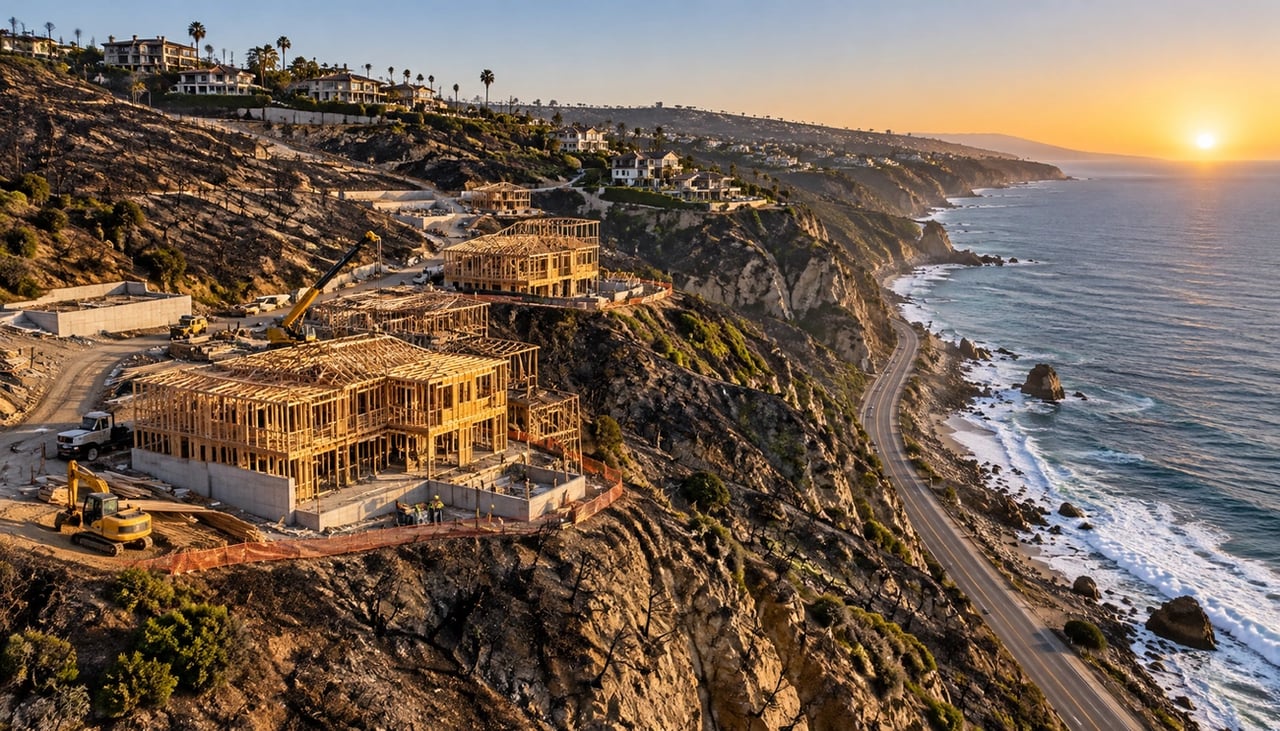
Castellammare's cliffside properties are at the forefront of the pacific palisades rebuild, emerging as the earliest and most active pocket of recovery following one of California's most devastating wildfires on record. The January 2025 fire scorched over 40,700 acres and destroyed more than 12,300 structures, claiming at least 27 lives. Nearly 1,000 homes are now under construction — a meaningful marker of momentum for a community that has been defined by uncertainty since the disaster struck.
Whether Pacific Palisades would rebuild, and how, has been a question at the center of conversations since the first home received authorization after almost a year of recovery. What Castellammare's early progress reveals is worth understanding — both for those with a stake in the area and for those watching how high-value coastal communities respond when circumstances demand it.
Why Castellammare Cliffside Homes Are Rising First in Pacific Palisades Rebuild
Luxury real estate in Los Angeles has always operated through private channels, where timing and access carry more weight than public announcements. Castellammare's cliffside properties reflect that reality in the pacific palisades fire rebuild. With median pre-fire values at $2.93 million, these homes follow a different reconstruction path than the rest of the market — and the reasons are practical, not surprising.
Property complexity, for one, works in favor of those with resources. Larger estates demand detailed architectural plans, longer design cycles, and sophisticated financing structures. Wealthy homeowners can pull these together quickly. For many other survivors, the same process stalls — 71 percent of single-family homeowners reported being extremely concerned about insurance coverage gaps. Castellammare owners, by contrast, tend to hold stronger insurance positions and have liquid capital available when it counts.
The hillside terrain tells a similar story. Sloped lots require geotechnical assessments and grading before any foundation work can begin — yet affluent owners engage specialized engineering firms right away, sidestepping the delays that hold others back. Contractor access works the same way. With rebuild costs running from $350 to over $750 per square foot and demand split between the Palisades and Altadena, securing capable contractors is a competition — one that well-capitalized owners are better positioned to win.
Permitting reforms have also helped those who came prepared. Pre-approved designs and expedited reviews now move applications through at nearly three times the pre-fire pace. Homeowners who engaged architects early and submitted complete plans are the ones seeing the benefits.
From Devastation to Foundation: Tracking the Castellammare Rebuild Timeline
"‘Fine architecture can follow in the wake of tragedies,’" — Ian Davis, British architect
"'Fine architecture can follow in the wake of tragedies.'" — Ian Davis, British architect
January 7, 2025 was the ignition point for a 23,700-acre inferno that moved through Castellammare with uneven force. Some streets lost nearly everything. Others were largely spared. The Getty Villa's buildings and collection survived, though its grounds did not. That patchwork of destruction would go on to shape the rebuild in ways that are still unfolding.
Debris removal moved at a pace that caught many observers off guard — 35 days after ignition, work was already underway, roughly half the time it took following the 2018 Woolsey Fire. The EPA completed Phase 1 hazardous material extraction in 28 days, clearing 4,349 buildings across the Palisades burn zone by February 26, 2025. More than 300 tons of hazardous debris were removed during this phase, including exploded lithium-ion batteries. The Army Corps of Engineers then stepped in for Phase 2 structural debris clearance.
March 2025 delivered an unwelcome reminder of the hillside's fragility. Heavy rain destabilized the terrain, and a debris slide split a Castellammare-area house that had survived the fire. Pacific Coast Highway, closed in the immediate aftermath, reopened in phases through the year as conditions allowed.
Permit approvals told a different story — one of efficiency. The first rebuilding permits were issued within 57 days, processing at nearly three times pre-fire speed. By mid-2025, over 1,200 rebuilding plans had been approved across 600+ addresses, with more than 340 projects confirmed in active construction. Sixteen months on, cleared lots and active construction sites throughout Castellammare were visible from aerial views — the community, piece by piece, taking shape again.
Is Pacific Palisades Rebuilding Differently This Time
"Every $1 spent on rebuilding wildfire-resistant communities could save $210 in avoided future losses." — Headwaters Economics, Research organization focused on economic analysis
The rebuild is not simply about replacing what was lost — it is about building what should have existed all along. Homes constructed after California's 2008 fire code update survived the January 2025 blaze at notably higher rates than older structures. The margin came down to materials and design decisions that kept embers out and flames from spreading.
Concrete has become the structural material of choice. Insulated Concrete Forms hold up against fire exposure for as long as four hours without compromising integrity. Architect Greg Chasen's home offered one of the clearest illustrations of this — it stood intact while neighboring properties were reduced to ash, owing to sealed construction, double-paned windows, no attic vents or eaves, metal roofing with fire-resistant underlayment, and concrete garden walls. Michael Kovac's rebuild told a similar story: fiber cement siding, Class A roofing, commercial glazing, and a fire retardant system brought his home to LEED platinum certification.
California's Building Code Chapter 7A now requires ember-resistant vent screens, enclosed eaves, dual-pane tempered windows, and non-combustible siding for all properties in Very High Fire Hazard Severity Zones. Zone zero regulations — mandating cleared vegetation within five feet of any structure — brought destruction rates down from 27 percent to nine percent in areas where they were applied. The FAIR Plan has responded accordingly, offering wildfire hardening discounts of 13 to 16 percent for documented mitigation measures. Fire-resistant construction, once seen purely as a safety consideration, now carries real financial logic as well.
Conclusion
Castellammare's story is ultimately one about access — to capital, to the right professionals, and to a market that rewards those who know how to move within it. The rebuild has underscored that luxury real estate, even in the aftermath of disaster, operates quietly and efficiently for those who understand its rhythms. Fire-resistant construction standards are now part of what defines value in coastal communities, and that will hold true for decades to come.
For clients with a stake in Pacific Palisades or the broader Los Angeles coastal market, informed representation makes all the difference. Christina Pope at Sotheby's International Realty brings the experience and discretion that high-value transactions in recovering markets demand. Clients can reach her through EliteResidenceInternational.com.
Key Takeaways
The Castellammare neighborhood is leading the Pacific Palisades fire rebuild, offering crucial insights into disaster recovery dynamics and fire-resistant construction standards that will reshape California's coastal communities.
• Wealth accelerates reconstruction: Castellammare's cliffside properties are rebuilding first due to stronger insurance positions, liquid capital reserves, and ability to secure specialized contractors immediately in a stretched market.
• Speed matters in disaster recovery: Debris removal took just 35 days (half the 2018 Woolsey Fire timeline), and permits now process three times faster than pre-fire, with first approvals issued in 57 days.
• Fire-resistant construction saves billions: Homes built after California's 2008 fire code survived at significantly higher rates, with concrete structures, ember-resistant vents, and zone zero vegetation clearing reducing destruction from 27% to 9%.
• Insurance incentivizes hardening: The FAIR Plan now offers 13-16% discounts for documented wildfire mitigation measures, making fire-resistant construction financially advantageous beyond survival benefits.
• Nearly 1,000 homes under construction: Sixteen months post-fire, over 1,200 rebuilding plans have been approved for 600+ addresses, with 340+ projects in active construction, marking significant recovery progress.
The rebuild demonstrates that every dollar spent on wildfire-resistant communities could save $210 in avoided future losses, fundamentally changing how California approaches coastal development in high-risk fire zones.
FAQs
Q1. How many homes are currently under construction in Pacific Palisades after the fire? Nearly 1,000 homes are under construction in the Pacific Palisades area. More specifically, over 1,200 rebuilding plans have been approved for 600+ addresses, with more than 340 projects confirmed in active construction sixteen months after the January 2025 fire.
Q2. What makes fire-resistant homes more expensive to rebuild? Fire-resistant construction typically costs between $350 to over $750 per square foot depending on finish quality. The higher costs come from specialized materials like Insulated Concrete Forms, fiber cement siding, Class A roofing, commercial-grade glazing, ember-resistant vent screens, and dual-pane tempered windows required in Very High Fire Hazard Severity Zones.
Q3. How long does the debris removal process take after a major wildfire? The debris removal process for the Palisades Fire took approximately 35 days for Phase 1 hazardous material extraction, which was roughly half the time required following the 2018 Woolsey Fire. The EPA cleared 4,349 buildings by February 26, 2025, removing over 300 tons of hazardous debris before structural debris clearance began.
Q4. Do fire-resistant building materials actually prevent home destruction? Yes, fire-resistant materials significantly improve survival rates. Homes built after California's 2008 fire code update survived at notably higher rates than older structures. Properties with zone zero vegetation clearing saw destruction rates drop from 27 percent to just 9 percent, and concrete structures can withstand fire exposure for up to four hours.
Q5. Are there insurance discounts for building fire-resistant homes? Yes, the FAIR Plan now offers wildfire hardening discounts of 13 to 16 percent for documented mitigation measures. This makes fire-resistant construction financially advantageous beyond survival benefits, as every dollar spent on wildfire-resistant communities could save $210 in avoided future losses.