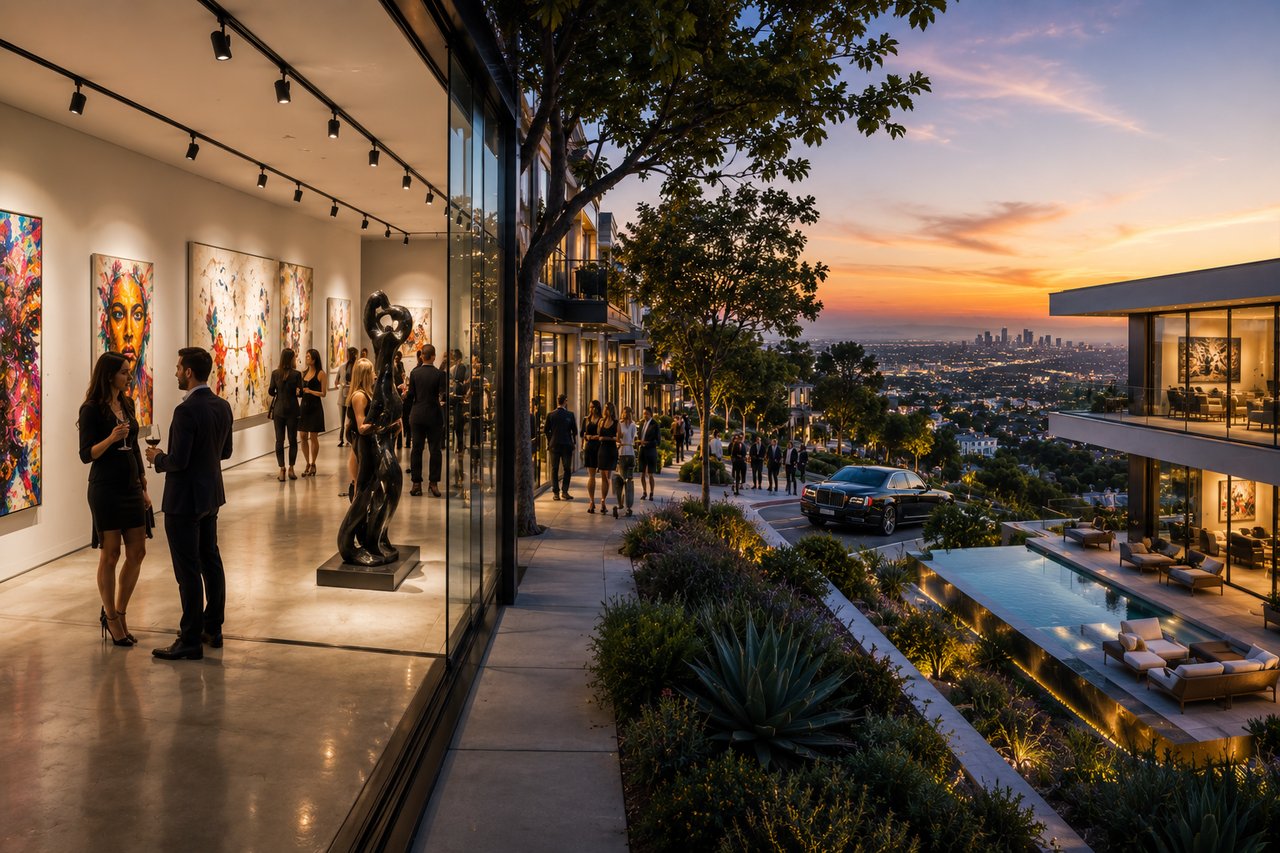
Boyle Heights gentrification follows patterns from Manhattan's gallery districts during the 1990-2003 period, where cultural institutions reshape property values through mechanisms invisible to conventional markets. Around 900 galleries per year operated in Manhattan during 1990-2003, and 70 percent concentrated in just four neighborhoods by 2000. Properties within walking distance of SoHo's gallery core command higher prices than comparable lofts outside the district. Gentrification art dynamics from Boyle heights gentrification 2019 through 2021 reveal timing opportunities for investors who value discretion and strategic collaborations in emerging cultural corridors.
The Cultural Capital Premium in Luxury Real Estate
Cultural institutions create value through channels that traditional appraisal methods struggle to capture. Properties near museums, galleries and performance venues command premiums rooted in social capital rather than physical attributes. This dynamic separates transactions between sophisticated buyers from conventional residential sales, where intangible benefits carry calculable weight in pricing negotiations.
What separates art districts from standard luxury markets
Gallery districts operate on different economic principles than other high-end residential zones. Research on Manhattan's gallery landscape reveals that these establishments cluster in already affluent neighborhoods rather than driving gentrification. Star galleries demonstrate stronger business fundamentals and survive longer. They operate multiple locations compared to independent spaces. This pattern suggests galleries follow wealth rather than create it. They position themselves where collectors already reside.
Beverly Hills illustrates this principle through concrete pricing data. Properties in the 90210 ZIP code near LACMA, the Petersen Automotive Museum and the Hammer command $1487 per square foot, well above the city-wide average of $718. The differential reflects more than proximity to cultural amenities. It signals access to a specific social ecosystem where collectors, curators and cultural influencers intersect.
Los Angeles luxury real estate operates through private channels where timing and discretion determine outcomes. Christina Pope at Sotheby's International Realty understands that visibility matters less than strategic positioning in emerging cultural corridors. Major transactions unfold within trusted networks before properties reach public listings because high-net-worth buyers value privacy alongside cultural access.
Measuring intangible value in cultural neighborhoods
To calculate cultural capital requires methodologies distinct from conventional comparable sales analysis. Willingness to pay studies captures value that entrance fees and market transactions fail to reflect. Research on heritage sites demonstrates visitors would contribute additional payments beyond admission prices to preserve cultural assets, suggesting deeper perceived value.
Property markets translate this preference into measurable premiums. Buildings with the highest cultural classification sell at 36 to 60 percent premiums compared to similar structures without cultural designation. These figures represent direct capitalization of cultural value into real estate pricing. Spillover effects extend beyond individual buildings. Houses situated near structures with high cultural value command a 1 percent premium, a statistically notable externality that compounds across whole districts.
Cultural proximity operates on distance gradients. Each cultural monument within 50 meters of a residence adds a 1.7 percent price premium, declining to 1.4 percent within 100 meters and 0.5 percent within 200 meters. Street art produces similar patterns, with sculptures increasing pre war commercial building prices by 8.32 percent within 100 meters. These measurements provide frameworks for evaluating properties in districts where gentrification art installations and gallery openings signal neighborhood transformation.
Why galleries attract specific buyer profiles
Art collectors represent a distinct demographic segment within luxury residential markets. Owners of homes valued above $10 million maintain art collections, according to analysis from Gibson Sotheby's International Realty. This correlation reflects shared values around cultural participation, esthetic refinement and social positioning within circles where collecting confers status.
Miami demonstrates how cultural events shape buyer composition. Art Basel, launched in 2002, contributes an estimated $500 million to the local economy each year. The event attracts clients who prioritize properties capable of showcasing collections and seek homes with appropriate wall space, lighting and architectural context. Elena Bluntzer at ONE Sotheby's International Realty notes many clients are serious collectors for whom cultural programming drives residential decisions.
Gallery districts provide daily access to exhibitions, artist talks and social gatherings that define lifestyle for this buyer segment. The appeal extends beyond occasional museum visits to cover cultural participation as part of identity and routine. Properties in these zones deliver experiential value that transcends square footage or finishes and create competitive dynamics where buyers compete for proximity to specific galleries or cultural anchors rather than comparing traditional amenities.
Gallery Proximity and Property Performance Across Markets
Property transactions in gallery districts that are decades old rarely announce themselves through public listings. Christina Pope at Sotheby's International Realty operates within networks where discretion determines access, especially when you have Los Angeles where most important acquisitions unfold through private channels before reaching conventional markets. Timing matters more than visibility in these circles, and strategic positioning near emerging cultural corridors creates opportunities invisible to buyers who rely on public data alone.
Manhattan's art neighborhoods from decades past
Manhattan maintains around 1,450 art galleries and represents the highest concentration globally. This density creates compounding effects where multiple galleries within walking distance generate foot traffic, collector activity and sustained property demand for decades. Chelsea functions as the densest gallery district. Most exhibition spaces concentrate between West 20th and West 27th Streets along the 10th and 11th Avenue corridor. High-end galleries including David Zwirner and Gagosian own their spaces and insulate themselves from rent fluctuations while anchoring the neighborhood's cultural identity.
Gallery rents in Chelsea averaged USD 90 to USD 100 per square foot for ground-floor locations before the 2008 financial crisis. Those rates reached USD 120 per square foot by 2019. Properties that command these commercial rents signal underlying residential value, as cultural programming drives consistent buyer interest even during broader market corrections.
Chelsea and SoHo valuation patterns
Chelsea's transformation began during the 1990s and attracted artists and creative professionals who sought spacious living and work environments. The average sales price in Chelsea appreciated around 180 percent from 1990 to 2010. The neighborhood recorded an additional 120 percent appreciation from 2010 to 2020. Current median sale prices reach USD 1.68 million, with 175 transactions recorded in recent quarters.
SoHo shows even stronger performance metrics. The neighborhood's limited inventory and iconic cast-iron architecture contributed to around 210 percent appreciation from 1990 to 2010. SoHo properties appreciated an additional 130 percent from 2010 to 2020. SoHo claimed the third position among Manhattan neighborhoods with a USD 3.69 million median sale price and represented a 19 percent yearly increase. The average home value stands at USD 3,064,571 currently, up 8.9 percent over the past year.
Rental markets reflect cultural district premiums accordingly. Rent prices average USD 4,660 per month within a 0.5-mile radius of Manhattan's Fourth Arts Block. Chelsea commands USD 4,229 monthly rent on average, well above citywide benchmarks for comparable square footage.
Los Angeles emerging cultural corridors
Los Angeles presents a different investment timeline than Manhattan's districts from decades past. The Arts District in Downtown Los Angeles experienced dramatic appreciation as artists and tech professionals met at converted factory and warehouse spaces. Sales prices jumped from USD 242 per square foot in the first quarter of 2015 to USD 655 per square foot by year-end. Average rents rose from USD 3.00 per square foot to over USD 4.00 during the same period.
Boyle Heights represents an emerging corridor where gentrification art patterns mirror early-stage Manhattan dynamics. The neighborhood's Hispanic heritage and artistic influence attract investors who recognize transformation potential before widespread buyer awareness. Echo Park shows promising growth through cultural integration and gentrification effects. Leimert Park, steeped in Afro-American arts and culture, shows steady property value increases over the past decade. West Adams combines historic architectural heritage with community initiatives that appeal to buyers who value authenticity alongside appreciation potential.
Comparative analysis of art district premiums
Cultural districts outperform non-cultural neighborhoods in rental premium measurements. Houston's Museum District shows the largest differential, with rents USD 1,916 (176 percent) more expensive than the city average. Houston's Theater District follows at USD 1,693 (156 percent) above baseline. Manhattan's gallery neighborhoods from decades past maintain premiums through decades rather than initial gentrification phases and demonstrate sustainability of culturally-driven appreciation once districts achieve critical mass of institutions and collector activity.
Understanding Gentrification Art Patterns for Investment
Luxury real estate in Los Angeles operates through mechanisms invisible to conventional market analysis. Major acquisitions unfold within private networks where discretion and timing matter more than public listings. Christina Pope at Sotheby's International Realty recognizes that strategic placement near emerging cultural corridors creates chances before widespread buyer awareness develops. Investors who value precision over visibility can learn about neighborhood transformation paths through gallery arrival patterns. EliteResidenceInternational.com serves clients who operate within these circles, where access determines outcomes.
The gallery arrival cycle and property timing
Gallery openings follow predictable sequences that signal investment windows. Research understanding Manhattan's development patterns reveals galleries select locations based on existing amenities rather than creating conditions for appreciation. New galleries open on blocks with pre-1940 housing, close to museums and parks, with commercial-friendly zoning and higher household income. Proximity to prior star galleries predicts new gallery openings with strength, creating clustering effects that compound over time.
This pattern suggests galleries function as indicators rather than catalysts. Star gallery locations from 1970 and proximity to high-income census tracts predicted gallery density in the 1990s and early 2000s with strength. The mechanism operates through fixed-location amenities that attract both galleries and affluent households. Certain architectural features prove especially attractive: galleries prize distinctive architecture, require large open floorplan rooms or high ceilings to display artwork, and benefit from agglomeration economies near other galleries.
Investment timing hinges on recognizing these signals before broader market recognition. Gallery arrivals concentrate in districts undergoing capital influx, often industrial zones offering affordable space and authentic character. The staged process begins with artist pioneers, followed by gallery clusters, then hospitality establishments, and ended up attracting higher-income residents who drive property appreciation.
Boyle Heights gentrification 2019-2021 trajectory
Boyle Heights demonstrates how concentrated gallery arrivals produce measurable property effects. 17 art galleries set up operations in the neighborhood between 2015 and 2016, clustering in a former low-income industrial zone along the east side of the Los Angeles River. This concentration triggered dramatic pricing shifts across both commercial and residential sectors.
Commercial properties experienced 77 percent growth in sale prices from pre-2015 to 2015-2016, while residential properties recorded 45 percent increases during the same period. Additional increases of 32 percent for commercial and 30 percent for residential properties emerged in early 2017. The greater Los Angeles metropolitan area showed only 5 percent residential and 9 percent commercial price increases for equivalent timeframes in comparison.
Geographic analysis reveals direct correlation between gallery locations and value appreciation. Heat mapping of commercial property sales prior to 2015 showed no correlation with current gallery locations. Once galleries established presence in 2015-2016, a new high-value corridor coinciding with the gallery cluster along the river appeared. This spatial relationship provides concrete evidence of galleries influencing property valuations in Boyle Heights.
Gentrification pressure originated from ongoing redevelopment of downtown Los Angeles from the west and adjacent neighborhoods from the north. Northern and western portions of Boyle Heights entered varying stages of gentrification, while southern and western portions remained at risk without active gentrification. Displacement and gentrification will likely continue expanding eastward from the Arts District and Downtown, given current market conditions and planning frameworks.
Artist displacement versus investor opportunity
The gallery-led appreciation cycle creates tension between capital opportunity and community stability. More than a dozen galleries, many from New York, established themselves in Boyle Heights over three years, drawn to affordable space and proximity to Downtown LA's art scene. These establishments brought wealthier clientele to areas of little interest previously, aligning with gentrification definitions.
Local resistance manifested through activist groups including Defend Boyle Heights and Boyle Heights Alliance Against Artwashing and Displacement, which targeted galleries through protests, mock eviction notices and disruptions. This opposition stems from concerns that galleries function as forerunners of real estate speculation, driving displacement and eviction as property values rise.
Research presents conflicting evidence on causation. Some studies establish strong links between galleries and gentrification, while others find limited concrete evidence. Results vary by neighborhood characteristics including location, history and demographics. Investment decisions require recognizing that galleries may signal rather than cause appreciation, responding to foundational amenities and demographic shifts already underway.
Lifestyle Benefits That Drive Affluent Buyer Decisions
High-net-worth buyers assess properties through frameworks invisible to conventional residential markets. Affluent purchasers seek environments that deliver daily cultural immersion and help access specific social networks beyond appreciation potential and architectural pedigree. Gallery districts provide these intangible benefits through mechanisms that traditional amenity checklists fail to capture. Christina Pope at Sotheby's International Realty works with clients who recognize that proximity to cultural institutions shapes daily experience and social positioning in ways square footage cannot replicate. EliteResidenceInternational.com serves buyers who prioritize these experiential dimensions alongside financial considerations.
Daily cultural engagement and social capital
Social capital generates value through networks that provide access to financial resources, influence, essential information, and growth opportunities. Trust, reciprocity, and mutual support form the basis of these networks and give the ability to achieve goals difficult to attain in isolation. Social capital shows itself through five distinct pathways within gallery districts: access to financial resources, power and decision-making authority, information channels, opportunities to flourish, and networking connections built on trust.
Cultural venues function as relationship infrastructure where collectors, artists, and patrons intersect. Exhibition openings, artist talks, and fundraising events create structured opportunities for meaningful engagement beyond transactional interactions. Trusting relationships formed through these networks offer direct benefits including recommendations, endorsements, and introductions to influential contacts. Residential proximity eliminates barriers to participation in this social ecosystem for buyers seeking integration into circles where collecting confers status.
Arts participation strengthens community bonds by nurturing trust, openness, cooperativeness, and respect among participants. Public art inspires civic pride and unites residents in collective appreciation. Gallery districts provide safe spaces to bridge differences and resolve community tensions through shared cultural experiences. Residents develop deeper connections through ongoing cultural engagement rather than isolated consumption in these environments.
Architectural character in gallery districts
Los Angeles Arts District shows how industrial heritage shapes residential appeal. Buildings dating from the early 20th century provide large open floor plans and high ceilings that manufacturers originally designed. Artists moved to these spaces during the late 1960s and early 1970s and sought affordable quarters with distinctive character. The 1981 Artist in Residence ordinance legitimized residential use of formerly industrial buildings and created legal frameworks for live-work conversions.
The Southern California Institute of Architecture relocated to the Santa Fe Freight Depot, a structure built in 1907, and created an educational anchor for the district. Hauser & Wirth set up operations in a former flour mill and combined galleries with a bookstore, garden, and restaurant across multiple acres. These adaptive reuse projects preserve authentic architectural elements while accommodating contemporary functions and create environments distinct from purpose-built luxury developments.
Street art throughout the district reinforces creative identity. Over 100 murals, graffiti pieces, and street art installations transform building facades into outdoor galleries. This visual density signals cultural vitality to residents and visitors and contributes to neighborhood character that newer developments cannot replicate through design alone.
Walkability and experiential living
Walkability directly influences happiness for adults aged 36 to 45. Those in highly walkable neighborhoods score 26 percent higher on happiness measures compared to residents of car-dependent areas. Research measuring access to 16 functional destinations including shops, pharmacies, cafes, parks, and transit stops found strong correlations between walkability scores and life satisfaction. The right home makes all the difference for those who love to entertain. Christina Pope would be delighted to help you find spaces designed for elevated living and effortless hosting if you're thinking over a purchase in the near future or beginning your search.  310-404-9931
  [email protected]
Mixed-use, pedestrian-oriented neighborhoods improve social capital by making spontaneous interactions between residents possible. Respondents in highly walkable areas showed 28 percent higher odds of knowing neighbors, 14 percent higher political participation rates, and 15 percent greater trust in others compared to car-dependent neighborhoods. Each additional walkable destination increased social engagement odds by 20 percent.
Downtown LA's Arts District contains modern luxury apartments, live-work lofts, and converted warehouses within walking distance of galleries, performance spaces, and restaurants. Traction Avenue functions as the district center and hosts Würstkuche, Angel City Brewery, and Arts District Brewing Company along a short pedestrian-friendly corridor. Residents can access cultural programming, dining, and social venues without vehicular dependency through this concentration.
Community composition and exclusivity
Location choices signal tribal affiliation within luxury markets. Properties in cultural enclaves offer access to pre-vetted social networks where neighbors function as implicit endorsements. Buying on specific streets provides instant credibility within circles that value cultural sophistication. Distance from museums, galleries, and performing arts centers verifies the cultural identity buyers wish to project while providing ongoing opportunities for status-appropriate social engagement.
Cultural districts attract demographics seeking enriching activities and community involvement beyond passive consumption. Neighborhoods with strong cultural programming develop solid community identity and contribute to stability and sustained desirability. Residents share values around artistic engagement in these environments and separate these districts from conventional luxury zones where amenities serve individual consumption rather than collective cultural participation.
Risk and Opportunity in Art-Driven Neighborhood Change
Risk and Chance in Art-Driven Neighborhood Change
Market timing in cultural corridors requires assessing institutional stability among other factors like appreciation potential. Christina Pope at Sotheby's International Realty reviews these dynamics for clients who recognize that sustained value depends on factors extending beyond original gallery arrivals. EliteResidenceInternational.com serves investors seeking precision in markets where regulatory frameworks and funding mechanisms determine long-term outcomes.
Sustainability of gallery-led appreciation
State-designated cultural districts receive certification for five years. Recertification is required every three years. This administrative structure introduces uncertainty absent from neighborhoods that are decades old. Residential properties within district boundaries command 7 percent premiums after certification. Sustained funding remains problematic. State programs lack direct ongoing support for artists or cultural organizations. Districts must rely on municipal funding, private contributions or local business investment.
Market cycles in cultural districts
Cultural proximity provides stability during downturns. Art districts retain relevance in market cycles and protect values when broader markets decline. Institutions do not relocate with ease. They anchor demand through multiple economic periods. This durability separates cultural neighborhoods from retail-driven zones vulnerable to tenant turnover.
Zoning and preservation considerations
Historic district designations create regulatory conflicts with density objectives. Design standards that ensure architectural compatibility may limit development types. This reveals tensions between preservation and housing supply goals. Tax incentives in four states provide marketing tools for galleries but introduce administrative complexities. Developers think about these credits within multilayered tax environments when they review investments.
Executing Transactions in Gallery-Influenced Markets
Transactions in these districts unfold through channels where discretion determines access. Los Angeles luxury real estate operates on private conversations and trust networks rather than public listings. Christina Pope at Sotheby's International Realty guides these circles where visibility matters less than smart positioning. EliteResidenceInternational.com serves clients who recognize that important acquisitions require precision over headlines.
Off-market acquisition strategies
Private deals require proof of funds before property details are shared. Buyers sign NDAs that prohibit disclosure of asking prices or seller identities. Networks operate through well-known brokers who maintain unlisted inventory in private files. Access depends on showing serious intent and clear acquisition parameters upfront.
Timing market entry in emerging districts
Cash buyers should break cultural proximity into components rather than paying unified premiums. Walkability is different from short-drive convenience. Direct cultural views warrant stronger bids than borrowed neighborhood reputation. Disciplined buyers compare alternatives across lifestyle and privacy, building quality and future exit potential before committing.
Working with specialized representation
The right home makes all the difference if you love to entertain. Christina Pope would be delighted to help you find spaces designed for refined living and effortless hosting if you're thinking about a purchase in the near future or beginning your search. 310-404-9931 [email protected]
Privacy protocols for high-net-worth clients
LLC ownership keeps personal names off public deeds. Most LLCs must report beneficial owners to FinCEN federal databases as of January 2024. FinCEN Geographic Targeting Orders require title companies in Miami and Manhattan to report cash buyers above certain thresholds. Public record privacy remains achievable, but regulatory anonymity no longer exists when it comes to beneficial owners.
Conclusion
Gallery districts create value through mechanisms that conventional appraisals struggle to measure. Manhattan's long-standing neighborhoods demonstrate sustained appreciation over decades, while Los Angeles corridors present timing opportunities for investors who recognize transformation patterns early. Properties near cultural institutions command premiums rooted in social capital rather than physical attributes alone. Transactions in these markets unfold through private networks where discretion determines access. Christina Pope at Sotheby's International Realty guides these circles where timing matters more than visibility. Buyers who value precision and cultural proximity can gain practical insights from understanding gallery arrival cycles before widespread market recognition develops.
Key Takeaways
Gallery districts create measurable property premiums through cultural capital that traditional appraisals often miss, offering sophisticated investors unique opportunities in luxury real estate markets.
• Gallery proximity drives consistent premiums: Properties near cultural institutions command 7-60% price premiums, with effects strongest within 50-100 meters of galleries and museums.
• Timing gallery arrivals predicts appreciation: Neighborhoods see 45-77% property value increases within 1-2 years of concentrated gallery openings, following predictable gentrification patterns.
• Cultural districts outperform during downturns: Art neighborhoods retain stability across market cycles as institutions anchor demand, protecting values when broader markets decline.
• Off-market transactions dominate luxury cultural zones: Significant acquisitions unfold through private networks requiring proof of funds and NDAs before property details are shared.
• Walkability amplifies cultural value: Residents in highly walkable gallery districts score 26% higher on happiness measures and demonstrate stronger social capital through daily cultural engagement.
The intersection of art and luxury living creates investment opportunities that extend beyond traditional real estate metrics, where social capital and cultural proximity generate sustained value for discerning buyers who understand these market dynamics.
FAQs
Q1. How do art galleries influence property values in luxury neighborhoods? Properties near art galleries and cultural institutions typically command 7-60% price premiums compared to similar properties without cultural proximity. This effect is strongest within 50-100 meters of galleries, where buyers value daily access to exhibitions, cultural programming, and the social networks that form around these institutions.
Q2. What are the signs that a neighborhood is undergoing gallery-driven gentrification? Gallery-driven gentrification follows predictable patterns: galleries cluster in areas with pre-1940 architecture, proximity to museums, and higher household incomes. When 15-20 galleries open within a concentrated area over 1-2 years, property values typically increase 45-77% for residential and commercial properties within that timeframe, significantly outpacing citywide averages.
Q3. Why do affluent buyers prioritize living near cultural districts? High-net-worth buyers seek gallery districts for lifestyle benefits beyond property appreciation. These neighborhoods offer daily cultural engagement, walkability to exhibitions and events, distinctive architectural character, and access to social networks of collectors and cultural influencers. Residents in walkable cultural districts report 26% higher happiness scores and stronger community connections compared to car-dependent areas.
Q4. How do Manhattan's established gallery neighborhoods compare to emerging Los Angeles art districts? Manhattan's Chelsea and SoHo demonstrate sustained appreciation over decades, with Chelsea properties appreciating 300% from 1990-2020 and SoHo reaching a $3.69 million median sale price. Los Angeles' emerging districts like the Arts District and Boyle Heights show earlier-stage growth patterns, with dramatic short-term appreciation of 45-77% following concentrated gallery arrivals, presenting different timing opportunities for investors.
Q5. What risks should investors consider in gallery-influenced neighborhoods? While cultural districts typically retain value across market cycles, investors should evaluate institutional stability, funding mechanisms, and regulatory frameworks. State-designated cultural districts require recertification every 3-5 years, and many lack ongoing funding support. Additionally, historic preservation requirements may limit development flexibility, though properties near established cultural institutions generally demonstrate greater stability during economic downturns than retail-driven zones.