Los Angeles modern architecture has been shaped by its creative economy. Cultural institutions generate nearly $1 billion in economic impact and art collections increase property values by up to 20%. The entertainment industry, music scene and visual arts community have changed residential design throughout the city. Architectural styles in Los Angeles reflect this creative influence, from mid century modern architecture Los Angeles to contemporary innovations. This piece is about how Beverly Hills' entertainment heritage and the Arts District's industrial conversions define la architecture style, while understanding sustainable design trends and technology integration that shape the future. Artist lifestyle priorities play a role in these developments.
The Creative Economy's Foundation in Los Angeles Architecture
Historic Hollywood's Architectural Legacy
Hollywood Boulevard went through a dramatic transformation between 1915 and 1935. The street evolved from a residential area into the bustling commercial center of the motion picture industry. This period produced an eclectic mix of architectural styles that now serve as historic markers. Structures nearly 100 years old receive careful renovations to preserve their character.
Movie moguls shaped the architectural landscape. Jesse Lasky, co-founder of Paramount Pictures, and Samuel Goldwyn, co-founder of MGM, founded Hillview Apartments in 1917. The Tifal Brothers designed the four-story Mediterranean-style complex. It became one of the only apartment buildings willing to rent to actors and attracted screen legends from the silent era. The property was renamed The Harlan Residences after its 2021 purchase. It continues its hundred-year tradition of appealing to creative professionals seeking an authentic Hollywood lifestyle.
The Hollywood Studio Building at 6554-6566 Hollywood Boulevard exemplifies how architectural styles in los angeles reflected the entertainment industry's growing influence. Gogerty & Weyl constructed the Spanish Colonial Revival building in 1927. It features Churrigueresque ornamentation that inspired Hollywood studio set designers creating fantasy settings for motion pictures. The ornamental decoration, named for Spanish architect José Benito de Churriguera, showcases fanciful combinations of floral and scrollwork cast into the building's facade.
The Palmer Building, developed by Hollywood Chamber of Commerce founder Dr. Edwin O. Palmer in 1921, housed the printing press for the Hollywood Citizen-News in its basement. The four-story reinforced concrete structure also accommodated the Los Angeles bureau of the Associated Press. This positioned it as a media hub during Hollywood's formative years.
Cultural Institutions as Design Influencers
Los Angeles counts around 400 modern and contemporary art spaces, with an estimated 50 opening since 2013. This influx, concentrated in the downtown arts district, has both new enterprises and names setting up second spaces.
The Geffen Contemporary, a satellite of the Museum of Contemporary Art, demonstrates the symbiotic relationship between architecture and creative expression. Some 1,500 architects and designers attended the preview party when it opened in late 1983 as the Temporary Contemporary. Frank O. Gehry's 55,000-square-foot modernization of AC Martin's 1947 industrial building contrasted sharply with the studied postmodern geometries being developed for MOCA's main location.
Cultural institutions benefit from Los Angeles' modern architecture tour potential. Spaces available in LA allow gallerists and artists to expand in ways impossible in other cities. This architect-led transformation unites the city's art scene with its historic design legacy.
How Creative Industries Fund Architectural Innovation
Production facilities continue driving architectural investment. Hollywood Park announced plans for a state-of-the-art movie studio and production facility as part of a 300-acre mixed-use development in Inglewood. The first phase occupies 12 acres with five sound stages of 18,000 square feet each. Two of these open to create a single 36,000 square foot stage.
Occidental Studios, dating back to 1913 and once used by Mary Pickford and Douglas Fairbanks, hit the market seeking $45 million. This ranks it among the most valuable studios in Southern California at $651 per square foot. The seller imagines new-media businesses who value the history and legacy of a studio linked to early cinema. They would use the space for promotional activities and content creation.
Los Angeles Modern Architecture Tour Through Creative Neighborhoods
Creative professionals seeking authentic architectural environments find distinct expressions of la architecture style across Los Angeles neighborhoods, each shaped by specific industry influences and design philosophies.
Beverly Hills and Entertainment Industry Esthetics
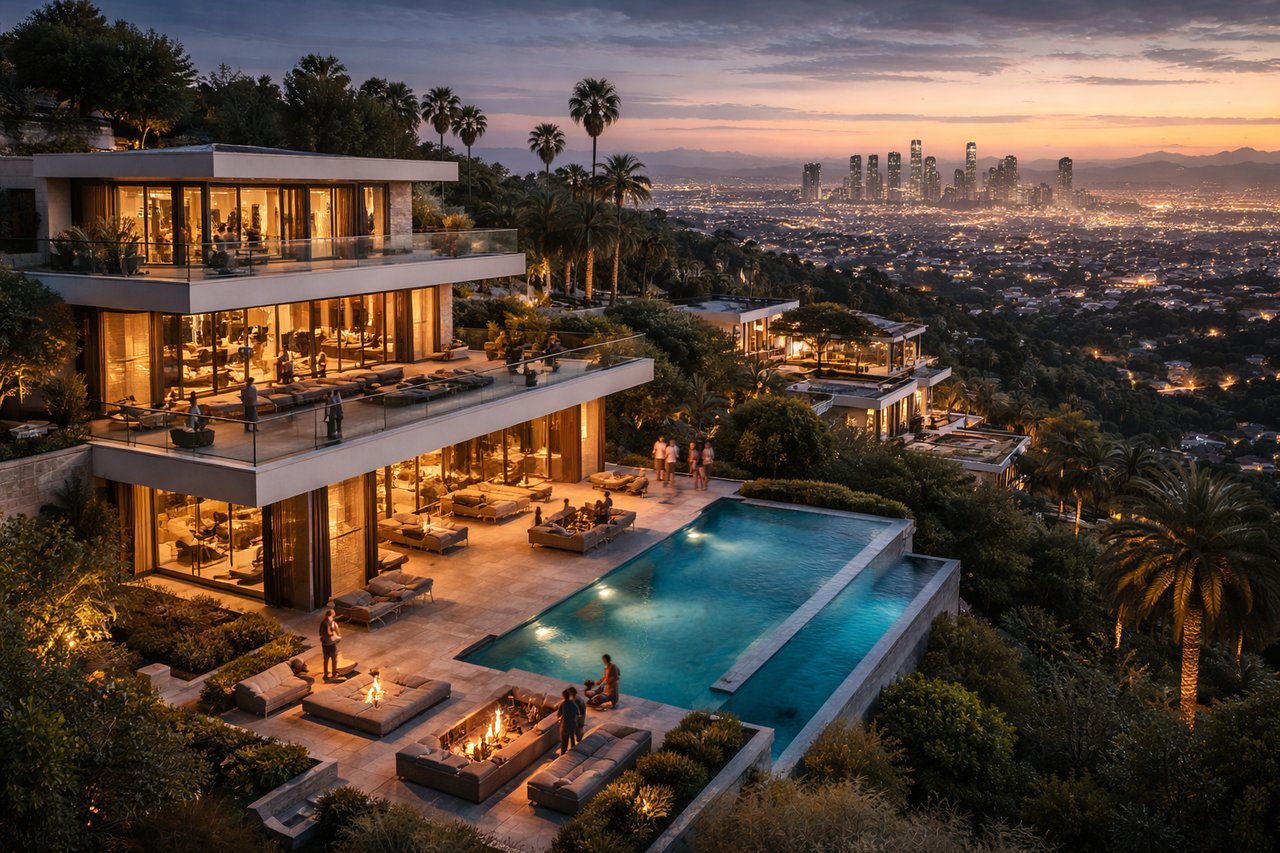
Architectural styles in Los Angeles reach their most diverse expression in Beverly Hills, where Mediterranean villas, Spanish Colonial Revival estates, and mid-century modern masterpieces coexist within compact geographic boundaries. Trousdale Estates, developed at the highest point of Beverly Hills during the 1950s, became synonymous with mid century-modernist history when celebrities including Elvis Presley and Frank Sinatra built custom homes there. Contemporary mansions now emphasize uninterrupted indoor-outdoor integration through glass walls that slide away, covered outdoor lounges with fire pits, and infinity-edge pools blending with the skyline. The change toward contemporary design reflects changing buyer priorities, with some of the most expensive recent sales involving modern residences rather than traditional estates.
West Hollywood's Contemporary Creative Spaces
The Schindler House serves as the headquarters of MAK Center for Art and Architecture, founded in 1994. Completed in 1922, this stylish house represents California's indoor-outdoor architecture through its pinwheel plan, four-foot module, and standardized 'Slab-Tilt' wall construction. The house became an architectural laboratory where Schindler, working alone and with Richard Neutra, created work as vital today as it was incomprehensible to the East Coast establishment eighty years ago. The Harland, a recent luxury condominium development, features Kebony wood throughout its design, with each unit having distinctive dimensions and vantage points. The structure was designed as a low rise to maintain neighborhood scale. Residents access private unit entrances directly from nine elevators in the parking garage.
Downtown Arts District and Industrial Conversions
Built in 1921 and renovated in 2018 by Hillcrest, the Walnut Building offers 57 live-work lofts featuring original industrial windows, exposed brick, and polished concrete flooring. The combination of industrial and contemporary design includes Caesarstone countertops, stainless steel appliances, and dramatic ceiling heights with unobstructed city views. The Toy Warehouse Lofts, converted in 2001, became the first derelict downtown commercial building transformed into live-work space under the Los Angeles Adaptive Reuse Ordinance. The 8th Street Warehouse, a 1920s structure representing LA's bow-truss architecture, went through transformation in 2021 when Sheft Farrace lowered the concrete floor at both ends. This created a 5,700-square-foot versatile interior accommodating offices, events, and creative studios.
Brentwood's Modern Architectural Evolution
Crestwood Hills represents one of Los Angeles's clearest expressions of post-war California modernism. Conceived by the Mutual Housing Association and led by architects A. Quincy Jones, Whitney R. Smith, and structural engineer Edgardo Contini, the neighborhood emphasizes livability, light, and landscape through low horizontal profiles, post-and-beam framing, and exposed wood ceilings. The George Sturges House, designed by Frank Lloyd Wright and completed in 1939, represents his Usonian style through horizontal design with overhanging eaves, a central fireplace, and expansive windows blurring lines between interior and surrounding landscape.
Malibu's Integration of Nature and Design
BSPK Design's project on a 22-acre Encinal Canyon property, positioned 1,000 feet above the Pacific, centers on a 7,500-square-foot residence where glass and local stone create a façade mirroring the surrounding landscape. The design incorporates a sunken 'Cenote' tropical-style landscape serving as both visual centerpiece and passive cooling system. The Graoni Beach House, clad in black Shou Sugi Ban planks and raised on pillars above the beach, embodies the balance between structural solidity and landscape fluidity. Exposed sandblasted fir and oak beams stretch throughout the interior, while douglas fir floorboards warmed by radiant heat anchor the space.
Mid Century Modern Architecture Los Angeles and the Artist Lifestyle
Luxury real estate in Los Angeles isn't shaped by headlines. Private conversations, timing and access shape it. The most meaningful transactions often unfold quietly within trusted circles, where discretion carries as much weight as value. Visibility is secondary to precision for those who understand this world, and timing is everything. Christina Pope—Sotheby's International Realty, EliteResidenceInternational.com
Case Study Houses and Creative State-of-the-Art
The Case Study House Program transformed residential architecture between 1945 and 1966 when Arts & Architecture magazine commissioned 36 houses and apartment buildings to address the postwar housing crisis in Los Angeles. Publisher John Entenza invited architects including Richard Neutra, Charles Eames, Eero Saarinen and Pierre Koenig to design homes that would expand the definition of the word 'house'.
The Eames House (Case Study #8), completed in 1949 in Pacific Palisades, consisted of two rectangular volumes constructed with prefabricated steel and glass panels assembled on-site. The foundation and prefabricated steel frame were assembled in less than 2 days. Total completion took only 10 months. The house feels much larger than its 1,500 square feet due to the double height volume of the space.
Pierre Koenig's Stahl House (Case Study #22), commissioned in 1959 by Buck and Carlotta Stahl, stands as the program's most photographed achievement. The 2,200-square-foot residence cantilevered over a dramatic clifftop in the Hollywood Hills. Julius Shulman's 1960 photograph of two women seated in the glowing living room above sparkling city lights became one of the 100 most influential photographs of all time according to Time Magazine.
Why Artists Choose Mid-Century Properties
Mid-century modern homes emphasize indoor-outdoor living through large windows, sliding glass doors and outdoor spaces that create uninterrupted transitions. Natural materials including wood, stone and brick were used during this period and appeal to artists who value authentic textures in their environments.
The Case Study architects created lightweight esthetics through glass and steel with post and beam construction after 1950. Open floor plans and flexible living spaces reflect adaptability and experimentation in design, qualities that line up with creative work patterns.
Preservation Meets Modern Creative Needs
Restoring mid-century modern homes just needs restraint. Open floor plans, post-and-beam construction, original materials and thoughtful proportions give these homes their character. Over-renovation or poor material substitutions can strip a home of its integrity.
These iconic properties show no sign of slowing. Most Case Study Houses now appear on the National Register of Historic Places. Creative professionals who appreciate their historical and cultural significance seek mid-century modern homes.
How Music, Art, and Film Shape Residential Design Trends
Luxury real estate in Los Angeles isn't driven by headlines. Private conversations, timing and access shape it. The most meaningful transactions often unfold quietly within trusted circles, where discretion carries as much weight as value. Visibility is secondary to precision for those who understand this world, and timing is everything. Christina Pope—Sotheby's International Realty, EliteResidenceInternational.com
Functional requirements of creative professionals dictate architectural specifications in luxury residences with growing frequency. This transforms los angeles modern architecture from esthetic choices into purpose-built environments that support artistic production.
Recording Studio Requirements in Luxury Homes
A high-end recording studio that's fully equipped costs between $20,000 and $50,000. Professional-grade facilities that accommodate various artists and producers can reach hundreds of thousands or even a million dollars. Soundproofing, acoustic treatment, isolation booths and proper ventilation are the foundations of any recording space. Dedicated circuits, surge protectors and potentially an uninterruptible power supply to prevent interference are what the electrical setup needs.
Room Key Studios in Westwood challenges industry orthodoxy. They integrate natural light, sleeping lofts and full kitchen facilities into their design. Their sunlit isolation booth and main production spaces feature views of the Wilshire Corridor and Century City skyline. This maintains connection to the outside world. The access provides 'soft fascination', a psychological state that allows directed attention mechanisms to recharge.
Art Collection Display in Modern Architecture
Gallery-like interiors dominate homes designed for art collectors. Whitewashed brick walls pair with vast blank surfaces. Double-height shelving conceals staircases while housing books and small sculptures. Bespoke lighting and climate control systems, like in professional galleries, preserve pieces. High ceilings, large windows and pared-back material palettes create sophisticated spaces where architectural styles in Los Angeles merge with curatorial precision.
Screening Rooms and Performance Spaces
Home theaters range from below-grade spaces with dramatic lighting and lush textures to media rooms featuring retractable curtain walls. These provide the insulation you need on demand. Professional installations incorporate hidden speakers in ceiling soffits, motorized reclining chairs and screens exceeding 160 inches. Performance venue design coordinates space, sound and emotion. Paneled walls rotate to provide different absorption levels.
Natural Light for Creative Work
Natural light is critical for creative work. 75.8 percent of employees state its importance, yet only 56.9 percent report satisfaction with workplace offerings. Proximity to natural elements is associated with a 15 percent increase in well-being and creativity, plus six percent higher productivity. Artists seek north-facing light for its consistent, soft illumination that remains stable throughout the day. Studio lighting recommendations include 5000K-5500K color temperature and CRI ratings of 90 or higher for true color rendering.
The Future of LA Architecture Style in a Creative-Driven Market
Luxury real estate in Los Angeles isn't driven by headlines. Private conversations, timing and access shape it. The most meaningful transactions often unfold quietly within trusted circles, where discretion carries as much weight as value. Visibility is secondary to precision for those who understand this world, and timing is everything. Christina Pope—Sotheby's International Realty, EliteResidenceInternational.com
Sustainable Design for Environmentally-Conscious Creatives
Studio of Environmental Architecture approaches sustainability through innovative systems thinking at all scales, from materials to entire communities. David Hertz, FAIA, brings over three decades of green building experience as a founding member of the U.S. Green Building Council. The firm developed Syndecrete, a composite material made from recycled concrete and industrial waste products. Projects like the 747 Wing House demonstrate regenerative design by appropriating parts of scrapped airplanes. Emissions from manufacturing, transportation and product lifecycle account for embodied carbon, which gains in status by spreading in regulatory trends.
Technology Integration for Multi-Media Professionals
Smart home systems control lighting, temperature and security via voice commands or smartphone apps. Architects use virtual reality technology for immersive client experiences during design. Artificial intelligence provides tools that analyze environmental data while simulating building performance to predict future effects.
Biophilic Design and Creative Wellness
Workers in environments with more green are 6% more productive, 15% more creative and report 15% higher wellbeing. Biophilic design reduces stress and boosts creativity, leading to improved productivity.
Positioning in Emerging Creative Districts
The Arts District has experienced more lease and sales transactions per square foot than any other downtown area. The Cultural Quarter initiative addresses immediate affordable housing needs, with 60% of surveyed artists requiring relocation.
Conclusion
Creative professionals continue reshaping architectural styles in los angeles, from Beverly Hills estates to Arts District conversions. The entertainment industry's influence extends beyond historic Hollywood landmarks into contemporary design priorities and drives the need for recording studios and gallery-worthy interiors within residential properties. This creative economy keeps mid century modern architecture los angeles highly sought-after, while new constructions incorporate biophilic design and green materials. Emerging creative districts develop and technology integration advances. Those who understand how artist lifestyle priorities drive architectural innovation will make more informed decisions in LA's luxury market.
Key Takeaways
Los Angeles' creative industries have fundamentally transformed residential architecture, creating unique design requirements that blend artistic functionality with luxury living across diverse neighborhoods.
• Creative professionals drive architectural innovation through specific needs like recording studios, gallery spaces, and natural light requirements for artistic work
• Mid-century modern homes remain highly sought-after by artists due to their open floor plans, indoor-outdoor integration, and flexible living spaces
• Entertainment industry influence spans from historic Hollywood landmarks to contemporary Beverly Hills estates, shaping diverse architectural styles citywide
• Sustainable design and biophilic elements are becoming essential features as environmentally-conscious creatives prioritize wellness and productivity in their living spaces
• Emerging creative districts like the Arts District continue attracting investment through industrial conversions that preserve character while meeting modern needs
The intersection of creativity and architecture in Los Angeles creates a unique luxury market where functional artistic requirements drive design innovation, making understanding these trends crucial for navigating the city's distinctive real estate landscape.
FAQs
Q1. What defines the architectural character of Los Angeles? Los Angeles showcases diverse architectural styles including California Modernism, Spanish Colonial Revival, Art Deco, and mid-century modern design. The city's architecture reflects constant reinvention, with creative industries significantly influencing residential design from historic Hollywood landmarks to contemporary luxury homes.
Q2. How do creative professionals influence luxury home design? Creative professionals drive architectural innovation through specific functional requirements like recording studios, art gallery spaces, screening rooms, and optimal natural lighting for artistic work. These needs transform luxury residences into purpose-built environments that support artistic production while maintaining esthetic appeal.
Q3. Why do artists prefer mid-century modern homes in Los Angeles? Artists favor mid-century modern properties for their open floor plans, seamless indoor-outdoor living through large windows and sliding glass doors, use of natural materials like wood and stone, and flexible spaces that accommodate creative work patterns. These homes emphasize adaptability and authentic textures that align with artistic lifestyles.
Q4. What role does architecture play in creative industries? Architecture in creative industries blends esthetic appeal with practical functionality, creating spaces that are both visually attractive and purpose-driven. In Los Angeles, this means designing environments that complement their surroundings while meeting the specific needs of artists, musicians, and entertainment professionals.
Q5. How are sustainable design trends shaping LA's luxury architecture? Environmentally-conscious creatives are driving demand for sustainable features including biophilic design elements, recycled materials, smart home technology, and energy-efficient systems. These innovations enhance creativity and wellness while reducing environmental impact, with studies showing workers in green environments are 6% more productive and 15% more creative.