Few gated communities operate with the level of quiet authority that defines Hidden Hills. Decisions about security, standards, and community life are made among roughly 1,800 residents across 620 estates — people who put a premium on privacy over visibility. With median home prices around $8 million, the Hidden Hills Community Association recently brought fees down from $0.26 to $0.25 per $1,000 of assessed value. What those dues actually fund goes well beyond surface-level amenities — the real story is in the security infrastructure, the enforcement of Hidden Hills HOA rules, and the services that quietly guard both property values and the privacy of everyone living within this 1.7-square-mile community.
Hidden Hills HOA Dues: The Current Structure
"These special assessments can arise with limited notice when major systems fail, natural disasters cause damage, or the HOA discovers they’ve been underfunding necessary reserves." — Community Associations Institute (CAI), Industry Association
Fee calculation method
Hidden Hills Community Association bases fees on property assessed value rather than a flat rate. At $0.25 per $1,000 of assessed value, a property valued at $8 million carries an annual assessment of $2,000. Owners of higher-valued estates contribute proportionally more — a structure that differs from the uniform fee models common in most HOA communities.
The assessed value ties directly to Los Angeles County tax records, giving the fee determination a transparent, consistent baseline. Annual assessments adjust to reflect any official changes in a property's valuation.
Historical fee changes
The association has lowered fees twice in recent years — first from $0.27 to $0.26 per $1,000 of assessed value, then again to the current $0.25 rate. Both reductions came out of budget reviews that found room to trim costs without cutting into security or maintenance. Residents paid less while the community's core infrastructure remained intact.
Payment schedule and terms
The annual assessment is due January 1st, with a $30 discount offered to owners who pay in full by January 31st. Those who prefer to split payments can do so — half on January 1st, half on July 1st — though the early payment discount does not apply to this option.
A 30-day grace period follows the due date. After that, the full balance comes due immediately along with a $75 late fee. Continued non-payment leads to:
- Interest charges on outstanding balances
- Court costs and legal fees
- Property liens for persistent non-payment
Payments can be made in person at the Clubhouse, online through the association portal, or by mailing a check to the designated P.O. Box. The 2026 budget and dues invoice are sent via U.S. Mail, with the budget also available online. Some payment channels carry processing fees, which owners should account for before choosing a method.
Transfer fees of $200 apply when a property changes hands, and HOA closing letters carry a $500 charge — standard administrative costs tied to real estate transactions within the community.
What Your HOA Dues Actually Cover
24/7 guarded gate operations
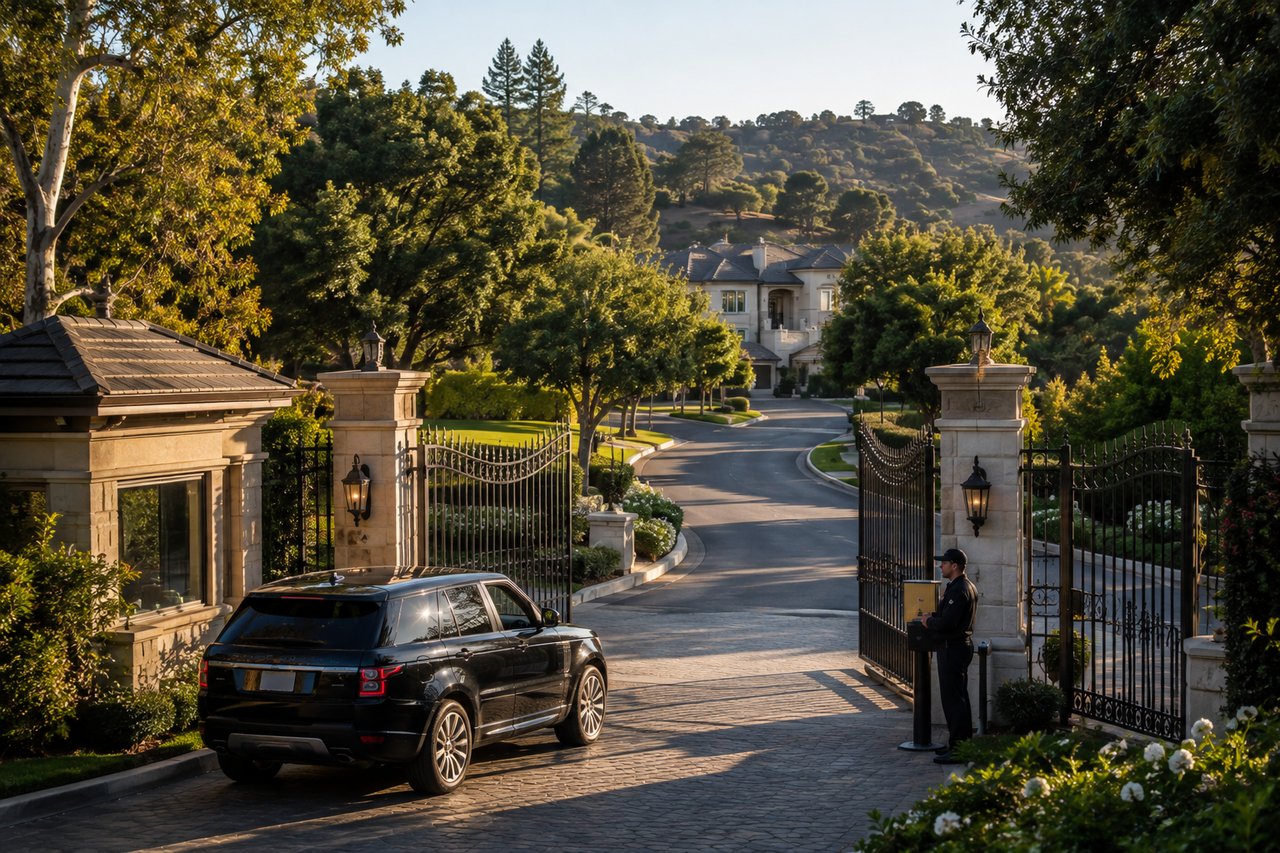
All controlled access points are continuously staffed, around the clock. Guards manage visitor entry, reach out to residents for approval before anyone is let through, and keep detailed logs of arrivals and departures. Personnel are trained to know residents, their properties, and the protocols that make this enclave function the way it does. Guard booths are equipped with communication systems tied directly to resident homes, visitor management databases, and surveillance equipment covering every approach lane and entry point.
Community patrol and monitoring
Stationary gates are only part of the picture. The Hidden Hills Homeowners Association also funds dedicated patrol services that move through neighborhoods continuously. Officers respond to suspicious persons or vehicles, follow up on alarm activations, and handle burglary concerns as they come up. Their findings are documented and reported to both residents and association management — building an ongoing record that shapes how security is handled over time.
Landscape maintenance for common areas
A meaningful share of the annual budget goes toward keeping common areas in the condition residents expect. Crews handle mowing, edging, trimming, and fertilizing across entrance zones and shared spaces. Seasonal flowers keep entry points looking sharp, while irrigation systems maintain the landscaping year-round. Street lighting falls under this same allocation — energy costs, fixture upkeep, and all. The association also carries insurance on these areas against liability and property damage.
Equestrian trail upkeep
The horse trails that run through Hidden Hills need consistent attention to stay safe and usable. The association sets aside dedicated funds for equestrian areas and riding zones, with trail surfaces graded and repaired on a regular basis. This is what keeps the equestrian character of Hidden Hills intact — a distinction that sets it apart from virtually every other gated community in Los Angeles.
Recreational facility management
Pool maintenance is a recurring budget line. Tennis courts, sports courts, and playgrounds all require ongoing upkeep, repairs, and safety checks — from water treatment and equipment replacement to surface resurfacing and compliance work. Community events are also funded through this allocation, bringing residents together within the privacy of association property.
Administrative and legal costs
Behind every well-run community is a layer of operational work that rarely gets noticed. Administrative costs cover staff salaries, office operations, communication systems, and the platforms that track assessments, violations, and architectural reviews. Legal expenses arise from covenant enforcement, architectural review disputes, and property matters that require counsel. Financial audits, budget preparation, and regulatory compliance round out the administrative spend — the work that keeps everything functioning without friction.
The Security Investment: Behind the Gates
Security in this 1.7-square-mile incorporated city is not a single system — it is several interconnected layers, each funded through Hidden Hills HOA fees and built around technology, trained personnel, and coordinated response protocols.
Guard station staffing and technology
Three gated entrances are staffed around the clock by personnel drawn from law enforcement, military, and private security backgrounds. Guards protect approximately 2,000 residents, trained not only to manage access control but to observe, assess, and respond as situations develop. Every vehicle entering the community is logged through digital systems that allow residents to pre-authorize guests, while the access control infrastructure maintains detailed records of all community access.
The role extends well beyond the gate booth. Guards coordinate with residents through integrated communication systems, handle visitor verification, and serve as the first line of response before external agencies are called. Training emphasizes threat detection, sound judgment under pressure, and clear protocols for emergency situations — all while maintaining working relationships with law enforcement.
Surveillance system infrastructure
Advanced camera systems with real-time intruder reporting capabilities were installed during documented infrastructure upgrades, providing overlapping coverage across entry points, internal roadways, and critical zones throughout the community. Access control technology includes systems fitted directly to resident vehicles, temporary pass protocols for approved guests, and monitoring equipment that tracks movement patterns.
Gate stations, patrol vehicles, and central command functions are connected through an integrated monitoring architecture — a networked approach that eliminates the blind spots single-layer security often leaves behind.
Emergency response coordination
Hidden Hills holds a contract with the Los Angeles County Sheriff's Department through the Malibu/Lost Hills Station, though response times for high-priority incidents can run five to seven minutes or more. The association's guarded gates and internal patrol carry the weight of daily security operations — handling access control, maintaining patrol presence, and providing immediate response well ahead of any external law enforcement arrival.
Security personnel follow structured protocols during incidents and alarms, functioning as first responders while keeping established LASD channels ready for situations that require law enforcement involvement.
Recent security upgrades and improvements
April 2023 marked a turning point. Following documented security incidents — burglaries, stalker attempts, and unauthorized trespass — the community put significant upgrades in place: additional guard personnel, new camera systems with real-time reporting, and expanded patrol coverage. The results were immediate. Weekly burglaries dropped to zero.
The value of those upgrades was demonstrated again in 2025, when an attempted burglary at a high-profile property was stopped outright because of the detection and response systems already in place. What exists today in Hidden Hills is a layered operational model: LASD for emergency response and investigations, community infrastructure for access control and surveillance, and property-level systems for dedicated on-site protection.
Hidden Hills Community Association Rules and Enforcement
"Fines are used as a last resort and are never intended to be revenue streams for the HOA."
Architectural review requirements
Every exterior modification — painting, roofing, window changes, landscaping, driveways, retaining walls, tree planting or removal, and any remodeling — requires Architectural Committee approval before a single contractor is called. The committee convenes the first and third Monday of each month, and three sets of drawings must be submitted ten days in advance. For new builds and substantial additions, HHCA approval must come before the city permit process even begins — buyers should realistically plan for six to twelve months of design review and entitlement before breaking ground.
Skipping that approval, or deviating from what was approved, results in a Stop Work Notice and a Board hearing. The Board can pull priority gate access and other privileges tied to good standing, rescind approvals already granted, and require the property to be restored to its last compliant condition before any further work is permitted. The Architectural Fee Schedule was last updated September 19, 2024, with 2026 Architectural Standards currently under review.
Property maintenance standards
Vacant or occupied, every property is held to the same standard: neat, well-kept, and attractive. When a property falls short, the association can step in after ten days' notice — cutting grass, clearing dead vegetation, and addressing maintenance issues, all billed directly to the owner. Those costs attach to the property as a permanent lien. Trash containers must stay out of sight from neighboring lots except during collection windows, with cans not permitted curbside before 4:00 p.m. the day before pickup and removed no later than noon the following day.
Rental restrictions and guidelines
Short-term rentals are restricted under both city ordinance and HHCA rules. Anyone planning to purchase with rental income in mind should confirm current regulations directly with the city and the association before factoring those numbers into a purchase decision. The community is built around long-term residents, and the rules reflect that.
Equestrian zone regulations
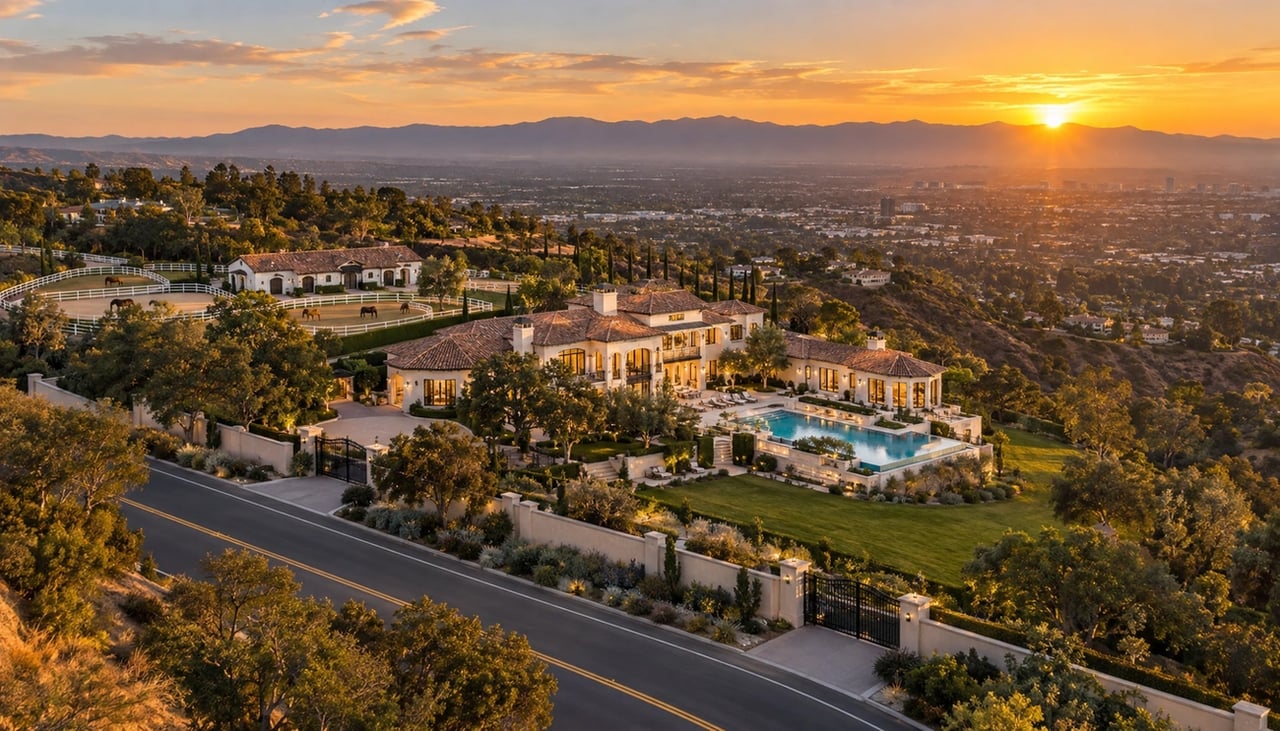
A one-acre minimum building-site requirement applies across all lots, preserving the estate scale that defines the community. Horses are welcome for personal enjoyment — commercial equestrian use is not permitted. Private stables, corrals, and farm buildings all require Architectural Committee approval, as do any modifications to barns, paddocks, or arenas, which typically require city permits as well.
Is the Hidden Hills HOA Worth It?
Serious real estate decisions at this level rarely happen in public view. Hidden Hills reflects that reality — a community where value is guarded as carefully as the entrance gates.
Property value protection
The numbers speak for themselves. Properties here delivered 52.9% price appreciation over five years. Equestrian zoning keeps overdevelopment, added density, and commercial use off the table, which is precisely what preserves the countryside character that commands premium pricing. HOA-governed properties also tend to sell for four to six percent more than comparable non-HOA homes — and in Hidden Hills, the governance standards that produce that outcome are strictly maintained.
Exclusive amenities access
Six miles of private roads, 25 miles of bridle trails, riding arenas, tennis courts, a pool, a recreation center, and a 99-seat theater make the community genuinely self-contained. For those who love to entertain, the right home makes all the difference. Christina Pope would be delighted to help you find one. Christina Pope  310-404-9931
  [email protected]
Privacy and discretion benefits
Hidden Hills holds a distinction that no other community in Los Angeles can claim — it is the only fully-private, fully-gated, residential-only incorporated city in the region. The concentration of high-profile residents makes it arguably the highest celebrity-density gated community in the world.
Comparison to neighboring communities
Calabasas gated communities charge anywhere from $150 to $400 monthly in HOA fees. Hidden Hills works differently — fees tied directly to assessed property value at $0.25 per $1,000, a structure that scales with the investment rather than applying a uniform cost across the board.
Conclusion
Hidden Hills HOA fees deliver far more than basic amenities — they fund a way of life that is genuinely difficult to find elsewhere. Structured governance, rigorous architectural standards, and a security infrastructure built around real incidents rather than theoretical concerns all work together to protect what residents have invested here.
Those evaluating Hidden Hills should weigh these fees against what they produce: sustained appreciation, controlled density, and a community that holds its standards over time. The numbers — 52.9% price appreciation over five years, zero burglaries following the 2023 security overhaul — speak for themselves.
Christina Pope brings the kind of expertise that makes these decisions clearer. She works through Sotheby's International Realty at EliteResidenceInternational.com, where clients who value discretion find the guidance they need — without the noise.
Key Takeaways
Hidden Hills HOA fees operate on a unique assessment-based model that scales with property value, currently charging $0.25 per $1,000 of assessed value—meaning an $8 million estate pays approximately $2,000 annually. Understanding what you're actually paying for reveals a comprehensive security and lifestyle infrastructure that goes far beyond typical gated community amenities.
• Assessment-based fees scale with property value at $0.25 per $1,000 assessed value, recently reduced from $0.27, with early payment discounts available by January 31st.
• 24/7 security infrastructure includes three staffed guard gates, advanced surveillance systems, community patrols, and real-time intruder detection that eliminated weekly burglaries after 2023 upgrades.
• Architectural review is mandatory for all exterior modifications, requiring 6-12 months for design approval before construction begins, with strict enforcement through fines and privilege suspension.
• Properties appreciate significantly faster with 52.9% price gains over five years, selling 4-6% higher than comparable non-HOA homes due to protected equestrian zoning and estate character preservation.
• Exclusive amenities justify the investment including 25 miles of private bridle trails, six miles of private roads, equestrian facilities, tennis courts, pool, and recreation center in LA's only fully-private incorporated city.
The value proposition extends beyond amenities to measurable outcomes: sustained appreciation, controlled density, and architectural standards that protect long-term investment value in one of the world's highest celebrity-density communities.
FAQs
Q1. How much are HOA fees in Hidden Hills and how are they calculated? Hidden Hills uses an assessment-based fee structure charging $0.25 per $1,000 of assessed property value. For example, a property assessed at $8 million would pay approximately $2,000 annually. This differs from flat-rate HOA fees and scales proportionally with property values, with owners of higher-valued estates contributing more to community operations and security.
Q2. What services and amenities do Hidden Hills HOA dues actually cover? Your HOA dues fund 24/7 guarded gate operations with trained security personnel, community patrol services, landscape maintenance for common areas, equestrian trail upkeep, recreational facility management (including pools, tennis courts, and playgrounds), and administrative costs. The fees also cover advanced surveillance systems, street lighting, and legal expenses related to community governance and enforcement.
Q3. Are there payment discounts or penalties for Hidden Hills HOA fees? Yes, owners who pay the full annual assessment by January 31st receive a $30 discount. Alternatively, you can split payments with half due January 1st and half due July 1st, though this option forfeits the early payment discount. Late payments incur a $75 fee after the 30-day grace period, plus interest charges and potential property liens for persistent non-payment.
Q4. Do I need approval for home improvements in Hidden Hills? All exterior modifications require Architectural Committee approval before work begins, including painting, landscaping, roofing, window changes, and any construction. The committee meets the first and third Monday of each month, and you must submit three sets of drawings ten days in advance. New builds and major additions typically require 6-12 months for design review and approval before construction can start.
Q5. Do Hidden Hills HOA fees protect property values compared to non-HOA communities? Properties in Hidden Hills have demonstrated 52.9% price appreciation over five years, and research shows HOA-governed properties typically sell for 4-6% more than comparable non-HOA homes. The fees fund protections like equestrian zoning that prevents overdevelopment, comprehensive security infrastructure, and architectural standards that preserve estate character and long-term investment value.