Glass House Architecture Evolution in Hollywood Hills
Glass House Architecture Rise in Hollywood Hills
Architectural transparency began as an industrial solution. Le Corbusier designed the Maison Dom-Ino between 1914 and 1915 and replaced heavy load-bearing walls with reinforced concrete columns and slabs. This groundbreaking modular structure gave rise to large glass facades and open floor plans that blurred boundaries between interior and exterior spaces.
The Hollywood Hills became a testing ground for these principles decades later. Pierre Koenig graduated from USC School of Architecture in the early 1950s and brought industrial materials into residential design. His sketches of steel cranes and locomotives at the marina informed an architectural vocabulary built on prefabricated components and welding techniques that World War II had developed.
Case Study House No. 22, known as the Stahl House, materialized these ideas on a parcel other architects deemed unbuildable. Buck Stahl purchased the hillside lot for $13,500 in 1954. Construction began in May 1959 and was complete by May 1960 at a cost of $37,500. The 2,200-square-foot residence featured a steel frame cantilevered ten feet over the hillside, with floor-to-ceiling plate glass walls on three sides.
Hollywood Hills homes adopted rectilinear forms with floor-to-ceiling glazing and retractable wall systems from the 2000s forward. Materials remained refined: concrete, stone, wood and steel. Recent projects emphasize view lines and disappearing glass walls, with frameless railings and long roof overhangs providing support.
Skywalks and Bridges: The Defining Feature of 2026 Luxury Homes
Luxury real estate in Los Angeles operates through private conversations rather than public listings. The biggest architectural innovations emerge within trusted circles where discretion matters as much as design. Skywalks and bridges have become that innovation for 2026 and transform how affluent buyers experience Hollywood hills view properties.
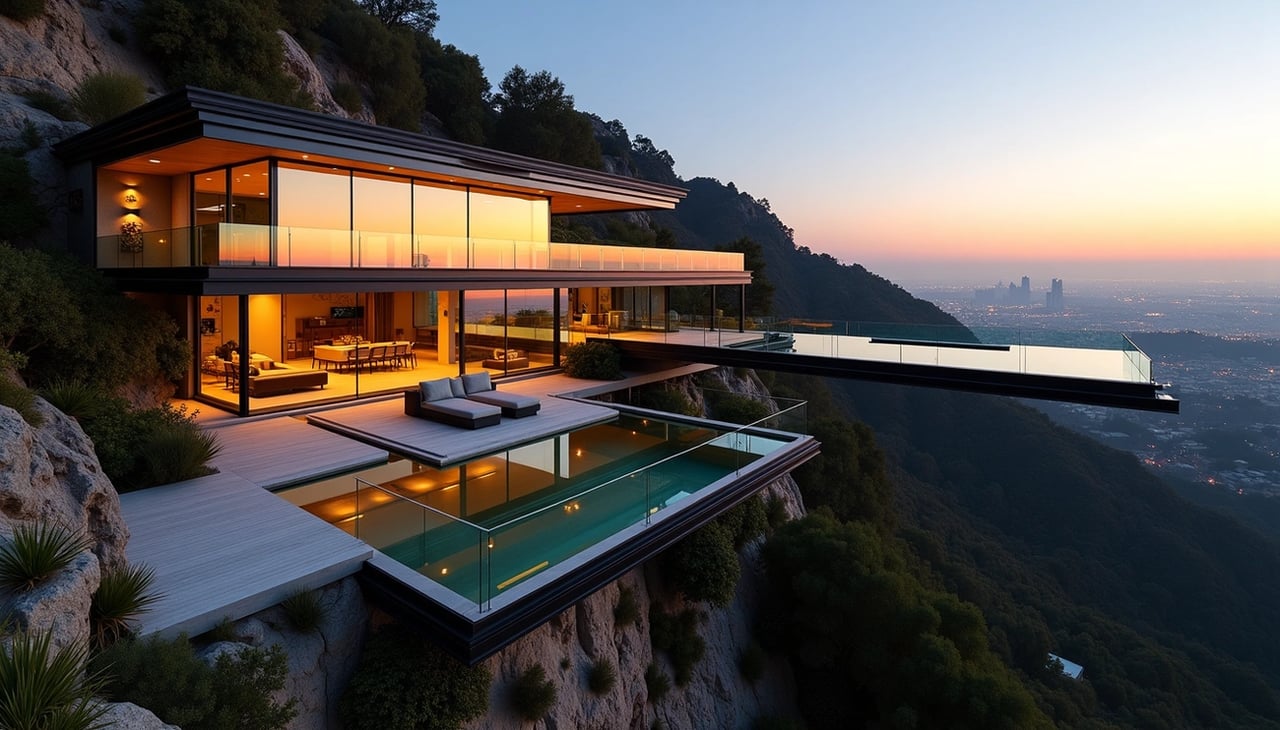
LLAMA Urban Design's Bridge House in Muskoka exemplifies this move. The wooden structure spans 18 meters above a ravine and sits five meters off the ground with 12-meter-long glazing on both sides. Stanley Saitowitz's bridge house in Marin stretches 22 feet across a grassy ravine just as boldly. Main living areas sit on the upper floor alongside expansive windows.
These elevated connections serve multiple purposes. The skywalk in one three-story residence creates symbolic separation between work and home realms. Upper floors cantilever beyond the lower level's footprint. Glass bridges boost transparency and light distribution throughout interiors, while steel structures provide strength with refined profiles.
The right home makes all the difference if you love hosting. I'd be delighted to help you find spaces designed for elevated living and effortless hosting if you're thinking about a purchase in the near future or beginning your search. Christina Pope  310-404-9931
  [email protected]
Living in a Glass House: Practical Realities and Design Benefits
Energy performance defines the practical reality of Hollywood hills glass house living. Smart glass technology consumes less than 5 watts per square meter at the time of operation. This minimal power draw becomes most important when filtering up to 98% of UV and 85% of infrared radiation. It reduces solar heat gain that would otherwise burden air conditioning systems. Buildings equipped with smart glass reduce energy needs by about 20% and translate to substantial savings in climates where cooling dominates utility expenses.
Installation costs range between $50 and $150 per square foot. But a 30% federal tax credit reduces these figures to $35 to $105 per square foot and makes the technology more available for new construction and renovations. Electrochromic windows demonstrate even greater performance and reduce peak cooling loads by 25% to 58% compared to spectrally selective low-e windows.
Natural light remains the main design benefit. South-facing windows capture consistent sunlight throughout the day and enable passive solar heating during winter months while reducing dependency on artificial lighting. Proper window orientation cuts electricity consumption during daylight hours, especially when you have open floor plans where light travels freely between spaces.
Maintenance requires attention to sealants and gaskets that need replacement after ten years because of UV exposure and temperature fluctuations. Regular inspection prevents air and water infiltration that compromises thermal performance.
Conclusion
Glass house architecture in Hollywood Hills has evolved beyond esthetic ambition into practical luxury. Skywalks and bridges define this elevated living in 2026. Smart glass technology and strategic design deliver measurable energy savings while maintaining unobstructed views. The right property makes entertaining effortless for those who value privacy and design. Christina Pope specializes in finding spaces built for elevated living. Reach her at 310-404-9931 or [email protected] to explore homes where architecture meets investment value.
Key Takeaways
Hollywood Hills glass house architecture has transformed from simple transparency to sophisticated elevated living, with skywalks and bridges becoming the defining luxury feature of 2026.
• Smart glass technology reduces energy costs by 20% while filtering 98% of UV radiation, making transparent living both sustainable and comfortable
• Skywalks and bridges create dramatic architectural separation between living zones while maximizing hillside views and indoor-outdoor flow
• Installation costs range $35-105 per square foot after federal tax credits, with properties commanding premium prices like recent $4.95 million listings
• Strategic window orientation and natural light optimization eliminate artificial lighting dependency during daylight hours in open floor plans
• Maintenance focuses on 10-year sealant replacement cycles to preserve thermal performance and prevent air infiltration in floor-to-ceiling glass systems
These architectural innovations represent more than aesthetic choices—they're investment strategies that combine cutting-edge engineering with practical luxury living, positioning Hollywood Hills glass houses as the pinnacle of modern residential design.
FAQs
Q1. What makes the Stahl House so significant in Hollywood Hills architecture? The Stahl House (Case Study House No. 22) stands as one of the most important residential works of the 20th century. Designed by architect Pierre Koenig and completed in 1960, this 2,200-square-foot residence featured a steel frame cantilevered ten feet over the hillside with floor-to-ceiling plate glass walls on three sides, establishing the blueprint for modern glass house architecture in the Hollywood Hills.
Q2. How much does it cost to install smart glass technology in a luxury home? Smart glass installation typically ranges between $50 and $150 per square foot. However, with the 30% federal tax credit, the effective cost reduces to $35 to $105 per square foot. This technology reduces building energy needs by approximately 20% while filtering up to 98% of UV radiation and 85% of infrared radiation.
Q3. What are skywalks and bridges in modern Hollywood Hills homes? Skywalks and bridges are elevated walkways that connect different living zones within luxury homes, often suspended above canyons or ravines. These architectural features create dramatic separation between spaces while maximizing hillside views and enhancing indoor-outdoor flow, becoming the defining luxury element of 2026 glass house design.
Q4. How much maintenance do floor-to-ceiling glass homes require? Glass house maintenance primarily focuses on sealants and gaskets, which typically need replacement after ten years due to UV exposure and temperature fluctuations. Regular inspection prevents air and water infiltration that could compromise thermal performance, ensuring the home maintains its energy efficiency and structural integrity.
Q5. What energy savings can homeowners expect from glass house architecture? Buildings equipped with smart glass technology reduce energy needs by approximately 20%, with electrochromic windows reducing peak cooling loads by 25% to 58% compared to standard windows. Strategic window orientation and natural light optimization eliminate artificial lighting dependency during daylight hours, resulting in substantial utility savings in climates where cooling dominates expenses.