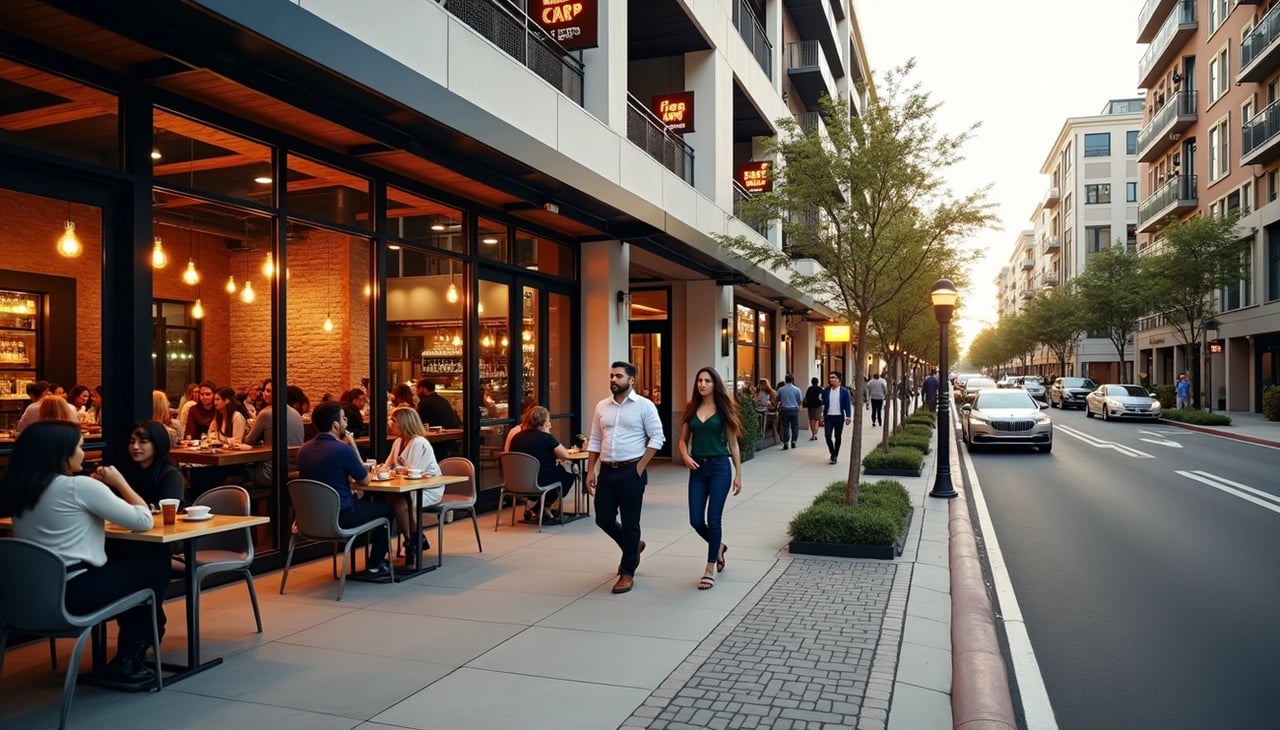
Los Angeles food culture is reshaping real estate investment patterns in ways that extend beyond traditional market analysis. Angelenos spend $884.72 monthly on dining out, and over 760 fast-food locations have closed statewide. This closure rate of 5.1% in California creates unexpected opportunities for adaptive reuse and strategic positioning. The move toward bistro-style dining and smaller restaurant formats is altering commercial lease structures, especially in neighborhoods like Koreatown, Little Tokyo, Chinatown and downtown food halls where culinary identity drives property premiums. Residential buyers prioritize walkability to the best Los Angeles food destinations more than ever. This analysis examines how dining trends are influencing commercial footprints, residential valuations and investment strategies for buyers who know how to identify value in 2026.
How Food Culture Neighborhoods Are Driving Real Estate Demand
Luxury real estate in Los Angeles operates through private conversations and careful timing rather than public listings. The most important transactions unfold within trusted circles, where discretion carries equal weight to valuation. Christina Pope at Sotheby's International Realty and EliteResidenceInternational.com understands this dynamic, especially in neighborhoods where culinary identity shapes property premiums.
Koreatown Los Angeles Food Scene and Property Values
Koreatown houses 704 restaurants within roughly two square miles and employs nearly 9,700 workers. This density positions the neighborhood among the highest restaurant concentrations in Los Angeles County. 10% of all business establishments are classified as restaurants and 3% of the county's total restaurant inventory. Metro line expansion and liberal conditional use permits for alcohol sales have accelerated development.
Real estate developers targeting millennial buyers benefit from Koreatown's public transit access and walkability. The neighborhood's central location and dining diversity support apartment buildings that maintain occupancy rates above 90%. Property appreciation continues as the area attracts both immigrant workers and affluent residents seeking 24-hour dining access.
Little Tokyo Los Angeles Food District Development
The Fourth & Central development represents a $2 billion investment spanning 7.5 acres. The project was originally proposed with 10 buildings ranging from six to 44 stories. The project delivers 1,589 residential units, including approximately 250 affordable apartments, alongside 145,000 square feet of retail and restaurant space.
Community organizations oppose the development's scale. They argue that luxury market-rate units will accelerate gentrification. Legacy businesses face displacement risk during the seven-year construction period. Little Tokyo has contracted from 20 square blocks to two-and-a-half blocks since 1942.
Chinatown Los Angeles Food Revival and Commercial Spaces
Chinatown's commercial real estate inventory totals 591,925 square feet across 20 properties. The district demonstrates how food-driven cultural branding attracts real estate speculation while raising concerns about displacement among existing communities.
Downtown Los Angeles Food Court and Food Hall Developments
Grand Central Market has operated since 1917 at 317 South Broadway. It established the blueprint for Los Angeles food hall typology. Adaptive reuse dominates development scenarios and converts former industrial warehouses and historic buildings into multi-vendor spaces across Arts District, Chinatown, and Koreatown. Mixed-use residential integration positions food halls as ground-floor activation under Transit-Oriented Communities Guidelines.
Incubator models reduce entry barriers. Rental rates have reached $1.75 per square foot compared to conventional restaurant leases. Food halls generate sustained foot traffic that supports surrounding commercial tenants.
The Bistro-Style Restaurant Impact on Commercial Real Estate
Bistro-format restaurants operate with footprint assumptions that differ from traditional full-service establishments. Christina Pope at Sotheby's International Realty and EliteResidenceInternational.com tracks this change, especially as smaller dining concepts reshape commercial lease negotiations in Los Angeles neighborhoods.
Why Smaller Dining Spaces Are Changing Lease Structures
Lease agreements accommodate flexible permitted use clauses that allow operators to modify menus and restaurant themes without landlord approval. Broad use clauses favor tenants. Landlords prefer narrow definitions to control restaurant mix and quality. Trade name requirements limit operator flexibility, though tenants negotiate time-based restrictions to preserve assignment and subletting options.
Restaurants should allocate 5-10% of projected revenue toward rent and utilities. An operation that anticipates $40,000 in monthly revenue targets $2,000-$4,000 for rent and utilities to maintain financial viability.
Lower Square Footage Requirements Attracting New Operators
Neighborhood cafés work well within 750 to 1,600 square feet and accommodate 20 to 40 guests with compact kitchens. Fast-casual restaurants occupy 1,076 to 3,767 square feet. Bistros and casual dining concepts require 1,600 to 3,200 square feet for 50 to 100 guests. Small-format restaurants in New York City face purchase prices ranging from $99 per square foot in Queens to $2,521 per square foot in Central Park South.
Neighborhood Integration Over Destination Dining
Restaurants serve as community fabric rather than isolated destinations. People prioritize walkability to grocery stores, restaurants, delis and cafes over other retail categories. Independent, locally owned restaurants create authenticity and sense of place that national chains cannot replicate.
Reduced Overhead Costs Making More Locations Viable
Rent represents the largest overhead expense for most operations. Month-to-month tenants negotiate lease contracts by committing to extended terms. Subleasing kitchen space during off-hours to food trucks, catering companies and pop-up restaurants brings in additional revenue streams.
Residential Real Estate Premiums Near Food Culture Hubs
Proximity to culinary destinations now functions as a quantifiable asset in residential real estate transactions. Christina Pope at Sotheby's International Realty and EliteResidenceInternational.com recognizes that buyers who can identify quality assess neighborhoods through dining access as much as school districts or transit connections.
Walkability to Best Los Angeles Food as a Sales Driver
Properties in neighborhoods scoring 90-100 on the Walk Score metric, classified as a "Walker's Paradise," command higher prices than car-dependent areas. Buyers prioritize access to restaurants, grocery stores and cafes on foot. This proximity creates lifestyles where daily logistics require less time and effort. Professionals and families managing demanding schedules find this especially valuable. Walkability acts as value insulation because buyers view it as non-negotiable.
Mixed-Use Development Appeal for Food-Focused Buyers
Food and beverage establishments serve as social anchors within mixed-use developments and provide spaces for gathering and interaction that improve community sense. Having dining options within walking distance adds value to daily life for residents and workers. Popular dining spots attract steady customer streams that benefit surrounding retail and entertainment venues and promote thriving local economies.
How All-Day Dining Concepts Increase Residential Foot Traffic
All-day restaurant models turn real estate into revenue generators. They eliminate dead zones where rent and utilities drain profitability. Extended operating hours create more opportunities to monetize fixed costs.
Property Values in Food-Dense Neighborhoods
Properties near Michelin-starred restaurants average £527,690 compared to £351,834 in wider local areas. This represents a 33% premium. Homes near Trader Joe's appreciated 148% between 1997 and 2014 and reached median values of $406,600, while properties near Whole Foods appreciated 140% to $376,200. The median U.S. home appreciated only 71% during the same period.
The right home makes all the difference for those who love to entertain. If you're thinking over a purchase in the near future or beginning your search, I'd love to help you find spaces designed for better living and effortless hosting. Christina Pope 📞 310-404-9931 ✉️ [email protected]
Investment and Development Opportunities in 2026
Investment strategies in Los Angeles food-driven real estate require understanding adaptive reuse economics and cultural positioning. Christina Pope at Sotheby's International Realty and EliteResidenceInternational.com guides clients through opportunities that combine culinary infrastructure with long-term appreciation potential.
Adaptive Reuse for Small-Format Restaurant Spaces
Renovating existing structures costs substantially less than new construction by employing infrastructure like plumbing, electrical, and HVAC systems. Historic buildings offer architectural features that create distinctive dining experiences impossible to replicate. This green approach reduces environmental effect while preserving local history and deepening community fabric. Property evaluations must think over zoning regulations, building codes, and accessibility requirements.
Food Hall Conversions in Underutilized Commercial Buildings
Food-oriented development functions as a capital-efficient model, especially when you have communities excluded from traditional markets. Food halls in mixed-use developments attract tenants by generating foot traffic and improving lease quality. Successful projects just need high-traffic locations, plentiful seating, and curated cuisine diversity. Single-story buildings reduce construction costs through simplified ventilation systems.
Community Dining Trends Shaping New Construction
Communal dining formats build loyalty while reducing operational complexity. Food halls function as cultural infrastructure rather than temporary trends.
Strategic Positioning for High-Net-Worth Buyers
Affluent buyers prioritize cultural capital among traditional amenities. Properties near dining destinations offer lifestyle integration that appeals to discerning purchasers.
Conclusion
Los Angeles food culture represents more than dining trends. Consumer priorities have shifted toward walkable neighborhoods and smaller restaurant formats. Both commercial and residential real estate strategies require recalibration. Savvy investors recognize that culinary density functions as a reliable indicator of long-term appreciation potential. Christina Pope at Sotheby's International Realty and EliteResidenceInternational.com guides clients through these opportunities, where cultural infrastructure and strategic positioning meet to deliver sustained value in 2026 and beyond.
Key Takeaways
Los Angeles food culture is fundamentally transforming real estate investment patterns, creating new opportunities for both commercial and residential properties. Here's what investors and buyers need to know:
• Food-dense neighborhoods command significant premiums - Properties near Michelin-starred restaurants average 33% higher values, while homes near quality grocery stores like Trader Joe's appreciated 148% compared to 71% market average.
• Smaller restaurant formats are reshaping commercial leases - Bistro-style restaurants require only 750-3,200 square feet versus traditional full-service establishments, creating more viable locations and flexible lease structures.
• Walkability to dining destinations drives residential demand - Properties scoring 90-100 on Walk Score metrics in food-rich neighborhoods consistently outperform car-dependent areas as buyers prioritize culinary access.
• Adaptive reuse presents lucrative investment opportunities - Converting underutilized buildings into food halls and small-format restaurant spaces offers capital-efficient development with reduced construction costs and preserved architectural character.
• Cultural neighborhoods like Koreatown show exceptional growth potential - With 704 restaurants in two square miles and 90%+ apartment occupancy rates, food-driven districts demonstrate sustained appreciation and investment stability.
The convergence of culinary culture and real estate creates lasting value for investors who understand that dining destinations function as community anchors, driving both foot traffic and property premiums in Los Angeles's evolving market landscape.
FAQs
Q1. How is Los Angeles' food culture affecting property values in 2026? Properties near culinary destinations are commanding significant premiums. Homes located near Michelin-starred restaurants average 33% higher values compared to surrounding areas, while properties near quality food retailers like Trader Joe's have shown appreciation rates of 148% versus the 71% market average. Food-dense neighborhoods like Koreatown, with over 700 restaurants in two square miles, consistently maintain apartment occupancy rates above 90% and demonstrate sustained property appreciation.
Q2. Why are smaller restaurant formats changing commercial real estate in Los Angeles? Bistro-style and small-format restaurants require significantly less space than traditional establishments—typically 750 to 3,200 square feet versus larger footprints. This shift is creating more viable locations across neighborhoods and making commercial real estate accessible to new operators. Lower square footage requirements reduce overhead costs and allow restaurants to allocate 5-10% of projected revenue toward rent while maintaining profitability, fundamentally reshaping lease structures and commercial property demand.
Q3. What makes walkability to restaurants a key factor for residential buyers? Walkability to dining destinations has become a quantifiable asset in residential transactions. Properties scoring 90-100 on Walk Score metrics in food-rich neighborhoods consistently outperform car-dependent areas because buyers prioritize daily access to restaurants, cafes, and grocery stores. This proximity creates lifestyles requiring less time for daily logistics, which is particularly valuable for professionals and families, making walkability function as value insulation that buyers view as non-negotiable.
Q4. What investment opportunities exist in food-oriented real estate development? Adaptive reuse of underutilized buildings into food halls and small-format restaurant spaces presents capital-efficient opportunities. Converting existing structures costs significantly less than new construction by utilizing infrastructure like plumbing and HVAC systems already in place. Food halls in mixed-use developments generate sustained foot traffic that benefits surrounding tenants, while historic buildings offer distinctive architectural features that create unique dining experiences impossible to replicate in new construction.
Q5. Which Los Angeles neighborhoods are seeing the strongest real estate growth due to food culture? Koreatown leads with 704 restaurants employing nearly 9,700 workers within two square miles, representing 10% of all business establishments in the area. Little Tokyo is experiencing major development with projects like Fourth & Central delivering 1,589 residential units alongside 145,000 square feet of restaurant space. Downtown Los Angeles food halls and Chinatown's commercial revival are also driving real estate demand, with culinary identity functioning as a primary driver of property premiums and long-term appreciation potential.