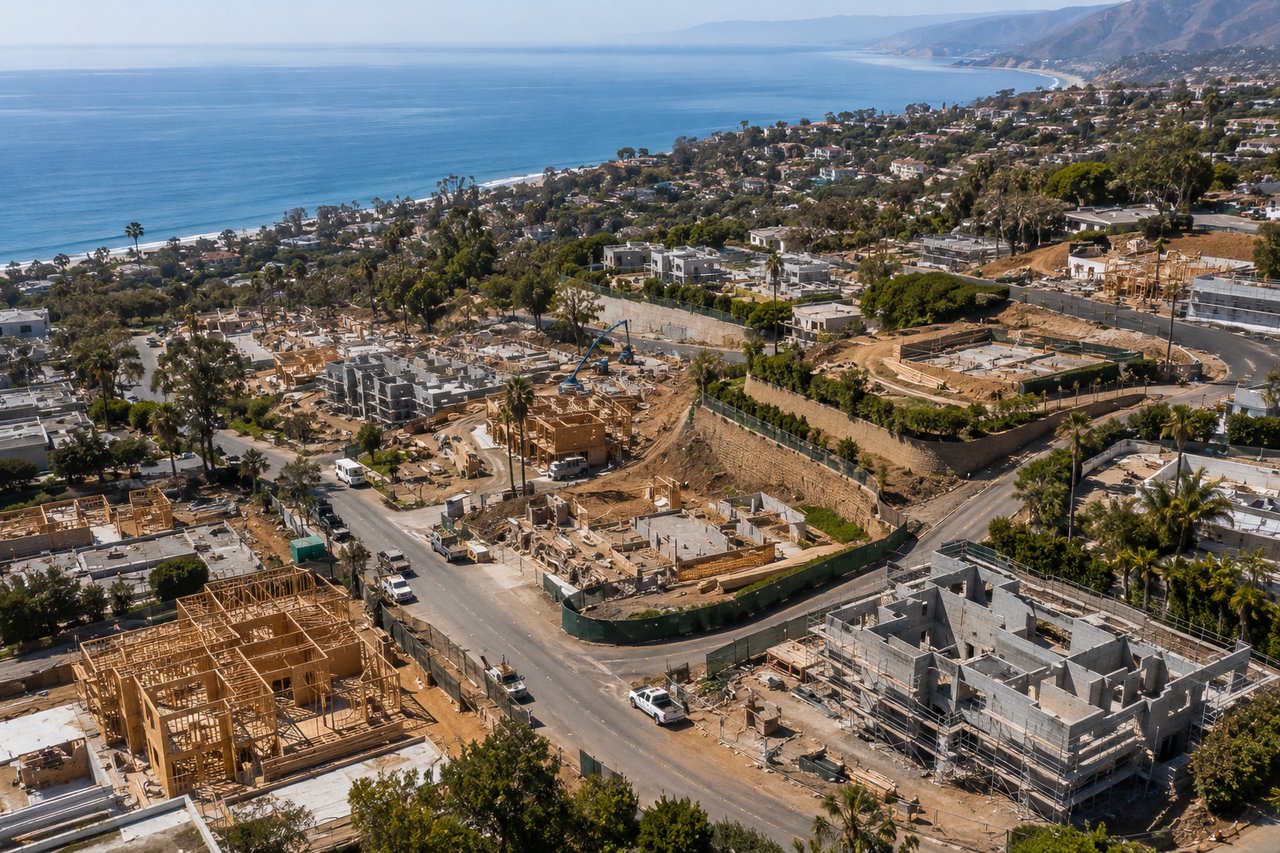
Permit counts for Pacific Palisades tell a story, though not the one most buyers expect. Los Angeles had issued roughly 2,140 to 2,600 permits across the burn zones by early 2026, with another 3,300 applications still under review. The numbers sound significant until weighed against the reality the Palisades Fire destroyed nearly 12,000 homes, and actual rebuild activity remains concentrated among a select group of owners who acted quickly and with a clear plan.
For buyers evaluating the Pacific Palisades market in 2026, the rebuild picture is far more nuanced than headline figures suggest. The real questions are which lots hold genuine value, which timelines are achievable, and how the current rebuild climate shapes a sound acquisition strategy particularly in a market where timing and discretion define outcomes.
Pacific Palisades Permit Numbers: Current Status and What They Tell Us
"California Governor Gavin Newsom issued an executive order to streamline the rebuilding of homes and businesses destroyed in the recent Southern California firestorms." — Gavin Newsom, Governor of California
Total permits issued across the burn zone
The city approved 3,090 building and electrical permits in Pacific Palisades following the January 2025 fire a figure that sounds substantial until the breakdown comes into focus. Only 563 of those represented actual groundbreaking permits for new construction. The rest covered electrical work, utility connections, debris removal, and minor repairs. Full structural rebuilds account for a much smaller slice than public tallies suggest.
A closer look at the September 2025 data confirms this. The city had issued 620 permits against 1,564 rebuilding applications, and permit counts themselves can be misleading Mayor Bass's office confirmed that 1,000+ permits were issued for roughly 515 addresses. Each rebuild typically requires two or more separate approvals before construction can begin.
Permits under review and approval timelines
Processing times are where the real friction shows. The Department of Building and Safety recorded an average 49-day wait between application submission and permit issuance as of January 2026, with 42% of December permits still in queue at that same threshold. Like-for-like rebuilds move through expedited review within six to eight weeks, while projects requiring Coastal Commission oversight add three to six months to the process.
At the one-year mark, 3,340 applications remained under review. Plan approval averages 69 days in Pacific Palisades a meaningful improvement from the 24-month timelines that apply outside fire zones. Even so, total time from application to issued permit runs four to six months on straightforward projects, stretching to nine to twelve months when multiple agencies are involved.
What the 13% rebuild start rate actually means
One year after the fire, only 13% of single-family homeowners had broken ground roughly 340 confirmed projects across thousands of destroyed properties. The gap between a permit issued and a foundation poured comes down to financing constraints, insurance disputes, and contractor availability far more than delays within the permitting process itself.
How permit volume compares to homes lost
The Palisades Fire destroyed nearly 7,000 structures. Measured against that scale, the roughly 2,600 residential permits issued across Palisades and Altadena represent one permit for every five homes lost. The majority of property owners are still in early recovery weighing options, resolving claims, and deciding whether to rebuild or sell. Execution, at this stage, belongs to a minority.
The Rebuild Process: What Buyers Need to Understand Before Making an Offer
Streamlined permitting pathways and Executive Order programs
Mayor Bass signed Executive Order 1 within days of the fire, creating like-for-like rebuild pathways for projects staying within 110% of the original footprint and height. CEQA requirements were waived, and departments were directed to complete reviews within 30 days or less. Executive Order 8 went further, extending eligibility beyond the 110% threshold for single-family projects in the Coastal Zone that meet objective zoning standards. Properties that qualify skip the discretionary reviews that once added months to approval timelines.
The pathway has limits worth knowing. Lot consolidations, subdivisions, and projects involving bluff setbacks or biological resource reviews are excluded. Anything falling outside the like-for-like criteria returns to standard discretionary review, which adds six to twelve months to the process.
Construction timelines from permit to occupancy
From permit issuance to occupancy, 18 to 24 months is the realistic range. Some builders handling repeat like-for-like projects report permit timelines as short as 54 days, but that figure covers only one part of the process. Design, engineering coordination, material procurement, and utility connection approvals all run on separate tracks outside the building department's control. Homes that are structurally complete can still wait weeks for final utility hookups managed by outside agencies.
Contractor capacity and the Altadena effect
Crews are currently working across Pacific Palisades, Malibu, and Altadena at the same time. That competition for skilled labor is the single greatest factor controlling how fast any individual project moves. Owners who locked in builder contracts by mid-2025 are already framing and roofing — those entering agreements now will wait considerably longer.
Insurance claims as the real bottleneck
The permitting process, for all its complexity, is not where most rebuilds stall. Roughly 70% of survivors are contending with insurance delays or outright denials. California FAIR Plan counts climbed 44% year-over-year, with a 29.1% rate increase filing anticipated for late 2026. The average insurance payout falls $600 per square foot short of what rebuilding actually costs a gap wide enough to freeze construction starts on otherwise permit-ready properties.
Are People Rebuilding in Pacific Palisades: Market Activity and Land Pricing
Lot sales data and transaction volume
Permit activity and actual market movement are two separate conversations. Through August 2025, 160 lots sold across Pacific Palisades, generating $477.70 million in transaction volume. January 2026 alone recorded 58 property sales at an average price of $3.14 million. Buyer composition shifted considerably: entities accounted for 40% of purchases between January and July, compared to zero investor activity during the same period a year prior. Investors went on to purchase 40.3% of vacant lots in the third quarter.
Current land pricing by submarket
Location and available amenities drive meaningful price differences across the area. Area 8 averaged $10.60 million with a median of $10.20 million across 11 sales. Area 5 recorded 48 transactions at an average of $2.10 million, while Area 2 averaged $1.70 million across 16 sales. The Huntington submarket held up relatively well, with value declines of only 10 to 15%, whereas most zones fell 35 to 40% from pre-fire levels.
Why some lots are sitting while others close quickly
Phase 2 debris clearance is what separates marketable lots from discounted ones. Cash buyers will move without clearance in place, though they factor removal costs and associated risk into lower offer prices.
The gap between permit issued and actual construction starts
Roughly 80% of property owners are still working through insurance negotiations. That single reality accounts for most of the distance between permit readiness and a construction crew on site.
What This Means for Buyers Entering the Market in 2026
"Buyouts are a critical component of a holistic approach to smart and resilient community recovery after a disaster." — Brandy Bones, Senior Director of Disaster Recovery and Resiliency Programs at ICF
Most buyers arrive at Pacific Palisades focused on lot prices and miss the fuller picture. The median lot trades around $3.50 million, down 17% year over year, with land costs averaging $330 per square foot though that figure varies considerably by location. Alphabet Streets properties have corrected 30 to 50 percent from pre-fire comparables. Flat lots with ocean views are scarce and priced accordingly, while sloped parcels look attractive on paper until engineering, retaining walls, and grading requirements come into focus during construction.
Evaluating Lot Value Against Rebuild Costs
Standard rebuilds run $350 to $500 per square foot, mid-range projects fall between $500 and $750, and luxury builds exceed $750 per square foot. Geotechnical work, architectural fees, and permit costs sit outside those figures. A contingency of 15 to 20 percent is prudent given how often unforeseen site conditions emerge.
Insurance Considerations That Affect Every Transaction
FAIR Plan premiums now reach $30,000 to $60,000 annually. Lenders incorporate those costs into debt-to-income calculations, which shifts buyer qualification thresholds in ways many don't anticipate. With roughly 70% of survivors still facing insurance delays or underpayments, available inventory stays constrained regardless of what demand looks like.
Site Suitability Factors That Drive Pricing
Permit pathway certainty, debris clearance completion, and confirmed utility connections are what separate a lot worth pursuing from one that carries hidden costs. Water meter status, sewer lateral integrity, LADWP electrical service, and SoCalGas availability should all be verified before contingencies are removed.
When to Buy Versus When to Wait
Buyers who need occupancy within 12 to 18 months are better served by standing inventory outside the burn zones. Those with a 24 to 36-month window may find real opportunity in rebuild-eligible parcels that qualify for streamlined permit pathways. For patient buyers with a five-to-ten-year outlook, raw lots offer a compelling entry point for those who can underwrite long-term submarket recovery.
Each of these scenarios calls for a different approach, and the right guidance makes all the difference. Christina Pope works closely with clients to understand exactly what they're looking for whether it's a lot ready to build on today or a long-term land investment and ensures every acquisition decision is made with clarity and confidence. 📞 310-404-9931 ✉️ [email protected]
Conclusion
The Pacific Palisades rebuild is a market that rewards knowledge, patience, and the right relationships. With only 13% of owners having broken ground despite thousands of permits issued, opportunity here belongs to buyers who understand what cleared, permit-ready parcels actually represent — and who move with both conviction and care.
Luxury real estate at this level rarely unfolds through public channels. The transactions that matter happen through trusted advisors who know which questions to ask, which details to verify, and which parcels genuinely merit attention. Christina Pope brings that level of discernment to every client conversation — whether the goal is acquiring a rebuild-ready lot, evaluating land value against realistic construction costs, or simply understanding the market before committing to anything.
For buyers who expect both expertise and integrity throughout the process, Christina is ready to help. 310-404-9931 | [email protected] | EliteResidenceInternational.com
Key Takeaways
Understanding the Pacific Palisades rebuild requires looking beyond surface-level permit numbers to grasp the real market dynamics shaping buyer opportunities in 2026.
• Only 13% of homeowners have started construction despite 2,600+ permits issued, revealing that insurance disputes and contractor capacity—not permitting—create the real bottleneck for rebuilds.
• Land prices dropped 35-40% in most zones with lots averaging $3.5M, but strategic buyers focus on cleared, permit-ready parcels where timing and site suitability drive actual value.
• Realistic timelines span 24-36 months from lot purchase to occupancy, with rebuild costs of $350-$750+ per square foot plus insurance premiums now reaching $30K-$60K annually.
• Executive Order streamlined pathways reduce approval times to 30 days for like-for-like rebuilds within 110% of original footprint, but projects requiring Coastal Commission review add 3-6 months.
The Pacific Palisades market rewards buyers who understand that opportunity lies in discrete transactions with favorable permit pathways, completed debris clearance, and confirmed utility connections—not in waiting for broader market recovery.
FAQs
Q1. How many building permits have been issued for Pacific Palisades after the fire? As of early 2026, Los Angeles has issued approximately 2,140 to 2,600 permits across the burn zones, with another 3,300 applications under review. However, only 563 of these represented actual groundbreaking permits for new construction, while most covered electrical work, utility connections, and debris removal rather than full structural rebuilds.
Q2. What percentage of homeowners have actually started rebuilding in Pacific Palisades? Only 13% of single-family homeowners had begun construction one year after the fire, representing approximately 340 confirmed projects. The gap between permit issuance and actual construction starts reflects financing constraints, insurance disputes, and contractor availability rather than permitting delays alone.
Q3. How long does it take to get a building permit approved in Pacific Palisades? The average wait between application submission and permit issuance is 49 days as of January 2026. Simple like-for-like rebuilds receive expedited review within 6-8 weeks, while projects requiring Coastal Commission oversight add three to six months. Total time from application to issued permit runs four to six months for straightforward projects.
Q4. What are current land prices in Pacific Palisades after the fire? The median lot trades around $3.5 million, down 17% year over year, with per-square-foot land costs averaging $330. Pricing varies significantly by submarket, with some areas like Area 8 commanding an average of $10.6 million, while Area 5 averaged $2.1 million across transactions.
Q5. What is the realistic timeline from buying a lot to moving into a rebuilt home? Realistic completion spans 24 to 36 months from lot purchase to occupancy. This includes 18 to 24 months from permit issuance to completion, plus time for design, engineering coordination, material procurement, and utility connection approvals that occur outside building department control.