Luxury homes in Brentwood Los Angeles don't trade hands through public listings alone. The most important transactions unfold quietly, shaped by private conversations and strategic timing. Discerning buyers in the $10M+ segment now view security and privacy as main purchase criteria rather than afterthoughts. Brentwood is one of Los Angeles' most coveted neighborhoods, known for its luxurious estates and secluded retreats. Modern buyers assess properties through layered security frameworks that span physical boundaries and smart automation systems. High-net-worth purchasers assess and implement security across estate-scale properties in one of California's most exclusive markets, and this piece gets into how they do it.
Understanding the Brentwood luxury market and buyer profile
Real estate transactions in Los Angeles unfold differently at certain price points. The most important deals rarely begin with public listings or open houses. They emerge through relationships that are years old, discreet questions, and timing that matters. Understanding the mechanisms matters more than following conventional search methods if you're navigating this market.
Market positioning among Los Angeles neighborhoods
Brentwood occupies distinct terrain west of the 405 Freeway. It sits between Pacific Palisades and Bel Air. The neighborhood combines metropolitan sophistication with a retreat-like atmosphere that distinguishes it from nearby Beverly Hills. Properties here range from USD 3.40 million to over USD 20.00 million. Luxury rentals command USD 30,000 per month or higher.
Recent market data reveals notable changes. Average sales prices reached USD 6.32 million in July 2024, marking a 46% increase. Average list prices stood at USD 10.23 million. Properties spent an average of 47 days on market, up 72% from previous periods. The price per square foot climbed to USD 1,529, representing an 18% increase. These figures reflect a market where buyers exercise considerable selectivity.
The neighborhood attracts attention from local and international purchasers seeking stable value appreciation. Limited inventory drives sustained demand. Many high-end properties change hands through off-market channels. Celebrities and business executives maintain residences here, which reinforces Brentwood's status as one of LA's most exclusive addresses. Properties show strong appreciation rates due to prime location and restricted development.
Typical buyer expectations in the $10M+ segment
Buyers at this tier represent a specific demographic profile. The area houses 33,315 residents with a median age of 42 and average individual income of USD 136,049. White collar workers comprise 99% of hired residents. Married couples account for 40% of households, while 21% include children.
Move-up families seek larger yards and functional layouts. Downsizers prioritize single-level designs or low-maintenance configurations. Executives who are relocating focus on finish quality, privacy, and outdoor usability. These purchasers inspect ceiling heights, kitchen design, suite placement, garage capacity, and outdoor living spaces rather than relying on square footage alone.
Properties at premium price points spend more days on market than entry-level listings because the buyer pool narrows considerably. Marketing requires professional photography, detailed floor plans, and strategic staging. Flexible showing arrangements and pre-qualification standards help maintain momentum while respecting the seller's privacy.
Price per square foot varies widely based on lot characteristics, topography, and interior updates. Premiums apply for quiet locations with favorable topography and high ceilings. Updated kitchens and bathrooms, main-level suites, and gated community access also command higher prices. So buyers segment comparable sales by price band and neighborhood style before evaluating adjusted pricing against recent closings.
Why privacy has become a main purchase criterion
Research from Knight Frank identifies privacy as the number one concern for high-net-worth individuals selecting homes. Security follows closely behind. This change stems from personal safety concerns, digital threats, and desires to maintain low profiles. A luxury home functions as sanctuary from public scrutiny for many wealthy individuals.
Visibility onto properties ranked as the top security and privacy consideration among luxury homebuyers, according to 44% of agents surveyed by Sotheby's International Realty in 2026. External security also ranked high, cited by 44% of respondents. The emphasis reflects changing priorities where tranquility and beauty matter as much as architectural features.
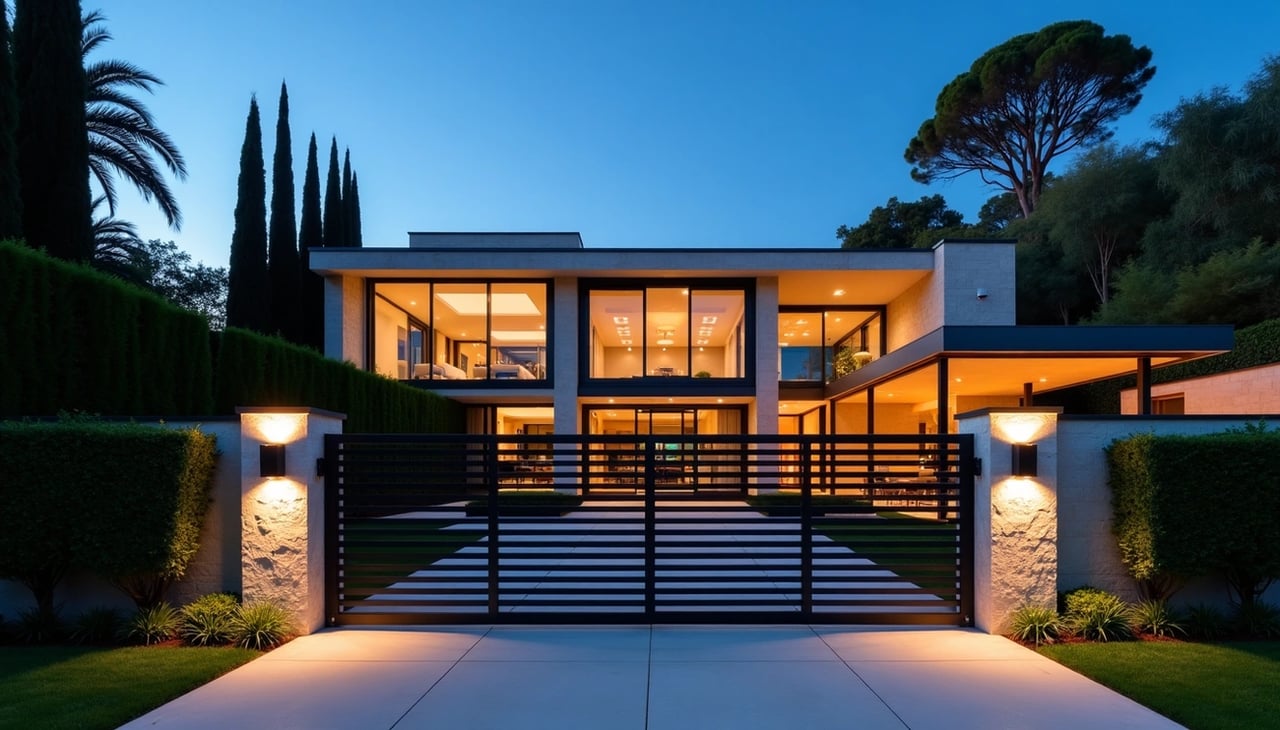
Homes set behind gates or long private driveways offer secluded retreats while maintaining proximity to Beverly Hills, Santa Monica, and Downtown LA. This positioning makes privacy a key selling point in Brentwood. Buyers in 2026 search for legacy assets rather than temporary residences. They run careful calculations on long-term performance and generational durability.
Wealthy buyers relocating from New York and San Francisco choose Brentwood for space, safety, and privacy advantages. The neighborhood provides more room and seclusion compared to denser urban markets. Areas like Brentwood Park feature pricey mansions along quiet hillside streets. Residents include LeBron James, Tom Brady, and Gwyneth Paltrow.
Foundation layer: property boundaries and natural surveillance
Physical design determines security outcomes before technology enters the equation. The property's physical layout, boundary definitions, and sight line management establish the foundation upon which all other security measures are built for those assessing mansions in Brentwood CA. This assessment precedes equipment selection, automation integration, or staffing decisions.
Site assessment and access point mapping
Estate-scale properties need systematic assessment of every entry possibility. Professionals map main gates, service entrances, pedestrian access points, and potential breach locations along the perimeter. This process identifies vulnerable transitions between public streets and private grounds.
Access point mapping documents where legitimate users enter and how unauthorized individuals might attempt entry. Brentwood CA luxury homes spanning multiple acres mean walking the whole boundary and noting elevation changes, adjacent properties, and natural barriers. Drainage systems, utility corridors, and neighboring easements often create overlooked access routes.
The assessment extends beyond perimeter walls. Internal pathways guide service personnel, guests, and family members through distinct zones. A curved path to the front entrance creates natural transition points between public and private space. Stairs leading right to the main door discourage approaches toward side windows. These architectural elements function as passive access control and guide movement without overt barriers.
CPTED principles for luxury residential properties
Crime Prevention Through Environmental Design introduces methods that deter criminal activity through spatial design rather than active intervention. Five core principles shape how security professionals assess Brentwood Los Angeles mansions.
Natural Access Control guides entry and exit patterns through placement of entrances, fences, landscaping, and lighting. The principle decreases criminal opportunities by denying access to targets and creating perceived risk for offenders. Homes without physical barriers face three times higher burglary targeting rates compared to properties with fencing, signage, and lighting.
Natural Surveillance positions physical features to maximize visibility. Windows, lighting, and landscape placement determine how much occupants and passersby can observe. Potential criminals avoid attempts when observation risk increases. Research indicates 60% of convicted burglars would bypass homes with visible cameras or active neighborhood watch signs.
Low bushes replace tall hedges. Motion-sensitive lighting eliminates dark corners. Windows face streets in considered ways. Properties with clear sightlines invite observation from neighbors and pedestrians and remove comfort zones for intruders. Trimming shrubs below window levels and raising tree canopies to six feet maintains visibility while preserving landscaping esthetics.
Territorial Reinforcement creates perceived ownership through visual and physical cues. Defined property lines and clear public-private distinctions deter potential offenders. Fresh paint, maintained lawns, personalized signage, and considered pathways signal active guardianship. Well-maintained properties convey that spaces are watched and loved, which discourages violation.
Maintenance creates guardianship perception. Well-kept homes and grounds deter criminals through implied oversight. Neglected properties invite intrusion. Maintained estates do not.
Activity Support discourages criminal acts by encouraging legitimate user activity in visible spaces. Front porches, outdoor seating areas, and pedestrian-friendly pathways increase natural surveillance through routine occupancy.
Balancing visibility with concealment reduction
Luxury buyers face competing demands. Privacy needs visual screening. Security needs observation capability. Resolving this tension defines successful implementation for luxury homes in Brentwood Los Angeles.
Tall hedges provide privacy but create burglar concealment. About 34% of burglars enter through front doors, 22% through back doors, and 23% via off-street windows. Dense landscaping near these entry points eliminates natural surveillance that deters intrusion.
The solution involves strategic screening placement. Perimeter vegetation blocks external views into the property while internal landscaping remains low near structures. This configuration prevents street-level observation of residents without creating hiding spots adjacent to vulnerable entry points.
Lighting placement resolves another visibility paradox. Soft illumination along pathways signals occupancy and care without creating harsh spotlight effects that announce wealth. Well-used front porches and visible outdoor activity spaces increase passive deterrence while maintaining refined esthetics.
Properties must capture only their own boundaries. Cameras pointed toward neighboring estates create legal exposure. Privacy masking features prevent inadvertent recording of adjacent properties while maintaining detailed coverage of owned perimeter. So camera positioning focuses on choke points like gates and doorways with wider context views and tighter identification angles.
Technology layer: cameras, sensors, and automation
Equipment selection separates functional security from theater. For Brentwood ca luxury homes, the difference between consumer-grade and professional systems determines whether technology delivers reliable protection or creates false confidence. Buyers evaluating mansions in brentwood ca encounter equipment spanning wide price ranges and capability gaps that go way beyond initial cost.
Professional-grade vs consumer security equipment
Image quality defines the value gap. Consumer cameras offer HD (720p) or Full HD (1080p) resolution. Professional systems deliver 4K or higher with superior low-light performance, dynamic range and noise reduction. Commercial-grade cameras contain larger internal video sensors and High Dynamic Range (HDR) capabilities that handle challenging light transitions, from doors flooding sensors with daylight to midnight footage capture.
Durability separates temporary installations from permanent infrastructure. Consumer models use plastic components suitable for indoor and light outdoor use. Professional cameras employ weatherproof, vandal-resistant materials rated IP66 or IP67. These ratings provide full protection from dust, rain, snow and sprinklers. White camera housings reflect summer heat and prevent temperature-related failures common in dark-colored consumer models.
Connectivity architecture creates reliability differences. Consumer systems rely on Wi-Fi, which simplifies installation but introduces interference and stability concerns. Professional installations use Power over Ethernet (PoE) and deliver both power and data through single cables while maintaining consistent performance. This wired infrastructure supports estate-scale deployments where wireless signals struggle with distance and building materials.
Analytics capabilities determine notification usefulness. Consumer cameras offer simple motion detection prone to false alerts from insects and weather. Professional systems provide sophisticated AI that includes facial recognition, license plate reading, heat mapping and integration with broader security networks. Storage options reflect these capability gaps. Consumer models use SD cards or subscription cloud services. Professional systems deploy Network Video Recorders (NVRs) with capacities reaching 144TB across 32 channels.
Support structures differ. Consumer-grade equipment provides online resources and manufacturer helplines. Professional installations include complete support packages with on-site maintenance, advanced troubleshooting and certified partner integration.
Integration with Control4, Crestron, and Savant platforms
Control4 supports Luma Surveillance systems that offer AI features, cloud-based recording and tailored notifications. Luma cameras span Bullet, Turret, Dome, Fisheye and PTZ formats up to 8MP resolution with Color at Night technology and Active Deterrence features. NVR configurations accommodate up to 32 channels with 12MP recording capability. All Luma products maintain NDAA compliance with three-year limited warranties.
Luma Insights adds 24/7 AI-powered analytics with person, vehicle, package and animal detection. The subscription service stores 7 days of video clips in Control4 Cloud and makes them available through touchscreens and mobile apps. Customizable notifications reduce alert fatigue by filtering detection types per camera.
Crestron Home OS manages door locks and includes Yale Pro 2 Deadbolt integration with user-specific access permissions. The platform unifies garage doors, gates and locks within a single interface and incorporates myQ drivers for Chamberlain and Liftmaster systems. Pin code protection locks touchscreens in specific rooms. Homeowners can restrict control access during events or maintain permanent privacy in primary bedrooms.
Network security protocols include AES encryption, 802.1x authentication, Active Directory integration, TLS, SSH and HTTPS. Crestron products carry NIAP and JITC certifications from the U.S. Department of Defense. Secure CIP ensures encrypted communications between control processors and video devices.
Savant integrates Ring entry systems with 135-degree camera views, night vision and motion detection alerts. Video recording triggers when keypads are pressed or tampering is detected. The platform mirrors native security system interfaces and maintains familiar controls without requiring user retraining.
Network architecture for reliable remote monitoring
Remote monitoring systems use probe-central architectures where probes installed at monitored sites discover, map and detect faults, then report to central servers. Communication occurs via XML over HTTP or HTTPS and maintains security across distributed networks. Probes function behind firewalls or proxy servers and enable monitoring without compromising network segmentation.
Central servers collate probe data into unified consoles that provide complete visibility across multiple properties. Local administrators access web consoles at probe locations while maintaining centralized oversight. This architecture scales as networks expand to additional locations and multiply resources.
Encrypted storage and privacy protection
Secure VPN connections create closed pathways between cameras and cloud storage. This limits exposure to external threats. Firmware-embedded security protects cameras even when home networks are compromised and prevents unauthorized access without explicit credentials.
Military-grade 256-bit encryption, double the government standard, protects all footage whether live-streamed or archived. Proprietary cloud systems reduce breach risks compared to third-party storage providers. Two-factor authentication using SMS provides stronger protection than email-based codes.
Local storage options eliminate cloud vulnerabilities. Cameras supporting RTSP and ONVIF protocols stream to self-hosted systems on isolated networks without internet connectivity. This configuration prevents remote subpoenas while maintaining full functionality for on-site access.
Operational layer: daily workflows and access management
Managing access across estate-scale properties requires structured protocols that separate family movements from service personnel and guest arrivals. Brentwood CA luxury homes depend less on equipment capabilities and more on how protocols execute across daily routines for operational security.
Family versus guest versus service entry protocols
Modern access control solutions establish distinct entry pathways. Family members get immediate access through biometric scanners using fingerprint or retina recognition. Guests and regular contractors use smart cards or mobile passcodes. License plate recognition automates vehicle entry for registered cars.
Homeowners can set different permission levels with advanced user control. Family members receive unrestricted access. Staff get time-based credentials that activate during scheduled shifts. Guests receive temporary codes valid for specific dates. This tiered approach maintains security and accommodates legitimate access needs.
Multiple entry points require individual attention. Service entrances, garage access and rooftop doors each need intelligent locking mechanisms monitored for unusual activity. Basement entries often receive less scrutiny despite providing direct access to mechanical systems and storage areas containing valuable items.
Gate communication and intercom systems
Gate intercoms function as the main access communication devices at controlled entry points. Modern systems provide two-way audio that enables immediate communication between visitors and residents. Video capability allows visual confirmation of visitor identity before granting entry.
Smartphone integration eliminates physical presence requirements. Residents open gates remotely through mobile apps whether inside the house or traveling. Cloud-based systems enable property managers to update resident directories, manage access permissions and issue single-use PINs without visiting the site.
Video verification reduces unauthorized entry risks and supports better decisions when allowing access. Residents can see delivery drivers, service providers and guests at the gate before responding. Systems with audit trails maintain timestamped records of all entries.
Package handling and delivery coordination
Package volume averages 12,000 a year for multifamily properties and consumes over 2 hours of staff time daily. Smart package lockers address this operational burden. Carriers deliver directly to lockers and scan package barcodes. Systems notify residents with one-time access codes immediately.
Some gated communities position lockers outside entrance gates and eliminate daily delivery traffic through private streets. This approach preserves road integrity and reduces security exposure from multiple carrier access grants. Homeowners receive app notifications when packages arrive. Weatherproof construction protects deliveries from environmental damage.
Emergency access planning
Emergency plans address evacuation procedures, shelter-in-place protocols and communication systems for informing residents during crises. Properties maintain rosters of resident responders who can check on vulnerable occupants or staff information centers. Plans include recall procedures for off-duty employees and specific task assignments once staff arrives. Damaged security gates require additional personnel to verify manually that only residents, responders and authorized contractors enter.
Architectural privacy in mansions in brentwood ca
Architectural privacy in mansions in brentwood ca
Architectural decisions embedded during design phases shape privacy outcomes more permanently than any system installed afterward. Site positioning, structural elements and material specifications establish privacy boundaries that technology and protocols can only reinforce for brentwood los angeles mansions. Construction completion fixes these choices permanently, making original design scrutiny necessary for buyers who evaluate luxury homes in brentwood los angeles.
Lot placement and setback considerations
Brentwood planning regulations establish minimum distances between structures and property boundaries. Standard requirements mandate 5-foot side yard setbacks, 15-foot front yard setbacks measured from living areas, and rear yard setbacks of 10 feet from first floors with 15 feet from second floors. Properties with irregular shapes or constrained dimensions sometimes require variances. A recent approval reduced side yards to 4 feet, front setbacks to 9 feet, and rear setbacks to about 5 feet on both levels for a lot measuring just 49 feet at its narrowest point.
Strategic positioning uses topography to control sightlines and restrict unwanted observation. Architects study elevation changes, slope direction and natural barriers to position homes with care. Living areas may rise above approach lines, tuck into hillsides or use downward slopes to conceal outdoor zones. Visibility stays protected without closing off the property through these considered choices.
Window positioning and glazing specifications
Façade layouts determine how much interior space remains visible from outside. Window angles shift away from neighboring sightlines. Glass positions where exposure stays limited, and structural overhangs break visibility. Clerestory windows bring natural light while maintaining complete privacy from neighbors. Laminated or impact-resistant glazing adds security without diminishing architectural intent.
Smart glass technology provides dynamic privacy control. Switchable glass contains layers that transition from clear to frosted with electrical current application. Standard smart glass uses double-glazed safety glass suitable for exterior applications, while insulated glass units deliver improved thermal performance in extreme climates. Home automation platforms integrate these systems and allow residents to adjust transparency through mobile apps.
The right home makes all the difference for those who love to entertain. If you're thinking about a purchase in the near future or beginning your search, I'd be delighted to help you find spaces designed for elevated living and effortless hosting. Christina Pope  310-404-9931
  [email protected]
Outdoor living spaces and screening solutions
Free-standing walls at varied heights block views without creating fortress esthetics. Frosted glass panels obstruct adjacent buildings while allowing light transmission. Dense evergreen hedges planted at half the recommended spacing intervals provide maximum privacy and sound suppression. Layered materials combining metal, stone and concrete with lighter elements like hedges absorb more sound than individual materials used alone. Private courtyards surrounded by walls or hedges create secluded environments. Water features incorporated into these spaces mask external noise while boosting seclusion.
Sound attenuation and acoustic privacy
Privacy extends beyond visual barriers. Rooms that require quiet benefit from separation by buffer zones including closets, hallways and bathrooms that absorb sound before it reaches occupied spaces. Back-to-back plumbing walls between bathrooms and bedrooms generate noise complaints that thoughtful floor plan organization prevents entirely. HVAC ductwork acts as sound conduit and carries noise between rooms through air distribution systems. Lined ducts, duct silencers and properly sized air terminals reduce mechanical noise and room-to-room sound transfer. Double-glazed windows provide additional acoustic protection from external sources.
Environmental security: fire zones and natural hazards
Much of Brentwood sits within designated wildfire hazard areas. This brings regulatory obligations that affect both construction specifications and ownership costs over time. Fire risk shapes design decisions, maintenance requirements and insurance availability for luxury homes in brentwood los angeles in ways that extend way beyond esthetic priorities.
Very High Fire Hazard Severity Zone designation
Fire Hazard Severity Zones assess hazard based on physical conditions creating fire likelihood and expected behavior over 30 to 50-year periods. Many areas of Brentwood fall within Very High Fire Hazard Severity Zones, where fire danger ranks among the highest categories. This designation reflects scientific assessment of fire history, existing vegetation, predicted flame length, blowing embers, terrain and typical weather patterns.
The classification system uses five categories: Low, Moderate, High, Very High and Extreme. Brush fires spread faster when Red Flag conditions arrive and humidity drops below 15% while winds exceed 25 mph. Properties in these zones face specific construction requirements and maintenance obligations that properties in lower-risk areas avoid.
Required clearances and vegetation management
California law mandates 100 feet of defensible space around structures. This requirement divides into distinct zones with stricter standards closer to buildings. Zone 0 extends 0 to 5 feet from buildings and focuses on intense fuel reduction. Zone 1 reaches from 5 to 30 feet and requires removal of dead plants, maintenance of 10-foot gaps between tree canopies and clearance under decks. Zone 2 spans 30 to 100 feet with horizontal tree spacing and vertical separation between vegetation layers.
Assembly Bill 30 now requires defensible space inspections before escrow closes on properties in Very High Fire Hazard Severity Zones. Non-compliant vegetation must be cleared before transactions complete. Some counties enforce stricter standards than state minimums. San Diego County requires a 50-foot Zone 1.
Structural hardening elements
California requires Class A-rated roof coverings in high-risk zones. These include asphalt shingles, tile, cement or metal panels. Attic and underfloor vents require 1/16 to 1/8 inch noncombustible metal mesh or California State Fire Marshal-approved ember-resistant designs. Tempered glass windows provide four times greater resistance to breakage during wildfires compared to single-pane alternatives. Combustible fencing attached to residences must transition to noncombustible materials for the first eight feet.
Effect on insurance and long-term value
Wildfires have altered the map of how properties are built, bought and insured. Insurance premiums can reach USD 30,000 to USD 60,000 annually on USD 5 million homes in high-risk zones. Many major insurers have exited California or stopped writing new policies in fire-prone areas. The California FAIR Plan serves as an insurer of last resort and offers basic coverage with limited protections.
Properties within 1,000 feet of brush face particular scrutiny. One Pacific Palisades property struggled to secure coverage until installing fire-resilient upgrades. It survived the Palisades fire while neighboring structures burned. Insurability now drives purchasing decisions as much as location and finishes for Brentwood ca luxury homes.
Vetting and selecting security professionals
Property owners looking to hire security professionals for Brentwood CA luxury homes need verification processes that go beyond reviewing proposals or checking references. California has specific regulatory frameworks that separate licensed operators from unlicensed alternatives. These distinctions carry legal and financial consequences that affect property owners directly.
Licensed contractors and installation standards
The Bureau of Security and Investigative Services regulates all security companies and guards operating in California. Security companies must hold a Private Patrol Operator (PPO) license. This requires passing background checks, meeting experience requirements, posting surety bonds and maintaining liability insurance. Individual guards need valid Guard Cards. They get these through background checks, fingerprinting and 40 hours of training. Armed guards require separate Firearms Permits from BSIS. Additional firearms training, range qualification and psychological evaluations are mandatory.
Private patrol services and monitoring companies
Estate security operatives require specific qualifications beyond licensing. Professionals should demonstrate relevant training and appropriate certification for protecting residences. Experience within residential protection roles provides the skills and knowledge needed. Close proximity work with high-net-worth individuals demands trust, confidentiality and integrity. Operatives need alertness to identify threats and initiative to respond appropriately.
Questions about response protocols and liability coverage
Insurance requirements protect property owners when incidents occur. Security companies must carry minimum $1 million general liability coverage. Workers' compensation covers injuries guards sustain on the job and prevents liability for owners. Professional liability addresses errors and omissions in security services. Property owners should request certificates of insurance showing current coverage before engagement.
Phased implementation strategies for estate-scale properties
Implementation timelines for Brentwood los angeles mansions rarely follow single-contract models. Occupied properties present logistical constraints that make staged deployment practical rather than optional. Security improvements work better in phases. Homeowners can maintain residence continuity while addressing vulnerabilities one by one.
Why buyers phase security upgrades
Properties with active occupancy cannot accommodate simultaneous infrastructure replacement in all systems. Disruption to daily routines, temporary access restrictions and construction noise make complete one-time installations impractical for families maintaining normal schedules.
Phasing allows validation of workflows before expanding scope. Original deployments demonstrate whether selected platforms meet operational needs before committing to estate-wide integration. This approach reduces risk of pricey replacements when systems fail to perform as expected.
Prioritizing the most effective improvements first
Risk assessment determines implementation sequence. Property owners identify vulnerabilities based on likelihood and consequence severity. They address highest-priority exposures before secondary concerns. Perimeter access control comes before interior automation because boundary security provides immediate threat reduction.
Planning for future expansion without infrastructure replacement
Device lifecycle management requires complete documentation of existing equipment. Standardized formats make upgrade planning efficient across multiple buildings or detached structures on estate properties. Proactive scheduling based on expected component lifecycles reduces emergency repairs and makes budgeting predictable.
Budget considerations across phases
Smart home automation for hillside estates ranges from USD 5,000 to USD 50,000. Control4 starter systems covering three rooms begin around USD 6,000. Full-estate Savant deployments incorporating motorized shades and climate zoning reach USD 40,000 to USD 50,000.
Conclusion
Security and privacy have moved from supplementary features to foundational requirements that luxury buyers in Brentwood expect. Successful implementation depends on layered strategies that combine physical design and professional-grade technology. Properties worth protecting need expertise beyond standard installations. Licensed professionals deliver systems that function for decades rather than months. Those thinking about a purchase and seeking spaces designed for lifted living can contact Christina Pope at Sotheby's International Realty. She provides access to properties where security infrastructure matches architectural sophistication. Reach her at 310-404-9931 or [email protected] to explore estates built with discretion and lasting value in mind.
Key Takeaways
Modern luxury buyers in Brentwood prioritize security and privacy as primary purchase criteria, fundamentally changing how $10M+ properties are evaluated and designed.
• Layered security architecture is essential: Successful protection combines physical boundaries, professional-grade technology, and structured operational protocols rather than relying on single solutions.
• Professional-grade equipment outperforms consumer systems: Commercial cameras offer 4K resolution, weatherproof durability, and AI analytics versus basic HD consumer models prone to false alerts.
• Architectural privacy decisions are permanent: Site positioning, window placement, and structural elements embedded during design create privacy outcomes that technology can only reinforce, not replace.
• Fire zone regulations drive construction costs: Brentwood's Very High Fire Hazard designation requires specific materials, defensible space clearances, and can result in $30,000-$60,000 annual insurance premiums.
• Phased implementation reduces disruption: Estate-scale security upgrades work best when staged to maintain family routines while validating systems before full deployment, with budgets ranging $5,000-$50,000.
The shift toward security-first luxury real estate reflects changing buyer priorities where protection and discretion matter as much as architectural features and location prestige.
FAQs
Q1. What celebrities are known to live in Brentwood? Brentwood is home to several high-profile residents including NBA star LeBron James, actress Reese Witherspoon, and former California Governor Arnold Schwarzenegger. The neighborhood's combination of privacy, security, and spacious estates makes it particularly attractive to celebrities and high-net-worth individuals seeking seclusion while maintaining proximity to Los Angeles amenities.
Q2. How does Brentwood compare to Beverly Hills for luxury homebuyers? Brentwood and Beverly Hills cater to different lifestyle preferences at similar price points. Beverly Hills offers a globally recognized address with walkable urban amenities, while Brentwood provides a quieter, more residential atmosphere with larger lots, greater privacy, and a retreat-like environment. The choice depends on whether buyers prioritize international prestige and walkability or spacious seclusion and family-friendly surroundings.
Q3. What makes Brentwood an upscale neighborhood? Brentwood qualifies as an upscale neighborhood through its combination of tree-lined streets, high-end shopping districts, top-rated schools, and proximity to the Santa Monica Mountains for outdoor recreation. The area features luxury estates ranging from $3.4 million to over $20 million, attracts affluent professionals and celebrities, and maintains a sophisticated yet relaxed atmosphere that distinguishes it from denser urban luxury markets.
Q4. Why do luxury buyers prioritize security and privacy in Brentwood homes? Security and privacy have become primary purchase criteria for high-net-worth buyers due to personal safety concerns, digital threats, and the desire to maintain low profiles. Research shows that 44% of luxury real estate agents identify visibility onto properties as the top concern for their clients, reflecting a shift where homes function as sanctuaries from public scrutiny rather than just architectural showcases.
Q5. What security features are most important for Brentwood luxury properties? The most effective security approach combines multiple layers: physical boundaries with strategic landscaping, professional-grade camera systems with 4K resolution and AI analytics, integrated access control for family and service personnel, and architectural privacy elements like strategic window placement and sound attenuation. Properties also require compliance with fire zone regulations including defensible space clearances and structural hardening elements.