The most expensive house in US luxury markets rarely announces itself through public fanfare. High-value real estate transactions in Los Angeles unfold through private conversations, precise timing and managed visibility. But when properties do surface publicly, they reveal telling patterns about market dynamics and buyer expectations.
Bel Air has become a focal point for understanding this move. Villa Siena returned to market at $135 million, while another mega-mansion dropped from $139 million to $99.95 million after failing to attract buyers. These substantial recalibrations signal more than simple price adjustments. They reflect a fundamental reset in how trophy properties are valued and transacted in today's luxury scene.
The Assemblage Strategy Behind America's Most Expensive Homes
Luxury real estate in Los Angeles operates through private conversations and timing. The most meaningful transactions unfold within trusted circles, where discretion carries as much weight as value. Those who understand this world know that visibility remains secondary to precision.
Land assemblage drives the creation of America's most expensive compounds. This strategy combines two or more parcels owned by different parties into a single, larger site. The combined land sells for more than the sum of its parts, especially when assemblage enables higher-density development or creates unprecedented scale.
Success depends on confidentiality. Walt Disney's secret land purchases for Disney World illustrate this principle. Disney assembled nearly 28,000 acres across 51 different property owners using anonymous entities. Most brokers didn't know who they were working for. Land prices skyrocketed from $80 per acre to over $80,000 per acre once the truth emerged.
Contemporary buyers follow similar patterns. Jeff Bezos spent more than $200 million on three properties on Indian Creek. Citadel founder Ken Griffin assembled six properties on Star Island for nearly $170 million. Former Google CEO Eric Schmidt spent a combined $114 million buying at least five adjacent homes on the Sunset Islands since 2020.
These transactions require patience and deep market understanding. Christina Pope at Sotheby's International Realty and EliteResidenceInternational.com specializes in navigating these complex assemblages where timing and discretion create value.
Inside the Most Expensive House in Los Angeles
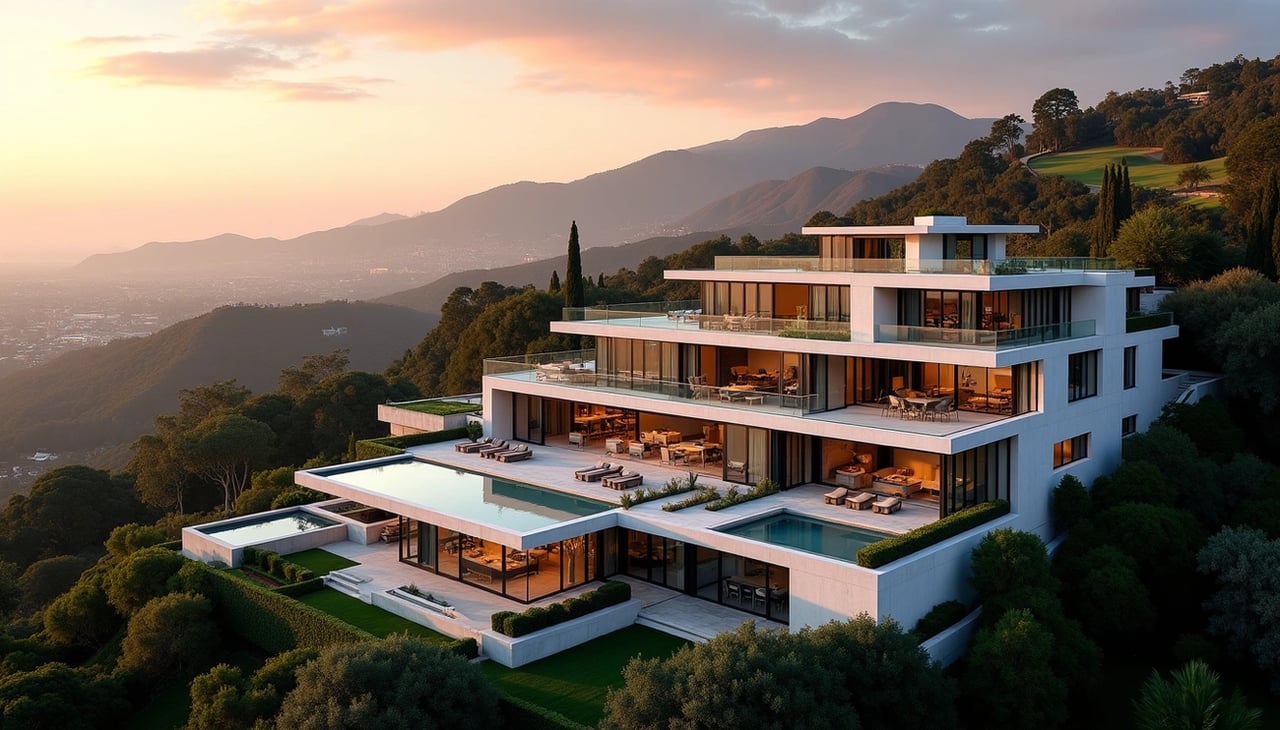
Two Bel Air properties demonstrate how expectations have changed. Villa Siena at 607 Siena Way carries a $135 million price tag. This represents a 24 percent reduction from its previous $177 million ask. The estate spans about 35,000 square feet with eight bedrooms and 20 bathrooms, roughly $3,857 per square foot. Developer Ardie Tavangarian designed the home with 30-foot glass walls, a four-story floating staircase, and a primary suite with a retractable roof for stargazing. The wellness center features hot and cold plunges, red-light therapy, and ceiling plantings that create a rainforest atmosphere.
La Fin at 1200 Bel Air Road dropped from $139 million to $99.95 million after years without a buyer. Joseph Englanoff acquired the vacant land in 2014 for $5 million. He spent five years developing the 36,000-square-foot property with 12 bedrooms and 17 bathrooms. Amenities include a 44-foot chandelier made from 55,000 crystals, an automated six-car elevator display, and a 6,000-square-foot entertainment level with a vodka tasting room and cigar lounge.
The right home makes all the difference if you love to entertain. I'd be happy to help you find spaces designed for exceptional living and effortless hosting if you're thinking about a purchase in the near future or beginning your search. Christina Pope  310-404-9931
  [email protected]
What the Luxury Market Reset Means for Trophy Properties
Price adjustments across Bel Air properties signal recalibration rather than distress. Douglas Elliman's Cory Weiss frames the move: "Ultra-luxury is no longer aspirational pricing; it's precision pricing". Buyers at this level operate with discipline and evaluate properties through metrics like interest rates, liquidity, and chance cost.
The buyer profile has evolved. Five years ago, size and spectacle drove purchases. Buyers now prioritize privacy, security, and flexibility over bragging rights. Amenities that integrate into daily life—wellness facilities, smooth indoor-outdoor flow, and smart security—win over novelty features that photograph well but rarely get used.
International buyers intensify this move. Foreign purchasers target properties averaging €9 million compared to domestic buyers' €3.2 million, a consistent 3x premium in major US markets. California leads foreign interest at 64.5%. International buyers bypass traditional luxury entry points and focus on trophy properties.
Time on market determines final pricing. Multimillion-dollar properties average 319 days to sell. Properties spending more than 180 days on market achieve 80 percent of asking price, while faster sales average 87 percent.
Christina Pope at Sotheby's International Realty and EliteResidenceInternational.com understands these dynamics and positions clients within market realities where timing and precision create value.
Conclusion
The Bel Air market has reset around precision rather than aspiration. So buyers who understand this move will find opportunities where smart timing meets realistic valuation. Trophy properties still command premium prices. Success now depends on clear lifestyle narratives and expert positioning. Christina Pope at Sotheby's International Realty and EliteResidenceInternational.com guides clients through these transactions where discretion and market intelligence create lasting value. 310-404-9931 [email protected]
Key Takeaways
Understanding the ultra-luxury real estate market reveals strategic patterns that drive America's most expensive home sales and assemblage strategies.
• Land assemblage drives mega-mansion values: Combining multiple parcels creates properties worth more than individual parts, enabling $100M+ estates through strategic, confidential acquisitions over time.
• Luxury market has shifted from aspiration to precision pricing: Buyers now prioritize privacy, wellness amenities, and lifestyle integration over spectacle, forcing 20-30% price reductions on trophy properties.
• International buyers target 3x higher price points: Foreign purchasers average €9 million purchases versus domestic buyers' €3.2 million, with California capturing 64.5% of international luxury interest.
• Time on market directly impacts final sale price: Properties selling within 180 days achieve 87% of asking price, while longer listings average only 80% of original pricing.
• Discretion and timing create competitive advantage: Following Disney's Florida model, anonymous assemblage strategies prevent price inflation and enable successful mega-estate development.
The most successful luxury transactions now combine market intelligence, strategic timing, and expert positioning to navigate a landscape where precision trumps publicity.
FAQs
Q1. What makes Bel Air properties so expensive compared to other luxury markets? Bel Air commands premium prices due to its combination of custom architecture, sweeping views, rare amenities, and strategic land assemblage. The neighborhood attracts celebrity buyers and elite developers who create estates that often exceed $100 million by combining multiple parcels into single compounds with unprecedented scale and luxury features.
Q2. How do developers create mega-mansions worth over $100 million? Developers use a land assemblage strategy, confidentially acquiring multiple adjacent parcels from different owners over time and combining them into a single, larger site. This approach creates properties worth more than the sum of individual parts, enabling the scale and amenities necessary for ultra-luxury estates while preventing price inflation during acquisition.
Q3. Why have some Bel Air mega-mansions seen significant price reductions? The luxury market has shifted from aspirational to precision pricing. Properties like Villa Siena dropped from $177 million to $135 million because today's buyers prioritize clear lifestyle value, privacy, and functional amenities over spectacle. Time on market also impacts pricing—properties listed longer than 180 days typically achieve only 80% of asking price.
Q4. How do international buyers differ from domestic buyers in the luxury market? International buyers target properties averaging €9 million compared to domestic buyers' €3.2 million—a consistent 3x premium. Foreign purchasers focus exclusively on trophy properties rather than traditional luxury entry points, with California capturing 64.5% of international luxury real estate interest.
Q5. What amenities do ultra-luxury buyers prioritize today? Modern ultra-luxury buyers favor wellness facilities (hot and cold plunges, red-light therapy), seamless indoor-outdoor flow, smart security systems, and privacy features over novelty amenities. They seek spaces that integrate into daily life and support elevated living rather than features that simply photograph well but rarely get used.