Bel Air's Historical Foundation as an Estate District
Planning that prioritized privacy from 1922
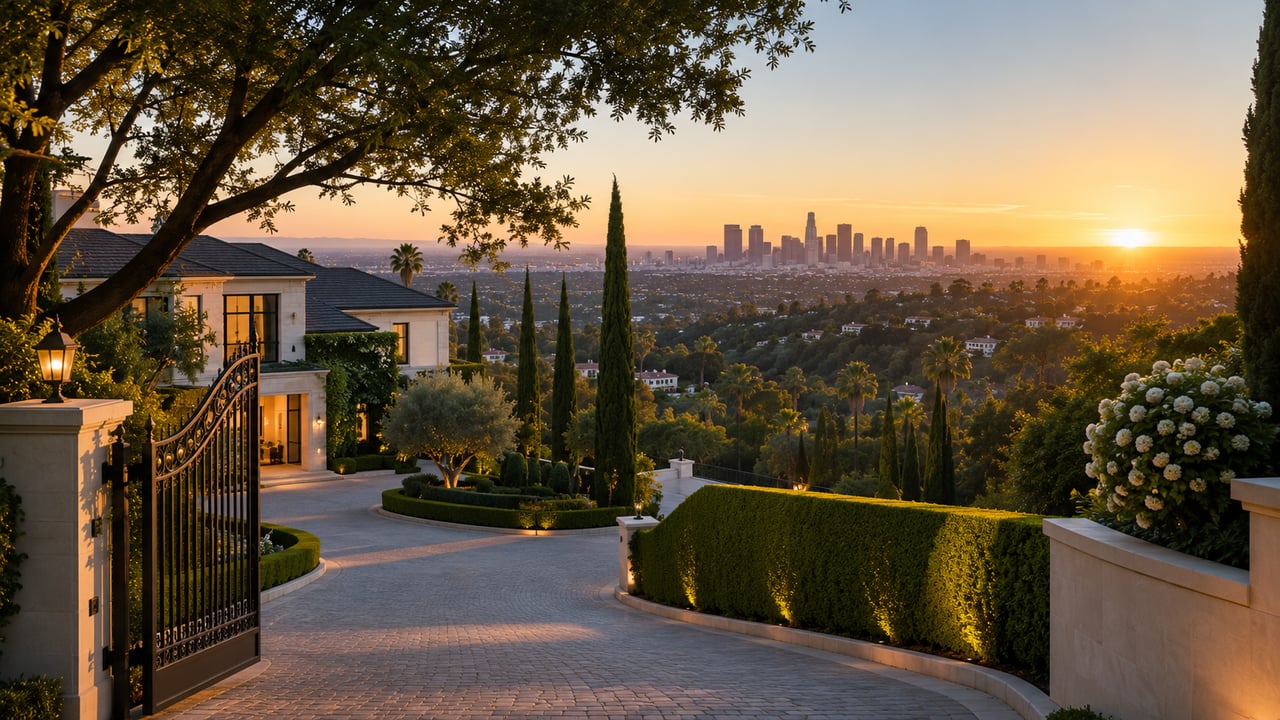
Alphonzo Bell opened the first Bel Air Allotment in 1922. He created 128 lots across 1,700 acres of undeveloped hillside terrain in the Santa Monica Mountains. Bell designed infrastructure that prioritized seclusion over accessibility with landscape architect Mark Daniels, engineer Wilkie Woodward, and Aurele Vermeulen. Underground utilities replaced overhead lines. Thousands of trees went into the ground along winding streets configured to improve topography and capture mountain, city, and ocean views. Easements on each parcel created a network of bridle paths that reinforced the estate character without compromising lot privacy.
The original tract required a minimum investment of $10,000 for new construction. Bell restricted sales to protect what he imagined as a community insulated from commercial pressure. He refused to sell to anyone in the motion picture industry at first. The Frank Meline Company marketed Bel Air California Los Angeles as comparable to Montecito or Tuxedo Park. They presented it as a collection of "Gentlemen's Estates" rather than another residential subdivision.
The Platinum Triangle position with Beverly Hills and Holmby Hills
Bel Air forms one corner of the Platinum Triangle with Beverly Hills and Holmby Hills. This geographic designation reflects sustained affluence and multi-million dollar housing stock concentrated within adjacent boundaries. Where Bel-Air sits within this framework matters for estate buyers evaluating long-term appreciation and social capital. Beverly Glen Boulevard marks the eastern edge, Sepulveda Boulevard defines the west, with Sunset Boulevard forming the southern boundary.
The Platinum Triangle designation carries practical weight beyond social standing. Architectural diversity spans from Spanish Colonial Revival to Mid-Century Modern across all three neighborhoods, yet each area developed under distinct planning regimes. Bel Air vs Beverly Hills comparisons often center on parcel scale and hillside privacy rather than architectural preference alone.
How original lot sizes still shape the market
Bell's subdivision created estate-scale parcels that continue to define inventory composition. Many original properties covered several acres with main residences, guest houses, pool houses, tennis courts, swimming pools, extensive gardens, and separate servants' quarters. These configurations created a development pattern where architectural scale matched land holdings rather than maximizing density.
Topography reinforces this pattern. Steep hillsides, canyons, and narrow winding roads limit what can be built or expanded on existing sites. Site conditions dictate development possibilities, which explains why the bel air gated community character varies from one street to another. Some areas feature staffed entrances, others rely on low-visibility hillside placement and mature vegetation for privacy.
Architectural committee standards that endure
Bell created a design committee staffed by architects including Roland E. Coate and Gordon Kaufmann to maintain "architectural harmony" across the development. Mediterranean architecture received encouragement without mandate. This allowed stylistic diversity within parameters that protected visual cohesion. The approach permitted homes by George Washington Smith, Wallace Neff, Paul Williams, John Byers, and H. Roy Kelley during the 1920s and 1930s. Richard Neutra, Lloyd Wright, and Raphael Soriano followed after World War II.
The Bel Air Association has been operational since 1942. It continues oversight functions that evolved from Bell's original committee structure. Historic designations such as the Bel Air Estates Residential Planning District and Stone Canyon Road Residential Historic District now formalize protection for architecturally important areas. Those who live in Bel Air California benefit from these layered preservation mechanisms that prevent incompatible redevelopment while permitting sensitive renovation.
Why Legacy Estates Hold Their Value in Bel Air
Value retention in the bel air neighborhood stems from attributes that resist replication. The positioning of bel-air relative to newer luxury developments becomes clear when you look at what existing estates offer: time-intensive features no construction budget can compress into a project timeline.
Mature landscaping you cannot replicate quickly
Newly planted landscapes require years to achieve the density and screening that mature properties already possess. Dense evergreen hedges, layered mid-story plantings, and tree canopies that have grown for decades create immediate privacy on legacy estates. A fresh development might install similar species, but the growth timeline stretches across decades rather than seasons. Mature plantings differ from new installations in their maintenance protocols. They need specialized trimming, pest management, and irrigation systems adjusted to root structures that have been there for years rather than juvenile specimens.
Thoughtful planting operates as the most flexible privacy tool in hillside properties, yet effectiveness depends entirely on maturity. Buyers acquire what previous owners spent years cultivating. This transfer of botanical capital carries direct market implications when adjacent properties lack comparable screening.
Provenance and ownership history
Real estate provenance functions as with art authentication. Documented ownership history verifies legitimacy and deepens narrative value. Properties with notable prior residents or ties to most important architectural movements command premiums beyond comparable square footage. A Mediterranean estate from 1960 with botanical gardens carries different market positioning than a similar-sized new build. This holds true when ownership records trace back to original development phases.
Classic estates in bel air california los angeles often appeal to buyers who value architectural pedigree and addresses that have been there for years as much as updated systems. Provenance ties properties to specific moments in design history and creates cultural anchors that strengthen long-term positioning. Items with well-documented histories consistently outperform anonymous equivalents. This principle extends from collectibles to residential real estate in prestige markets.
Privacy through vegetation and setbacks
Privacy commands market premiums where secluded siting and mature screening create genuine separation from neighboring parcels. Properties that have been there for years benefit from vegetation planted decades earlier. These provide layered privacy buffers and new construction cannot match right away. Original estate setbacks often exceed current minimum requirements and add spatial separation modern zoning might not mandate.
Low-density zoning and estate parcel configurations sustain tight supply in the bel air gated community zones. Privacy buffers, mature landscaping, and capable driveway access add meaningful premiums to properties that possess these characteristics. Dense plantings can take years to fill in effectively. This gives legacy estates structural advantages in markets where discretion matters.
Limited supply of original estate parcels
A 15.9-acre assemblage acquired over four decades represents the second-largest lot available on the open market in the neighborhood. This lack of supply underscores how rarely original estate parcels become available intact. Properties comprise main residences, guest houses, pool houses, and landscaped grounds that reflect planning approaches. These approaches prioritized composition over density. Estate-scale configurations remain difficult to replicate under current development economics.
Those who live in bel air california benefit from limited inventory pressure. Large usable lots, elevated view sites, and flat buildable pads lead value equations in markets where lack of supply sustains pricing. The bel air vs Beverly Hills comparison often centers on parcel size and hillside privacy configurations that original estate planning put in place permanently.
Bel Air California Los Angeles Location Advantages for Estate Buyers
Geographic positioning determines access patterns in ways subdivision planning cannot alter. Bel Air California Los Angeles sits approximately 12 miles west of Downtown Los Angeles within the Santa Monica Mountains, directly across Sunset Boulevard from UCLA's main campus. This placement creates a functional relationship between hillside seclusion and urban infrastructure that defines daily life for estate owners.
Proximity to Beverly Hills and Century City
Beverly Hills sits 5 to 6 miles from the bel air neighborhood, translating to roughly 20 minutes of drive time through mountainous terrain. Century City lies similarly available and positions estate buyers within short reach of business centers without residing inside commercial districts. The Hotel Bel-Air notes its front gates sit only minutes from Beverly Hills and Century City. It provides complimentary car service within a three-mile radius. This configuration lets residents maintain hillside privacy while they access Westside employment hubs, medical facilities and luxury retail corridors.
The 405 and 101 freeways provide connectivity to broader Los Angeles regions. Sunset Boulevard and Mulholland Drive provide direct routes to coastal and valley destinations. LAX sits approximately 20 to 30 minutes away depending on traffic conditions, a practical consideration for buyers requiring frequent air travel.
Access to cultural institutions without commercial intrusion
The Getty Center at 1200 Getty Center Drive sits just off the 405 north of Sunset and provides free admission with timed entry. The Hammer Museum at 10899 Wilshire Boulevard in Westwood provides another free-admission option. The Skirball Cultural Center at 2701 N. Sepulveda Boulevard adds a third nearby institution. UCLA hosts year-round lectures, performances, film screenings and exhibitions that those living adjacent to campus can access.
These resources operate independently of the bel air gated community's residential structure. Estate owners can engage cultural programming without commercial intrusion into the neighborhood itself. The separation matters for buyers who value institutional access but reject mixed-use density.
Hillside privacy with Westside convenience
Westwood Village has more than 260 neighborhood-serving businesses, retail options and restaurants according to its improvement association. Brentwood Country Mart, operational since 1948, provides shops, dining and services alongside community events. These destinations support daily needs while the neighborhood maintains overwhelmingly residential zoning with very limited commercial activity.
Protected residential character near major corridors
Official sources describe commercial activity in the bel air vs beverly hills comparison as very limited, with small pockets serving Beverly Glen and Roscomare Valley. Low-density zoning with hillside rules moderates height, coverage and grading. This produces quiet residential character with fewer commercial intrusions than flatter, busier districts. Private, low-traffic roads support walking and scenic drives without through-traffic pressure.
Architectural Heritage That Defines Bel Air Legacy Properties
"To provide meaningful architecture is not to parody history but to articulate it." — Daniel Libeskind, Architect
Architectural difference separates investment-grade properties from standard luxury inventory in markets where heritage commands premiums. The bel air neighborhood developed during periods when residential commissions attracted architects whose work now defines California's design legacy.
Spanish Colonial Revival and Mediterranean estates
Carleton Winslow Sr. designed the Bel Air Country Club along with numerous estates that set the neighborhood's early character. Wallace Neff created a historic estate in 1938 for actress Judy Garland and blended traditional charm with design that sustained value across decades. Spanish Colonial Revival architecture from the 1920s featured white stucco exteriors contrasted against painted tile, with ornamental ironwork, archways, decorative edging and red-tiled roofs. Mediterranean homes from the same era integrated indoor-outdoor living through interior courtyards and gardens, painted in earthy tones with flat roofs, shady terraces and projecting porches.
These estates set spatial principles around courtyards that created protected outdoor rooms, a feature difficult to modernize into properties lacking original configurations. Materials sourced internationally during restoration projects demonstrate the lengths current owners pursue to maintain period authenticity.
Mid-Century Modern landmarks by notable architects
A. Quincy Jones designed custom hillside residences in Bel Air, Brentwood and Pacific Palisades that remain among the most prized examples of architecturally significant homes in bel air california los angeles. His work featured refined post-and-beam construction and continuous connection between interior living and the Southern California landscape. Richard Neutra, John Lautner and other architects helped define California modernism through work in neighborhoods surrounding the area. These properties typically feature larger lot sizes, complex floor plans and custom detailing while retaining commitment to openness, natural materials and indoor-outdoor living.
Craftsmanship and details lost in new construction
Period homes display hand-carved wooden ornaments, intricate stained glass windows and fine details showcasing skills from earlier eras. Surface qualities of materials impart craftsmanship and age that distinguish historic buildings, with an infinite variety of textures and finishes that prove fragile and easily lost. Hand-painted ceilings, leaded glass windows, wood-beam construction and arched doorways executed with techniques modern builders rarely replicate serve as specific examples.
Estate sale with guest houses and grounds
Historic compounds feature main residences plus detached guesthouses, separate apartment suites and extensive grounds. A Bel Air compound on nearly 6 acres has two guest houses, one cleverly positioned beneath a tennis court with two bedrooms, full kitchen and wraparound terraces. The right home makes all the difference for those who love to entertain. I'd be delighted to help you find spaces designed for elevated living and effortless hosting if you're thinking about a purchase in the near future or beginning your search. Christina Pope  310-404-9931
  [email protected]
Period features that add long-term difference
Character-defining elements include overall building shape, materials, craftsmanship, decorative details, interior spaces and site environment. Features like fireplace mantels with period tile work, exposed wooden beams, butler's pantries and wine cellars create difference new construction doesn't replicate very well. Properties maintaining consistent architectural themes throughout perform better than those with mixed styles, especially when authentic materials replace synthetic alternatives.
What Legacy Estate Buyers Should Evaluate Before Purchasing
Due diligence protocols for legacy estates differ from standard residential transactions. Hillside properties carrying architectural significance need evaluation frameworks that address site stability, structural integrity, regulatory compliance and risk mitigation.
Geotechnical and hillside site considerations
California Building Code mandates slope stability analysis for hillside projects and requires Factor of Safety of 1.5 for static conditions and 1.1 to 1.25 during seismic events. Geotechnical investigations must include subsurface exploration extending below potential failure surfaces, laboratory testing for shear strength parameters and groundwater characterization. Water infiltration causes most slope failures, which makes drainage evaluation critical. Hillside construction requires geotechnical reports, slope stability analysis, structural foundation plans and erosion control documentation before permit approval.
Systems upgrades and seismic retrofitting needs
Historic buildings constructed before seismic codes face vulnerability. You need professionals experienced with both seismic requirements and preservation standards, as retrofitting may damage character-defining features. Seismic work should preserve historic materials, stay reversible when possible and respect architectural integrity. Assessment begins by gathering original construction information and evaluating existing material conditions.
Permit history and code compliance verification
Building departments maintain searchable permit, inspection and violation records by address. Code compliance databases allow verification of construction permits, inspection status and property standards violations without formal records requests.
Insurance and wildfire mitigation requirements
California insurers provide tiered wildfire mitigation discounts ranging from 12.5% to 45% based on defensible space compliance, vegetation management and structural hardening. Retrofitting homes to adequate wildfire resistance costs $23,000 to $40,000.
Long-term maintenance and grounds stewardship
Estate properties demand ongoing grounds stewardship beyond typical residential maintenance. Mature landscapes require specialized care protocols, irrigation system calibration and vegetation management aligned with fire safety requirements.
Conclusion
Legacy estate transactions in Bel Air unfold through private channels where timing and discretion outweigh public visibility. Without doubt, the most important properties rarely reach open listings. They circulate instead within trusted networks that understand provenance, architectural integrity and long-term value preservation. Buyers who recognize what mature landscaping, original estate parcels and protected hillside privacy represent position themselves where they lack sustains premiums.
Christina Pope at Sotheby's International Realty specializes in navigating these private channels for buyers seeking architecturally important properties. She evaluates geotechnical reports, verifies permit histories and understands wildfire mitigation requirements to protect investments before transactions close. Success in this market depends on access and expertise rather than speed alone. Patience matters.
Key Takeaways
For discerning buyers seeking generational wealth preservation through real estate, Bel Air's legacy estates offer irreplaceable advantages rooted in century-old planning principles and architectural heritage.
• Bel Air's 1922 founding established estate-scale parcels with privacy-first infrastructure that modern developments cannot replicate, creating enduring scarcity within the Platinum Triangle alongside Beverly Hills and Holmby Hills.
• Legacy estates command premiums through mature landscaping requiring decades to establish, documented provenance, and architectural heritage from masters like Wallace Neff and Richard Neutra that new construction cannot authentically reproduce.
• Strategic hillside positioning delivers privacy with Westside convenience—minutes from Beverly Hills, Century City, and cultural institutions like the Getty Center while maintaining protected residential character.
• Due diligence for hillside estates requires specialized evaluation of geotechnical stability, seismic retrofitting needs, permit compliance, and wildfire mitigation—factors that significantly impact long-term value and insurance costs.
• Transactions unfold through private channels where timing and discretion matter more than public listings, making specialized expertise essential for accessing architecturally significant properties before they reach the open market.
The combination of irreplaceable mature grounds, architectural pedigree, and limited supply of original estate parcels positions Bel Air legacy properties as wealth preservation vehicles that appreciate through cultural significance as much as market dynamics.
FAQs
Q1. Is Bel Air considered a wealthy neighborhood? Bel Air is internationally recognized for its association with affluence and exclusivity. Nestled in the foothills of the Santa Monica Mountains, this gated community offers exceptional privacy and security within an exclusive setting characterized by lush landscaping and estate-scale properties. With a median household income of $215,670 and 85.4% owner-occupied housing, it represents one of Los Angeles's most prestigious residential areas.
Q2. What makes Bel Air a desirable place for families? Bel Air offers residents a sparse suburban atmosphere with excellent privacy and security. The neighborhood features numerous parks, quality dining options, and cultural amenities while maintaining its quiet, residential character. Most residents own their homes, and the area attracts families seeking a secure, upscale environment with access to top-tier schools and recreational facilities, all while being minutes from Beverly Hills and Century City.
Q3. How does Bel Air compare to Beverly Hills for luxury estate buyers? While both neighborhoods form part of the prestigious Platinum Triangle, Bel Air distinguishes itself through larger estate-scale parcels, enhanced hillside privacy, and more secluded settings. Bel Air properties typically offer more land, mature landscaping, and greater separation from commercial districts, whereas Beverly Hills provides closer proximity to luxury retail and dining. The choice depends on whether buyers prioritize maximum privacy or walkable urban amenities.
Q4. What should buyers know about HOA fees in Bel Air gated communities? HOA fees in exclusive Bel Air communities like Bel Air Crest can range around $1,500 monthly, covering 24/7 armed security, maintained amenities, and infrastructure upkeep. These fees help preserve property values through consistent standards and professional management. However, buyers should review HOA governance documents, financial health, and enforcement policies, as some communities maintain strict architectural and landscaping guidelines.
Q5. What are the main considerations when purchasing a legacy estate in Bel Air? Legacy estate buyers should evaluate geotechnical stability and slope conditions, seismic retrofitting requirements, permit history and code compliance, and wildfire mitigation needs. Additionally, assess the condition of mature landscaping, infrastructure systems, and long-term maintenance requirements. Insurance costs and availability are critical factors for hillside properties. Working with specialists experienced in historic properties and hillside construction ensures proper due diligence before closing.