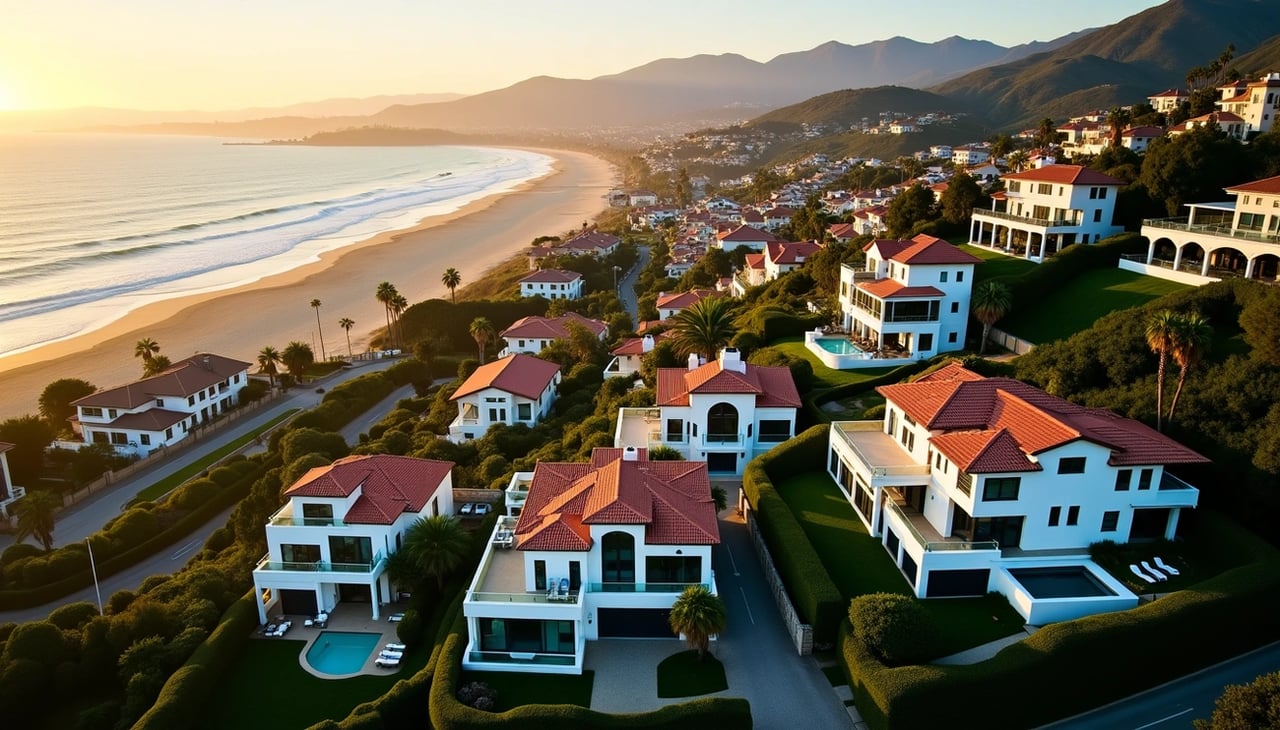
The most affluent neighborhoods in Los Angeles differ from typical real estate markets. Transactions in Pacific Palisades, Malibu, and Hidden Hills unfold through private channels where discretion matters as much as value. These wealthy neighborhoods in Los Angeles command property values ranging from $3.97 million to over $15 million. Timing and strategic access shape luxury real estate in Los Angeles, California. This piece analyzes the most expensive neighborhoods in Los Angeles and compares investment profiles, appreciation trends, and market dynamics. Investors seeking luxury property in Los Angeles will find specific data on entry points, returns, and strategic considerations that matter in 2026.
Understanding Luxury Real Estate Investment in Los Angeles
Luxury real estate in Los Angeles isn't driven by headlines. Private conversations, timing and access shape the market. Meaningful transactions unfold quietly within trusted circles, where discretion carries weight equal to value. Visibility takes a backseat to precision for those who understand affluent neighborhoods in Los Angeles.
Why These Three Affluent Neighborhoods in Los Angeles Stand Apart
Pacific Palisades, Malibu, and Hidden Hills represent three distinct investment profiles within the most expensive neighborhoods in Los Angeles. Pacific Palisades attracts buyers with an average individual income around $132,000 who seek coastal living balanced with accessibility. Entertainment industry families value top-rated schools and Westside convenience, which makes the neighborhood appealing.
Malibu operates at a different tier. Beachfront parcels average $9,828,773, with per-acre costs reaching $16,199,655. Hidden Hills commands $9,350,000 for typical properties, reflecting both exclusivity and substantial acreage. Each market serves buyers with different priorities: coastal community involvement, beachfront privacy, or gated estate living with equestrian amenities.
The luxury property market on the Westside just needs a different approach than conventional searches. The most important transactions happen through relationships and precise timing rather than public listings.
How Private Transactions Shape the Market
Almost 25% of luxury deals now occur without touching the Multiple Listing Service. This creates an exclusive system where homes worth tens of millions trade hands through quiet conversations. Properties listed on MLS sell for 13% more than those sold through private channels. California sellers who skip the MLS lose around $30,000 per property, with combined losses exceeding $1 billion in recent years.
The mansion tax implemented in April 2023 adds another layer. The tax asks for an additional 4% on property sales of $5 million or more and jumps to 5.5% at the time properties cross the $10 million threshold. Sellers of $100 million estates face tax bills of $5.5 million, which pushes many to structure deals through private channels.
Major brokerages maintain substantial off-market inventories. One leading Los Angeles firm currently holds $1.3 billion in unlisted properties. About 20% of buyers in this realm come from global wealth hubs, including the Middle East and China.
Investment Timeline and Market Access
Luxury real estate timing operates differently than conventional markets. Days on Market averaged 31 days for single-family homes through May 2025. Sale-to-list ratios held firm above 98%. High-end properties can sit for extended periods at the time timing misaligns with buyer sentiment, unlike standard homes that sell within 30-90 days.
Cash transactions dominate the current market. Over 96% of surveyed Luxury Property Specialists report seeing steady or rising all-cash purchases. 31% of repeat buyers purchase with all cash, up from 19% pre-pandemic. Over 68% of surveyed specialists say their clients are holding or increasing their real estate investments this year.
Working with specialized advisors becomes crucial in this environment. Access to off-market inventory requires trusted broker networks and invite-only platforms. Properties in Brentwood, Pacific Palisades, Beverly Hills, Bel Air, and Malibu trade through private channels to protect buyer privacy and control transaction timing.
Pacific Palisades: Coastal Investment Profile
Pacific Palisades emerged from catastrophic wildfires in early 2025 with a fundamentally altered investment landscape. The fires destroyed over 11,000 homes and placed $46 billion in housing value at risk, with Pacific Palisades absorbing $5.2 billion in damages. Understanding this market requires us to examine both the disruption and the stabilization patterns that followed.
Property Values and Price Points
Pre-fire median home prices hovered between $3.2 million and $3.8 million depending on street, view, and proximity to the village. The median sale price stands at $3,499,250 as of February 2026. Average sale prices dropped from $3.6 million to $2.4 million, marking a 33% decline. The average sale price reached $3,141,772 in January 2026, influenced by high-end transactions including an $18.8 million sale in the Riviera.
Vacant lots now price between $1.1 million and $2.8 million depending on size, location, and fire clearance status. The most sought-after parcels include ridge lots with ocean views that were prohibitively expensive to develop before the fire. Lot values stabilized at roughly 45-50% below pre-fire values by late spring 2026 after months of steep declines. Multiple offers have re-emerged in some sections, a development unthinkable six months earlier.
The median listing price sits at $3.7 million, while the median price per square foot registers at $1,200. Properties sell at 95.33% of asking price, with homes spending a median of 80 days on market.
Appreciation Trends 2020-2026
Active listing inventory sits roughly 60% below its pre-fire five-year average in Q1 2026. Prices on surviving properties have held firm or increased in many cases. Untouched homes within the burn zone lost 10% of their value. Year-over-year median sale prices decreased by 0.17% through early 2026, though this masks the volatility caused by the fire's timing.
Late 2025 saw 31 single-family home transactions, up from just six after the fire, though still below the 45 sales recorded during the same period in 2024. Vacant lot listings surged to 309 in late 2025, up from just seven listings a year before.
Buyer Demographics and Market Demand
Former residents returning to rebuild or buy back represent one buyer category, armed with insurance proceeds and strong motivation to re-establish roots. Out-of-area buyers drawn by location prestige and lower entry points on lots form a second group. Investors and builders with capital and construction relationships constitute the third category and plan to build and sell finished homes into the premium tier.
The right home makes all the difference for those who love to entertain. I'd be delighted to help you find spaces designed for hosting if you're thinking over a purchase in the near future or beginning your search. Christina Pope  310-404-9931
  [email protected]
Demand for move-in-ready homes remains strong among buyers wanting immediate community access while their rebuilds progress. Investors purchased 40% of vacant lots in fire-affected ZIP codes during the third quarter.
Community Infrastructure and Long-Term Value
Pacific Palisades contains 10,235 housing units, with 71.4% being detached single-family homes. Owner-occupied units make up 79.1% out of 9,160 occupied housing units. The median household income reaches $174,406 a year, while the average annual household income hit $335,854 in 2024.
Infrastructure improvements advance at the Pacific Palisades Recreation Center, with groundbreaking scheduled for January 2026. Temporary library services will be installed near the old gym in August, while tennis courts and baseball fields undergo rehabilitation through September.
Nearly two-thirds of single-family homeowners whose homes were destroyed or experienced major damage intend to rebuild in Pacific Palisades. Only 13% of those planning to rebuild report construction underway.
Malibu: Beachfront Premium Investment Analysis
Malibu's real estate structure splits into two distinct valuation tiers that rarely overlap. The market's overall median sale price reached $3.68 million in February 2026. Micro-market analysis reveals dramatic variations. Douglas Elliman's September 2025 data showed Malibu Beach beachfront properties trading at a $17.81 million median with $4,643 per square foot. Redfin reported Malibu Canyon at just $1.40 million median. A Broad Beach beachfront estate listed at $17.98 million stands in stark contrast to a Latigo Canyon property at $5.25 million. This shows how direct coastal frontage commands premiums that hillside properties cannot match.
Beachfront vs Hillside Property Values
Price per square foot jumped 51% year-over-year, reaching $1,890. Beachfront value stems from direct access and oceanfront positioning. Hillside properties derive worth from views, lot size, and privacy. Paradise Cove typical home values hit $6.46 million, with Point Dume at $5.12 million. Canyon homes offer lower entry points but face different risk profiles. These include wildfire exposure across High or Very High Fire Hazard Severity Zones. Bluff-top properties provide ocean views without sand access, though planning documents treat them within the coastal hazard environment.
Limited Inventory and Market Lack
Oceanfront property inventory remains constrained by geographic reality. Malibu stretches across 21 miles of coastline bordered by the Santa Monica Mountains National Recreation Area. This creates finite beachfront positions that will never expand. New developers face land availability limits that prevent meaningful competition shifts. Demand outpaces supply, with properties often selling above asking price.
The 2025 Palisades fire destroyed around 720 Malibu homes. Vacant lot listings surged to 214 in late 2025, up from 125 a year earlier. Only a small fraction of destroyed homes has been rebuilt. Malibu's first condo project in decades underscores inventory lack, with just 24 for-sale condos available across the entire city. Properties sell quickly in this environment. Thirteen homes sold in February 2024, up 44.4% year-over-year, though days on market extended to 157 from 61 before.
Celebrity Market Influence on Pricing
Celebrity transactions increase Malibu's pricing structure. Beyoncé and Jay-Z's $200 million purchase in 2023 set California's residential record. Leonardo DiCaprio sold his estate for $10.30 million in 2021 before upgrading within the area. These high-profile deals boost market interest and drive pricing higher. Point Dume attracts Hollywood and Silicon Valley buyers, with recent purchases by Marc Andreesen, Sergey Brin, and Laurene Powell Jobs. An $8.15 million transaction in Point Dume reflects the neighborhood's desirability.
Coastal Regulations and Development Restrictions
The entire city sits within the California Coastal Zone. This requires Coastal Development Permits for most projects. CDPs regulate additions, remodels, shoreline structures, and septic replacements. Beachfront work requires geotechnical, hydrology, biological, and wave run-up studies. Fire rebuilds allow replacement structures within 110% of previous height, bulk, and square footage. New septic systems cost hundreds of thousands to install. Permitting timelines extend two years or longer when Commission involvement is required.
Hidden Hills: Gated Community Investment Returns
Hidden Hills operates within a double-gated structure that sets it apart from both Pacific Palisades and Malibu. The incorporated city maintains 24/7 guard-gated access and eliminates public entry while preserving an equestrian countryside atmosphere just 30 miles from downtown Los Angeles. This configuration attracts buyers who prioritize security and privacy over coastal proximity. The market dynamic takes shape from lack of supply and exclusivity rather than oceanfront positioning.
Entry Price Points and Estate Values
The median sale price in Hidden Hills sits at $6.2 million as of March 2026, though this figure masks substantial variation among estate types. Median listing prices reach $11.97 million, while new construction properties command approximately $22 million median list prices. Homes range from $5 million entry points to ultra-luxury estates exceeding $30 million. Price per square foot averages $1,400. Recent exceptional properties price as low as $1,102 per square foot for newer construction.
Coastal markets see inventory fluctuate with seasonal patterns. Hidden Hills maintains thin availability year-round. Currently, 26 homes sit available for sale with inventory declining just 0.16% year-over-year. Properties sell at 100% of asking price on average. Homes move in 15 days during balanced market periods, though this extends to 70-105 days for higher-priced estates. The community contains approximately 648 home sites total with a population around 1,725 residents. These structural supply constraints protect values whatever broader economic conditions may bring.
Hidden Hills showed 52.9% price appreciation over a five-year period and ranked third among California's fastest-growing housing markets. The typical home value reached $5.06 million with one-year gains of 5.4% and five-year appreciation totaling 47.3% through recent measurement periods.
Equestrian Property Premium
Equestrian properties in Hidden Hills average $13.24 million in listing price across eight available properties. The average cost reaches $5.52 million per acre for equestrian-zoned land, with properties averaging 2.4 acres in size. Listings spend an average of 168 days on market. This reflects the specialized buyer pool for horse-equipped estates.
The community maintains 25 miles of bridle trails that wind through neighborhoods, plus three community riding arenas and additional rings. City regulations enforce a one-acre minimum building site requirement and preserve the low-density estate character that supports horse keeping. Buyers prioritize barn capacity and direct trail access when they evaluate properties. Equestrian zoning protects against overdevelopment and density increases. This provides structural value preservation that extends beyond typical real estate fundamentals.
Security and Privacy Value Drivers
The dual governance structure combines city administration with the Hidden Hills Community Association, which manages gates, roads and trails for residents. This eliminates paparazzi intrusion and unauthorized access. Privacy levels remain unmatched in non-gated luxury markets. High-value estates require layered security that includes private patrols, access control and tailored protection strategies beyond community-level measures.
Association Fees and Ownership Costs
The Hidden Hills Community Association charges approximately $0.25 per $1,000 of assessed property value annually. Note that this represents a reduction from previous $0.26 and $0.27 rates. A $10 million property carries annual association fees that approximate $2,500 based on this assessment structure. Separate homeowners associations in some sections charge around $350 annually per lot, with funds allocated to grounds maintenance (28.8%), utilities (15.9%), management (14.4%) and insurance (10.5%).
Investment Comparison: Property Costs and Returns
Comparing investment returns across the most affluent neighborhoods in Los Angeles requires exploring six financial dimensions that directly affect portfolio performance. Q1 2026 data reveals substantial variance in entry costs, ongoing expenses and liquidity across these luxury property markets.
Median Home Prices Across All Three Markets
Pacific Palisades median sale prices sit at $3 million over the trailing 12 months. Current median listings stand at $3.29 million. Malibu commands higher positioning, with median prices reaching $4.83 million in 2025 and luxury properties trading at $6.35 million. Hidden Hills operates at the premium tier with median home values at $2.91 million, though actual sale prices hover around $8 million for mid-tier estates and $9.35 million for typical properties.
Property Tax Rates and Annual Costs
Property tax structures differ across jurisdictions. Pacific Palisades homeowners face a 1.64% effective rate, resulting in about $25,000 annually for owners with older assessments. Malibu properties carry a 1.25% rate and yield $25,000 on a $2 million assessed value. Hidden Hills maintains a 1.14% median effective rate and produces a $33,158 median annual bill.
Appreciation Rates: 5-Year Historical Data
Hidden Hills showed 52.9% appreciation over five years and ranked third among California markets. One-year gains hit 5.4% while five-year totals reached 47.3%. Santa Monica multifamily appreciation grew 1.9% annually over five years, slower than Los Angeles's 2.8%. Malibu price per square foot increased 56.32% since 2019.
Rental Income Potential and Cap Rates
Cap rates for luxury buildings in Santa Monica trade at 3-4%, below the broader Los Angeles multifamily average of 5.6%. A well-laid-out 3-bedroom Pacific Palisades home generates $115,000 annually on short-term platforms at $425 nightly rates.
Liquidity and Days on Market
Pacific Palisades properties average 51 days on market, while luxury homes across Los Angeles average 58 days. Properties over $50 million sit 200 to 800+ days typically.
Cost Per Square Foot Analysis
Pacific Palisades averages $1,287 per square foot. Malibu reaches $2,346 per square foot. Hidden Hills prices average $1,400 per square foot.
Strategic Investment Considerations for 2026
Strategic allocation in the most affluent neighborhoods in Los Angeles requires understanding market cycles, portfolio positioning, and institutional-grade exit planning. The luxury segment operates independently from conventional housing pressures. It has distinct timing patterns and wealth preservation strategies that separate sophisticated investors from speculative buyers.
Market Entry Timing and Economic Indicators
The luxury segment entered stabilization in 2026, with entry-level luxury holding near $1.20 million nationally. Ultra Luxury properties climbed for five months, rising from $5.40 million to $5.60 million. First mover advantage matters when opportunities arise, especially in development projects that adjust pricing. Cash transactions dominate this realm. In markets like Miami, 84.7% of homes priced between $5 million and $10 million were purchased without financing. Real estate now represents 17.1% of total assets among the top 10% of households, down from 20.2% in 2022. This provides flexibility in capital allocation.
Portfolio Diversification Benefits
Luxury real estate in Los Angeles offers low correlation with equities and provides balance within broader portfolios. Geographic diversification reduces reliance on single-market economic health, though currency exposure requires review. Properties in hubs like Pacific Palisades hold enduring appeal due to limited supply and consistent demand. Concentration risk becomes material when portfolios hold multiple properties in one submarket.
Exit Strategy and Resale Considerations
1031 exchanges allow investors to defer capital gains taxes when reinvesting in like-kind properties. Delaware Statutory Trusts provide fractional ownership in institutional assets with professional management and remove operational responsibilities. Seller financing creates income streams for patient sellers. Properties with renovation potential add modern amenities and resale value.
Working with Specialized Luxury Real Estate Advisors
Specialized agents understand which streets, neighborhoods, and property types in Pacific Palisades offer strongest long-term upside. Access to off-market inventory requires trusted networks. For those who love to entertain, the right home makes all the difference. If you're thinking about a purchase in the near future or beginning your search, I'd be delighted to help you find spaces designed for elevated living and effortless hosting. Christina Pope 310-404-9931 [email protected]
Comparison Table
Investment Comparison: Pacific Palisades vs Malibu vs Hidden Hills
Luxury real estate in Los Angeles isn't shaped by headlines—private conversations, timing and access drive it. The most meaningful transactions unfold in quiet circles within trusted networks, where discretion carries as much weight as value. Those who understand this world know that visibility is secondary to precision and timing is everything.
Detailed Market Comparison Table
| Investment Metric | Pacific Palisades | Malibu | Hidden Hills |
|---|---|---|---|
| Median Sale Price (2026) | $3,499,250 | $3.68 million (overall) $17.81 million (beachfront) |
$6.2 million |
| Median Listing Price | $3.7 million | $4.83 million | $11.97 million |
| Price Per Square Foot | $1,200 - $1,287 | $2,346 $4,643 (beachfront) |
$1,400 |
| Property Tax Rate | 1.64% | 1.25% | 1.14% |
| Annual Property Tax (Typical) | ~$25,000 | ~$25,000 (on $2M assessed) | $33,158 (median) |
| Days on Market | 51-80 days | 157 days (luxury tier) | 15-105 days (varies by price) |
| Sale-to-List Price Ratio | 95.33% | Not mentioned | 100% |
| 5-Year Appreciation | Not mentioned | 56.32% (price per sq ft since 2019) | 52.9% (3rd fastest in CA) |
| 1-Year Appreciation | -0.17% (fire-impacted) | 51% (price per sq ft) | 5.4% |
| Typical Property Range | $3.2M - $3.8M (pre-fire) $1.1M - $2.8M (vacant lots) |
$1.4M (canyon) - $17.98M (beachfront) | $5M - $30M+ |
| Average Individual Income | $132,000 | Not mentioned | Not mentioned |
| Median Household Income | $174,406 | Not mentioned | Not mentioned |
| Total Housing Units | 10,235 | Not mentioned | ~648 home sites |
| Owner-Occupancy Rate | 79.1% | Not mentioned | Not mentioned |
| Cash Transaction Prevalence | 96%+ (luxury market-wide) | 96%+ (luxury market-wide) | 96%+ (luxury market-wide) |
| Main Market Driver | Coastal living + top schools + Westside access | Beachfront lack + celebrity influence | Privacy + security + equestrian lifestyle |
| Key Buyer Demographics | Entertainment industry families | Hollywood & Silicon Valley elite | Privacy-focused high-net-worth individuals |
| Geographic Constraints | Fire risk zones | 21 miles coastline (finite) | 1-acre minimum lots |
| Regulatory Challenges | Fire rebuilding permits | Coastal Development Permits (2+ years) | Dual governance (city + HOA) |
| Association Fees | Not mentioned | Not mentioned | $2,500 annually (on $10M property) |
| Rental Income Potential | $115,000/year (3BR short-term) | Not mentioned | Not mentioned |
| Investment Profile | Coastal community + accessibility | Beachfront premium + lack | Gated exclusivity + equestrian |
Specialized Property Categories
| Category | Pacific Palisades | Malibu | Hidden Hills |
|---|---|---|---|
| Equestrian Properties | Not applicable | Not applicable | $13.24M avg listing $5.52M per acre 168 days on market |
| Beachfront Premium | Not applicable | $9,828,773 average $16,199,655 per acre |
Not applicable |
| New Construction | Not mentioned | Not mentioned | $22M median list price |
| Vacant Lots (Post-Fire) | 309 listings (late 2025) $1.1M - $2.8M |
214 listings (late 2025) | Not applicable |
Discreet access to off-market opportunities in Los Angeles' most affluent neighborhoods requires strategic timing as much as capital.
Christina Pope | Sotheby's International Realty 310-404-9931 | [email protected]
EliteResidenceInternational.com
Conclusion
Pacific Palisades, Malibu, and Hidden Hills serve different investment profiles. No single market suits every buyer. Pacific Palisades offers coastal accessibility with strong schools at $3.5 million median entry. Malibu commands beachfront premiums reaching $17.81 million where lack drives value. Hidden Hills delivers gated privacy with equestrian estates at $6.2 million median.
Timing and access matter more than public listings in these markets. Cash transactions dominate. Appreciation varies by micro-location. Specialized guidance is required for strategic positioning. Buyers prioritizing community participation lean toward Palisades. Those seeking absolute beachfront exclusivity choose Malibu. Privacy-focused investors gravitate toward Hidden Hills.
Christina Pope | Sotheby's International Realty 310-404-9931 | [email protected]
EliteResidenceInternational.com
Key Takeaways
Understanding these three luxury markets helps investors make informed decisions about Los Angeles' most exclusive neighborhoods, each offering distinct advantages and investment profiles.
• Pacific Palisades offers coastal accessibility at $3.5M median, combining top-rated schools with Westside convenience for entertainment industry families seeking community engagement.
• Malibu commands beachfront premiums up to $17.8M median, where geographic scarcity and celebrity influence drive values in a finite 21-mile coastal market.
• Hidden Hills delivers gated privacy at $6.2M median, featuring equestrian estates with 52.9% five-year appreciation and dual-gated security for ultimate discretion.
• Cash transactions dominate 96% of luxury deals, with 25% occurring off-market through private channels requiring specialized broker networks and timing.
• Strategic timing matters more than public listings, as meaningful transactions unfold through trusted relationships where discretion carries equal weight to value.
The luxury real estate market in Los Angeles operates on relationship-driven access rather than conventional search methods. Each neighborhood serves different priorities: Palisades for coastal community living, Malibu for beachfront exclusivity, and Hidden Hills for private estate living. Success requires understanding that visibility takes a backseat to precision in these affluent markets.
FAQs
Q1. Which Los Angeles neighborhood has higher property values: Malibu or Beverly Hills? Malibu's Colony Beach neighborhood leads with a median sales price of $10.65 million, slightly surpassing Beverly Hills Gateway at $10.05 million. However, Malibu's beachfront properties can reach significantly higher values, with some beachfront estates averaging $17.81 million, while pricing varies considerably between coastal and hillside locations within both markets.
Q2. What makes the Riviera area the most desirable section of Pacific Palisades? The Riviera neighborhood, encompassing both Upper and Lower sections, features some of Pacific Palisades' most sought-after luxury homes due to its proximity to the prestigious Riviera Country Club, panoramic ocean views, and classic architectural styles. This area commands premium pricing within the broader Pacific Palisades market.
Q3. How do home prices in Pacific Palisades compare to Brentwood? Pacific Palisades typically commands higher prices for single-family homes, particularly properties with ocean or hillside views and larger estate lots. Brentwood offers a broader price spectrum with more attached housing options, providing greater variety at entry-level and mid-tier price points for buyers seeking Westside locations.
Q4. Where do Los Angeles billionaires typically choose to live? Los Angeles billionaires concentrate in exclusive enclaves including Beverly Hills, Bel Air, and Malibu's "Billionaire's Beach." These neighborhoods provide exceptional privacy, luxury amenities, and often spectacular views, attracting technology executives, entertainment industry leaders, and other ultra-high-net-worth individuals.
Q5. Why do luxury properties in these neighborhoods often sell through private channels? Approximately 25% of luxury transactions occur off-market to protect buyer privacy, control transaction timing, and avoid the mansion tax implications on properties exceeding $5 million. Cash purchases dominate 96% of luxury deals, with many high-value estates trading through trusted broker networks rather than public listings.