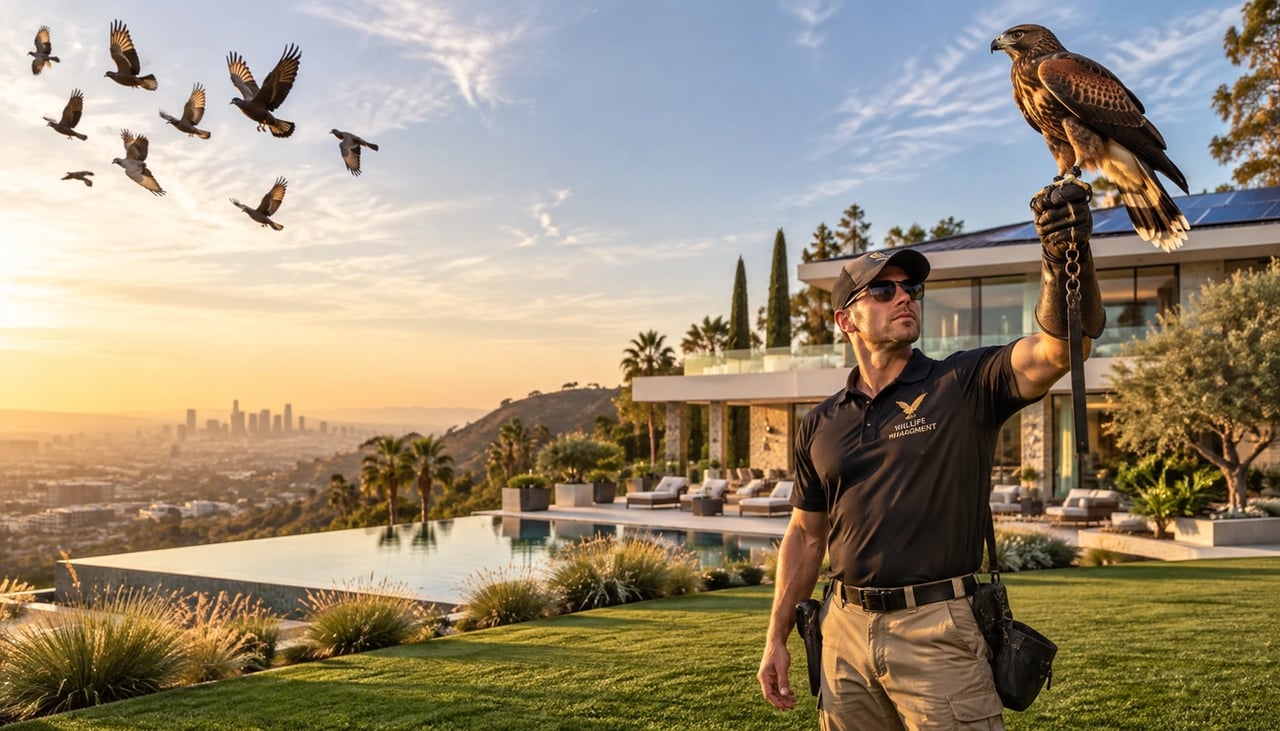
Luxury estate owners across Los Angeles have a sophisticated, eco-friendly answer to persistent bird problems—one that relies on neither harsh chemicals nor disruptive deterrents. Falconry-based bird abatement works by deploying trained raptors that introduce genuine, unpredictable predator pressure, something static scare tactics simply cannot replicate. Nuisance birds may ignore a plastic owl within days, but they never dismiss a live hawk. The approach is non-lethal, operating as a behavioral conditioning protocol that produces lasting results. Quiet, organic, and sustainable, it appeals to estate owners who hold both their properties and their environmental standards in equal regard. Most property owners notice significant shifts in bird behavior within the first 2 to 3 weeks of consistent raptor deployment. For high-end properties across Los Angeles, this method offers what conventional options rarely do—real effectiveness without compromise.
Bird Abatement Services for Luxury Properties
"Our trained birds need not make contact with pest species. The visual presence of a raptor combined with occasional pursuit flights creates sufficient psychological pressure to drive pest birds away—a humane approach that aligns with UK wildlife protection laws whilst delivering exceptional results." — Dealey Environmental, Pest management company
Effective bird abatement for luxury estates demands more than deterrence. The methods chosen must respect environmental standards, avoid disrupting estate activities, and genuinely protect the architectural and outdoor investments that define high-end properties.
What Makes Falconry Different From Conventional Methods
Standard bird control products have a fundamental weakness—pest birds figure them out. Mylar tape, scarecrows, propane cannons, and recorded distress calls may scatter nuisance species at first, but these birds soon recognize the absence of genuine threat. Plastic owl decoys lose credibility the moment pigeons notice they never move. Noise makers fade into background sound. Chemical deterrents demand repeated applications and raise real environmental questions.
Falconry eliminates that problem at its root. Trained hawks and falcons create predator pressure that nuisance birds never dismiss as harmless. A raptor patrolling property perimeters carries unpredictability no fixed installation can offer—birds of prey move dynamically, and each appearance reinforces the threat rather than eroding it.
The Biological Advantage of Live Predators
What makes falconry exceptionally effective is also what makes it simple: survival instinct. A pest bird spotting an actual predator in flight triggers an immediate, powerful fear response that sends it elsewhere. This operates at an evolutionary level—a horned lark that sees its natural predator swooping nearby does not weigh its options; it seeks safer foraging grounds immediately.
The result is sustained deterrence rather than temporary disruption. Pest birds don't simply scatter and return; they learn to associate the property with danger and seek alternative nesting and roosting sites entirely. No amount of repeated exposure changes this. Birds never grow comfortable with live predators the way they adapt to scarecrows or noise devices—a pigeon's instinctive fear of a hunting falcon remains constant regardless of how many encounters occur.
Legal Compliance and Eco-Friendly Credentials
Falconry bird control operates under Federal Bird Abatement Licenses and applicable state wildlife permits, ensuring full compliance with the Migratory Bird Treaty Act, which protects over 1,000 bird species from unregulated harm. Estate owners can be confident the approach meets every applicable regulatory standard.
The environmental profile is equally clean. Falconry introduces zero chemicals, toxins, or pollutants onto a property. There is no noise disruption, no physical harm to pest species, and no risk to non-target wildlife. For estate owners who hold their environmental values as seriously as their property values, this matters considerably—and it reflects a commitment to ethical, responsible pest management that conventional methods rarely can claim.
Common Bird Problems Facing LA Estates
Luxury estates across Los Angeles contend with avian challenges that go well beyond surface-level aesthetics. Pigeons and seagulls establish colonies on architectural elements, and what follows—corrosive damage, health exposure, and operational disruption—demands serious attention.
Property Damage from Pigeons and Seagulls
Pigeon droppings carry uric acid that actively corrodes building materials, producing pitting and discoloration across paint, metal, signage, and roofing substrates. Protective coatings deteriorate faster under this acidic exposure, and tar-based roofing materials can perforate entirely, leaving structures open to leaks. Nesting debris packed into gutters and downspouts creates blockages that back up water and compromise structural integrity. On flat-roof estates, clogged drainage during heavy rainfall generates pooling severe enough to strain load-bearing elements.
Health Hazards and Disease Transmission
The health risks associated with accumulated droppings are well documented. Histoplasmosis develops from fungus that thrives in waste buildup, particularly where droppings have collected over two or more years. Cryptococcosis originates from yeast found in pigeon intestinal tracts—the fungus has been identified in as many as 84 percent of samples taken from established roosts. Salmonella and E. coli contaminate surfaces when dried droppings become airborne, spreading through direct contact, inhalation, or contact with outdoor food preparation areas.
Impact on Outdoor Entertainment Spaces
Pool terraces and al fresco dining areas take the most visible hit. Droppings accumulate on furniture, flooring, and table surfaces, creating slip hazards and compromising the appeal of spaces designed for gracious entertaining. Seagulls add another layer of disruption entirely, swooping in to steal food from guests mid-gathering. For those who love to entertain, the right home makes all the difference. If you are considering a purchase in the near future or beginning your search, I'd be delighted to help you discover spaces designed for elevated living and effortless hosting. Christina Pope 📞 310-404-9931 ✉️ [email protected]
Damage to Solar Installations and Roofing Systems
Rooftop solar panels present an attractive nesting site—pigeons treat the sheltered gap beneath arrays as permanent habitat. Guano accumulation on panel surfaces alone can reduce energy output by 10 to 20 percent in heavier infestations. Birds chewing through electrical cabling introduce fire hazards and system faults, while nesting debris restricts airflow beneath arrays, raising operating temperatures and compounding efficiency losses over time.
The Falconry Bird Control Process for High-End Homes
"Falconry creates moving, unpredictable pressure, not just a static deterrent they can work around." — Urban Wildlife Trapping Experts, Wildlife and bird-control company

Image Source: Raptor Resource Project: Bald Eagle and Bird of Prey Cams
Professional falconry bird abatement is not a one-size program. Each engagement begins with thorough property assessment and moves through a carefully tailored raptor deployment plan suited to the estate's specific conditions and demands.
Site Evaluation and Species Identification
Falconry providers conduct on-site assessments to identify pest species, observe behavioral patterns, and determine the extent of the infestation. Technicians examine roosting zones, nesting sites, feeding areas, and flight paths across roofs, beams, and outdoor structures. This evaluation determines the coverage level required for each specific location.
Raptor Selection and Flight Planning
Species selection matters. Harris's Hawks perform exceptionally well in confined urban environments, where their agility allows them to patrol tight spaces with precision. Peregrine Falcons are the preferred choice for large open areas, capable of reaching speeds exceeding 240 mph. Programs typically involve 2 to 5 visits per week, structured around the site's specific layout and the nuisance species present. Raptors are flown over affected zones at strategically determined times to maintain consistent predator pressure.
Coordinated Scheduling Around Estate Activities
Flight schedules are coordinated directly with property management teams, ensuring no disruption to events, daily routines, or the privacy that estate owners reasonably expect. For those considering properties where sophisticated management protocols are simply part of the ownership experience, Christina Pope would be pleased to discuss options that suit your lifestyle. Christina Pope 📞 310-404-9931.
Results Timeline and Behavioral Shifts
Active dispersal is typically visible during raptor flights in the first one to two weeks. By weeks three to six, dramatic reductions in pest bird populations become apparent. With sustained programs, clients can expect zero birds remaining within three to five years of initiation.
Complete Bird Abatement Solutions
Raptor deployment addresses behavior, but a complete program goes further. Physical barriers reinforce what the birds have already learned to fear, while thorough sanitation removes the attractants that draw pest populations back once activity subsides.
Physical Deterrents and Exclusion Hardware
Bird spikes made from stainless steel or plastic deny landing access on ledges, gutters, window sills, and roofing edges. Bird netting seals off rafters, HVAC units, and architectural pockets that would otherwise invite nesting. Wire systems establish tensioned cables that make surfaces too unstable for birds to settle on. Solar panel protection kits address the sheltered gap beneath rooftop arrays that pigeons favor as permanent habitat. Each of these elements works in concert with falconry bird control—securing the access points raptors have already conditioned birds to avoid.
Cleanup and Sanitation Protocols
Professional remediation begins with wetting accumulated droppings using disinfectant solutions, typically one part bleach to ten parts water. Workers addressing large accumulations wear NIOSH-approved respirators with HEPA filters, non-latex rubber gloves, eye protection, and disposable coveralls. Contaminated materials are double-bagged for proper disposal, and hospital-grade disinfectants eliminate residual bacteria and fungi once physical removal is complete.
Ongoing Maintenance and Monitoring
Physical barriers require attention over time. Weather and wear can compromise installations, and regular inspections catch those gaps before pest populations take advantage of them. Monitoring bird activity at treated sites keeps coverage current, and periodic site reviews ensure long-term protection holds.
Working with Estate Managers and HOAs
Bird control programs at this level require coordination—property management teams, board approvals, and compliance documentation all factor into the process. For estate owners, that coordination unfolds best through someone who understands how luxury properties in Los Angeles operate. Christina Pope—Sotheby's International Realty, EliteResidenceInternational.com—welcomes those conversations.
Conclusion
Falconry bird abatement gives luxury estates something most solutions cannot—real results without the noise, chemicals, or unsightly apparatus that compromise the character of a fine property. Pest birds never dismiss a live raptor, and that biological truth is precisely what makes this approach so enduring. Results appear within weeks, yet the entire process unfolds quietly, which is exactly how significant decisions tend to be made in Los Angeles. Estate owners who value both effectiveness and discretion will find this method speaks directly to both.
Christina Pope—Sotheby's International Realty, EliteResidenceInternational.com
Key Takeaways
Falconry-based bird abatement offers luxury estate owners a sophisticated, eco-friendly solution that outperforms traditional deterrents through live predator pressure that pest birds never adapt to.
• Live raptors create lasting behavioral change – Unlike static deterrents that birds ignore within weeks, trained hawks and falcons trigger hardwired survival instincts, causing pest birds to permanently relocate rather than simply scatter temporarily.
• Results appear within 2-3 weeks with zero environmental impact – Property owners observe significant bird population reductions in the first month, with complete elimination possible within 3-5 years, all without chemicals, noise, or harm to wildlife.
• Bird infestations cause serious property damage and health risks – Pigeon droppings contain uric acid that corrodes building materials, while accumulated waste harbors pathogens like histoplasmosis, cryptococcosis, and salmonella that threaten human health.
• Comprehensive solutions combine falconry with physical barriers – Effective bird abatement integrates raptor deployment with exclusion hardware like bird spikes and netting, plus professional cleanup protocols to eliminate attractants and prevent re-infestation.
• Legal compliance and discretion matter for luxury properties – Falconry operations require Federal Bird Abatement Licenses and coordinate with estate managers to ensure services align with privacy needs, event schedules, and environmental standards.
This approach represents the intersection of biological effectiveness and luxury property management—delivering results that protect both architectural investments and the refined lifestyle high-end estates demand.
FAQs
Q1. How does falconry-based bird control differ from traditional methods like scarecrows or noise devices? Unlike static deterrents that pest birds quickly learn to ignore, falconry uses trained raptors that create genuine predator pressure. Birds never adapt to the presence of live hawks or falcons because their survival instincts trigger an immediate fear response, causing them to permanently relocate rather than simply scatter temporarily.
Q2. How long does it take to see results from falconry bird abatement services? Property owners typically observe significant changes in bird behavior within the first 2 to 3 weeks of consistent raptor deployment. Dramatic population reductions usually occur by weeks 3-6, with some programs achieving complete elimination of pest birds within 3-5 years.
Q3. Is falconry bird control safe and legal for use on residential properties? Yes, falconry bird control operates under Federal Bird Abatement Licenses and complies with the Migratory Bird Treaty Act. The method is completely non-lethal, uses no chemicals or toxins, produces no noise pollution, and poses no hazard to non-target wildlife or pets.
Q4. What health risks do bird droppings pose to luxury estate residents? Bird droppings harbor serious pathogens including histoplasmosis fungus, cryptococcosis yeast, salmonella, and E. coli bacteria. These contaminants spread through direct contact, inhalation of dried droppings as airborne dust, or contamination of outdoor living spaces and food preparation areas.
Q5. Can bird infestations damage solar panels and roofing systems? Yes, pigeons nest beneath solar panels and their droppings can reduce energy output by 10-20 percent. Birds also chew through electrical cabling creating fire hazards, while nesting debris restricts airflow and elevates operating temperatures, compounding efficiency losses over time.