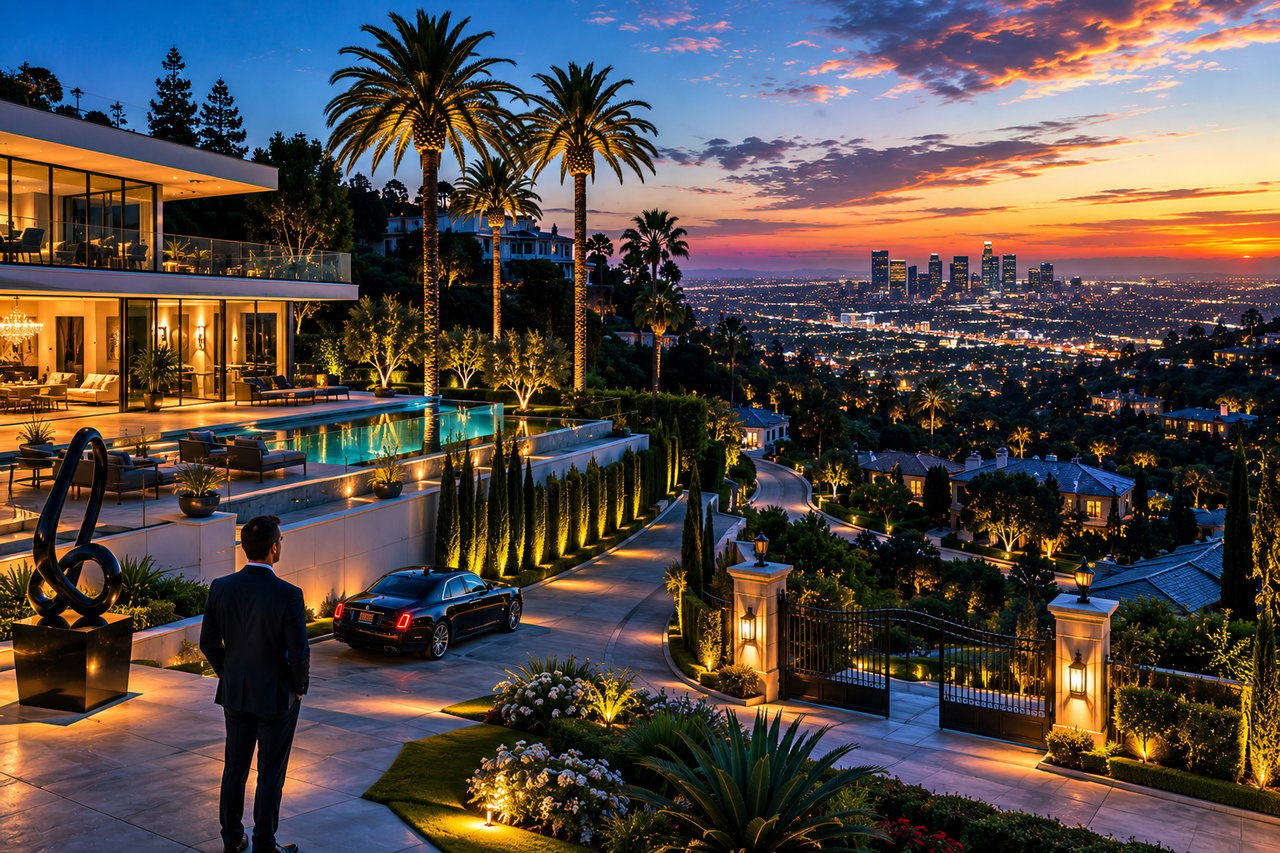
Business leaders seeking luxury homes in Los Angeles discover that the wealthiest neighborhoods follow their own rules. Executives choose Bel Air and other elite enclaves for reasons that extend beyond amenities - they understand the importance of legacy acquisition, privacy infrastructure, and off-market transactions that shape the most exclusive segments of Los Angeles real estate. This guide examines why corporate leaders select these neighborhoods, how private sales work in the city's most expensive areas, and what sets luxury real estate Los Angeles California apart from other elite markets worldwide.
The business case for luxury real estate Los Angeles California
High-net-worth individuals view property acquisition differently than traditional homebuyers. Their decisions focus on legacy acquisition rather than immediate returns, where provenance and privacy matter more than short-term financial considerations. Corporate executives choose hillside estates in wealthy neighborhoods over urban penthouses for this very reason.
Why corporate executives choose hillside estates over urban penthouses
Hillside properties provide natural topography that creates privacy barriers urban penthouses cannot match, despite commanding a 5% to 10% premium over other luxury apartments. Estate design allows business entertaining on a scale vertical living cannot accommodate. Security infrastructure blends seamlessly into hillside architecture, while controlled access systems benefit from terrain advantages that multi-unit buildings cannot achieve.
Market dynamics in the richest neighborhoods in Los Angeles
Individuals worth more than $30 million globally increased from approximately 551,000 in 2021 to over 713,000 in 2026. This growth fuels demand in the richest neighborhoods in Los Angeles, where homes priced at or above $2 million experienced an 8.4% increase in sales. Los Angeles' mansion tax created significant market disruption. The 4% tax on properties over $5 million and 5.5% on properties exceeding $10 million led to a 70% drop in sales above $5 million since 2023.
How Bel Air became the executive headquarters of West Coast wealth
Bel Air Investment Advisors managed approximately $3.10 billion for 225 individuals and families as of December 31, 2000, serving high-net-worth entrepreneurs and executives principally in Southern California. This concentration of wealth management services established Bel Air as the executive headquarters of West Coast wealth, drawing those who value proximity to specialized financial advisory capabilities.
Investment performance compared to other wealthy neighborhoods in Los Angeles
Properties purchased in Bel Air during the 1990s and early 2000s appreciated between 150% to over 300% in value. This performance exceeded many comparable affluent neighborhoods, positioning Bel Air as a proven wealth-building vehicle for those seeking luxury homes with established long-term performance records.
Geographic and architectural advantages for high-level professionals
Physical geography shapes professional life in ways that blueprints cannot capture. Bel Air's hills, ridges, and canyons serve as natural screening mechanisms that shield properties from view. Large, irregular lots paired with mature landscaping eliminate sightlines from streets and neighboring estates. Properties positioned far back from roads feature long, winding driveways that create substantial buffers between public access and private domains.
Natural topography that creates built-in privacy barriers
The area's canyon terrain and hillside roads deliver dramatic settings with stronger separation from urban density below. Streets follow natural contours rather than rigid grid patterns, creating the winding, concealed character that defines the neighborhood. Vertical living arrangements cannot replicate this topographic advantage, where proximity and shared access points compromise the discretion that executives require.
Estate design that accommodates business entertaining
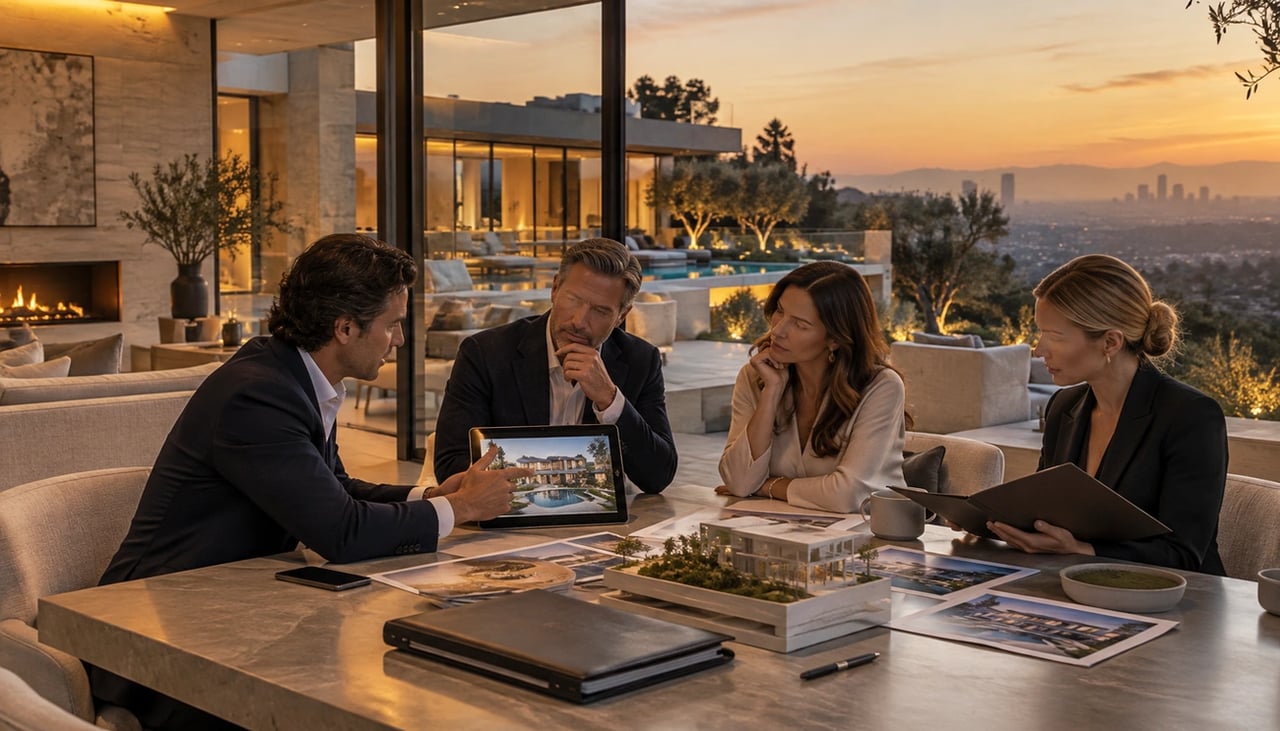
Properties harness Los Angeles' natural topography to create dramatic living spaces that appear suspended above the urban landscape. Floor-to-ceiling windows frame panoramic vistas while outdoor entertainment areas take advantage of mild climate conditions. Modern hillside estates offer expansive indoor-outdoor flow with multiple terraces, including infinity-edge pool decks that extend visual space. Main living areas open seamlessly to exterior zones designed for executive dinners, brand activations, and reception functions without heavy staging requirements.
Security infrastructure and controlled access systems
Gated communities deliver 24-hour security and controlled access that high-profile residents require. Properties feature biometric entry systems at every access point, enterprise-level firewalls, and security cameras with long-term video storage. Advanced implementations include safe rooms, blast-resistant construction, man radars for perimeter detection, and laser curtains protecting valuable collections.
Proximity to LAX and major business corridors
Hotel Bel-Air sits just 20-30 minutes from Los Angeles International Airport. The front gates remain minutes from Beverly Hills and Century City business hubs, placing executives within efficient reach of commercial centers while maintaining residential separation from operational demands.
The off-market acquisition process for business leaders
Transactions in Los Angeles' most expensive neighborhoods happen through private conversations rather than public exposure. Close to 25% of luxury deals now complete without ever appearing on the Multiple Listing Service. The Pocket Listing Service reached nearly 2 billion listings shared exclusively among 2,750 member agents, creating a parallel market invisible to conventional buyers.
How most luxury transactions happen before public listings
Pocket listings remain off the public MLS and circulate privately through broker networks. Office-exclusive arrangements share properties within a brokerage or among select partner brokers. Invitation-only showings limit access to pre-qualified buyers, while NDA-conditioned previews release details only after confidentiality agreements and proof of funds. Sellers choose this route to avoid media attention, minimize household disruptions through fewer showings, and connect directly with qualified buyers to accelerate timelines.
Financial qualification and proof-of-funds requirements
Listing agents demand proof of funds or lender pre-approval before any showings. Buyers must provide recent proof of funds, typically dated within 30-60 days. The documentation must include the buyer's full legal name matching the purchase contract, institutional letterhead with verifiable contact information, stated available amount, issue date, and authorized officer signature. Cash purchases represent roughly 30% of U.S. residential transactions, with higher percentages in luxury segments.
Broker relationships that provide early access
Private broker networks serve as the primary pathway to off-market opportunities. Top agents maintain invitation-only lists and concierge outreach for qualified buyers. Direct relationships with Bel Air listing brokers prove essential, along with referrals from attorneys, wealth managers, and family offices who learn about quiet sales before public announcements.
Timeline expectations for confidential purchases
Financed purchases typically require 30 to 45 days from contract to close. Luxury transactions often include extended inspection periods beyond the standard 10-day window to accommodate thorough evaluations. Jumbo financing demands detailed underwriting, requiring extensive documentation of income, assets, and liquidity reserves.
Lifestyle infrastructure that serves executive needs
Executive residences in Los Angeles' affluent neighborhoods function as complete lifestyle ecosystems, not simply residential addresses. These properties compete with five-star hospitality standards, offering amenities that eliminate the need for external facilities.
Self-contained amenities that replace public facilities
Today's estates feature resort-style wellness centers with spa facilities, treatment suites, and recovery spaces designed for professional athletes. Entertainment infrastructure includes private cinemas, bowling alleys, game lounges, and performance venues. One $400 million Bel Air compound reportedly contains indoor and outdoor pools, private cinema, entertainment lounges, fitness spaces, and extensive service infrastructure for full-time estate living. Properties incorporate indoor lap pools, hot and cold plunges, saunas, steam rooms, wine cellars, and fully equipped gyms.
Elite country clubs and professional networking venues
Bel Air Country Club served as part of the original amenity package used to attract buyers. The Los Angeles Country Club on Wilshire Boulevard and Riviera Country Club on Capri Drive reinforce the Westside pattern of private leisure woven into executive routines.
Commute times to downtown LA and Century City
Route 534 connects Downtown LA and Century City in approximately 26 minutes. Century City to Bel Air requires roughly 20 minutes by bus. Hotel Bel-Air sits 20-30 minutes from LAX.
Premium services and concierge-level property management
Crown Luxury Management delivers full-service property management dedicated to high-end properties in Beverly Hills, Bel Air, and West LA. Services include inspections, cleaning, vehicle maintenance, gardening, repairs, and concierge coordination.
For clients who value entertaining and elevated living, the right home makes all the difference. Those considering a purchase or beginning their search can rely on my expertise to discover spaces designed for both exceptional living and effortless hosting.
Christina Pope  310-404-9931
  [email protected]
Conclusion
Bel Air continues to attract business leaders who value strategic positioning over public exposure. The most sought-after properties move through private networks well before public announcements. Success in acquiring premier estates requires advisors who master discretion, timing, and exclusive market access.
For executives exploring Bel Air and other elite Los Angeles neighborhoods, the right partnership delivers results.
Christina Pope 310-404-9931 [email protected]
Sotheby's International Realty | EliteResidenceInternational.com
Key Takeaways
Business leaders choose Bel Air and other affluent Los Angeles neighborhoods for strategic advantages that extend far beyond luxury amenities, focusing on privacy, investment performance, and executive lifestyle infrastructure.
• Off-market dominance: 25% of luxury deals complete privately without MLS listings, requiring broker relationships and proof-of-funds for exclusive access to $5M+ properties.
• Natural privacy barriers: Bel Air's hillside topography creates built-in screening that urban penthouses cannot match, offering executives discretion and security infrastructure.
• Investment performance: Bel Air properties gained 150-300% value since the 1990s, with home values rising 79% over eight years despite recent mansion tax impacts.
• Self-contained lifestyle: Modern estates feature resort-level amenities including private cinemas, wellness centers, and entertainment venues that eliminate dependence on public facilities.
• Strategic positioning: Properties offer 20-30 minute access to LAX and major business corridors while maintaining residential separation from commercial intensity.
The most successful acquisitions happen through private networks and specialized advisors who understand that discretion and timing determine access to premier estates in Los Angeles' wealthiest enclaves.
FAQs
Q1. What makes Bel Air different from other luxury neighborhoods in Los Angeles? Bel Air offers natural topography that creates built-in privacy barriers through hillside terrain and winding roads. The area features estate designs that accommodate large-scale business entertaining, advanced security infrastructure, and proximity to LAX (20-30 minutes) and major business corridors like Century City. Properties have demonstrated strong investment performance, with values rising 79% over eight years and some estates gaining 150-300% since the 1990s.
Q2. How do most luxury real estate transactions happen in Beverly Hills and Bel Air? Approximately 25% of luxury deals complete privately without appearing on public listings. Most high-end transactions occur through off-market channels including pocket listings, office-exclusive arrangements, and invitation-only showings. Buyers need proof of funds or pre-approval before viewings, and access typically comes through private broker networks, direct relationships with listing agents, or referrals from wealth managers and family offices.
Q3. Who typically lives in Beverly Hills and Bel Air? Residents include corporate executives, business owners, entertainment industry professionals (both on-screen talent and behind-the-scenes executives), medical professionals, attorneys, real estate developers, and tech entrepreneurs. There's also a significant Persian-Jewish community, many of whom arrived during the Iranian revolution in the late 1970s. A substantial portion of residents benefit from generational wealth or purchased properties decades ago when prices were considerably lower.
Q4. What amenities do modern estates in these areas typically include? High-end properties feature self-contained amenities such as resort-style wellness centers, private cinemas, entertainment lounges, fitness facilities, indoor and outdoor pools, wine cellars, and spa facilities. Many estates are designed to eliminate dependence on public facilities. Properties also benefit from proximity to elite country clubs like Bel Air Country Club and access to premium concierge-level property management services.
Q5. What are the financial requirements for purchasing luxury property in these neighborhoods? Home prices in affluent Los Angeles neighborhoods range from $5 million to over $100 million. Buyers must provide recent proof of funds (typically dated within 30-60 days) showing available capital, with documentation including full legal name, institutional letterhead, and authorized signatures. Cash purchases account for roughly 30% of transactions in luxury segments. Financed purchases typically require 30-45 days to close, with jumbo financing involving detailed underwriting of income, assets, and liquidity reserves.