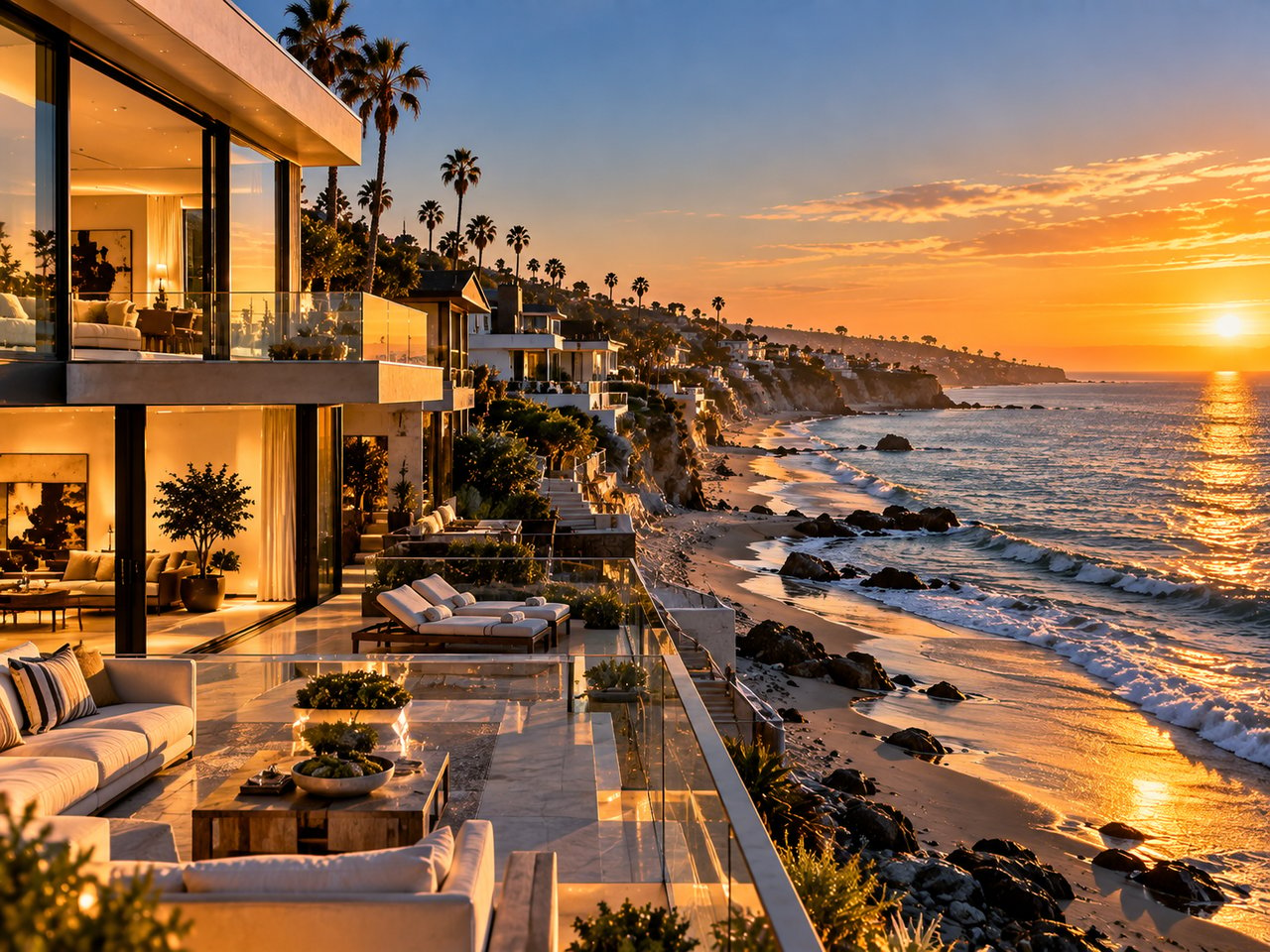
Carbon Beach — formally, though rarely, called by that name — holds a position few coastal markets can claim. Seventy oceanfront lots, a south-facing orientation, and thirty years of record-setting sales have made it California's most expensive piece of sand. The numbers alone tell part of the story: Marc Andreessen's $165 million purchase in 2022 reset what buyers and sellers believed was possible, while Peter Morton's $110 million sale set the county's residential record before that. Yet pricing on Carbon Beach has never been purely about square footage or finishes.
Major owners like Larry Ellison and David Geffen have quietly consolidated multiple parcels over the years, pulling inventory off the market one transaction at a time. Each acquisition tightens supply further. The result is a stretch of coastline where scarcity, geography, and ownership concentration combine to create valuation dynamics that no other California beach can match.
The Geographic Advantage That Built Billionaire's Beach
Point Dume Blocks Winter Swells and Protects the Sand
Point Dume sits at the northern terminus of Santa Monica Bay, jutting south into the Pacific as a coastal flatland bluff. That promontory acts as a natural barrier against the dominant winter swell patterns that have steadily stripped sand from neighboring coastlines. Southern California's winter swells travel from the northwest, born from Gulf of Alaska storms. Point Dume intercepts most of that wave energy well before it reaches Carbon Beach — keeping sand firmly in place while beaches two miles west lose ten feet of dry sand per decade.
Carbon Beach faces almost due south. Broad Beach and most of western Malibu face southwest or west. That distinction matters. Summer south swells reaching Carbon Beach arrive smaller and more diffuse, depositing sand rather than pulling it away. The headland-shelter effect is precisely why Carbon Beach maintains more consistent sand levels than Broad Beach, La Costa, or stretches of Malibu Road.
The South-Facing Crescent Shape Compounds the Effect
Carbon Beach runs in a crescent from Carbon Canyon Road on the east to just east of the Malibu Pier. That curved geometry carries its own sand-retention advantage. Wave energy naturally disperses to its lowest point at the center of a curve, and sand accumulates there. The middle stretch holds noticeably more dry sand than either end, with deeper buffers between homes and the high-tide line through the summer months.
Homes sit directly on the sand with no seawall obstruction. The crescent's center delivers the broadest, driest lots — a detail that drives valuations within the already tight 70-parcel inventory. Lot position within the curve determines not just the view but the actual width and usability of the beach in front of a home.
Why Carbon Beach Holds 30% More Dry Sand Than Broad Beach
Broad Beach continues losing shoreline. Carbon Beach holds. Lots near the pier on the east end and near Carbon Canyon on the west end carry less sand on average, and a few expose more rock at low tide. Two homes on the same block can offer meaningfully different beach experiences at the same price point. Proximity to the crescent's center matters more than square footage or construction quality when assessing long-term sand retention.
No two lots are quite the same — and that variation is not visible from a listing. Walking the beach at different tides reveals which parcels hold consistent dry sand year-round and which shift with seasonal swells and storm activity. That physical inspection is essential before any offer is written.
Larry Ellison's $200 Million Land Consolidation Strategy
"Buy land, they’re not making it anymore." — Mark Twain, writer and humorist
Twelve Lots Out of Seventy Total Beachfront Parcels
Oracle co-founder Larry Ellison's first Carbon Beach purchase closed in 2002 at $11.8 million — a single-family home that, in hindsight, marked the opening move of a two-decade accumulation. What followed was methodical. By the late 2010s, he had assembled at least 12 separate Carbon Beach properties, along with the former Casa Malibu Inn, two adjacent restaurant parcels, and former gas station lots converted to guest parking. Total estimated spend sits at roughly $200 million, though the real figure is difficult to pin down — much of the buying moved through nominee LLCs.
The math is straightforward. Twelve-plus parcels out of 70 represents nearly one-sixth of all residential inventory on the beach. Those holdings are effectively off-market for the foreseeable future. Neighboring owners know they sit beside parcels that will not trade for a generation, and that knowledge shapes how they think about their own assets.
The Off-Market Buying Pattern That Changed Carbon Beach Forever
Across two decades, the pattern held: contiguous parcels, acquired in waves, almost always off-market, almost always all-cash. Jerry Bruckheimer's property sold to Ellison without ever appearing on a public listing. Terry Semel's beachfront spread transferred privately for close to $37 million. Joel Silver's seven-bedroom home changed hands for $38 million in 2018 through direct negotiation. Norman Ackenberg's estate closed at $48 million in 2017. Most of Ellison's Carbon Beach acquisitions fell in the $10 million to $17 million range, bought from fellow billionaires who saw no reason for a public process.
The market effect has been lasting. The real activity on Carbon Beach runs agent-to-agent, well before anything reaches the MLS. When lots adjacent to Ellison's holdings do trade publicly, asking prices tend to anchor higher — sellers and their representatives know the surrounding inventory is effectively frozen. Ellison applied the same strategy on the Hawaiian island of Lanai. Carbon Beach followed identical logic: identify a finite asset, acquire contiguously, hold indefinitely.
That concentration of ownership is one reason Carbon Beach prices hold firm even when the broader Malibu market pulls back.
How One Billionaire's Holdings Tighten Supply and Lift Prices
Luxury real estate at the ultra-high end of Los Angeles operates on its own terms. The most consequential transactions happen quietly — within trusted circles, where discretion carries as much weight as the numbers themselves. Carbon Beach exemplifies this reality, where private conversations shape pricing far more than anything that appears on the MLS.
Ellison's consolidation produces a compounding effect that goes well beyond simple supply reduction. Jan Brzeski, portfolio manager for Arixa Capital, which finances prime-location home renovations, framed it plainly: a house on Carbon Beach "is worth what Larry Ellison thinks it is worth". A buyer with a net worth of $43 billion is not price-sensitive. That single fact removes traditional market constraints from the equation entirely.
Neighboring owners benefit from this dynamic even without sharing Ellison's holdings. When lots adjacent to his properties do trade publicly, they price-anchor higher because the surrounding parcels are perceived as untradeable for a generation. Buyers understand they are purchasing into a neighborhood where a substantial portion of inventory will simply never come to market during their ownership period. That kind of permanence changes how value gets calculated.
Alan Rappaport, who manages many of Ellison's Malibu purchases, acknowledged that "people initially thought the prices we paid were high." Looking back, "they are great values". The vision to treat Carbon Beach homes as a generational hold rather than a flip target — and the timing to act on it before the market caught up — produced a collection of properties that would be nearly impossible to replicate today.
Three effects follow from that strategy. Much of the real activity on Carbon Beach moves off-market, agent-to-agent, well before anything surfaces publicly. The asset class as a whole benefits from a single, non-price-sensitive owner anchoring long-term value. And that structural scarcity keeps Carbon Beach celebrity homes priced firmly even when the broader Malibu market pulls back.
Twelve-plus lots out of 70 effectively held off-market for the foreseeable future — each one a permanent withdrawal that raises the scarcity premium on every property remaining.
Why 70 Lots Create Pricing Power No Other Beach Can Match
Scarcity Economics When Every Sale Resets the Comp Range
Carbon Beach holds exactly 70 oceanfront parcels — a number that will not change regardless of demand, interest rates, or market cycles. Real estate supply at any specific location is constrained by three characteristics: immobility, indestructibility, and uniqueness. At 70 lots, that constraint becomes acute. A handful of active single-family listings appeared in 2026, with asking prices ranging from high single-digit millions into the tens of millions. Each transaction carries disproportionate weight precisely because the sample size stays permanently small.
Price per square foot loses its reliability here. Frontage, orientation, privacy, and sand access create meaningful value differences between homes on the same block. A modest structure with direct sand access can command pricing entirely separate from a larger home set back from the water. Every listing on Carbon Beach becomes a benchmark for the next one, and buyers who rely on statistical averages — the kind that smooth volatility across thousands of transactions in larger markets — will find those tools fail them here.
Marc Andreessen's $165 Million Purchase and What It Signals
Marc Andreessen paid $177 million in 2021 for a Paradise Cove compound, surpassing Jeff Bezos's prior California record of $165 million. The property encompasses nearly seven contiguous acres above Paradise Cove, with 13 structures across the holding. That purchase, combined with two additional Malibu acquisitions, brought Andreessen and his wife to $255.50 million spent on three properties within five months. The Paradise Cove transaction ranks as the second-highest residential sale in U.S. history, behind only Ken Griffin's $238 million New York penthouse.
What that signals matters as much as the number itself. Carbon Beach celebrity homes and their neighboring parcels function as global luxury assets, not standard residential inventory. Ultra-high-net-worth buyers willing to exceed prior records by $12 million are not making lifestyle decisions alone — they are acquiring scarce holdings with long-term optionality that very few locations on earth can offer.
The Market Too Thin to Average
The buyer pool here stays narrow by nature: ultra-high-net-worth individuals, second-home buyers, and capital seeking irreplaceable coastal holdings. Volatility cannot smooth across thousands of transactions when transactions rarely number more than a handful per year. Beachfront properties nationally command roughly 29% premiums over landlocked homes, yet high-profile markets like Carbon Beach exceed that figure by a wide margin. Properties with direct sand frontage or genuine redevelopment potential sit well above regional medians. Standard valuation tools were built for markets with sufficient data — Carbon Beach simply does not provide it.
What Carbon Beach Homes Actually Cost to Own Beyond the List Price
Purchase price is the entry point, not the total cost. The permitting requirements, infrastructure obligations, and insurance realities that come with Carbon Beach ownership add substantially to what any buyer will actually spend.
Coastal Development Permits and the Easement Reality
A Coastal Development Permit application for a beachfront property requires coastal engineering reports, geotechnical investigations, biological surveys, archeological assessments, civil engineering plans, and OWTS design before any construction permit gets pulled. Direct CDP costs run between $100,000 and $250,000. Timeline expectations range from 12 to 24 months even under the city's expedited rebuild framework.
Public easement boundaries add another layer of complexity. Decks, walls, and pool equipment placed seaward of recorded easements draw Coastal Commission enforcement — the Lisette Ackerberg settlement exceeded $1.1 million in penalties and remediation alone.
Onsite Wastewater Treatment at $250,000 Per Lot
Carbon Beach has no municipal sewer connection. Advanced Onsite Wastewater Treatment Systems handle tertiary-level treatment with disinfection before dispersal, functioning essentially as small-scale wastewater plants on each lot. Standard AOWTS installation runs $150,000 to $250,000 for most Malibu rebuilds. Beachfront conditions — limited space, poor percolation, high water tables — push that figure to $250,000 to $350,000 or higher. Combined OWTS and seawall systems can reach $750,000 on narrow lots.
Layered Insurance After the Palisades Fire
The California FAIR Plan caps residential coverage at $3 million. For properties valued well above that threshold, owners layer Difference in Conditions policies or surplus lines coverage to close the gap. Annual premiums on properties exceeding $30 million now routinely surpass $100,000.
The Real All-In Number for a Carbon Beach Rebuild
A realistic rebuild budget for a 4,000-square-foot Carbon Beach home in 2026 runs $10 million to $18 million on top of land cost. For a 2,500-square-foot beachfront home, actual rebuild costs reach $4.5 million or more. Insurance typically covers 60 to 80 percent of actual rebuild costs, leaving out-of-pocket gaps between $1.5 million and $5 million depending on property scale. Buyers who focus only on the purchase price rarely account for the full picture until well after the transaction closes.
The Three Public Access Stairways and How They Affect Property Values
"Waterfront properties in Fort Lauderdale can command a premium of 30-50% more than similar non-waterfront properties, depending on the quality of the view and direct water access." — DOTOLI Group, Real estate group specializing in waterfront properties
Zonker Harris, Geffen, and Ackerberg Access Points
Three legally mandated public entrances break Carbon Beach's mile-long stretch. The Zonker Harris Access opened in 1983 at 22664 Pacific Coast Highway, named for the Doonesbury character whose creator advocated for beach access. David Geffen fought public entry for 22 years before settling in 2007, paying $300,000 in legal costs to open the eastern access at 22126 PCH. The Ackerberg Access at 22466 PCH took nearly a decade of litigation before opening in 2013, with Lisette Ackerberg paying over $1.1 million for Coastal Act violations and pathway construction.
All three operate under California's Coastal Act of 1976, which mandates public beach access despite private ownership above the mean high tide line. Hours run from one hour before sunrise to one hour after sunset.
Proximity to Public Doors Changes Privacy and Price
Properties sitting directly beside or between access points deliver a fundamentally different ownership experience than homes positioned mid-stretch. The Zonker Harris Access sits near Nobu Malibu where the beach narrows considerably. The eastern Geffen Access draws steady foot traffic — calm surf, good sand, and free PCH parking make it a natural draw.
That foot traffic is not a minor inconvenience. At high tide, Carbon Beach narrows to a sliver, pushing the public closer to private structures. What feels like generous separation at low tide can disappear entirely within hours.
Walking Distance From Each Stairway Matters More Than Square Footage
Two homes with identical square footage and finishes can deliver meaningfully different privacy levels depending on which side of an access point they occupy. High tide narrows most of Carbon Beach to a sliver, concentrating public foot traffic closer to structures. The position of a home relative to these three specific doorways requires walking the beach at both low and king tides before writing an offer. Square footage and construction quality matter — but they cannot compensate for a poorly positioned lot.
Conclusion
Carbon Beach earns its reputation on factors that cannot be manufactured elsewhere. Point Dume's geographic shield, a fixed inventory of 70 lots, and decades of quiet consolidation by buyers like Larry Ellison have produced a market that operates entirely on its own terms. The most meaningful opportunities here rarely surface publicly — they move through private networks, between trusted parties, on timelines that reward preparation over impulse.
For buyers who understand that Carbon Beach represents a finite asset class rather than a conventional real estate purchase, the stakes of working with the right representation are equally clear. Specialists with genuine access to off-market conversations and private ownership circles — the kind cultivated at firms like Sotheby's International Realty — make the difference between knowing an opportunity exists and actually being in the room when it moves.
Key Takeaways
Carbon Beach's extraordinary pricing stems from three irreplicable factors that create a luxury real estate anomaly unlike any other California coastline.
• Geographic protection from Point Dume shields Carbon Beach from erosive winter swells, maintaining 30% more dry sand than neighboring Broad Beach through natural wave deflection and south-facing orientation.
• Only 70 oceanfront lots exist, with Larry Ellison controlling 12+ parcels worth $200 million, permanently removing nearly one-sixth of inventory and creating scarcity that resets pricing with each sale.
• Actual ownership costs exceed purchase price by $10-18 million due to Coastal Development Permits ($100K-$250K), onsite wastewater systems ($250K-$350K), and layered insurance exceeding $100K annually.
• Marc Andreessen's $177 million Paradise Cove purchase signals Carbon Beach functions as a global asset class where ultra-high-net-worth buyers view properties as generational holdings rather than lifestyle purchases.
• Proximity to three public access stairways (Zonker Harris, Geffen, Ackerberg) dramatically affects privacy and valuation, making walking distance from entry points more critical than square footage when evaluating properties.
The combination of fixed supply, billionaire consolidation, and geographic advantages creates pricing power that transcends traditional real estate metrics, making Carbon Beach a market where standard valuation tools fail and each transaction independently resets the comparable range.
FAQs
Q1. Who are the major property owners on Carbon Beach? Larry Ellison, Oracle co-founder, controls at least 12 beachfront parcels on Carbon Beach, representing nearly one-sixth of the total 70 oceanfront lots. His $200 million consolidation strategy began in 2002 and includes properties purchased from Jerry Bruckheimer, Terry Semel, Joel Silver, and Norman Ackenberg. Other notable owners include Marc Andreessen, who spent $255.50 million on three Malibu properties in 2022, and David Geffen, who maintains holdings along this exclusive stretch.
Q2. What makes Carbon Beach more expensive than other Malibu beaches? Carbon Beach commands premium pricing due to three unique factors: geographic protection from Point Dume that maintains 30% more dry sand than neighboring beaches, absolute scarcity with only 70 oceanfront lots, and strategic consolidation by billionaires who remove inventory from the market permanently. The south-facing crescent shape provides natural wave protection, while limited supply means each transaction resets pricing benchmarks independently.
Q3. What are the hidden costs of owning a Carbon Beach property beyond the purchase price? Ownership costs extend $10-18 million beyond purchase price for a typical rebuild. Coastal Development Permits run $100,000-$250,000 with 12-24 month timelines, onsite wastewater treatment systems cost $250,000-$350,000 per lot, and annual insurance premiums exceed $100,000 for high-value properties. Combined with construction at premium beachfront rates, actual rebuild budgets reach $4.5 million for smaller homes and $18 million for larger estates.
Q4. How do public access stairways affect Carbon Beach property values? Three public access points—Zonker Harris, Geffen, and Ackerberg—significantly impact privacy and pricing. Properties located directly beside or between these stairways experience higher foot traffic, especially during high tide when the beach narrows. Walking distance from access points matters more than square footage when evaluating properties, as homes positioned mid-stretch between entrances maintain substantially greater privacy than those adjacent to public doorways.
Q5. Why does Carbon Beach maintain better sand retention than other Malibu beaches? Point Dume acts as a natural barrier that intercepts northwest winter swells before they reach Carbon Beach, while the south-facing crescent shape disperses wave energy at its lowest point in the curve's center. This geographic advantage allows Carbon Beach to hold 30% more dry sand than Broad Beach, which faces southwest and experiences continuous erosion. The combination of headland protection and curved geometry creates natural sand deposition rather than removal.