Construction Freeze Hits Laurel Canyon's Hillside Properties
Hillside construction in Laurel Canyon has always operated by its own rules. The most consequential moves here happen quietly, through private channels rather than public listings, where regulatory knowledge carries more weight than marketing reach. Christina Pope at Sotheby's International Realty (EliteResidenceInternational.com) works with property owners and investors who understand that shifts like this one open doors for those who are paying attention.
The Regulatory Shift That Changed Everything
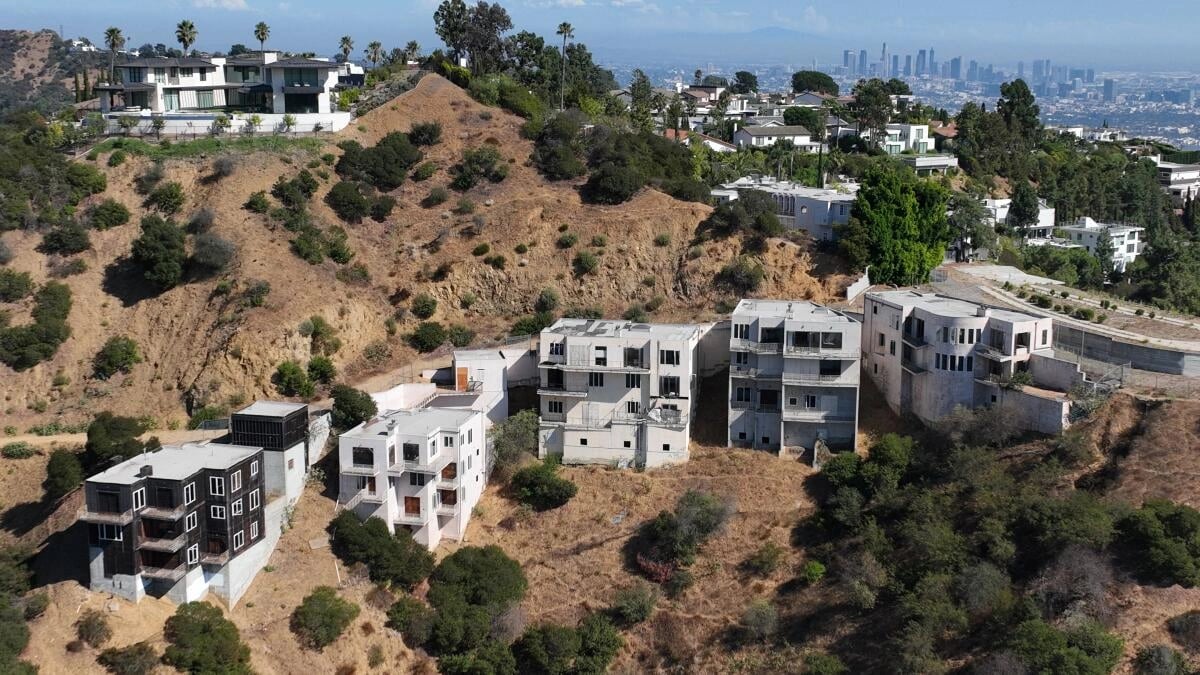
Five three-story homes on Woodstock Road tell the story plainly. Each spans 5,000 square feet, perched on Laurel Canyon's hillside with views across Los Angeles. Permits were issued between 1998 and 1999, and then work stopped in 2002 when city officials discovered developers had bypassed a required environmental impact assessment — a serious omission in an area where wildlife and residential life share the same terrain.
Demolition was ordered in 2003. The homes stayed standing. Ownership passed through multiple hands over the next two decades, with each new developer failing to revive the project. Shahram and Ester Ghalili acquired the unfinished properties in late 2020. Neighbors soon reported renewed construction activity, and city officials learned of the unauthorized work only through those complaints.
The LA City Attorney's Office responded with 35 criminal charges against the Ghalilis, citing building and safety violations including failure to obtain permits and disregard for prior city orders. The case ended in a plea agreement: all five homes must be demolished by August 7, 2026 to avoid criminal conviction. The Ghalilis must also comply with all building regulations, cooperate with inspectors, and pay $5,000 in fines.
The regulations governing hillside construction leave little room for interpretation. Weekday work runs from 8:00 AM to 6:00 PM. Saturdays are limited to interior work only. Floodlights and similar exterior illumination are prohibited after 6:00 PM on any day. Violations carry misdemeanor charges, with fines up to $1,000 and potential imprisonment.
How Many Homes Were Planning to Break Ground
The five homes on Woodstock Road were only the beginning. The original plan called for 21 homes. Only five ever broke ground before regulators intervened. This kind of overreach has a long history in Laurel Canyon.
Back in 1987, property owners organized against proposed restrictions on small residential lots. The Hillside Property Owners Association pushed back against plans requiring developers to seek zoning administrator approval before building. Bernt Lohr-Schmidt, a Laurel Canyon homeowner with several undeveloped lots, argued the proposal amounted to a building moratorium. Lots between 2,500 and 3,500 square feet were at the center of the debate.
Other homeowner groups took the opposite position, urging city officials to slow what they saw as unchecked overdevelopment. Their concern was that existing zoning Los Angeles laws allowed construction to proceed without accounting for the impact on traffic and parking. Lohr-Schmidt had a name for this tension: the "drawbridge mentality" — established residents pulling up access once they had secured their own properties.
Laurel Canyon was designed more than a century ago as a wooded retreat. Its narrow streets and irregularly sized lots were never meant to carry the load they carry today. From a safety and infrastructure standpoint, the area surpassed its ideal capacity long ago. Stopping all construction is not realistic, but the community has consistently pushed to hold developers to the letter of current law.
For anyone with capital in play here, that history matters. Projects with clean approvals have faced years of litigation. Permit status does not guarantee completion. Those who understand the regulatory landscape, rather than simply reacting to it, are best placed to find the acquisitions others miss.
Understanding R-1 Zoning Overlays in Los Angeles
"The more zoning restrictions and regulations, the higher the prices and the more homeless people." — Ben Carson, Former Secretary of Housing and Urban Development
Luxury real estate in Los Angeles changes hands through private channels, where what you know matters considerably more than what you can find on a public listing. The most consequential transactions happen within trusted circles, quietly, where discretion carries as much weight as the numbers. Christina Pope at Sotheby's International Realty (EliteResidenceInternational.com) works within these circles, where timing and a precise understanding of regulatory conditions create real advantages for her clients.
What R-1 Zoning Means for Single-Family Development
The LA zoning code defines R1 as single-family residential zoning with a minimum lot size of 5,000 square feet. It is the most common zoning classification across Los Angeles by a considerable margin. R1 zones allow one-family dwellings as the primary use, with accessory structures — private garages, recreation rooms, and servant's quarters — permitted under specific conditions.
R1 Variation Zones add another layer. Four categories exist: R1V for variable mass, R1F for front mass, R1R for rear mass, and R1H for hillside properties. Each applies distinct bulk and massing rules while preserving the fundamental single-family character of the zone. Standard and variation zones alike must comply with encroachment plane limits.
The encroachment plane originates at a set height above minimum front and side yard setbacks and angles toward the lot interior. Building mass cannot rise above this plane, with limited exceptions for specified roof structures and equipment. Side walls exceeding 14 feet in height with a continuous length greater than 45 feet require an offset or plane break of at least 5 feet beyond the minimum side yard, spanning no less than 10 feet in length.
Setback requirements are equally precise. Front yards must be at least 20 percent of lot depth, not exceeding 20 feet. Side yards require a minimum of 5 feet for buildings up to two stories, with one additional foot for each story beyond the second. Rear yards must hold at least 15 feet in depth.
How Housing Overlays Were Supposed to Work
California's Housing Element Law requires local governments to periodically assess housing needs and produce plans to meet them. Those plans — the Housing Element — must align with the Regional Housing Needs Allocation set by the Department of Housing and Community Development. Where existing sites fall short of accommodating all income levels within RHNA obligations, local governments must include programs to rezone.
Residential overlay zones were introduced as a way to close the gap between existing zoning capacity and RHNA requirements. Jurisdictions placed these overlays atop commercial and industrial base zoning, theoretically adding residential development rights without removing the underlying uses. The approach seemed practical — sites could accommodate housing while retaining their original zoning classifications.
The strategy spread quickly across California. HCD certified numerous housing elements that relied on overlay zones, treating them as substantially compliant with state law. That certification established a presumption of validity for approved Housing Elements. For a time, the approach held.
The Fatal Flaw Courts Have Now Exposed
California's Second District Court of Appeal found fundamental defects in overlay zoning. The court drew on Martinez v. City of Clovis, which established that minimum density requirements are mandatory — not permissive. Government Code Section 65583.2(h)(2) requires rezoned sites to maintain a minimum density of 20 units per acre. "Minimum density and development standards" means exactly that: sites must be zoned to meet at least that threshold, not merely allowed to reach it.
Overlays sitting atop commercial or industrial base zoning permit projects to move forward with no residential component at all. The structure allows residential development but does not require it. That distinction proved fatal — such overlays cannot guarantee housing production and violate the mandatory language of State Housing Element Law.
The court found a second problem. The same statute requires at least 50 percent of lower-income housing sites be designated for residential use only, with nonresidential and mixed uses prohibited. Overlays that preserve underlying commercial and industrial zoning expressly allow retail, office, manufacturing, and warehousing. A jurisdiction cannot simultaneously permit and prohibit the same uses on a single site.
Courts remain the final word on statutory meaning. HCD certification cannot cure a clear statutory defect, and this ruling signals the judiciary will apply Housing Element Law more strictly than HCD's own administrative approach has suggested.
Why Builder's Remedy Applications May Flood Laurel Canyon
When Housing Elements Fail Compliance Standards
Local governments across California face mandatory housing planning cycles requiring updated elements every five to eight years. Over the last two years, jurisdictions scrambled to assemble plans meeting a statewide goal of 2.5 million new units by 2030. At last count, 227 jurisdictions, home to nearly 12 million Californians, still had not achieved certification from state housing regulators. That non-compliance opens the door to builder's remedy projects.
HCD holds sole authority to determine housing element compliance. Cities cannot self-certify their plans. AB 1886 settled the question explicitly, stating local agencies have no self-certification power. AB 2023 added a rebuttable presumption of invalidity, meaning HCD determinations stand unless jurisdictions produce contrary evidence. Cities that challenge HCD and lose may find all builder's remedy applications submitted during litigation suddenly validated.
Of California's 539 jurisdictions, 198 had not adopted substantially compliant housing elements as of August 24, 2023. Within the Southern California Association of Governments region alone, 106 of 197 cities and counties remain out of compliance. Some submitted draft elements currently under HCD review. Others have yet to draft revised elements and face extended periods of non-compliance.
What Developers Can Now Claim Under State Law
Builder's remedy allows developers to bypass local zoning regulations wherever jurisdictions lack compliant housing elements. Projects qualify under defined affordability thresholds: 20% of units for lower-income households at 80% area median income, or 100% of units for moderate-income households at 120% AMI. Emergency shelters also qualify.
Eligible housing development projects include residential-only buildings, mixed-use developments with at least two-thirds of square footage designated residential, and transitional or supportive housing. The remedy applies exclusively to these categories — entirely commercial projects remain ineligible.
Land-use attorney Dave Rand put it plainly: the loss of zoning control, with developers free to propose projects without zoning regulations, commands attention. Jurisdictions cannot deny qualifying projects based on general plan or zoning ordinance inconsistency. Only specific findings of adverse health or safety impacts can justify modifications or disapproval.
The Legislature added this provision to government code in 1990, and for decades, no one used it. Legal complexity, eight-year relevance cycles, and unclear environmental review exemptions kept developers away. Invoking the builder's remedy also carried a practical cost — it functioned as a declaration of war against local governments, which proved bad for business when municipalities held sweeping development discretion.
Developers who file preliminary applications under SB 330 while a jurisdiction remains non-compliant retain vested rights even after the city later adopts a compliant element. HCD has clarified this timeline protection, giving developers a clear incentive to act during non-compliance windows. Once HCD certifies a housing element, that window closes — which makes timing the deciding factor for those pursuing this regulatory pathway.
Impact on Laurel Canyon's Exclusive Real Estate Market
Zoning uncertainty does not affect all buyers equally. Those who know this market well, and who work within the right circles, find that disruption often surfaces opportunity before it becomes visible to others. Christina Pope at Sotheby's International Realty (EliteResidenceInternational.com) works with clients who understand that access and timing carry more weight than what appears on any public listing.
How Uncertainty Reshapes Buyer Behavior
Zoning changes affect property values in direct, measurable ways. Commercial rezoning near residential areas tends to push values upward through business demand. Industrial rezoning does the opposite. Properties that fall out of compliance with current zoning can expose owners to legal complications, fines, or required modifications, which is why thorough due diligence before any acquisition is not optional.
Laurel Canyon's numbers tell their own story. The median listing price stands at $1.60M with 17 homes currently available. Year-over-year, listing counts are down 18.18%, median prices down 27.65%, days on market down 33.33%, and price per square foot down 14.92%. Month-over-month figures follow the same pattern: listing counts declining 5.26%, median prices falling 1.54%, days on market dropping 48.15%, and price per square foot decreasing 10.93%.
Interest rate sensitivity runs high here. When rates climb, buying power for unique premium properties contracts and absorption slows. When they ease, buyers who have been waiting return quickly. With transaction volumes as low as they are, a single sale carries outsized influence on how the broader market is perceived. One standout transaction can shift expectations across an entire pocket of the canyon.
Off-Market Opportunities for Strategic Acquisitions
Roughly 38% of Lookout Mountain transactions close off-market. Qualified buyers with access to the right private networks receive early notice on pocket listings, pre-market properties, and confidential sales across the canyon system, often 72 hours ahead of anyone else. The average off-market transaction clears above $8.00M, and approximately one-third of premium canyon transactions never surface on public MLS platforms at all.
Value here is not measured in square footage. Canyon position, lot character, architectural pedigree, view orientation, and cultural history all factor in. A well-documented 2,400-square-foot mid-century home on Wonderland can command more than a 4,000-square-foot contemporary on a flag lot. Entry canyon homes begin around $1.50M. Turnkey properties run $2.50M to $4.00M. Architectural and view inventory clears $4.00M to $12.00M, and ridgeline properties move above $12.00M, most of them off-market. Transactions above $10.00M close off-market at rates exceeding 45%.
Why Timing and Privacy Matter More Than Ever
For buyers at this level, exposure carries real risk: personal safety concerns, unwanted media attention, unsolicited outreach, and the very real possibility of prices moving upward once word gets out. Privacy planning comes before property searches begin. The most discerning buyers work with advisors who control information carefully and limit access to vetted parties only. Off-market transactions keep addresses, prices, and photographs off listing platforms entirely.
NDAs address buyer identity, purchase price, property details, and closing timelines. Showings are arranged outside standard hours, using private entrances with restricted access. No open houses. No foot traffic. After closing, privacy is maintained through entity-held titles and anonymized utility accounts.
For those seeking a home that reflects a truly elevated way of life, the current conditions present real possibilities that will not remain available indefinitely. Christina Pope can be reached at 310-404-9931 or [email protected] to discuss the right approach for this moment.
What Happens to Properties Already in the Permit Process?
"Under what circumstances a property owner may complete a project which is in progress at the time his use of the property becomes nonconforming is a difficult question. Its resolution is ordinarily governed by the degree of hardship which would be imposed if the construction or expansion were halted before completion." — Hawkinson v. Itasca, Supreme Court of Minnesota
Permits issued during regulatory transitions carry inherent risk. The difference between valid authorization and revocable permission is not always visible on the face of a document. For property owners with substantial capital committed to municipal approvals, that distinction matters enormously. Christina Pope at Sotheby's International Realty (EliteResidenceInternational.com) works with clients who understand that permit status requires verification well beyond face-value acceptance.
Projects Approved Under Now-Invalid Overlays
Permits erroneously issued by local jurisdictions are invalid. Multiple Maryland appellate cases have held that permits issued in error can be revoked. Erroneous permits do not convey protection simply because a government officer signed them.
A permit issued for a use or structure that violates an ordinance is void. This holds true regardless of how much money was spent in reliance on that permit. Local governments retain the authority to revoke improperly issued permits. Obtaining the permit correctly matters far more than simply obtaining it.
Vested Rights vs. Regulatory Compliance
Vested rights doctrine offers some measure of predictability about when new ordinances apply to projects already underway. California recognizes three paths to vesting: vesting tentative maps, development agreements, or common law vesting. Common law vesting requires a building permit, substantial work performed under that permit, and substantial liabilities incurred in good faith reliance on it.
Courts approach estoppel claims against local governments with considerable reluctance. Municipalities, in the court's view, should not be held to employee errors or unauthorized conduct. That said, courts have acknowledged that exceptional circumstances can warrant estoppel — cases where the injustice would be severe enough to override public interest concerns. A homeowner who committed hundreds of thousands of dollars to construction based on city-issued permits may present exactly those facts.
The Litigation Path Forward
The void ab initio doctrine opens a less obvious avenue for challenging ordinances — one that extends beyond standard appeal windows. Statutes held unconstitutional under this doctrine are treated as though they never existed from the moment of enactment. An ordinance that was never properly enacted never became effective, which means the appeal period never began to run. Landowners in one Pennsylvania case used this doctrine to challenge an ordinance more than five years after it was enacted.
Virginia's Supreme Court invalidated Fairfax County's entire 2021 zoning ordinance on those grounds, finding procedural violations in how virtual adoption hearings were conducted. The ordinance was held void ab initio for violating open meeting requirements. At the time of publication, the county had not issued guidance on zoning actions approved virtually during the pandemic or on applications currently pending.
How to Navigate Los Angeles Zoning Information During This Transition
Zoning determines what can be built before construction begins. For residential investors in Los Angeles, it is the foundation of due diligence, not an afterthought. The gap between what currently stands on a property and what zoning actually permits is precisely where value is found — or lost.
Verifying Your Property's Current Zoning Status
The Zone Information and Map Access System (ZIMAS) is the starting point for any serious inquiry into a Los Angeles property. The web-based tool accepts searches by property address, street intersection, assessor parcel number, case number, community plan area, council district, or PIN number. A base zone alone does not tell the full story. Los Angeles layers overlays, specific plans, and special districts on top of base zoning, each capable of adding restrictions or modifying what is otherwise permitted. A single overlay can cap height, tighten setbacks, or introduce design review that adds months to a timeline.
Working with Land Use Specialists
Land use matters sit at the intersection of complex state law, local ordinance, and evolving court interpretation — territory that rewards hands-on legal experience. Real estate disputes arise frequently in this environment, where the stakes are high and the regulations rarely straightforward. Qualified specialists handle due diligence research, pre-development feasibility analysis, entitlements, zoning services, and compliance with both state and local requirements.
Christina Pope's Approach to High-Stakes Transactions
Christina Pope at Sotheby's International Realty brings the kind of market knowledge and client attentiveness that high-stakes transactions require. Her background spans international luxury markets, and her understanding of what discerning buyers and investors need is reflected in every transaction she handles. For those considering a purchase in Laurel Canyon or the broader Los Angeles market, Christina can be reached at 310-404-9931 or [email protected].
Conclusion
Laurel Canyon's regulatory landscape is not what it was. Court rulings have invalidated zoning overlays that developers relied upon, leaving existing permits in question and future projects on uncertain footing. Builder's remedy applications stand to increase in non-compliant jurisdictions, while property owners weigh vested rights against evolving compliance demands. These shifts matter most in a market where off-market transactions already define how premium properties change hands. The opportunities here are real, but they belong to those with both the legal clarity and the market relationships to act on them. Christina Pope at Sotheby's International Realty brings precisely that combination to every client she works with. She can be reached at 310-404-9931 or [email protected].
Key Takeaways
California's Second District Court of Appeal has invalidated R-1 zoning overlays across Los Angeles, halting new construction in Laurel Canyon and creating significant uncertainty for hillside development projects that relied on these regulatory frameworks.
Critical regulatory shifts reshaping Laurel Canyon's real estate landscape:
• Zoning overlays are now legally invalid – Courts ruled that overlays permitting but not requiring residential development violate California Housing Element Law, exposing projects to compliance challenges and potential revocation.
• Builder's Remedy applications may surge – With 227 California jurisdictions lacking compliant housing elements, developers can bypass local zoning in non-compliant areas, potentially flooding exclusive neighborhoods with projects.
• Off-market transactions dominate premium sales – Approximately 38% of Lookout Mountain deals close privately, with transactions above $10M occurring off-market at rates exceeding 45%, making discretion essential.
• Permits issued under invalid overlays carry significant risk – Properties in the permit process face uncertainty between vested rights and regulatory compliance, as erroneously issued permits can be revoked regardless of expenditures.
• Strategic timing creates acquisition opportunities – Market uncertainty, combined with year-over-year median price declines of 27.65% in Laurel Canyon, positions informed buyers to capitalize on regulatory transitions others overlook.
The current environment demands expert navigation of complex zoning regulations, legal precedents, and private market channels. Success requires understanding that regulatory disruption creates asymmetries favoring those with specialized knowledge and strategic positioning over conventional market participants.
FAQs
Q1. What does R-1 zoning mean for property owners in Los Angeles? R-1 zoning designates single-family residential use with a minimum lot size of 5,000 square feet. It permits one-family dwellings as the primary use, along with accessory structures like private garages and recreation rooms under specific conditions. R-1 properties must comply with setback requirements, encroachment plane limits, and height restrictions that vary depending on whether the property falls under standard R-1 or variation zones like R1H for hillside areas.
Q2. Can I build an ADU on a property zoned R-1? Yes, California state laws (including SB 13 and AB 68) override local zoning restrictions and permit ADUs on most residential lots, including those zoned R-1. These state regulations were designed to increase housing production and give property owners the right to add accessory dwelling units regardless of single-family zoning designations. However, hillside properties with additional overlays may face extra requirements related to grading, access, or structural considerations.
Q3. What happens if my property was legally built as a duplex but is now zoned R-1? Your property is likely a legal nonconforming use, meaning it was compliant when originally built but no longer aligns with current zoning regulations. These properties are "grandfathered in" and can continue operating legally as duplexes. However, if you plan to make modifications or add units, the city may require verification of the property's legal status through permit history documentation before approving new construction.
Q4. Can building permits be revoked if they were issued incorrectly? Yes, permits erroneously issued by local jurisdictions are considered invalid and can be revoked, even if substantial expenditures were made in reliance on them. A permit issued for a use or structure that violates an ordinance is void regardless of which government officer issued it. This makes proper verification of zoning compliance essential before beginning construction, as obtaining the permit correctly matters more than simply obtaining it.
Q5. How can I verify my property's current zoning status in Los Angeles? Use the Zone Information and Map Access System (ZIMAS), a web-based mapping tool that provides zoning information for Los Angeles properties. You can search by property address, assessor parcel number, or other identifiers. Keep in mind that Los Angeles layers base zoning with overlays, specific plans, and special districts that can add restrictions or modify development options, so reviewing the complete zoning profile is essential for understanding what can be built on your property.