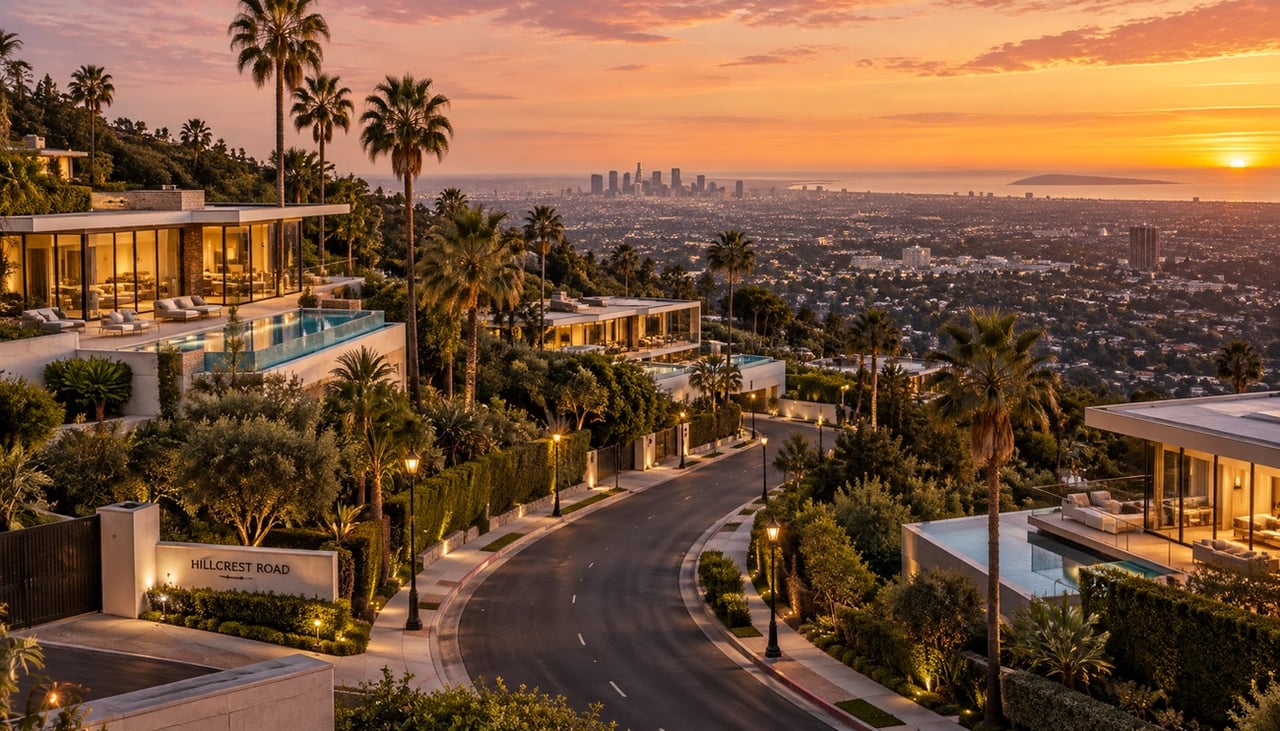
The most significant transactions in Trousdale Estates rarely surface on public platforms. They move through private conversations, between trusted agents and qualified buyers who already know what they want. This 410-acre hillside enclave, subdivided into 535 lots starting in 1955, holds the largest concentration of custom mid-century modern architecture in Los Angeles — a distinction that shapes every aspect of how this market behaves. Median sold prices in Beverly Hills 90210 sat near $5.62 million as of May 2026, while Trousdale Estates commanded 25 to 30 percent above that figure. North Hillcrest Road, now widely known as Billionaire's Row, tells the story of that premium most clearly — tech founders and international buyers have joined the ranks of those who call Trousdale Estates home today.
Hillcrest Road Within Trousdale Estates Beverly Hills
"Luxury is more than just a price point; it’s a combination of location, design, privacy, and lifestyle that places a home in a category of its own." — The Fridman Group, Real estate experts
The Geography and Layout of Hillcrest Road
North Hillcrest Road occupies the apex of Trousdale Estates' ridgeline system — a position that shapes both its physical character and its standing in the market. The street runs along elevated terrain north of Sunset Boulevard, where lots were graded into level pads during the original subdivision. A property like 1174 North Hillcrest, set on an approximately 1.18-acre promontory at the end of a quiet cul-de-sac, delivers city-to-ocean panoramas without the neighbor proximity that interior streets carry. The elevation is not merely scenic — ridgeline positioning means many Trousdale properties capture true 180-degree exposure without borrowing views across neighboring rooftops.
Lot sizes along Hillcrest Road typically range from 25,000 square feet to well over an acre, dimensions that exceed what most Beverly Hills streets can offer. That scale accommodates extensive terraces, pools, and private yard areas that steeper hillside sites simply cannot support. The flat building pads also make new construction and major remodels far more straightforward — an advantage that translates into real architectural flexibility within the boundaries of the Trousdale Ordinance.
How Hillcrest Road Differs from Other Trousdale Streets
Among all the streets within Trousdale Estates — Loma Vista Drive, Robert Lane, Drury Lane, Wallace Ridge, Carla Ridge — Hillcrest Road holds one designation none of the others can claim: the most expensive street in the neighborhood. Elevation contributes to that standing, but so does the precise orientation of building pads relative to the Los Angeles basin below.
The enclave was platted around ridgeline homes designed to maximize panoramic exposure over the basin. Hillcrest Road occupies the premium tier within that already rarefied market. Pacific Ocean visibility from the most elevated positions remains a genuine rarity in the Beverly Hills hillside market — and that rarity converts directly into price.
The View Corridors That Define Property Value
The view from a Hillcrest Road property is not a matter of luck or good fortune. It is the result of formal protections written into municipal code. Beverly Hills maintains a view restoration and vegetation mediation process specific to Trousdale, one that shields existing view corridors from obstruction by neighboring landscaping or construction. Buyers here enjoy a level of confidence that the view they purchase today will remain intact — a reassurance that most other hillside markets in Los Angeles simply cannot offer.
These sightlines carry a name in the market: jetliner views. Unobstructed sweeps across the downtown skyline, Century City, and the Pacific Ocean. The formal protections Beverly Hills has put in place reduce the risk of a neighbor's tree or new addition compromising what a buyer paid for. A home whose primary view is protected by the ordinance on both sides commands a premium that a home dependent on a single neighbor's restraint does not.
Architectural significance, view quality, and lot scarcity together keep Trousdale among the most sought-after micro-markets in Los Angeles. Hillcrest Road holds the top position within all three.
The Architects Behind Hillcrest Road's Most Notable Homes

Image Source: Architectural Digest
The name attached to an address on Trousdale Estates carries real weight. It functions as shorthand for design quality, historical significance, and the kind of disciplined modernism that gave the neighborhood its original character — and continues to drive its pricing today.
Harold Levitt and the Glamor Modern Style
Harold Warren Levitt earned the designation "Architect to the Stars" honestly. His client roster — Steven Spielberg, Dean Martin, Burt Lancaster, Debbie Reynolds, Quincy Jones, Lionel Richie — shared a common set of priorities: discretion, proportion, and a home that worked as a place to live rather than a statement to impress. Levitt answered with clear planning, generous but controlled spaces, and a material palette that conveyed permanence without ostentation. Deep roof overhangs, expansive glass planes, and a strict horizontal discipline dissolved the line between interior and landscape. His Trousdale work captured the neighborhood's social character precisely: mid-century architecture built for hosting, where courtyard sequences and large openings made the living room and the terrace feel like one continuous space.
Rex Lotery's Elvis Presley Residence at 1174 North Hillcrest
Rex Lotery completed 1174 North Hillcrest in 1958. The residence later became Elvis Presley's California address for six years, purchased by Elvis and Priscilla for approximately $400,000 the same year they married. Four bedrooms, five bathrooms, 5,367 square feet. Architectural Digest described it as an "idiosyncratic mash-up" of classic California modernism and Hollywood Regency. What the description captures well is the Trousdale formula Lotery applied: closed and private from the street, entirely open to the rear, built around indoor-outdoor living where the terrace and the views are as much a part of the architecture as any interior room.
Wallace Neff's Groucho Marx Home at 1083 North Hillcrest
Wallace Neff designed 1083 North Hillcrest Road in 1956 for Groucho Marx, who lived there from the late 1950s until his death in 1977. Neff's late-period style paired horizontal planes and moderne curves with glass walls and warm wood surfaces. The result was a residence with genuine Hollywood character: 12-foot ceilings, oversized rooms, terrazzo floors, and a walnut-paneled library that gave the home its tailored, unhurried feel. The 32,300 square foot lot included a gated motor court, pool, spa, and panoramic city and canyon views that have only appreciated in significance.
A. Quincy Jones and Paul R. Williams Properties
A. Quincy Jones brought spatial clarity to Trousdale Estates — a deep commitment to how a plan frames outdoor space and commands distant views. Paul R. Williams, the first Black architect elevated to Fellow of the American Institute of Architects, worked across Beverly Hills for decades, pairing technical precision with genuine glamor. Their collaboration on several Trousdale projects produced work that continues to serve as an architectural benchmark for the neighborhood.
Edward Fickett's Influence on the Street
Edward Fickett is credited with designing an estimated 50,000 homes across his career. He came up through Paul R. Williams' firm before establishing his own practice, and went on to serve as architectural adviser on housing to President Eisenhower. His final residence, completed at 1640 Loma Vista Drive in 1973, exemplified the signature he refined over decades: open L-shaped plans, glass walls, and playful rooflines placed confidently on hillside lots that other architects had passed over.
Trousdale Estates Celebrities and Billionaire's Row
"There’s definitely an increase in the value of [celebrity} homes, not only because of its intrinsic value, but you do get a much greater pool of buyers." — Susan Smith, Global real estate advisor at Hilton & Hyland, Beverly Hills, CA
The entertainment industry's migration to Trousdale Estates between 1955 and 1975 followed a clear rationale. No other Los Angeles development offered what this one did: a street-facing facade that revealed nothing, paired with an open, view-oriented rear designed entirely for entertaining.
Frank Sinatra and Dean Martin Era
Frank Sinatra, Dean Martin, Tony Curtis, Ray Charles, and Howard Hughes made Trousdale Estates the address of choice for mid-century Hollywood. Richard Nixon and Dinah Shore commissioned modern ranch houses from Allen Siple, the development's supervising architect, during the early buildout phase. Dean Martin's residence came from Harold Levitt — the same architect whose entertaining-focused philosophy shaped so much of what the neighborhood became. The formula was consistent: closed and discreet from the street, open and glazed toward the view, with every room oriented around hosting.
Elvis and Priscilla Presley at 1174 North Hillcrest
Elvis Presley purchased 1174 North Hillcrest Road in 1967 for $400,000, the same year he married Priscilla. The 1.18-acre promontory delivered panoramic city and ocean views[111], and the Presleys lived there with Lisa Marie into the early 1970s. The 5,367 square foot residence remains the most mythologized address in the neighborhood[111]. Rex Lotery's design held both qualities at once — completely private from the road, completely open to guests. Elvis signed autographs at the front gate.
Jennifer Aniston's Ohana at 1004 North Hillcrest
Jennifer Aniston's former home at 1004 North Hillcrest — a Harold Levitt design she restored and named Ohana — appeared in Architectural Digest in 2010. That single feature did more for the neighborhood's renewed profile than any listing could have. The single-level house carried a slightly Asian, Balinese quality, with massive sliding glass panels and a 20-foot-long section opening to the lanai.
Who Lives in Trousdale Estates Today
Elton John, Lionel Richie, and Justin Bieber are among the current residents. Business leaders and notable figures across industries have found their place here as well. The names change. The appeal does not.
The Tech Founders and International Buyers Reshaping the Street
North Hillcrest Road earned the Billionaire's Row nickname as technology money and international buyers claimed a street that once belonged to entertainers[153]. Video game developer Markus Persson invested $70 million into a property many now estimate is worth close to double that. The motivations, though, are the same ones that brought Groucho Marx here in the 1950s: to be above it all, and to be left entirely alone.
The Trousdale Ordinance and What You Can Build on Hillcrest Road
The rules governing Hillcrest Road properties were written into Beverly Hills Municipal Code on October 15, 1987, and they remain the most restrictive residential building standards in Los Angeles. What a buyer can build, how high it can rise, and whether the view they purchase today still exists in twenty years — the ordinance answers all of it.
The 14-Foot Height Limit and Building Pad Restrictions
Fourteen feet. That is the maximum height permitted for any structure in Trousdale Estates, measured from existing pad elevation. No slope-based formula grants additional height on steeper lots. No discretionary mechanism opens the door to exceptions on new construction. The practical result: new builds in Trousdale Estates are, without exception, single-story.
The grading rule gives the height limit its teeth. No permitted grading may occur where slope exceeds one vertical foot for every five horizontal feet. Equally important, no lot may be regraded to raise the level pad above its existing elevation. Without that restriction, a builder could simply lift the pad and claim fourteen feet from a higher starting point. Both rules working together fix a structure in space, with existing topography dictating the roofline.
View Protection Rules Specific to Hillcrest
Beverly Hills adopted formal regulations to address city views impaired by foliage on neighboring properties. The ordinance revised development standards for walls, fences, and hedges — amending the definition of hedge and establishing new height standards for hedges on slopes between adjacent lots. The Trousdale View Restoration Ordinance went further, creating a process for property owners to address views impaired by trees and foliage that fall outside the hedge classification. Coverage extends to foliage on any property within five hundred feet of the view owner's parcel.
For buyers on Hillcrest Road, this matters considerably. The panorama that draws someone to a property is not simply enjoyed — it is protected.
What the 1987 Grandfather Date Means for Properties
Structures that lawfully exceeded fourteen feet on October 15, 1987 were grandfathered[162]. Those homes may be remodeled or rebuilt, but they cannot surpass the height or envelope they held on that date without a Trousdale R-1 permit[162]. Critically, the protection belongs to the structure rather than the land itself — demolish the house, and the grandfathered status disappears with it. For buyers weighing a teardown against a restoration, that distinction carries real consequences.
Trousdale Estates Homes for Sale on Hillcrest Road in 2026
Current Asking Prices and Recent Sales
The average Trousdale Estates home value reached $7,915,354 as of August 31, 2026, up 8.6 percent over the prior year. Twenty-two properties were listed in October 2026 with a median asking price of $18,497,000 and an average of $2,930.23 per square foot. On Hillcrest Road itself, 1058 North Hillcrest listed at $9,950,000 for a meticulously preserved mid-century original, while 1016 North Hillcrest carried an asking price of $29,800,000. Among recent closings, 1053 North Hillcrest sold for $7.90 million.
The 40 to 50 Percent Off-Market Reality
Approximately 40 to 50 percent of transactions above $15 million take place entirely off-market, through pocket listings and private agent networks. Sellers prefer this approach to vet buyers with discretion. Buyers with cash positions move quickly, closing before a property ever reaches a public platform.
Architectural Provenance and Price Per Square Foot
Price per square foot runs from $2,300 to $2,900, with condition and location determining where a property falls within that range. Standard metrics, however, do not fully account for provenance. A home with a documented commission from an original-era architect commands a premium that an anonymous rebuild simply cannot match.
Cash Buyers and Market Velocity
Cash accounted for roughly 41 percent of Beverly Hills single-family closings in early 2026, and active listings averaged 108 days on market. For those who enjoy entertaining, the right home is everything. Whether the search is just beginning or a specific property is already in mind, Christina Pope would be glad to help identify homes designed for elevated living, where the view, the setting, and the architecture all do the work. Christina Pope 📞 310-404-9931 ✉️ [email protected]
Conclusion
Hillcrest Road earns its place at the top of the Beverly Hills market for reasons that hold up on close examination: ridgeline lots with protected view corridors, architectural commissions from names that still carry weight, and a zoning ordinance that preserves what buyers pay for. The properties that define Billionaire's Row tend to change hands before most buyers know they are available. Access and timing matter here in ways that capital alone cannot substitute.
For those who appreciate what this street represents — and are ready to act with the discretion this market requires — the right guidance makes all the difference.
Christina Pope Sotheby's International Realty EliteResidenceInternational.com
Key Takeaways
Hillcrest Road in Trousdale Estates represents the pinnacle of Beverly Hills luxury real estate, where architectural heritage, protected views, and strategic positioning create exceptional value. Here's what makes this street worth millions:
• Hillcrest Road commands 25-30% premiums over Beverly Hills' $5.62M median, earning its "Billionaire's Row" nickname through ridgeline positioning that delivers unobstructed city-to-ocean views protected by municipal code.
• The 1987 Trousdale Ordinance's 14-foot height limit and view protection rules preserve property values by preventing neighbors from blocking sightlines, making views a legally protected asset rather than a vulnerable amenity.
• Architectural provenance from masters like Harold Levitt, Wallace Neff, and Rex Lotery adds measurable premiums, with documented commissions commanding higher per-square-foot prices than anonymous rebuilds in the $2,300-$2,900 range.
• 40-50% of transactions above $15 million happen entirely off-market through pocket listings, meaning buyers need insider access and cash positions to compete for the most desirable properties before public listing.
• Lot sizes exceeding one acre with flat building pads provide construction advantages that interior Trousdale streets cannot match, enabling the indoor-outdoor entertaining formula that defined mid-century Hollywood glamor.
The combination of protected views, architectural significance, and restricted supply keeps Hillcrest Road at the apex of Los Angeles' most competitive luxury micro-market, where timing and discretion determine outcomes more than public listings.
FAQs
Q1. Which street holds the title of most expensive in Beverly Hills? Hillcrest Road in Trousdale Estates is recognized as the most expensive street in the neighborhood, commanding prices 25-30% above Beverly Hills' median of $5.62 million due to its ridgeline positioning, protected panoramic views, and architectural significance.
Q2. What makes Trousdale Estates different from other Beverly Hills neighborhoods? Trousdale Estates features the largest concentration of custom mid-century modern architecture in Los Angeles, with 535 lots across 410 acres. The neighborhood benefits from unique zoning protections including a 14-foot height limit and view corridor preservation rules that legally protect property values and sightlines.
Q3. How does the Trousdale Ordinance affect what can be built on Hillcrest Road? The 1987 Trousdale Ordinance limits all structures to 14 feet in height measured from existing pad elevation, effectively restricting new construction to single-story homes. The ordinance also prevents regrading to increase pad height and includes view protection rules covering foliage within 500 feet of a property.
Q4. Why do so many Hillcrest Road properties sell off-market? Approximately 40-50% of transactions above $15 million in Trousdale Estates occur entirely off-market through pocket listings and private agent networks. Sellers use this approach to vet buyers quietly while maintaining privacy, and cash buyers leverage their positions to close deals before properties reach public listings.
Q5. What role does architectural provenance play in Hillcrest Road property values? Homes designed by renowned architects like Harold Levitt, Wallace Neff, and Rex Lotery command measurable premiums over anonymous rebuilds. Documented commissions from original-era architects add significant value, with price per square foot ranging from $2,300 to $2,900 depending on provenance, condition, and location.