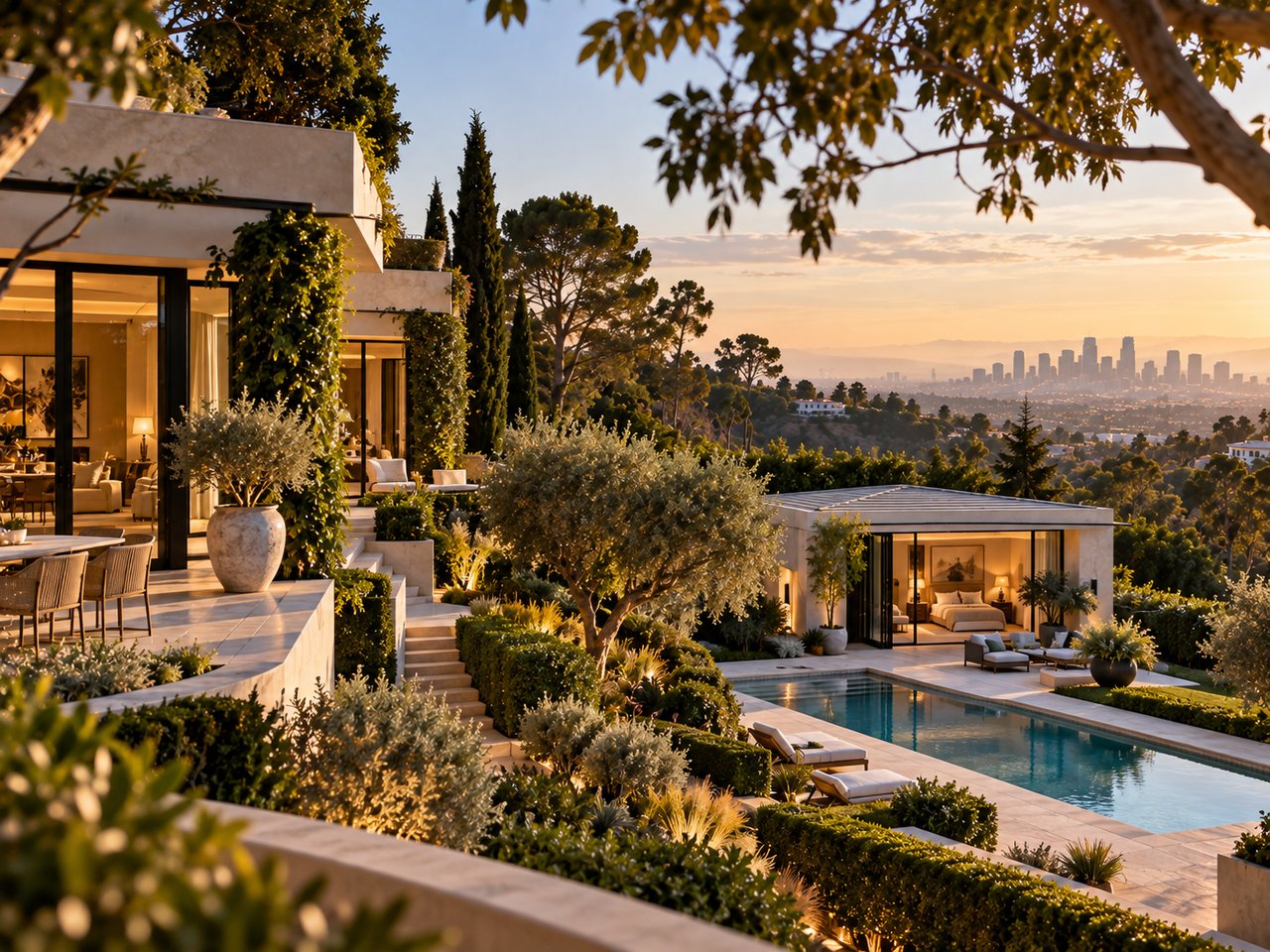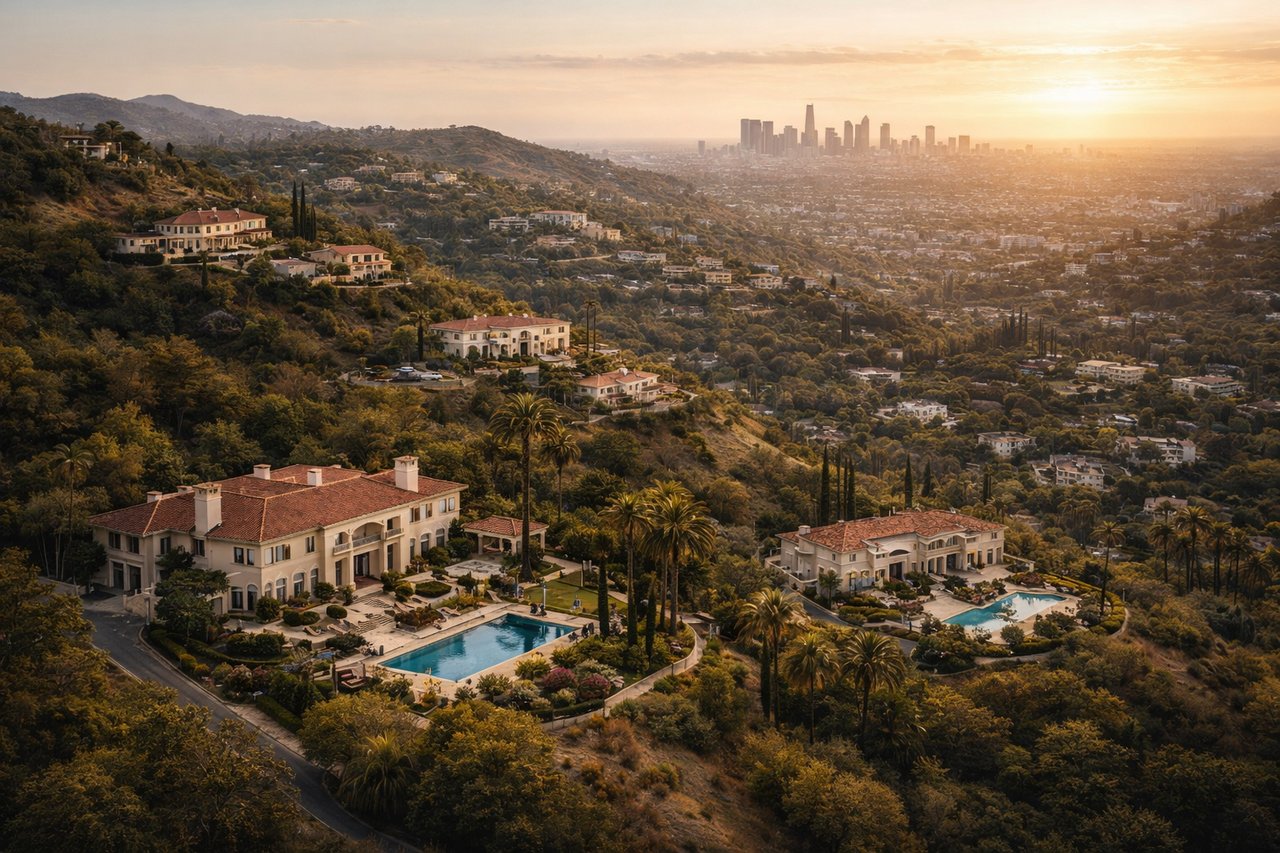
Sloped lots consistently sell for 10-20% above comparable flat parcels in Beverly Hills and Bel Air because vertical positioning delivers privacy that cannot be purchased through gates or landscaping alone. Properties with superior elevation enjoy natural sightline advantages and built-in screening from neighbors below, while Bel Air estates typically offer 0.5 to 2+ acres compared to Beverly Hills' standard 0.25 to 1-acre configurations. Buyers weighing beverly hills vs bel air vs holmby hills or examining brentwood vs beverly hills vs bel air options find that determining which is better beverly hills vs bel air depends on how topography, grade relationships, and elevation positioning affect privacy, views, and long-term value retention.
How elevation layering determines estate exclusivity in Beverly Hills and Bel Air
Elevation works differently in Los Angeles luxury markets than most buyers realize. The terrain determines privacy success before any gates, walls, or landscaping considerations. Vertical relationships between neighboring parcels create seclusion that cannot be added after purchase, making topographic positioning a permanent factor in estate exclusivity.
Vertical separation creates privacy between neighboring properties
Bel Air spans ridgelines and steep canyons along the Santa Monica Mountains north of Sunset Boulevard and west of Beverly Glen, where short distances change elevation by dozens of feet and alter privacy dynamics between neighboring parcels. Grade separation creates privacy between different areas of the property and between homes and neighboring structures. An estate positioned 30 feet above an adjacent parcel prevents the lower property's outdoor spaces and upper-level windows from intruding into the elevated home's terraces or living areas. This vertical buffer operates continuously without maintenance or operational costs.
Beverly Hills hillside sections follow similar principles with different terrain characteristics. Grade differential creates spatial separation that eliminates visual and acoustic intrusion. Properties achieve isolation through vertical positioning rather than horizontal distance, explaining why quarter-acre hillside parcels deliver privacy levels matching multi-acre flat estates elsewhere.
Elevation changes affect sound buffering and visual screening
Grade changes provide built-in sound buffering and framed views, creating natural screening. The physics operate through mass and distance. Sound waves traveling upward from a lower property dissipate across sloped terrain before reaching structures positioned above. Downhill neighbors cannot view upper terraces or living spaces due to sightline geometry.
Visual screening operates through similar terrain-driven mechanics. Slopes create angled planes that interrupt direct sightlines between neighboring structures. Landscaping placed on grade-separated tiers delivers exponentially greater screening effectiveness than plantings on flat ground. A 15-foot hedge on a 20-foot elevation change produces visual separation equivalent to a 35-foot wall on level terrain.
Ridgeline versus canyon positioning and their privacy implications
Ridgeline parcels deliver strong privacy from below. Properties positioned above neighbors on ridgelines gain superior seclusion, establishing uninterrupted views while preventing upward visual intrusion. Downhill properties see only sky and the ridgeline structure's foundation elements. Different from ridgeline settings, canyon positions offer intimacy and quiet with mature trees that act as visual barriers. Canyon settings provide intimacy through mature tree screening, surrounding estates with established canopy that creates enclosure rather than exposure.
This distinction shapes buyer priorities. Ridgeline buyers prioritize commanding views and defensible privacy from below. Canyon buyers value enclosure, reduced wind exposure, and acoustic dampening that vegetated slopes provide. Both positions deliver privacy through opposing mechanisms—elevation dominance versus topographic embrace.
Grade differential pricing patterns across both neighborhoods
Sloped lots command premium valuations because the terrain itself functions as a privacy asset, eliminating the need for imposing gates or visible security measures. Properties with favorable elevation relationships positioned above rather than below neighboring parcels trade at the upper end of hillside pricing bands. Estates with unfavorable vertical positioning, where higher neighbors overlook the property, require privacy mitigation measures that add construction costs and reduce effective usable space, suppressing values despite hillside locations.
Christina Pope at Sotheby's International Realty tracks these elevation-driven pricing patterns across Beverly Hills, Bel Air, and adjacent luxury markets through EliteResidenceInternational.com, where understanding vertical relationships determines acquisition strategy for buyers prioritizing long-term privacy and resale positioning.
Beverly Hills hillside estates: Trousdale elevation advantages and view protections
Trousdale Estates claims the eastern ridgeline above Sunset Strip, where Paul Trousdale's original development preserved the hilltop's natural contours rather than carving steep vertical pads into canyon walls. These parcels span hillsides and ridges with view corridors extending from 10,000 to 40,000 square feet, governed by slope regulations that create different buildable parameters than the heavily engineered compound sites found throughout Bel Air. The ridgeline positioning allows for flatter building platforms that support mid-century single-story architecture with motor courts and infinity pools capturing panoramic basin and ocean views.
Ridgeline parcels and flatter lot configurations
Trousdale lots maintain relatively level building areas with motor courts and pools oriented toward the vista, contrasting with the vertical, heavily graded platforms characteristic of many Bel Air developments. Cul-de-sac promontory sites command top pricing premiums, offering uninterrupted city-to-ocean perspectives from single-level homes that fully exploit the ridgeline elevation. The neighborhood's original subdivision preserved sightline corridors between properties, creating protected view channels that continue to influence pricing variations within Trousdale.
Structured height limits that preserve sightlines between properties
Beverly Hills maintains view-preservation height restrictions that limit construction to 14 feet when taller structures would materially obstruct Los Angeles basin views from neighboring properties within 300 feet. View measurements begin six feet above the finished grade of the primary residence pad. Standard hillside construction operates under a 26-foot base height ceiling, with structures allowed within height envelopes starting at 22 feet at front setbacks and ascending at 33-degree angles to 30-foot maximums. These controls prevent vertical encroachment that would compromise established sightlines, safeguarding view assets across adjacent parcels.
City permitting process for hillside construction
Beverly Hills 90210 projects operate under municipal hillside and geotechnical standards rather than Los Angeles County protocols, requiring soil studies and design criteria specific to slope and foundation conditions within hillside zones. Trousdale falls under Article 26 zoning provisions that regulate floor area ratios, setbacks, parking requirements, walls, fencing, landscaping, and level pad construction standards tailored to the neighborhood. Buyers should verify jurisdictional boundaries early, since Beverly Hills Post Office (BHPO) properties follow Los Angeles County procedures with different approval timelines and requirements.
View restoration procedures unique to Beverly Hills
The city's Trousdale View Restoration Ordinance from 2011 creates a structured process for addressing foliage-related view obstruction, protecting Los Angeles basin perspectives including city lights and ocean while excluding ridge or canyon views outside the basin sightline. The ordinance establishes "safe harbor" zones where vegetation remains protected from removal requests, defined by planes extending from view owners' pad edges to points one foot above neighboring structures' primary rooflines, capped at 15 feet from grade. Property owners must pursue direct neighbor communication and mediation before submitting View Restoration Permit applications to the Planning Commission. The framework prioritizes early resolution, with foliage owners bearing costs only when the Planning Commission approves permits mandating corrective action.
Christina Pope at Sotheby's International Realty works within these Trousdale regulatory frameworks through EliteResidenceInternational.com, where mastery of height envelope restrictions and view restoration rights shapes acquisition approaches for buyers weighing beverly hills vs bel air or determining which is better beverly hills vs bel air based on view protection mechanisms and long-term value preservation.
Bel Air hillside estates: Compound-style privacy through topographic isolation
Los Angeles luxury real estate moves through private networks where timing and discretion determine success before properties reach public visibility. Bel Air compound estates exemplify this principle significant parcels change hands through relationships developed over years rather than weeks. Those who understand this market recognize how terrain itself communicates value through topographic isolation that flatter sites cannot duplicate.
Canyon and promontory settings with engineered pad systems
Promontory parcels spanning over 5.5 acres anchor the upper pricing tiers, positioned at private road terminations with gated access and unobstructed sightlines. Larger estate parcels cluster in the upper hills and along ridgelines and canyon bottoms, including Stone Canyon and parts of Upper Bel Air. Canyon settings deliver intimacy through natural enclosure, while promontory positions provide commanding elevation above surrounding properties. Both require engineered pad systems where caissons extend 50 to 60 feet into bedrock. Terraced grounds, long private drives, and switchbacks characterize these sites, with deliberate view corridors carved through varied topography.
Larger acreage with natural screening from mature canopy
Bel Air parcels range from quarter-acre to one-acre configurations in developed sections, with multi-acre compounds concentrated along ridgelines and canyon floors. Mature tree canopy provides screening that compound walls cannot match, creating layered privacy through existing vegetation rather than constructed barriers. Canyon positions benefit particularly from established growth that reduces wind exposure and dampens sound transmission between properties. This natural screening matures over decades, functioning as a compounding privacy asset distinct from the more uniform lot configurations in Beverly hills vs bel air comparisons.
Hillside Construction Regulation requirements and grading thresholds
Projects within HCR Districts face grading limits capped at 6,000 cubic yards maximum for single-family developments. Import quantities cannot exceed 500 cubic yards, while export maximums reach 1,000 cubic yards. Geotechnical investigations precede grading permits, determining soil composition, bearing capacity, and slope stability requirements. Compaction standards require 90-95% relative density for engineered fill. These thresholds shape development costs and timelines differently than Beverly Hills jurisdictional processes.
Fire hazard zone implications for hillside development
Wildland-urban interface positioning brings defensible space obligations extending 100 to 200+ feet in Los Angeles County. Brush clearance requirements and restrictions on flammable landscaping and exterior materials affect ongoing maintenance protocols. Hillside exposure influences homeowners insurance availability and premium structures. Buyers evaluating which is better beverly hills vs bel air or comparing brentwood vs beverly hills vs bel air must account for these fire zone implications that compound estates face due to their topographic isolation. Christina Pope at Sotheby's International Realty works with these regulatory frameworks through EliteResidenceInternational.com, where understanding grading thresholds and fire zone positioning determines acquisition strategy for compound properties.
Which is better Beverly Hills vs Bel Air: comparing elevation strategies across LA luxury markets
Market positioning between Beverly Hills and Bel Air reflects buyer priorities that reach beyond address prestige into the mechanics of how elevation creates structural privacy. Estate transactions of significance happen through relationships cultivated over years, where timing and discretion determine outcomes. Christina Pope at Sotheby's International Realty understands these market dynamics through EliteResidenceInternational.com, where determining which is better Beverly hills vs bel air requires evaluating how vertical positioning affects both privacy and lifestyle access.
Beverly Hills vs Bel Air vs Holmby Hills elevation and privacy patterns
Bel Air, Holmby Hills, and Beverly Hills form the Platinum Triangle, containing the most expensive single-family homes in the country. Bel Air luxury homes attract buyers who want space and seclusion above everything else, with the topography and gated access making that separation structural rather than symbolic. Gated estates in Bel Air regularly sit on two to five acres. Holmby Hills real estate sits on flatter, more composed land with wide streets, English-style lamps, and mature trees. Holmby Hills delivers grandeur with accessibility while Bel Air trades walkable retail for greater hilltop seclusion and lot size.
Brentwood vs Beverly Hills vs Bel Air hillside development differences
Beverly Hills homes maintain median prices often soaring above ten million dollars for prime properties, with average sale prices surpassing 15 million dollars in some areas. Bel Air homes average around 13 million dollars but can easily top that for estate-sized properties. Brentwood property prices often range from 3 to 6 million dollars, providing more accessible options for luxury Westside living. Beverly Hills blends flat gridded lots with larger estates north of Sunset, while Bel Air's hillside terrain produces irregular, often larger parcels with switchback drives and multi-level outdoor areas.
How vertical relationships determine long-term estate value
Higher elevations offer larger parcels, privacy, and sweeping views. Buyers cross-shop Bel Air with Holmby Hills, Beverly Hills, and Brentwood, where differences in lot size, architecture, and lifestyle amenities can shift demand. Beverly Hills typically wins on lifestyle access and liquidity, while Bel Air wins on privacy and estate feel. Long-term appreciation in both neighborhoods outperforms broader Los Angeles trends, with Beverly Hills offering better liquidity for quicker sales and Bel Air rewarding patient sellers with top dollar for exceptional properties.
Access versus seclusion tradeoffs in each neighborhood
The Beverly Hills vs Bel Air decision comes down to access versus privacy. Beverly Hills provides immediate reach to city life, maintaining steady demand through its global reputation with properties typically selling faster than comparable luxury homes elsewhere. Bel Air offers quiet separation while staying close to major areas, appealing to buyers seeking ultra-luxury estates, which can mean longer selling times but often results in premium prices. Beverly Hills delivers polished urban-adjacent living with immediate access to hotels, spas, high-end retail, and destination dining, while Bel Air focuses on a private, residential rhythm where many owners invest in on-site amenities.
Buyer due diligence for hillside elevation properties
Hillside acquisitions in Beverly hills vs bel air demand technical verification that buyers of flat parcels rarely encounter. The terrain advantages that command premium pricing also introduce structural risks and regulatory complexities absent from traditional gridded lots. Buyers who forgo geotechnical and zoning analysis often inherit costly problems that emerge during construction or resale.
Testing view permanence and neighbor redevelopment rights
Most homeowners have no right to views unless granted in writing by local ordinance or subdivision rule. Homes with unobstructed views of the San Fernando Valley command approximately 20% higher values than properties without views. View easements must be negotiated between property owners as courts cannot impose them. Discerning buyers should verify whether neighboring parcels hold development rights that could obstruct sightlines, examining zoning envelopes and hillside height limits before closing.
Geotechnical requirements for sloped parcels
Geotechnical investigation determines soil composition, bearing capacity, and slope stability. California Building Code requires a minimum Factor of Safety of 1.5 for slope stability. Fill compaction must achieve 90-95% relative density for long-term stability. These investigations precede grading permits and shape foundation design, with caisson depths reaching 50-60 feet into bedrock on canyon sites.
Zoning overlays and discretionary review triggers
Hillside ordinances require geotechnical reports, slope stability analysis, structural foundation plans, and erosion control documentation before construction begins. Subdivisions in hillside areas typically need reports identifying geotechnical conditions and remediation proposals. Discretionary permits apply when projects encroach into steep hillside areas or trigger environmentally sensitive land regulations.
Building your technical team for hillside acquisitions
Licensed geotechnical engineers perform borings, sample testing, and slope stability computations. Christina Pope at Sotheby's International Realty coordinates these technical specialists through EliteResidenceInternational.com, where understanding which is better beverly hills vs bel air depends on verifying elevation advantages before acquisition.
Conclusion
Elevation advantages function as permanent privacy assets that cannot be replicated through construction or landscaping after purchase. Ridgeline properties deliver commanding positions with protected views, while canyon estates offer natural seclusion through established tree canopy and topographic enclosure. Hillside buyers require technical verification of geotechnical stability, view rights, and zoning parameters before closing, as these factors directly impact both enjoyment and future resale value. Jurisdictional differences between Beverly Hills and Bel Air create distinct regulatory frameworks that affect development costs and timelines.
Christina Pope at Sotheby's International Realty has worked with discerning clientele who understand that successful hillside acquisitions depend on confirming terrain advantages through proper due diligence rather than assuming elevation automatically justifies premium pricing. Her experience with luxury markets, accessible through EliteResidenceInternational.com, helps buyers evaluate which is better Beverly hills vs bel air based on how topographic positioning aligns with their privacy expectations and lifestyle priorities.
Key Takeaways
Understanding how elevation and topography create natural privacy advantages is crucial for luxury estate buyers comparing Beverly Hills and Bel Air properties.
• Elevation creates premium value: Sloped lots command 10-20% higher prices because vertical separation provides structural privacy that flat parcels cannot replicate through landscaping or gates alone.
• Beverly Hills offers view protection: Trousdale Estates features structured height limits and formal view restoration ordinances that preserve sightlines between properties, protecting long-term investment value.
• Bel Air delivers compound-style seclusion: Larger acreage (0.5-2+ acres vs Beverly Hills' 0.25-1 acre) with canyon positioning and mature tree canopy creates natural screening and topographic isolation.
• Technical due diligence is essential: Hillside properties require geotechnical investigations, slope stability analysis, and verification of neighbor redevelopment rights before purchase to avoid costly surprises.
• Choose based on lifestyle priorities: Beverly Hills wins on accessibility and liquidity with faster sales, while Bel Air rewards patient sellers seeking maximum privacy and estate-sized properties.
The key decision factor comes down to access versus seclusion—Beverly Hills provides polished urban-adjacent living with immediate amenities, while Bel Air offers ultra-private residential environments where terrain itself functions as the primary privacy asset.
FAQs
Q1. Which neighborhood offers more privacy, Beverly Hills or Bel Air? Bel Air typically provides greater privacy through its hillside topography, gated estates, and larger lot sizes ranging from 0.5 to 2+ acres. The canyon positioning and mature tree canopy create natural seclusion. Beverly Hills offers excellent security with responsive municipal services but emphasizes accessibility alongside privacy, with smaller lots typically ranging from 0.25 to 1 acre.
Q2. How does elevation affect property values in these luxury neighborhoods? Sloped lots command 10-20% higher property values compared to flat parcels because vertical separation creates structural privacy advantages. Properties positioned above neighbors on ridgelines gain superior sightlines and natural screening that cannot be replicated through landscaping or gates alone, making elevation a permanent value asset.
Q3. Are all areas of Beverly Hills hilly? No, Beverly Hills features varied topography. The Beverly Hills Flats, located between Sunset Boulevard and Santa Monica Boulevard, offer flat terrain with wide, palm-lined streets that are highly walkable. The hillside sections, including Trousdale Estates, sit on elevated ridgelines with sloped lots and panoramic views.
Q4. What are the main differences in lot sizes between Beverly Hills and Bel Air? Bel Air estates typically span larger acreage, with properties ranging from 0.5 to over 2 acres, and gated compounds regularly sitting on two to five acres. Beverly Hills parcels are generally more uniform, ranging from 0.25 to 1 acre, though larger estates exist in hillside sections north of Sunset Boulevard.
Q5. What special regulations protect views in Beverly Hills hillside properties? Beverly Hills enforces view-preservation height restrictions capping construction at 14 feet if taller structures would substantially block views from neighboring properties within 300 feet. The city also has a Trousdale View Restoration Ordinance that provides a formal process for resolving foliage-related view blockage, protecting long-term sightline value for property owners.