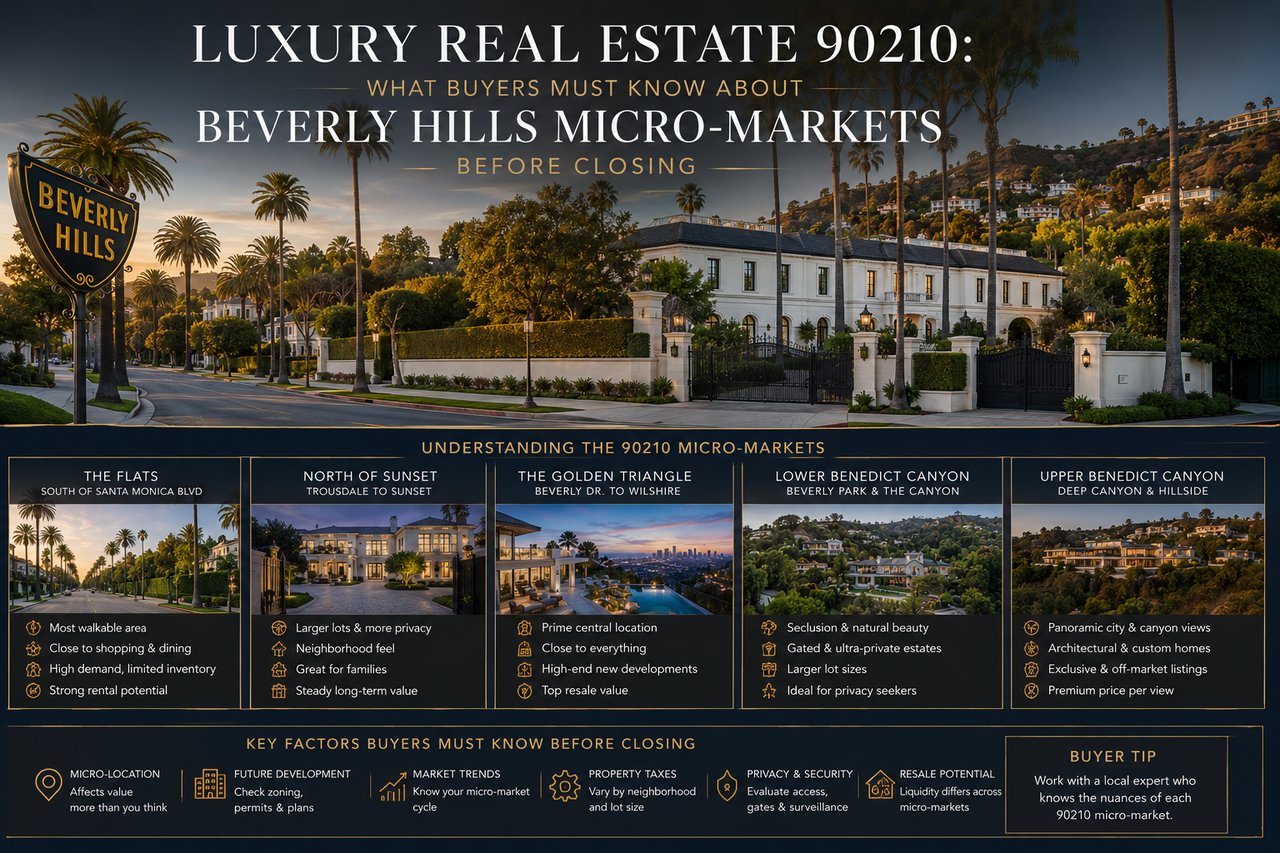
Luxury real estate 90210 transactions unfold through private channels where timing and strategic positioning matter more than public listings. Home values hovered around 4.9 to 5.0 million in mid-2025, and median sale prices reached 4.85 million by August. The market has steadied after two years of aggressive bidding as rates stabilized and sellers began negotiating. Buyers navigating Beverly Hills micro-markets must understand subdivision boundaries, cash trends, overlooked tax structures, and the psychology of lack that drives decisions in this built-out enclave.
The three distinct luxury real estate Beverly Hills sub-markets
Beverly Hills spans just 5.71 square miles, yet elevation shifts from 125 to 1,500 feet create three submarkets with distinct buyer profiles and price ceilings. You need to understand how topography, walkability, and municipal boundaries shape value when choosing between the Flats, the Hills, and properties with Beverly Hills Post Office addresses.
The Flats: flat lots and walkable streets
The Flats occupy the level residential blocks south of the hillside areas. Wilshire Boulevard forms the southern boundary. Streets follow a traditional grid pattern with sidewalks and place residents within walking distance of Rodeo Drive, Beverly Drive, and Canon Drive. Buyers who value access to dining, retail, and Beverly Gardens Park without daily car dependence just need this walkability.
Lot sizes tend toward smaller, rectangular parcels that support uniform buildability. Zoning follows R1 single-family variants across most blocks. Multi-family and commercial uses cluster along Wilshire and Santa Monica Boulevard corridors. Architectural styles reflect early- to mid-20th-century development and include Spanish and Mediterranean Revival, Tudor, Colonial Revival, and Craftsman bungalows. High land values have encouraged remodels and new luxury builds. Historic cottages now sit alongside reimagined estates on these blocks.
Pricing in the Flats remains in the multi-million-dollar range, though lower than hillside estates within the same city. Properties near prime retail corridors command premiums tied to convenience rather than views. Well-located homes move fast when they reach the market, and off-market sales dominate at the luxury tier. Wildfire exposure registers lower than in hillside zones, though standard earthquake disclosures apply countywide.
The Hills: elevation, views, and Trousdale
Hillside properties stretch north of the commercial core where streets become winding and terrain rises into the Santa Monica Mountains. Panoramic city, ocean, and canyon views function as the main price driver and often outweigh square footage differences. Lots vary in size and shape. Ridge and crest positions command premiums due to limited buildable land at top elevations.
Trousdale Estates represents a distinct hillside enclave developed in the 1950s by Paul Trousdale on former Doheny Estate land. The neighborhood holds 532 lots subject to strict design oversight that includes the Trousdale Ordinance enacted in 1987 to preserve views and architectural character. Homes must span at least 3,000 square feet and remain single story to protect sight lines and maintain the neighborhood's horizontal profile. Mid-century modern architecture dominates, with designs from A. Quincy Jones, Richard Dorman, Wallace Neff, Paul Williams, and Lloyd Wright.
Median pricing in Trousdale reached about 11.0 million, compared to the citywide Beverly Hills median near 4.0 million. Properties in the 20.0 million range and higher trade often and reflect view quality, lot scale, and architectural pedigree. The neighborhood benefits from 24/7 armed security patrols and boosted Beverly Hills Police Department coverage.
Beverly Hills Post Office: understanding the boundary difference
A 90210 mailing address does not confirm City of Beverly Hills jurisdiction. USPS delivery zones follow postal efficiency rather than municipal boundaries and create confusion for buyers. Properties labeled Beverly Hills Post Office often sit within the City of Los Angeles or unincorporated Los Angeles County while carrying Beverly Hills on the envelope.
Jurisdiction determines permitting authority, public safety response, school assignment, and utility providers. Beverly Hills Planning and Building & Safety handle permits under Beverly Hills Municipal Code inside city limits. Parcels fall under Los Angeles Department of Building and Safety or Los Angeles County Regional Planning outside the city, each with distinct zoning codes, ADU rules, and review timelines.
School district boundaries operate separate from postal zones. Beverly Hills Unified School District serves city parcels, while many BHPO homes fall within Los Angeles Unified or other districts. Base property tax follows Proposition 13 countywide, but local assessments, Mello-Roos districts, and parcel taxes vary by jurisdiction and can shift total carrying costs.
Market forces shaping real estate 90210 transactions in 2026
High-end property transactions in this market unfold through networks where access and discretion define the chance more than public exposure. Pricing signals, capital sources and risk factors have moved markedly since the pandemic-era bidding cycles ended. This reshapes how prepared buyers approach real estate 90210 deals.
Where prices stand and how inventory has moved
Median listing prices reached nearly 11.5 million by mid-2026, while median sold prices hovered around 8.0 million. This creates a gap that reflects both negotiating power and pricing recalibration. Properties now spend close to 58 days on market on average. Homes that close average 72 days while unsold inventory sits at 104 days. Active listings numbered about 211 homes in early 2026. This provides buyers with expanded selection compared to the constrained inventory of prior years.
Year-over-year single-family prices rose about 6.2 percent. This signals stable luxury demand despite broader macroeconomic fluctuations. Homes achieved 91 to 97 percent of list price at closing, meaning buyers negotiated reductions on asking prices. Inventory compression remained tight at 142 to 161 single-family homes citywide, down roughly 3 to 15 percent versus the same period the previous year.
The role of cash and private lending
Cash transactions dominate luxury real estate Beverly Hills closings. About 65 to 70 percent of single-family residential deals close in cash, with that figure climbing to 85 to 90 percent in the 10.0 million-plus trophy tier. Luxury sales from January to May 2025 in Los Angeles County show 56.7 percent of buyers paid cash for 104 homes priced above 10.0 million, while 54.3 percent paid cash for 287 homes in the 5.0 to 10.0 million range. Even in the 1.0 to 5.0 million segment, 25.4 percent of the 6,618 homes sold were all-cash purchases.
Private lending fills gaps where conventional financing cannot. Foreign national buyers secure purchase money loans outside traditional banking channels. Recent transactions include a 12.95 million private money loan for a Beverly Hills single-family residence structured through non-bank lenders.
Foreign buyer trends and capital flows
International buyers represent about 18 percent of luxury deals in premium Los Angeles neighborhoods. Chinese and Canadian buyers remain active. Foreign buyers purchased 56.0 billion worth of U.S. homes nationally from April 2024 through March 2025, with foreign capital sustaining high-end price levels amid broader economic uncertainty.
Wildfire insurance and risk planning
State Farm discontinued 46 percent of policies in Beverly Hills 90210 ahead of the 2025 wildfire season, part of a broader carrier retreat from hillside zip codes. Insurance premiums can run 30,000 to 60,000 each year on a 5.0 million home in fire-exposed areas. Premiums have risen as much as 35 percent in recent years. The California FAIR Plan caps residential coverage at 3.0 million. This requires buyers of higher-valued estates to layer excess surplus lines policies to close coverage gaps. Buyers must secure firm insurance quotes before removing contingencies, as inability to get affordable coverage constitutes valid grounds to exit purchase agreements during diligence periods.
Costs and taxes buyers overlook before closing
Financial obligations in luxury real estate Beverly Hills transactions extend well beyond down payments. Tax structures, reassessment timing and insurance underwriting create cost layers that change deal economics and need to be planned for early.
Transfer tax rules inside and outside city limits
Beverly Hills properties pay only the Los Angeles County transfer tax of 0.11%, whatever the sale price. A $20 million Beverly Hills home incurs around $22,000 in total transfer taxes. Properties inside the City of Los Angeles face different obligations. Measure ULA imposes a 4% tax on sales between $5 million and $10 million and 5.5% on sales above $10 million. A $20 million property in Pacific Palisades, within LA City limits, triggers $1.19 million in city transfer taxes plus $22,000 county tax. The total comes to $1.212 million. Beverly Hills Post Office addresses do not guarantee Beverly Hills jurisdiction. BHPO properties may sit within City of Los Angeles boundaries and thus fall under Measure ULA. You should confirm jurisdiction through title company inquiry before you structure offers.
Property tax timing and supplemental assessments
Ownership changes cause property reassessment under Proposition 13 and generate supplemental tax bills separate from annual statements. The county assessor calculates the difference between prior assessed value and new purchase price. It then prorates that increase for months that remain in the fiscal year. Purchases between June and December generate one supplemental bill that covers the period through the following June 30. Purchases between January and May generate two bills: one for the current fiscal year remainder and one for the full following fiscal year. Supplemental bills arrive three to six months post-closing. Mortgage impound accounts usually don't cover them. Buyers need to budget separately for these obligations.
Insurance availability and premium changes
Insurance premiums in the Los Angeles metro area rose around 35% between 2021 and 2024. California FAIR Plan enrollment surged 123% over three years as traditional carriers retreated. The FAIR Plan caps residential coverage at $3 million. This forces buyers of higher-valued estates to layer supplemental policies for full protection. Annual premiums can reach $30,000 to $60,000 on a $5 million home in fire-exposed areas. Properties in hard-to-insure zones run into closing delays and reduced buyer pools, which creates downward pricing pressure.
Holding costs and long-term reserves
Property taxes run around 1% of assessed value annually in California. A $10 million purchase generates roughly $100,000 in annual tax obligations. Insurance, maintenance reserves, utilities and staffing for high-value homes need modeling beyond acquisition costs. Buyers who plan to resell properties inside LA City limits should factor future ULA obligations into return calculations.
Your buyer preparation checklist for luxury real estate Beverly Hills
Preparation separates serious contenders from window shoppers in this market. Speed, certainty and documentation determine which buyers gain access to off-market inventory and close transactions without delay.
Confirm liquidity and lender pre-approval
Proof of funds or a current jumbo pre-approval from a reputable lender establishes credibility before private showings. Sellers expect verified financial documentation, not estimates. Cash offers dominate at this tier. Liquidity signals eliminate financing risk and shorten timelines. Buyers using financing need pre-approval that matches the purchase price. Underwriting should be mostly completed with timeline commitments from the lender. Pre-approval letters remain valid for 90 days and require renewal if the search extends beyond that window.
Choose your target micro-market
Narrowing to two or three micro-markets focuses search efforts and builds pattern recognition. The Flats, the Hills and BHPO zones serve different lifestyle priorities. Monitoring days on market and price cuts within the chosen submarkets reveals negotiation opportunities. Pricing spans 2.0 to 15.0 million depending on positioning. Premium properties command prices well above median.
Work with local representation that has off-market access
Beverly Hills luxury agents with experience deliver street-by-street pricing intelligence and off-market opportunities before public listing. A signed buyer-broker agreement signals commitment to listing brokers and unlocks access to pocket listings. Agents with documented transaction history in the target submarket at 5.0 million and above provide the relationships you need for discreet transactions.
Those who love hosting know the right home makes all the difference. If you're thinking about a purchase in the near future or beginning your search, I'd be delighted to help you find spaces designed for refined living and effortless hosting. Christina Pope  310-404-9931
  [email protected]
Model total cost of ownership early
Property tax, insurance and reserves shape long-term viability. Larger deductibles and specialty carriers change total cost of ownership. Talking with an insurance broker before final price negotiations avoids surprises. Setting aside 1 to 2 percent of home value each year covers unexpected repairs and maintenance.
Prepare for fast diligence and competitive timelines
Off-market windows close fast. Buyers must present clean terms and clear due diligence plans. Current proof of funds, minimal contingencies and reasonable inspection periods signal readiness. Assembling inspection teams before submitting offers allows credible execution of shorter timelines.
What drives buyer decisions in Beverly Hills micro-markets
Decision-making in this market operates through quiet confidence rather than public comparison. Buyers who understand Beverly Hills micro-markets recognize that value stems from factors impossible to replicate elsewhere. Christina Pope at Sotheby's International Realty and EliteResidenceInternational.com work within networks where these dynamics shape every transaction.
Limited supply and irreplaceable positioning
Fewer than 3,000 residential units qualify as luxury homes within city limits. Beverly Hills sits landlocked among neighboring municipalities. Territorial expansion cannot happen, and all development must occur within fixed boundaries. Prime developable parcels have reached near-complete buildout. Sophisticated buyers recognize that large flat lots in the Flats, unobstructed view corridors in Trousdale Estates, and guard-gated privacy in enclaves like Beverly Park cannot be reproduced. Beverly Park commands median prices of 47.50 million because positioning proves irreplaceable.
Privacy, security, and discretion features
Privacy functions as currency rather than amenity. Biometric entry systems, perimeter monitoring, gated motor courts, and mature hedging create baseline expectations for properties above 10.0 million. High-profile buyers just need control over who sees or enters the property. Features like concealed entries, double gates, and tree-lined setbacks drive stronger buyer interest than properties with street visibility.
Architectural authenticity and emotional connection
Emotional connection determines purchase decisions within minutes of entering a property. Mid-century modern architecture in Trousdale Estates creates immediate effect among design-focused buyers, while Beverly Park's scale appeals to those prioritizing seclusion. Architect-designed estates with historical provenance command premiums because authenticity strikes a chord with buyers who collect architecture.
Off-market exclusivity and access psychology
Access drives perceived value in Beverly Hills luxury real estate. Properties trading before public listing create exclusivity perception that increases urgency. Buyers granted entry to pocket listings through trusted relationships view opportunities as unavailable to competing purchasers. This psychology explains why premier properties sell through agent networks rather than open exposure.
Conclusion
Beverly Hills micro-markets reward buyers who understand jurisdictional boundaries, cash positioning, and tax structures that move total ownership costs. Success in luxury real estate 90210 depends on preparation. Verified liquidity and targeted submarket focus separate serious contenders from browsers. Properties trading above 10.0 million move through private networks where timing and discretion outweigh public exposure. The right home matters for those who love to entertain, and Christina Pope helps buyers find spaces designed for lifted living and effortless hosting at 310-404-9931 or [email protected]. Limited supply, irreplaceable positioning, and off-market access will continue driving decisions in this landlocked enclave. Meaningful transactions unfold within trusted circles.
Key Takeaways
Understanding Beverly Hills' three distinct micro-markets—The Flats, The Hills, and Beverly Hills Post Office areas—is crucial for making informed luxury real estate decisions in this exclusive enclave.
• Beverly Hills has three distinct submarkets: The Flats (walkable, grid streets), The Hills (views, Trousdale), and BHPO (different jurisdictions with 90210 addresses)
• Cash dominates 65-70% of luxury transactions, with foreign buyers representing 18% of premium deals despite recent insurance challenges
• Transfer taxes vary dramatically by jurisdiction—Beverly Hills pays 0.11% while LA City properties face up to 5.5% under Measure ULA
• Prepare with verified liquidity, target specific micro-markets, and engage local agents with off-market access for competitive advantage
• Scarcity drives value in this landlocked market with fewer than 3,000 luxury units, where privacy and architectural authenticity determine buyer decisions
The Beverly Hills luxury market operates through private networks where preparation, speed, and understanding of micro-market nuances separate serious buyers from casual browsers. Success requires navigating complex tax structures, insurance challenges, and off-market opportunities that define this irreplaceable real estate enclave.
FAQs
Q1. What are the three main luxury submarkets in Beverly Hills? Beverly Hills has three distinct submarkets: The Flats feature flat, walkable streets near Rodeo Drive with grid-pattern layouts; The Hills offer elevated properties with panoramic views, including the exclusive Trousdale Estates with mid-century modern architecture; and Beverly Hills Post Office (BHPO) areas, which carry 90210 addresses but may fall under different jurisdictions like the City of Los Angeles or unincorporated LA County.
Q2. How much of Beverly Hills luxury real estate is purchased with cash? Approximately 65 to 70 percent of single-family residential transactions in Beverly Hills close entirely in cash, with that figure climbing to 85 to 90 percent for trophy properties priced above $10 million. This cash dominance reflects the market's preference for speed and certainty in high-value transactions.
Q3. How do transfer taxes differ between Beverly Hills and Los Angeles properties? Beverly Hills properties pay only the Los Angeles County transfer tax of 0.11%, totaling about $22,000 on a $20 million home. In contrast, properties within City of Los Angeles boundaries face Measure ULA taxes of 4% on sales between $5-10 million and 5.5% above $10 million, which can add over $1 million in transfer taxes on a $20 million property.
Q4. Why has homeowners insurance become a challenge for Beverly Hills buyers? State Farm discontinued 46 percent of policies in Beverly Hills 90210 ahead of the 2025 wildfire season, and insurance premiums have risen approximately 35 percent across Los Angeles. Annual premiums can reach $30,000 to $60,000 on a $5 million home in fire-exposed areas, with the California FAIR Plan capping coverage at only $3 million, requiring additional surplus policies for higher-valued estates.
Q5. What makes Trousdale Estates unique among Beverly Hills neighborhoods? Trousdale Estates is a distinct hillside enclave with 532 lots subject to strict design oversight under the Trousdale Ordinance. Homes must span at least 3,000 square feet and remain single-story to preserve views and maintain the neighborhood's horizontal profile. The area features predominantly mid-century modern architecture and commands median prices around $11 million, with 24/7 armed security patrols.