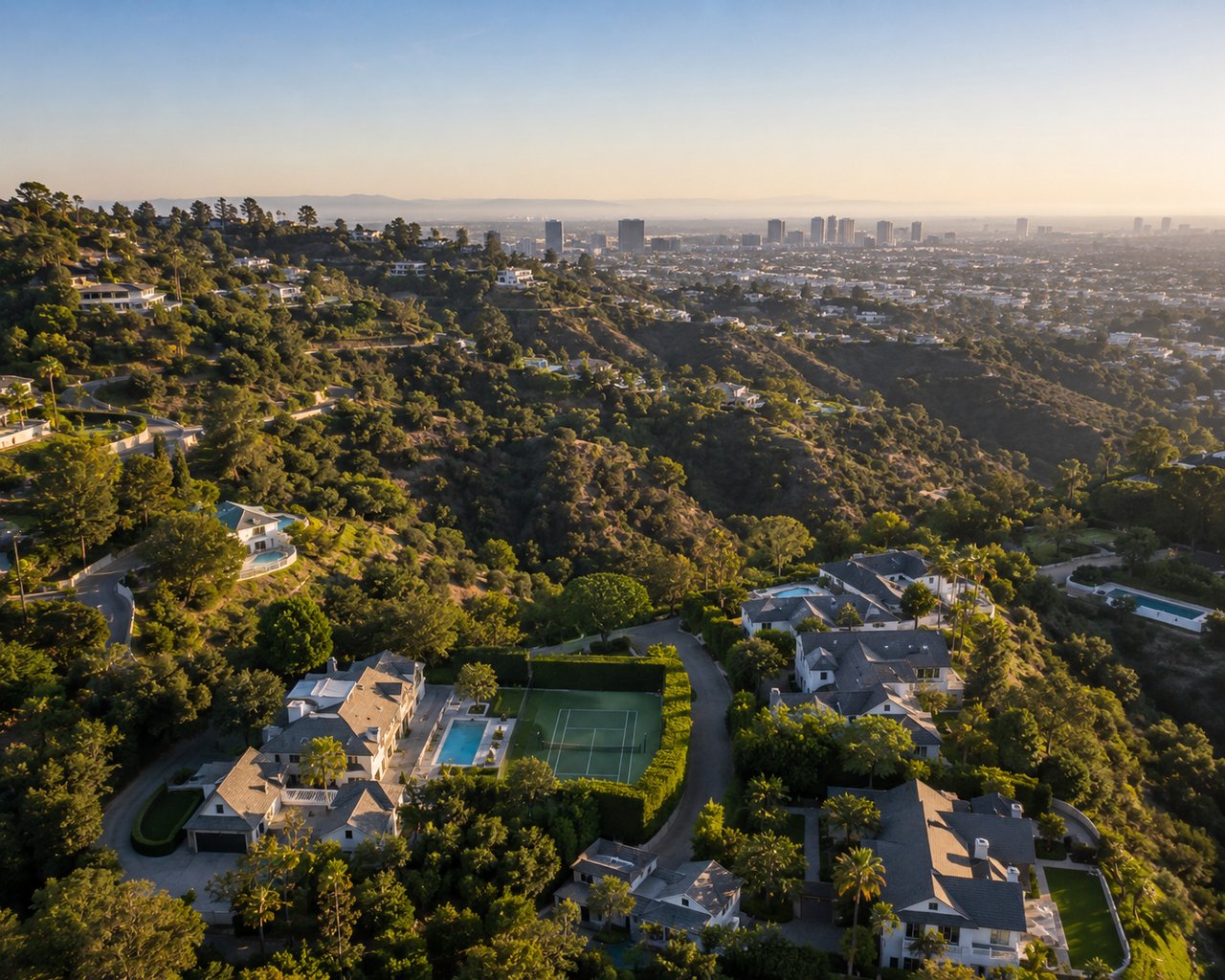
Buyers studying a Beverly Hills flats map tend to fix their attention on the Flats' walkable grid or Trousdale's ridge views and consistently overlook the canyon area that offers larger lots and genuine seclusion. The Flats carry a median of $8.5M, while prices across the Hills reach $14M. Benedict Canyon, sitting between these rich neighborhoods in Beverly Hills, tells a different story on price and lifestyle. What follows maps the three primary areas, then makes the case for why Benedict Canyon stands apart from the most coveted streets in Beverly Hills and which buyers will find it the shrewder choice.
Beverly Hills Neighborhoods Mapped: The Three Zones
Beverly Hills covers 5.7 square miles and roughly 35,000 residents, yet operates as three distinct residential markets rather than a single unified zone. The city's official planning framework divides single-family areas into the Central Area, the Hillside Area, and Trousdale Estates. Each designation carries its own rules on lot size minimums, setbacks, height restrictions, and review processes and those rules shape what buyers can build and how properties read from the street.
The Flats: Level Ground and Walkable Convenience
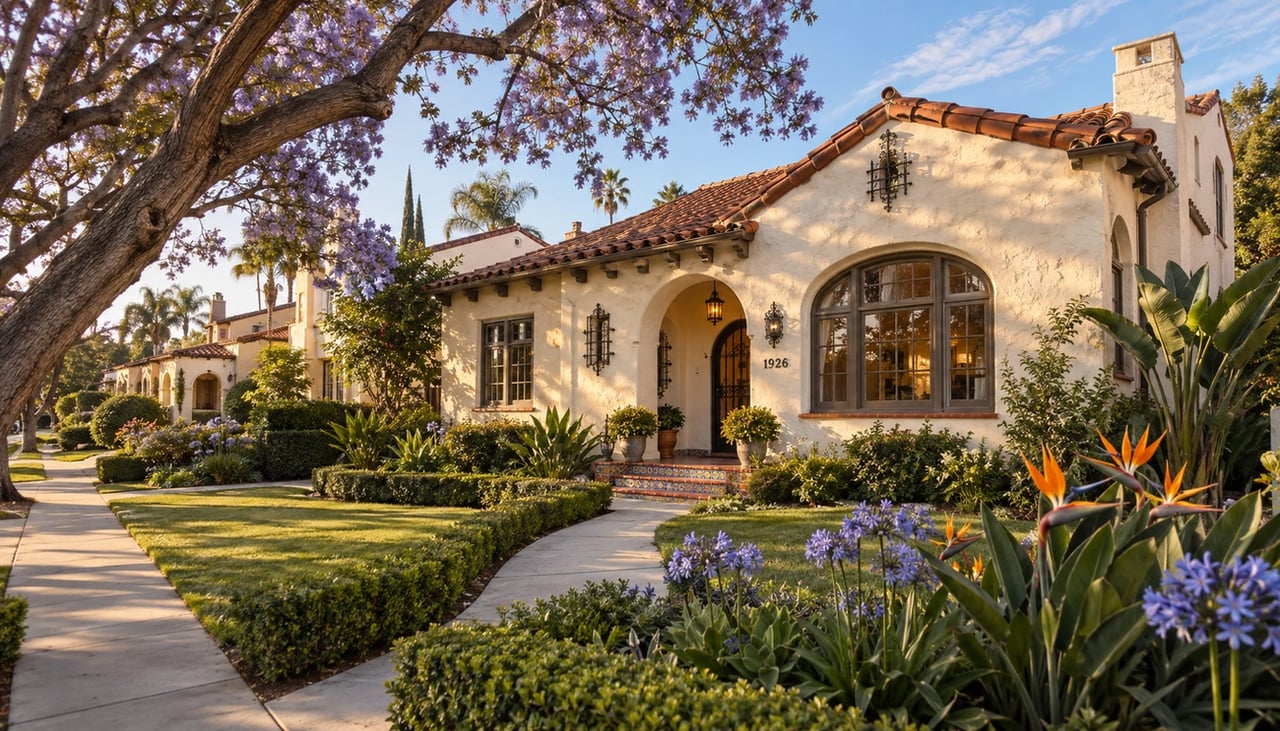
The Central Area forms the residential core between Sunset Boulevard and Santa Monica Boulevard. Agents and buyers call this section of Beverly Hills neighborhoods "the Flats," though the term holds no formal legal standing. Topography stays flat, streets follow a grid, and sidewalks run continuously to the commercial corridor anchored by Rodeo Drive and the Golden Triangle.
Lot dimensions shift as you move north through the Central Area. The middle stretch between Sunset and Santa Monica carries medium-density single-family parcels averaging 13,000 square feet on curving streets. South of Santa Monica Boulevard, the grid tightens and lots fall to around 7,500 square feet. The 500 blocks near the commercial core hold parcels between 11,000 and 15,000 square feet, while the 700 and 800 blocks approaching Sunset open up to 25,000 to 30,000 square feet.
Flat terrain means every square foot is usable no hillside grading, retaining walls, or switchback driveways eating into the buildable envelope. Design review applies to visible exterior changes throughout the Central Area, setting the regulatory tone for renovations and new construction.
The Hills: Elevation and Natural Separation
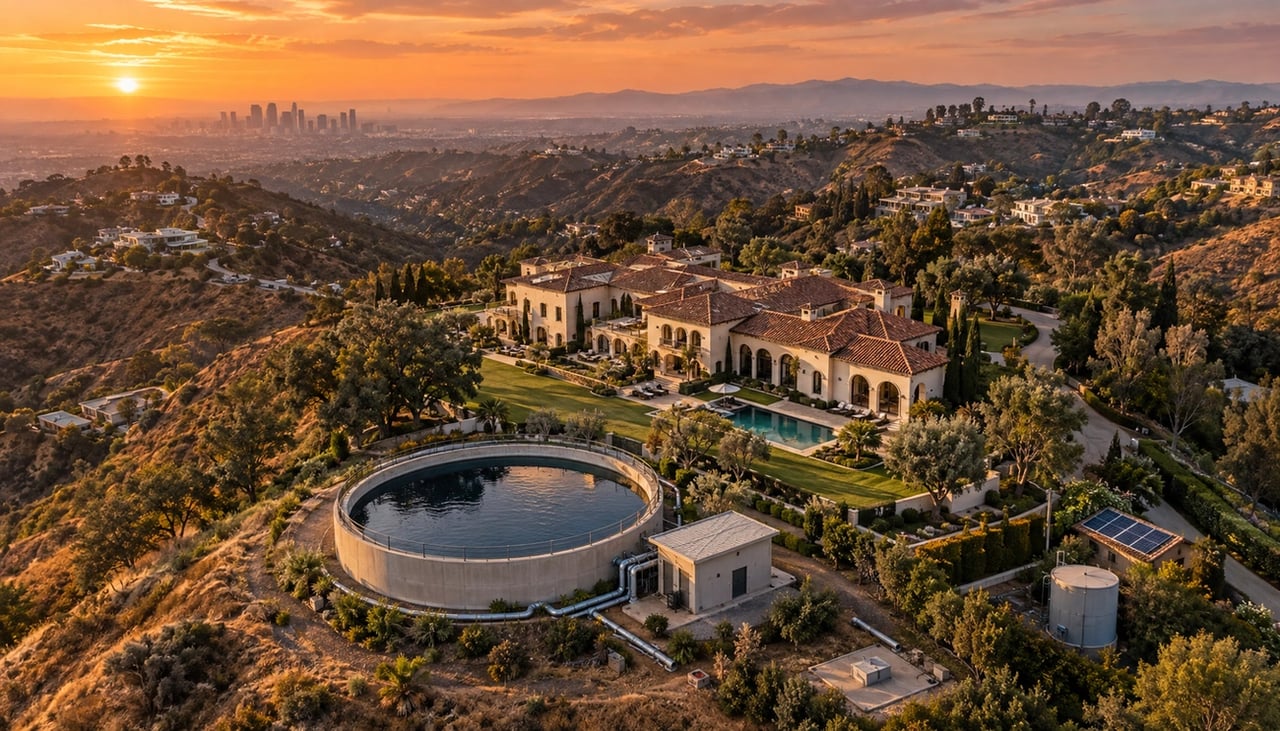
The Hillside Area begins mostly north of Sunset Boulevard, where topography takes over and dictates lot layout and street patterns. Beverly Hills designates this zone as the lowest-density single-family residential land in the city, with parcels typically reaching one acre. Streets curve and climb rather than intersect, sidewalks disappear, and homes sit behind gates screened by mature landscaping.
The regulatory framework differs here from the Flats. The Hillside Area carries no design review, though zoning codes still govern floor area ratios, height caps, setbacks, accessory structures, landform alteration, and view preservation. Buyers gain more freedom on exterior expression, but face stricter site engineering requirements tied to slope, drainage, and grading.
Terrain does the work of creating separation between properties. Homes terrace into hillsides with retaining walls and engineered pad work that adds both complexity and cost to construction timelines. Privacy grows with elevation, and views become a meaningful value driver depending on orientation and ridge position.
Trousdale Estates: Ridge Views and Architectural Legacy
Trousdale holds the city's highest elevation on the eastern ridge. Developed between 1954 and the 1970s, the enclave drew architects including Wallace Neff, Paul R. Williams, A. Quincy Jones, Lloyd Wright, Cliff May, and Richard Dorman. The design legacy centers on midcentury modernism single-story profiles, floor-to-ceiling glass, and horizontal lines calibrated to frame panoramic city and ocean views.
Despite the ridge location, lot pads in Trousdale sit level, which simplifies construction compared to steep hillside parcels elsewhere in Beverly Hills neighborhoods. Buyers here are after view corridors, architectural pedigree, and a visually cohesive setting not street-level walkability or retail proximity. Privacy, elevation, and design heritage define who belongs in Trousdale.
Why Benedict Canyon Stands Apart from Other Beverly Hills Areas
Benedict Canyon has remained entirely residential since its earliest development no commercial intrusions, no mixed-use conversions. Streets follow the natural landform rather than a grid, mature tree canopies frame generously set-back properties, and the spatial rhythm here feels nothing like the urban density closer to Sunset Boulevard. What the best streets in Beverly Hills achieve through manicured presentation, the canyon achieves through sheer topography.
Larger Lot Sizes and Natural Canyon Setting
Parcels range from quarter-acre sites to holdings exceeding three acres, with the largest compounds sitting on promontory lots that hold unobstructed canyon and valley views. Those dimensions put the canyon in a different category from the Beverly Hills flats map entirely where even the most coveted addresses near Sunset top out around 30,000 square feet. Elevation changes between neighboring properties do the work of privacy fencing without the need for it.
The housing stock skews heavily toward estate-scale residences. Condominiums and townhomes do not exist within canyon boundaries, and small single-family homes are rare. What buyers find instead are sprawling lawns, hillside gardens, pool terraces with fire features, and guest structures sharing a single parcel. Hillside positioning does require engineered grading and retaining walls, but the result is flat, usable building pads with view corridors intact.
Winding Roads and Forested Seclusion
Roads curve and climb rather than cross at right angles, ending in cul-de-sac terminations and gated driveways that keep through traffic out entirely. Towering trees and dense landscaping pull homes back from street view a forested quality that sets the canyon apart from the manicured front yards of the Flats and the controlled modernist presentation of Trousdale.
Walkability is not part of this equation. Residents drive for errands, school drop-offs, and dining. What that trade-off returns is a genuine retreat atmosphere within city limits the kind of separation that buyers who are used to active street presence rarely find until they look at the canyon.
Price Entry Points Compared to Flats and Trousdale
Pricing in Benedict Canyon spans $4 million to $40 million, shaped by lot size, view quality, architectural condition, and exact positioning within the canyon. Those figures place entry points below both the $8.5 million Flats median and the $14 million Hills benchmark giving buyers a path to a Beverly Hills address without stepping into full trophy estate competition.
Landmark compounds with exceptional architecture, rare acreage, or panoramic views can reach $50 million, but the canyon's range remains broader and more accessible than either of its better-known counterparts.
Who Buys in Benedict Canyon
Families with an eye on school access, professionals with Westside commutes, and buyers who simply want to come home to something quieter than a prestige address these are the canyon's consistent buyers. The profile is distinct from Flats clients who want to walk to everything, and from Trousdale buyers who arrive for the ridge views and architectural pedigree. Canyon buyers know what they are accepting: longer driveways, hillside upkeep, no nearby retail. What they receive in return are larger lots, natural surroundings, and a level of forested seclusion that the flat-terrain map cannot offer.
Benedict Canyon Property Types and Architectural Character
"There’s an axis in every direction. And corridors to the left and right. Axial views bring the whole outside in and are critical to reducing the apparent size of the house." — Bob Cain, Principal-in-Charge, Robert M. Cain Architect
No single design movement defines Benedict Canyon architectural diversity does. Mediterranean estates with tennis court compounds occupy 1.5-acre parcels behind double gates and security booths. Mid-century homes built in 1956 sit on sites where slope and bedrock dictated every foundation decision. Contemporary rebuilds from 2016 spread across 9,500 square feet in wood, stone, and concrete. The median construction year across the canyon lands at 1960, meaning the baseline inventory consists of original estates now approaching or well past six decades of age.
Original Estates Versus Contemporary Rebuilds
Properties from the 1956–1970s era present owners with a clear fork: preserve or start fresh. One mid-century residence from 1957 underwent full structural reinforcement to address a steeply sloping backyard all first-floor interior walls came out, replaced by tubular steel columns that opened an 85-foot floor plan. A 1956 home took a different path, receiving a major addition unified through warm wood tones and gray concrete, turning an incomplete mid-century shell into a considered California Modern statement. Entirely new construction takes a different approach altogether a 2016 build features sliding glass walls that open ground-floor living directly onto pool terraces and canyon views, designed for indoor-outdoor flow from the foundation up.
Single-Family Compounds on Acre-Plus Lots
Estate-scale configurations dominate. A Mediterranean compound on 1.54 acres unfolds across two structures and a championship tennis court, with the main residence at 8,023 square feet and a guest house complete with full kitchen, living room, office, upstairs bedroom, two baths, and a convertible gym. No condominiums or townhomes exist within canyon boundaries, and small single-family homes are rare beyond the early hunting cabins from the 1900s. Multiple outdoor zones come standard fire pit areas, outdoor dining, rooftop terraces with ledger stone fireplaces. Entertaining here happens across the full property, not just inside it.
View Corridors: Canyon to Valley Sightlines
Hillside positioning creates sightlines that flat parcels simply cannot offer. One contemporary build cantilevers the family room directly over the canyon edge, glass on three sides, with results that feel more observatory than living room. Floor-to-ceiling glass walls draw panoramic exposure into primary suites, while terraces and balconies push sight lines further still. The topography screens neighboring properties while keeping outward views clear a spatial quality that no amount of landscaping on a flat parcel can replicate.
Construction Costs and Hillside Development Factors
Hillside construction carries a 15–30% premium over flatland builds at the same finish level. On trophy projects between 9,000 and 14,000 square feet, that premium commonly adds USD 1.0M to USD 3.0M above a comparable flat-lot build. Foundation systems represent the single largest cost driver caisson-and-grade-beam configurations run USD 400K to USD 1.5M depending on bedrock depth and soil conditions. Individual caissons run USD 15K to USD 50K per pier, with hillside homes requiring 12 to 40 caissons drilled 30 to 80 feet into stable ground. Grading and shoring contribute another USD 150K to USD 700K, and export hauling adds USD 40K to USD 250K. Total timelines from design start to occupancy reach 28 to 42 months considerably longer than flat-lot schedules. Buyers building or rebuilding here should plan accordingly.
Practical Factors Before Choosing Benedict Canyon
Daily life in Benedict Canyon operates on its own terms. Traffic along the canyon road shifts predictably mornings flow toward the city, late afternoons back toward the Valley. Certain homes require reversing directly onto Benedict Canyon Drive, and stretches without sidewalks or street lighting are not uncommon. Road closures for erosion repairs or utility work can restrict access for weeks at a time, a reality worth weighing before committing to a hillside address.
Access and Daily Commute Considerations
Where a home sits within the canyon determines a good deal noise levels, natural light, and the degree of privacy all shift with elevation. Side streets carry parking limitations, and all errands require a car. For buyers accustomed to urban convenience, the adjustment is real.
Fire Zone Designations and Insurance Requirements
Of all the Beverly Hills neighborhoods, Benedict Canyon faces the closest scrutiny from wildfire insurance underwriters. The Very High Fire Hazard Severity Zone covers portions of the canyon and surrounding hillside communities, and buyers would do well to confirm insurability well before the close of escrow. Premiums run higher here, and policies require careful attention to fire deductibles, dwelling limits, and additional living expense provisions. When standard carriers decline coverage, the California FAIR Plan steps in as a basic fire policy though most homeowners will also need a separate Difference in Conditions policy to cover liability, water damage, and theft.
School District Boundaries: BHUSD Versus LAUSD
Families with children access public schools through Beverly Hills Unified School District. That said, certain properties carry Beverly Hills Post Office addresses while actually falling under Los Angeles city jurisdiction a distinction that affects schools, municipal services, and everything tied to local governance. Confirming the exact boundary before purchase saves considerable frustration later.
Permitting Timelines for Renovations and New Builds
Coastal California permitting moves at its own pace. Most jurisdictions run nine to eighteen months or longer for building permits, and the average approval timeline reaches 293 days, with the majority of projects cycling through two to three rounds of plan check comments before a permit issues. Buyers planning significant renovations or ground-up construction should account for this early in their financial planning.
Resale Liquidity and Buyer Pool Depth
Benedict Canyon draws a specific kind of buyer nature-oriented professionals, tech entrepreneurs, and creatives who prize seclusion over proximity to Rodeo Drive. That selectivity narrows the resale pool compared to walkable Flats addresses, which in turn affects time on market and negotiating dynamics. For the right buyer, that is a worthwhile trade. For those who may need to move quickly, it is a factor worth understanding from the outset.
How Benedict Canyon Compares to the Best Streets in Beverly Hills
Beverly Hills conversations happen quietly, where knowing the distinctions between these neighborhoods matters far more than surface-level reputation. Buyers who have spent time understanding the rich neighborhoods in Beverly Hills know the flats map reflects lifestyle preferences not a hierarchy.
Walkability trade-offs versus Flats addresses
Flats addresses near Wilshire and Doheny deliver the highest walkability in Beverly Hills, with groceries, cafes, and services minutes away on foot. Benedict Canyon requires driving for all errands and dining, with winding residential streets offering no retail proximity. Families who prize morning coffee walks and evening dinner strolls will find the Flats more accommodating; those willing to trade the sidewalk for seclusion will find the canyon more rewarding.
Privacy levels versus Trousdale gated estates
Trousdale Estates earns its reputation for discretion through lot scale, gates, hedges, and long driveways. Benedict Canyon arrives at comparable seclusion differently through topography and mature forest rather than a gated perimeter. Flats properties, even with landscaping and gates, maintain closer neighbors and a sidewalk presence that the canyon simply does not.
Lot value per square foot across zones
Trousdale historically trades at a premium over most Flats parcels, supported by larger lots, view premiums, and enclave cachet. Benedict Canyon pricing runs $3 million to over $25 million, with elevation, lot size, and views doing the heavy lifting on value.
When Benedict Canyon makes sense for your priorities
Benedict Canyon is the right fit for buyers who want nature-filled surroundings, generous lot sizes, and a retreat-style sense of privacy without giving up proximity to Beverly Hills amenities. For clients who love to entertain, the right home makes all the difference. Christina Pope would be delighted to help you find a property that delivers both effortless hosting and elevated daily living.
📞 310-404-9931 ✉️ [email protected]
Conclusion
Prestige addresses and walkable convenience are only one measure of Beverly Hills value and Benedict Canyon makes that case clearly. Larger lots, natural topography, and forested seclusion produce privacy that flat-terrain parcels simply cannot offer, even accounting for higher construction costs and fire zone realities. Buyers who choose the canyon tend to know exactly what they want: estate-scale space, retreat-style living, and distance from the street and they accept the trade-offs that come with it. Before moving forward, school boundaries deserve verification, insurance availability warrants an early check, and hillside maintenance should be honestly weighed against lifestyle habits. The canyon rewards buyers who have done that thinking clearly.
Key Takeaways
Beverly Hills divides into three distinct markets the Flats, the Hills, and Trousdale each offering different lifestyle trade-offs beyond simple prestige rankings.
• Benedict Canyon offers larger lots (quarter-acre to 3+ acres) and natural seclusion at lower entry points ($4M-$40M) compared to the Flats ($8.5M median) and Hills ($14M median).
• Hillside construction carries 15-30% cost premiums over flat lots, with foundation systems alone adding $400K-$1.5M due to caisson requirements and grading complexity.
• Properties in Very High Fire Hazard Severity Zones face stricter insurance requirements, often requiring California FAIR Plan coverage plus separate Difference in Conditions policies.
• Benedict Canyon suits buyers prioritizing privacy, larger estates, and nature-filled surroundings over walkability, accepting car-dependent access and longer permit timelines (9-18 months).
The canyon's winding roads, forested character, and estate-scale compounds create a retreat atmosphere within city limits—ideal for families and professionals who value spatial separation over proximity to Rodeo Drive's commercial corridor.
FAQs
Q1. What makes Benedict Canyon different from other Beverly Hills neighborhoods? Benedict Canyon offers larger lot sizes ranging from quarter-acre to over three acres, natural canyon topography, and forested seclusion that creates privacy through elevation and landscape rather than just gates and hedges. Unlike the walkable Flats or view-focused Trousdale Estates, the canyon features winding roads, mature tree canopies, and estate-scale compounds with no commercial development, creating a retreat atmosphere within city limits.
Q2. How much does it cost to buy a home in Benedict Canyon compared to Beverly Hills Flats? Benedict Canyon properties typically range from $4 million to $40 million, with entry points below the Flats' $8.5 million median and the Hills' $14 million benchmark. Premium estates with exceptional views or rare acreage can reach $50 million, but the canyon generally offers more accessible pricing for buyers seeking Beverly Hills addresses without competing at trophy estate levels.
Q3. What are the main drawbacks of living in Benedict Canyon? Benedict Canyon requires driving for all errands and dining since no retail exists within the canyon, and winding roads lack sidewalks. Properties face higher wildfire insurance premiums due to Very High Fire Hazard Severity Zone designations, often requiring California FAIR Plan coverage. Additionally, hillside construction costs run 15-30% higher than flat lots, and building permits can take 9-18 months or longer to obtain.
Q4. Which Beverly Hills neighborhood is most exclusive? Exclusivity varies by definition—Trousdale Estates commands premium pricing for ridge views and midcentury architectural pedigree, while certain Flats addresses near Sunset Boulevard offer prestige through walkability and proximity to Rodeo Drive. Benedict Canyon provides exclusivity through natural seclusion and larger estate parcels rather than street-level visibility, appealing to buyers prioritizing privacy over high-profile addresses.
Q5. Does Benedict Canyon fall within Beverly Hills Unified School District? Yes, families in Benedict Canyon access public schools through Beverly Hills Unified School District. However, some properties carry Beverly Hills Post Office addresses but fall under Los Angeles city services rather than Beverly Hills proper, which can affect jurisdiction and municipal support, so buyers should verify specific school boundaries before purchasing.