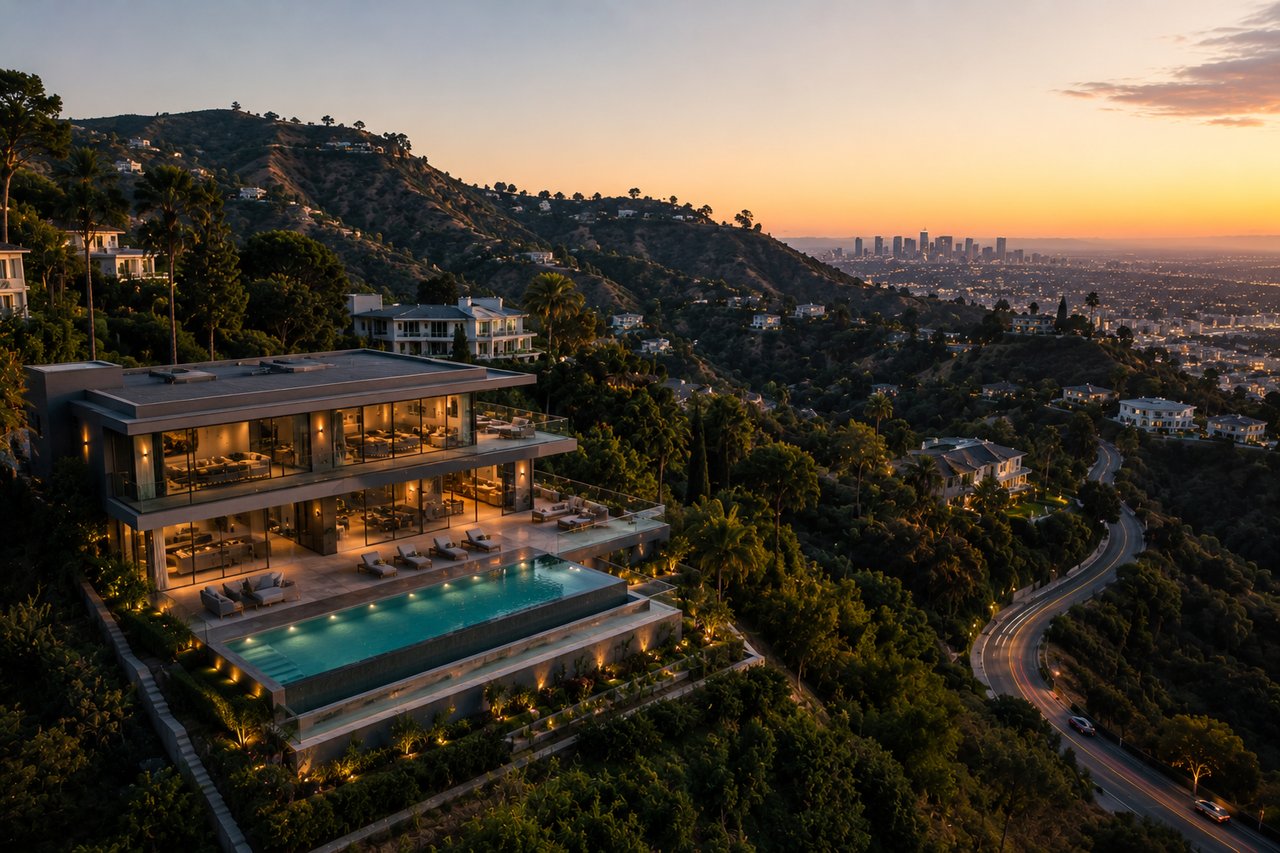
How topography defines Hollywood Hills property types
"Evaluating the land’s topography is essential as it influences the suitability for construction, foundation requirements, and erosion risk assessment." — Concord Homes, Home construction company
Geography creates distinct asset classes within the Hollywood hills real estate market. Properties separate into categories based on terrain position rather than architectural style or age. The difference between ridge, mid-slope, and canyon floor settings determines daily living patterns, maintenance requirements, and long-term value trajectories.
Ridge and crest locations
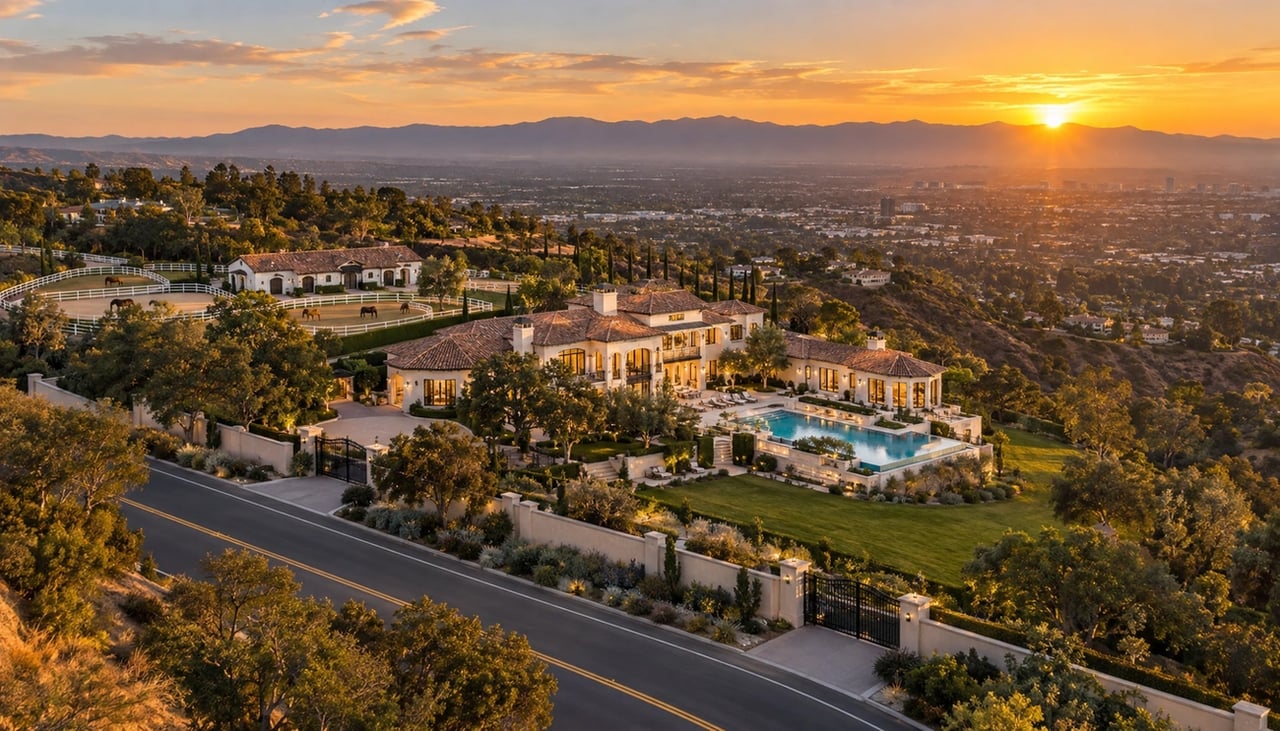
Ridgeline homes occupy positions on or near crest lines. These properties deliver broader, unobstructed views that can span city lights and mountains, with ocean horizons visible in some cases. Direct sun and wind exposure characterize ridgeline settings. Outdoor spaces dry faster after rain. Temperature swings register more than in sheltered canyon pockets. Ridgeline addresses connect to larger hillside roads such as Mulholland or Outpost. Driveways still climb steep grades, but moving trucks and service vehicles traverse these approaches more easily than deep canyon lanes.
Buyers focused on ridge properties review sightlines and exposure levels. They assess whether surrounding development could compromise view corridors. The relationship between lot geometry, view protection, and development rules shapes how these homes perform as assets over time.
Mid-slope and canyon floor settings
Canyon homes sit lower in narrow valleys or alongside slopes. Views look up or across the canyon, with sightlines that remain more limited than ridge positions. Canyon locations feel cooler and more shaded mid-day, with moderate temperatures. Steep walls and mature trees create enclosed, secluded environments. Canyons buffer distant city noise yet may magnify local sounds like cars and voices within the corridor.
Canyon streets follow the terrain, producing narrow and winding routes with steeper sections and limited guest parking. Lower driving speeds and longer walks to main arterials like Sunset or Laurel Canyon Boulevard become routine. These areas read as greener and more topography-driven. The tradeoff appears in approach roads and parking logistics. Access considerations factor into daily routines.
Street-side versus canyon-side orientation
Lot orientation operates under strict municipal definitions. Uphill lots position the front lot line and primary vehicular access at lower elevations than rear boundaries. Downhill lots reverse this pattern and place street access above the rear property line. This orientation affects solar panel viability and overall home value for buyers interested in renewable energy systems. The difference influences how structures sit on the land, where garages connect to streets, and how usable outdoor space is distributed across the lot.
Outpost Estates and protected ridge corridors
Outpost estates Hollywood hills consist of about 450 homes bordered by Mulholland Drive to the north, Franklin Avenue to the south, Runyon Canyon Park to the west, and Hollywood Heights and the Hollywood Bowl to the east. Charles E. Toberman developed the property in 1924 and established architectural standards that required Spanish, Mediterranean, or California modern style homes with red tile roofs. Most original houses remain preserved. The development introduced all-underground utilities, among the first neighborhoods in the country to do so. The area covers nearly 1.5 square miles.
Outpost Estates reads more like a planned hillside village than a raw canyon setting. The Mulholland Scenic Parkway protects scenic views and the natural character of Mulholland Drive. The Hollywoodland Specific Plan safeguards ridgelines and narrow winding streets while preserving hillside character. These protections add layers of regulation around views, right-of-way impacts, and landscape modifications.
Why elevation and terrain shape property value
"Real estate is not just a transaction. It’s about understanding the value of what lies beneath the surface." — Dean Jones, CEO of Realogics Sotheby’s International Realty
Buyers often assume any home with a view commands the same premium. The quality of the view corridor matters more than the fact that a view exists at all. Two homes with similar interior size can perform quite different results if one sits higher or faces a stronger view axis. Elevation and orientation change what occupants can see, how much of it they can see, and how protected that sightline feels.
View quality and permanence
A broad, open vista carries more value than a narrow or partially blocked one. Research cited in appraisal literature shows no universal "view premium" exists. Value depends on the type, breadth, and quality of the visual amenity. The most valuable views feel expansive and usable from main living spaces. Buyers respond more when the living room, kitchen, main suite, and outdoor areas all connect to the view than they do to homes where the best outlook limits itself to one window.
Strong, unobstructed ridge views command a premium over similar homes with limited or canyon-only views. The actual premium depends on view quality and permanence, privacy, access and parking, lot and home size, and condition. Homes with premium views in high-end markets can sell for up to 50% more than similar properties without them. The Hollywood Hills real estate market shows the effect becomes more dramatic when views pair with walls of glass or elevated outdoor decks.
Direct sunlight exposure and microclimate
Hillsides offer stronger morning and afternoon light than flats, though neighbor tree canopies and afternoon ridge winds require assessment before purchase. The sun's path shifts between seasons and alters how light enters each room. Summer brings a sun that tracks higher and longer through the sky. South-facing windows receive strong midday light from above. East and west exposures capture horizontal rays. Well-laid-out overhangs cast shade during summer months and reduce heat penetration.
Winter brings a lower sun angle that allows light to penetrate deeper into south-facing rooms. Ground-floor and lower-elevation properties that seem bright during summer showings can sit in permanent building shadow throughout winter months. Ridgeline settings receive more direct sun and wind exposure. Canyon locations feel cooler and more shaded mid-day, with moderate temperatures.
Buildable area and lot usability
Lot size and shape determine whether space exists to add structures or pools within setback requirements. Larger lots with minimal restrictions offer opportunities to build guest cottages or additional garages. Flat yards command premiums to create play areas and pools. Sloped terrain limits usable square footage and increases landscaping requirements. Slope steepness, drainage patterns, and the need to cut and fill operations increase construction costs.
Access quality and emergency vehicle standards
Easier access to Sunset Boulevard, superior parking configurations, and shorter commutes to studios or the Westside trade at premiums compared to remote pockets with narrow roads. Insurers and lenders assess road width and emergency access. This influences both insurability and financing terms. Narrow, winding roads combined with limited parking deter certain buyer segments. Los Angeles hillside rules require lots to have at least 20 feet of street frontage or a 20-foot access strip. Driveway slope, width, and turnaround space affect emergency access.
Privacy gradients across different terrain positions
Privacy in the Hollywood Hills real estate market operates on terrain rather than uniform gating standards. The Santa Monica Mountains create natural barriers through narrow, winding roads that make casual drive-bys nearly impossible. Steep inclines and sharp curves deter all but the most determined visitors and form a natural filtering system. This geographic protection varies by specific canyon and street cluster.
Visibility from neighboring properties and public viewpoints
Ridgeline homes gain panoramic sightlines but become visible from below and from distance. Strategic elevation captures views across the Santa Monica Mountains and establishes visual separation from neighboring properties. Hilltop positioning makes homes visible from vantage points below despite the absence of pedestrian traffic passing front gates. Properties perched on ridges offer commanding views while residents get what industry professionals describe as a vantage point that looks out at millions while remaining invisible to everyone below.
Many view lots trade openness for privacy. A view home can sacrifice seclusion based on pad position, street placement and neighboring decks. Canyon homes often feel enclosed and secluded thanks to steep walls and trees. Properties sit on sloping lots, are screened by walls or fences and orient toward views rather than streets.
Screening and setback advantages by elevation
Hillside position creates privacy variations that change with seasons. Yards feel secluded during summer foliage, but that buffer disappears once leaves fall and exposes backyards to neighboring sightlines or roadways. Corner lots deliver more natural light but two-street exposure reduces privacy compared to interior lots. Properties with just one neighboring structure provide quieter outdoor spaces and eliminate noise overlap.
Sound transmission through canyon corridors
Canyons buffer distant city noise but may increase local sounds like cars and voices within the corridor. The enclosed valley geometry traps and redirects acoustic energy differently than exposed ridge positions.
Gated versus open street configurations
Laurel Canyon operates as ungated public streets despite its celebrity history. Geography rather than gates creates seclusion. Beachwood Canyon houses over 22,000 residents across steep winding side streets, but the broader canyon remains open to the public. Select pockets within Upper Beachwood contain small gated clusters that represent exceptions within the larger ungated street grid. The Bird Streets perch above Sunset Strip without gating. Secluded streets with limited access points and challenging navigation provide privacy rather than guard posts.
Hollywood Hills real estate prices by topography and location
High-end real estate in Los Angeles unfolds through private conversations rather than public listings. The most meaningful transactions close quietly within trusted circles, where discretion carries weight and timing determines outcomes.
Ridgeline view homes and premium pricing
Strong, unobstructed ridge views command a premium over similar homes with limited or canyon-only views. The actual differential depends on view quality and permanence, along with privacy, access, parking, lot size, home size, and condition. Ridgeline and view homes often attract buyers fast when the view is exceptional and access is reasonable, though the buyer pool is specialized and can be more volatile.
Mount Olympus demonstrates this premium pricing, with a median listing price of $3,342,500. Properties in this elevated pocket spend a median of 59 days on market. Hollywood Hills West shows a broader median listing price near $3.00M.
Canyon privacy homes and value positioning
Canyon homes draw buyers who prioritize privacy and a natural setting. These properties may trade more steadily within that cohort, although peak prices center on homes with standout features or unique character. Laurel Canyon offers classic canyon ambiance with winding streets and strong enclosure, carrying a median listing price of $1,624,000. Properties here remain on market for a median of 67 days. Nichols Canyon blends canyon privacy with proximity to the Sunset Strip, showing a median listing price of $829,000.
The right home makes all the difference for those who love to entertain. If you're thinking about a purchase in the near future or beginning your search, I'd be delighted to help you find spaces designed for elevated living and effortless hosting. Christina Pope  310-404-9931
  [email protected]
How much is a house in Hollywood Hills: pricing ranges by terrain
The median home price in Hollywood Hills stands at $1,895,000. Sunset Square Historic District commands $2,445,000 median pricing with properties moving in 32 days. Terrain position drives value, so buyers need to pull comparable sales from the last 12 to 24 months within about a mile, matched for size, lot type, and condition, then sort by view class.
Hollywood Hills vs Beverly Hills: topography and market differences
Beverly Hills properties command 20% to 30% higher values per square foot compared to Hollywood Hills. The average home price in Beverly Hills runs nearly 40% higher than in Hollywood Hills. Beverly Hills features more sprawling, landscaped properties with lush gardens and wide-open space, while Hollywood Hills centers on city lights and mountain views. Hollywood Hills sees more fluctuation in price, with homes appreciating faster based on design, location, or celebrity association.
Christina Pope—Sotheby's International Realty, EliteResidenceInternational.com
Technical realities that affect long-term value
Subsurface conditions and infrastructure limitations determine long-term value trajectories that listing descriptions never reveal. Properties on slopes steeper than 33% require mandatory geotechnical analysis in Los Angeles. The slope's factor of safety must exceed 1.5 for static loads, with higher factors required in seismic zones. Hollywood Hills terrain contains three dominant soil types: colluvium (loose, unstable under pressure), engineered fill (reliable when verified), and bedrock (best for foundation anchoring).
Geotechnical conditions and slope stability
Geotechnical engineers conduct boring and slope stability calculations. Their reports include bearing strength analysis and landslide risk assessment. Properties near steep drops or liquefiable zones require more testing protocols. Two borings 50 feet apart on the same lot can encounter different soil types and different depths to bedrock.
Fire hazard zones and insurance availability
Fire Hazard Severity Zones classify areas based on fuel load, terrain, weather patterns, and historical fire behavior over 30 to 50-year periods. California's statewide homeowner policy nonrenewal rate climbed from 11% in 2018 to 13% in 2021. Home insurance costs in California exceed USD 2,000.00 annually for properties with USD 300,000.00 dwelling coverage. The California FAIR Plan provides fire-only policies with a USD 3.00 million coverage cap, well below replacement cost for most Hollywood hills real estate market properties.
Drainage, retaining walls, and maintenance cycles
Retaining wall longevity depends on materials and drainage design. Water management failures compromise foundations, destabilize retaining walls, and trigger soil erosion. Maintenance costs build up from inspection and drainage system cleaning.
Documented permits and buildable envelope limits
Properties with complete permit records close faster and get better prices. Undocumented improvements trigger appraisal adjustments and lender scrutiny that compress negotiating leverage.
Christina Pope—Sotheby's International Realty, EliteResidenceInternational.com
Conclusion
Topography determines value and privacy patterns across the Hollywood hills real estate market in ways that listings seldom reveal. Elevation, view corridors and slope stability create asset classes that perform in distinct ways over time. So buyers who understand these technical realities position themselves to make informed decisions rather than emotional ones based on surface appeal alone. The most successful hillside purchases pair terrain knowledge with local expertise and timing. The right home makes all the difference for those who love to entertain. Buyers considering a purchase in the near future will benefit from guidance that connects elevated living with practical hillside considerations. Christina Pope can help find spaces designed for both.
Christina Pope—Sotheby's International Realty, EliteResidenceInternational.com 310-404-9931 | [email protected]
Key Takeaways
Understanding how topography shapes the Hollywood Hills real estate market is essential for making informed investment decisions. Geography creates distinct asset classes that perform differently over time, with terrain position determining everything from daily living patterns to long-term value trajectories.
• Topography creates distinct property classes: Ridge homes offer panoramic views and premium pricing (up to 50% more), while canyon properties provide natural privacy and seclusion through enclosed terrain.
• Elevation directly impacts property value: View quality, sunlight exposure, buildable area, and emergency access standards vary dramatically by terrain position, affecting both pricing and long-term appreciation potential.
• Technical realities determine investment viability: Properties on slopes steeper than 33% require geotechnical analysis, fire hazard zones affect insurance availability (nonrenewals climbed to 13% by 2021), and undocumented permits compress negotiating leverage.
• Privacy depends on terrain, not gates: Geographic barriers through narrow, winding roads create natural filtering systems, though ridgeline homes gain visibility from below while canyon properties offer year-round seclusion.
• Location-specific pricing reflects terrain advantages: Median prices range from $829,000 in Nichols Canyon to $3.34M in Mount Olympus, with Beverly Hills commanding 20-30% higher values per square foot than Hollywood Hills.
The most successful hillside purchases combine terrain knowledge with local expertise, focusing on subsurface conditions, infrastructure limitations, and documented permits that listing descriptions rarely reveal.
FAQs
Q1. Should I hire a specialist to inspect hillside properties in Hollywood Hills for landslide risk? Yes, you should hire a geotechnical engineer or geologist to assess hillside stability. Properties on slopes steeper than 33% require mandatory geotechnical analysis in Los Angeles. These specialists conduct soil testing, slope stability calculations, and landslide risk assessments that standard home inspections don't cover. Two borings on the same lot can reveal completely different soil conditions, making professional evaluation essential before purchase.
Q2. How much does a geotechnical inspection cost for a Hollywood Hills property? Geotechnical inspections for hillside properties typically cost around $1,800 for a thorough analysis. The inspection includes measurements, crawl space examination, soil sampling, and a detailed report reviewing retaining wall conditions and areas that may need stabilization. While this represents a significant expense, it provides critical information that can prevent costly surprises or help you avoid purchasing a problematic property altogether.
Q3. What makes ridgeline homes more expensive than canyon properties in Hollywood Hills? Ridgeline homes command premiums up to 50% higher than comparable properties without views due to their panoramic sightlines across city lights, mountains, and sometimes ocean horizons. These elevated positions offer unobstructed views from multiple rooms, better sunlight exposure, and easier access via larger hillside roads. However, canyon homes provide greater privacy through natural enclosure and typically trade at lower price points while offering seclusion and cooler microclimates.
Q4. Can I get homeowner's insurance for a Hollywood Hills property in fire hazard zones? Obtaining homeowner's insurance in Hollywood Hills has become increasingly challenging, with California's statewide policy nonrenewal rate climbing from 11% in 2018 to 13% by 2021. Home insurance costs in California exceed $2,000 annually for properties with $300,000 dwelling coverage. Many buyers must rely on the California FAIR Plan, which provides fire-only policies capped at $3 million—often well below replacement costs for hillside homes.
Q5. What's the price difference between Hollywood Hills and Beverly Hills real estate? Beverly Hills properties consistently command 20% to 30% higher values per square foot compared to Hollywood Hills, with average home prices running nearly 40% higher overall. Beverly Hills features more sprawling, landscaped properties with wide-open spaces, while Hollywood Hills centers on city and mountain views with more varied terrain. The median home price in Hollywood Hills stands at $1.895 million, while specific pockets like Mount Olympus reach $3.34 million.