Square footage alone never explains record-breaking sales in Beverly Hills. Topography holds the real answer, though most buyers miss this crucial factor entirely. Properties worth more than $30 million share specific terrain advantages that separate ordinary luxury from true trophy assets. What is the most expensive house in Beverly Hills reveals clear patterns: elevation, contiguous flat pads, and protected sightlines create value that transcends neighborhood prestige.
The ultra-luxury segment spans from $15 million to well beyond $100 million, and here the land itself often matters more than what sits on top of it. Terrain shapes pricing at the highest levels in ways that surprise even experienced buyers. This analysis shows how the ground beneath these extraordinary properties determines their worth.
The most expensive house in Beverly Hills CA: what the location reveals
Luxury real estate in Los Angeles follows its own rules. Major transactions happen quietly among trusted networks, where discretion matters as much as the final price. Those who know this market understand that timing and precision count more than public attention. These dynamics determine how the most expensive house in Beverly Hills changes ownership and why particular properties reach record-breaking values.
Who owns the most expensive house in Beverly Hills and why they chose it
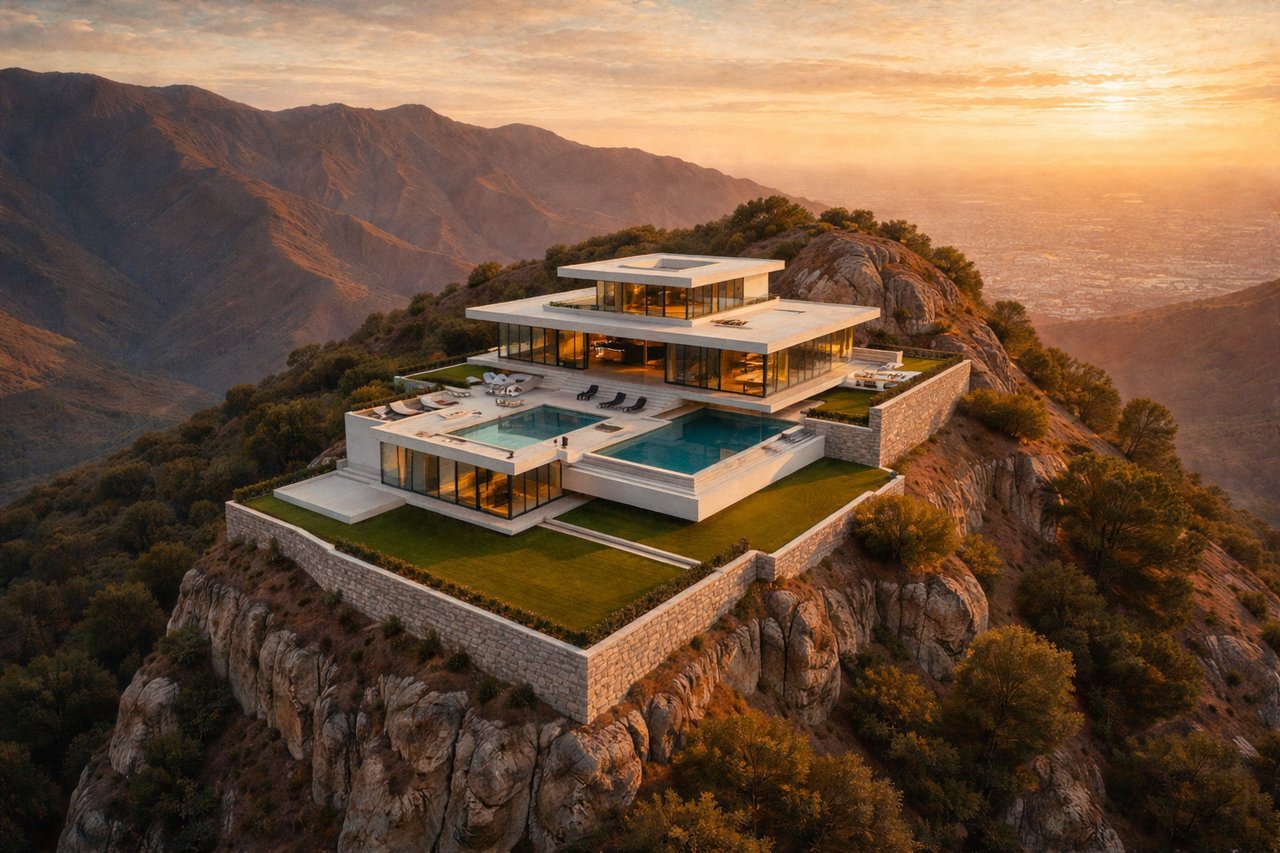
The One, a 105,000-square-foot residence in Bel Air, [sold at auction for $126 million](https://en.wikipedia.org/wiki/The_One_(Los_Angeles) in 2022, setting the record for the largest property sale at auction in the United States. Developer Nile Niami bought the 3.8-acre hilltop lot for $28 million in 2012, choosing it specifically for the 360-degree views spanning the Pacific Ocean, Downtown Los Angeles, and the San Gabriel Mountains. Creating the buildable pad meant removing 49,000 cubic yards of dirt in 5,000 truckloads over two years.
At 9505 Gloaming Drive, a $126 million price reflects the value of its 10-acre sanctuary position. The guard-gated property features a 21,661-square-foot main residence, 3,166-square-foot car museum, and 5,000-square-foot guesthouse, all with city, canyon, and mountain views. The scale and positioning show careful site selection, not chance.
Jeff Greene's Palazzo di Amore at 9505 Lania Lane proves how buyers focus on land first. At 25 acres, it remains the largest single property in Beverly Hills. Greene bought the property in 2007 for $35 million as an unfinished construction site after the original owner, former Saudi crown prince Sultan bin Abdulaziz, abandoned the project. Greene spent another $25 million completing what amounted to dirt roads and a shell.
Sale price breakdown and market context
Beverly Park shows a median list price of $47.5 million, with properties averaging 17,000 square feet for originals and 25,000 square feet for recent remodels. The current record hit $70 million for a 31,000-square-foot estate sold by billionaire Alec Gores in 2022. That buyer purchased an adjacent lot for $30 million, bringing total investment to $100 million.
Recent Beverly Park deals include Mark Wahlberg's 30,500-square-foot mansion at $55 million, Adele's purchase of Sylvester Stallone's estate for $58 million, and Justin Bieber's acquisition of an 11,000-square-foot home for $25.8 million. Dwayne Johnson paid $27.8 million for an 18,000-square-foot residence in 2021.
Beyond Beverly Park, the broader Beverly Hills market recorded a $44 million sale at 51 Beverly Park Way in October 2024. The property at 619 North Arden Drive closed for $35 million in December 2024, marking the year's second-highest deal.
The topographic signature of record-breaking properties
Properties worth more than $100 million share distinct terrain characteristics. The Mountain, listed for $1 billion, contains 17 football field-sized parcels from 2.7 to 12.2 acres, cascading down from the highest point in Los Angeles. This hilltop compound provides 1.5 million square feet of ready-to-build zoned lots with bird's-eye views from downtown to Catalina Island. A vested grandfather clause allows buyers to build dwellings up to 48 feet tall.
The One's hilltop location required massive excavation to create usable flat space while preserving the elevated vantage point. This pairing of altitude and buildable area defines what makes the most expensive house in Beverly Hills California. Properties at lower elevations, no matter how well finished, cannot match these premiums.
How elevation creates scarcity and drives value
Ridge-line real estate follows different rules than properties at standard elevations. Terrain itself creates supply constraints that no amount of development intensity or zoning adjustments can overcome. Crest properties enjoy geographic protection that preserves their exclusivity through any market cycle.
Limited ridge-line inventory
Buildable land on mountain ridges and plateaus faces absolute supply limitations. Developers cannot create additional peaks after prime crests reach full development. This geographic reality distinguishes ridge-line parcels from typical hillside inventory, where mid-slope locations permit higher density construction.
Beverly Hills offers a perfect example through one ridgeline cul-de-sac. Nine homes claim the entire available crest, each worth progressively more than the last. A single neglected property within this enclave jumped from $7 million as an existing house to $34 million as vacant land across twelve years and six ownership changes. The appreciation reflected pure land scarcity—no additional ridge-line sites could enter the market to reduce demand.
Zoning restrictions in elevated areas protect views and natural character. This regulatory framework creates another supply barrier beyond geography. Buyers securely view corridors as permanent assets rather than temporary features subject to future obstruction.
The psychology of being above it all
Ridgeline residences offer the widest city, ocean, and mountain views, particularly striking at night. This visual escape from urban density provides psychological benefits that extend well beyond square footage measurements. High-stress professionals assign considerable value to homes that offer retreat spaces with panoramic mountain views.
Rental markets reflect this intangible premium. Corporate relocations and remote professionals seek unique living environments that stand apart from conventional offerings. Properties pairing prestigious addresses with protected views generate rental premiums and superior investment returns for owners.
Elevation zones and their price bands
View quality and rarity drive premiums more than elevation alone. Partial views create modest value increases, while complete ocean or mountain panoramas generate substantial appreciation. This difference separates consideration-worthy properties from record-setting assets.
Ridge-line locations carry certain compromises including wind exposure and narrow access roads for guest parking. Planning approval becomes more rigorous for visible structures on crests, while wildfire risk and maintenance complexity add operational considerations. These factors naturally limit buyers to those who value view permanence over daily convenience.
City vs. canyon elevation patterns
Urban air quality and heat island effects strengthen demand for elevated locations. High-elevation land becomes increasingly valuable as commercial districts evolve. Trendy neighborhoods may lose their appeal when business patterns change, but mountain vistas and clean air hold enduring attraction.
Canyon properties at similar elevations operate under different value drivers. Sheltered positions within natural amphitheaters or prominent overlooks provide privacy benefits without ridge-line exposure. Canyon settings offer wind protection while preserving altitude advantages, creating a specialized market distinct from exposed crest locations.
Terrain features that separate standard luxury from record-breaking estates
Physical land characteristics create pricing gaps that square footage never captures. The terrain beneath a structure controls buildability, privacy, and site stability. These factors determine what separates the most expensive house in Beverly Hills from properties that simply sit in expensive neighborhoods.
Contiguous flat pads on hillside sites
Flat and gently sloped buildable land on hillside parcels offers rare development potential. A 2.5-acre property with these characteristics becomes a premier trophy asset. Large hillside development sites with flat pads and city or ocean views represent virtually nonexistent inventory.
Sloped lots earn 10-20% higher property values because grade separation provides privacy between different property areas and between homes and neighboring structures. This premium stems from scarcity, not preference alone. Developers cannot create contiguous flat building envelopes on steep terrain without extensive excavation that often becomes economically infeasible or architecturally compromised.
Natural amphitheater formations
Canyon settings offer intimacy and quiet through mature trees that function as visual barriers. These natural formations deliver acoustic and visual separation without walls or planted screening. Rim or bench lots occupy canyon edges on terraced pads, sheltered while remaining elevated enough to maintain separation from properties below.
Amphitheater configurations provide grade changes that create built-in sound buffering and framed views. Properties within these natural bowls gain privacy advantages while keeping openness to sky and distant vistas. Buyers acquire multiple privacy layers through terrain rather than constructed barriers.
Promontory positioning
Ridgeline parcels provide strong privacy from below. Downhill neighbors cannot view upper terraces or living spaces due to vertical relationships that control seclusion. Steep lots increase privacy when homes sit above neighbors, though vegetation and privacy louvers may prove necessary when an adjacent parcel sits higher.
Exposed positioning brings vulnerability to wind and weather that demands engineering solutions. The visibility from multiple vantage points requires architectural excellence since poor design cannot hide on prominent sites.
Water flow and drainage advantages
Hillside lots encounter erosion, drainage, and runoff problems, particularly after fire damage or during heavy rains. Properties at hilltops where surface waters drain away avoid accumulation issues but must retain topsoil. Most homes receive water flow from adjacent hillsides, requiring control of sediment carried with the water.
Proper grading stops water from pooling around foundations or concentrating into destructive volumes. Surfaces around homes must slope away from foundations at least 1-2 feet for every 100 feet. Hill living creates water drainage problems that can destroy lawns and cause major damage. Effective drainage systems prevent water from accumulating near foundations, avoiding costly repair work.
Sites with natural drainage advantages or space to install French drains, retaining walls, and proper grading systems earn premiums. The most expensive house in Beverly Hills California occupies parcels where terrain naturally manages water flow rather than fighting it.
Why some slopes command premiums while others don't
Slope orientation creates value differences that smart buyers recognize immediately. Properties facing the same direction at similar elevations carry distinct premiums based on sun patterns, construction costs, and environmental factors that affect both comfort and operating expenses.
South-facing vs. north-facing dynamics
South-facing properties in Beverly Hills capture direct sunlight all day, filling interiors with natural light while cutting winter heating bills. This same sun exposure raises summer cooling costs and fades furnishings, flooring, and artwork in rooms with southern windows. North-facing properties stay naturally cooler but receive limited direct sunlight, creating darker spaces that hold moisture, especially during winter months when the sun tracks lower. East-facing exposures offer gentle morning light without harsh afternoon heat, keeping rooms comfortable as temperatures rise and reducing energy consumption. West-facing properties absorb intense afternoon sun from 3 PM until sunset, generating substantial heat and glare that damages exterior materials and interior furnishings. Homes with extensive west-facing glass face the highest cooling expenses, with air conditioning systems working hardest during peak afternoon temperatures.
Gentle terracing vs. steep drops
Gentle grades of less than 10% offer the most straightforward construction conditions. Slopes between 15% and 20% require additional investment in grading and stepped foundations with deeper footings on the downhill side. Beyond 20%, buyers face extensive earthwork, retaining walls, and soil stabilization to create stable building sites and prevent erosion. Cut and fill operations become expensive quickly, particularly when importing additional fill material, making slope percentage a direct factor in total acquisition costs.
Orientation to prevailing winds and light
Building position relative to sun paths and wind patterns determines how efficiently a home operates. South-facing windows in well-oriented homes capture sunlight that warms interiors naturally during cooler months. Proper overhangs and shading control excessive heat gain during warmer periods, maintaining comfortable indoor temperatures. Wind-aligned design creates natural cross-ventilation that improves air circulation and reduces dependence on mechanical cooling.
Proximity to ridgeline vs. mid-slope positioning
Halfway up the slope proves ideal on mountainous terrain, where peaks face strong winds and valleys collect cold nighttime air. Mid-slope locations avoid both wind exposure and temperature extremes that affect properties at higher and lower elevations.
Strategic positioning for acquisitions in topographically privileged sites
Acquiring topographically privileged sites demands analysis that goes well beyond MLS listings and broker presentations. Physical site characteristics reveal value potential long before buyers step foot on a property.
Identifying overlooked terrain advantages
Topographical evaluation separates premium parcels from standard offerings in the luxury market. Properties with optimal elevation command higher prices, particularly those with protected views. Rolling topography creates dramatic views from upper levels, while elevated positioning allows sight lines over neighboring properties and trees. Improved natural light from elevated positioning adds another dimension to value assessment.
Pre-development topographic analysis
Topographic surveys provide detailed information about elevation, contours, and existing structures. This evaluation measures elevations and physical features of landforms, giving developers critical knowledge for creating development plans. Accurately evaluating shape, elevation, and features of raw land allows topographic surveying to help developers plan improvements in the fastest, safest, and most cost-effective way.
Working with advisors who understand site potential
Professionals experienced with slope construction and terrain optimization prove indispensable. Architects, engineers, and landscape architects who integrate hardscaping with natural contours deliver superior results.
Off-market opportunities on exceptional parcels
Off-market deals offer reduced competition and access to unique properties. These transactions attract fewer potential buyers, which translates to better prices and more negotiation room.
Conclusion
The ground beneath a property determines its worth at the highest levels of Beverly Hills real estate. Square footage and finishes pale beside elevation advantages, buildable flat pads, and natural drainage patterns. Buyers who grasp these terrain fundamentals acquire assets that hold value regardless of market conditions.
Properties worth $100 million and above succeed because of their sites, not their structures. Smart buyers examine the land first, then consider what sits on top of it. Understanding ridgeline positioning, slope orientation, and natural formations opens doors to opportunities that others walk past completely.
Most buyers still focus on interior finishes and architectural details. Those who study topography instead gain a significant edge in the ultra-luxury market. The land tells the real story of value.
Key Takeaways
Understanding how topography drives ultra-luxury real estate values reveals why the most expensive properties in Beverly Hills command record prices beyond their square footage and finishes.
• Elevation creates permanent scarcity - Ridge-line properties have limited supply that cannot be manufactured, with buildable mountain crests commanding premiums that persist across market cycles.
• Terrain trumps square footage at $100M+ - Properties exceeding nine figures share specific land characteristics: contiguous flat pads, natural drainage advantages, and unobstructed sightlines rather than just large floor plans.
• South-facing slopes reduce operating costs - Properties with optimal sun exposure and wind alignment deliver natural heating, cooling, and lighting benefits that translate to lower utility expenses and enhanced comfort.
• Mid-slope positioning offers ideal conditions - Properties halfway up mountainous terrain avoid both wind exposure at peaks and cold air pooling in valleys, creating the most comfortable microclimate.
• Pre-development topographic analysis reveals hidden value - Strategic buyers who evaluate elevation, drainage patterns, and buildable flat areas before examining structures gain access to undervalued opportunities others miss entirely.
The most expensive house in Beverly Hills sits where it does because the land itself holds more strategic potential than the structure built upon it.
FAQs
Q1. What makes Beverly Hills properties worth over $100 million? Properties exceeding $100 million share specific terrain advantages including contiguous flat building pads on hillside sites, natural drainage systems, unobstructed sightlines, and ridge-line positioning. These geographic features create permanent scarcity that cannot be replicated through construction quality or square footage alone.
Q2. Why do south-facing slopes command higher prices in luxury real estate? South-facing properties receive direct sunlight throughout the day, creating naturally bright interiors and reducing winter heating costs. While they may have higher summer cooling expenses, the year-round natural light, reduced energy consumption in colder months, and enhanced livability make them more desirable to buyers.
Q3. What elevation is best for building a luxury home on hillside terrain? Mid-slope positioning proves ideal on mountainous terrain. Properties halfway up the slope avoid strong winds that affect peak locations while escaping the cold air pooling that occurs in valleys. This positioning creates the most comfortable microclimate with optimal temperature regulation.
Q4. How does slope percentage affect construction costs for hillside properties? Gentle grades under 10% are easiest and most cost-effective to build on. Slopes between 15-20% require higher spending on grading and stepped foundations. Above 20%, extensive earth moving, retaining walls, and soil stabilization become necessary, significantly increasing development costs.
Q5. What should buyers analyze before purchasing hillside luxury property? Buyers should conduct pre-development topographic analysis to evaluate elevation, drainage patterns, buildable flat areas, slope orientation, and natural terrain advantages. This assessment reveals the property's true value potential and development feasibility before examining the existing structure or finishes.